Yoga studio SEO in India: found by the person whose back has hurt for a month
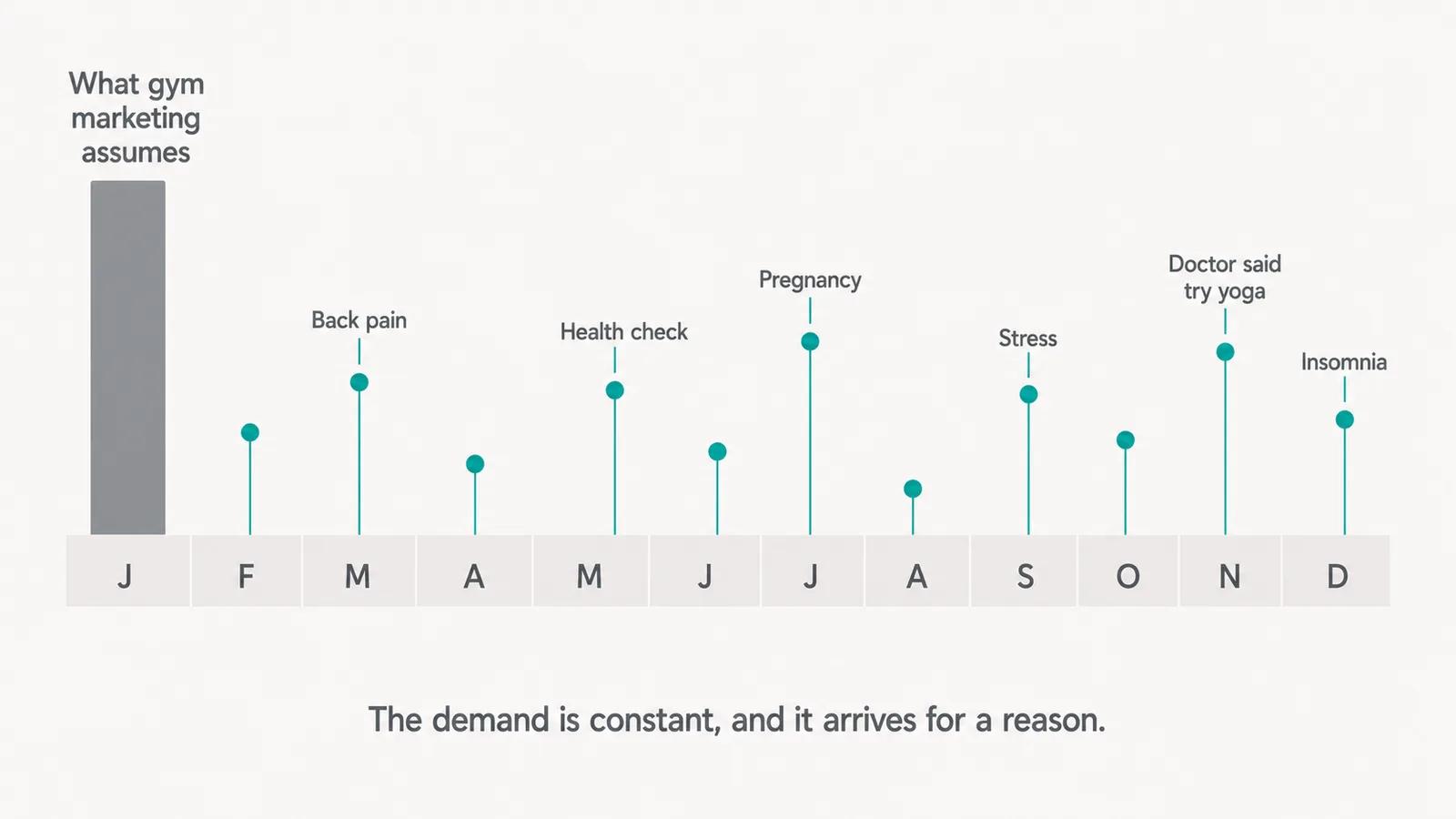
The gym guide in this series is organised around January, because gym demand arrives with resolutions and collapses by March. Yoga does not work like that, and studios that copy fitness marketing spend the year advertising into the wrong months. Yoga enrolment is triggered by something going wrong — a back that has hurt for six weeks, a diagnosis at a health check, a pregnancy, a stretch of insomnia, a doctor who said try yoga. Those events do not cluster in January. They happen all year, to somebody, constantly.
That changes almost everything downstream. The searches are about conditions rather than about fitness. The person arriving is often apprehensive rather than motivated. And it puts studios close to a line that fitness businesses never approach, because the moment you connect a practice to a medical condition you are making a health claim — and Indian advertising law is considerably less relaxed about that than the industry behaves as though it is.
This guide covers the trigger, the claims problem, the style vocabulary that decides who walks in, prenatal work as a separate business, why fifteen mats is a capacity question rather than a demand one, the studio that is really one person’s timetable, online competition, and the one day a year the entire country searches for you.

Nobody starts yoga in January, they start when something hurts
It is worth separating this trade from fitness early, because the two get lumped together and the marketing that works for one is close to useless for the other. A gym sells an intention: a person decides to become fitter, usually at a moment of collective resolve, and buys a twelve-month contract in a six-week window at the start of the year. That is why the gym guide in this series is organised entirely around a calendar.
Yoga enrolment is triggered rather than decided. Something happens — persistent lower back pain, a knee that has started complaining, a routine health check that produced an uncomfortable number, a pregnancy, a period of anxiety or poor sleep, a physician or a physiotherapist who suggested it. The person did not wake up wanting to take up yoga. They arrived at it as a response to a problem, frequently after trying to ignore the problem for several weeks.
Those triggers do not synchronise. They are distributed across the year and across the population more or less evenly, which means yoga demand is remarkably steady compared with almost every other trade in this series. There is no six-week window that decides your year and no long dead trough to survive. That is a considerably more comfortable business to run, and it means the marketing question is not when to be visible but what to be visible for.
The answer is the trigger rather than the practice. Somebody with six weeks of back pain is not searching yoga classes near me — that search comes later, from people who have already concluded yoga is the answer. Earlier and in far greater numbers they are searching yoga for back pain, yoga for knee pain, yoga for stress and anxiety, yoga during pregnancy, yoga for PCOS, yoga for thyroid, yoga for weight loss. The condition is the noun and yoga is the proposed solution, which is the reverse of how studios describe themselves.
This also explains a characteristic of the audience that studios consistently misjudge. A meaningful share of the people enquiring are not confident, flexible or sporty. They are apprehensive, often uncomfortable in their own bodies, frequently older than the studio’s existing students, and quietly worried they will be the worst person in the room. Marketing that leads with advanced postures and lean young practitioners is speaking past most of the demand — and it is a straightforward thing to correct in your photographs.
One consequence for retention worth naming here because it sets up the rest of the guide: because the trigger was a problem, the student frequently leaves when the problem resolves. The back stops hurting after ten weeks and attendance quietly stops. Studios that understand their intake as a stream of problem-driven arrivals plan for that, rather than treating each departure as a failure.
What you may and may not say about curing anything
The previous section pointed at a large body of demand attached to named medical conditions. This section is about the fact that you cannot simply reach for it, and it is the part of this guide with the most downside attached — because the way a great deal of the Indian yoga industry currently advertises is not defensible, and studios copy each other assuming it must be fine.
Start with what is being claimed. Yoga for thyroid cure. Reverse diabetes in ninety days. PCOS cure through yoga. Get rid of your back pain permanently. Those are not aspirational phrasings, they are assertions that a service cures a named disease, and they are made routinely on studio websites, profile descriptions and social posts across the country.
There are two legal frames worth knowing about, and they are not equally clear. The first is the Drugs and Magic Remedies (Objectionable Advertisements) Act, 1954, which prohibits advertisements suggesting the use of a drug for the cure, treatment, mitigation or prevention of any condition in its Schedule — a list of more than fifty conditions that includes diabetes, heart disease and cancer among many others. Whether a yoga service falls within that Act’s definition of a drug is genuinely contested rather than settled, so it would be wrong to tell you flatly that it applies to your studio.
The second frame is clearer and is the one that actually bites. Independent of the 1954 Act, an advertisement claiming that a service cures or reverses a named medical condition, without substantiation, is a misleading advertisement under consumer protection law, and the Central Consumer Protection Authority has been active on health claims — as the coaching guide in this series describes in a different sector. The self-regulatory advertising code points the same way. You do not need to resolve the drugs question to conclude that promising to reverse diabetes is a claim you would struggle to substantiate if asked to.
The practical rewrite is small and it improves the marketing rather than weakening it. Replace claims about outcomes with descriptions of practice and of who it is suitable for. Not cures thyroid but a class for people managing thyroid conditions, taught by somebody trained to modify for them. Not reverses diabetes but sessions designed for people with a diabetes diagnosis, run in consultation with your doctor. Not cures back pain but a therapeutic class for chronic lower back pain, with modifications and no floor-to-standing transitions. Every one of those is specific, honest, matches the same searches, and is considerably more convincing to the cautious person actually reading it.
Two related habits are worth adopting. Do not publish testimonials that make the claim you are avoiding — a student saying my diabetes is gone is the same assertion wearing somebody else’s clothes, and endorsement liability is a live concept in Indian advertising regulation. And where a class genuinely involves people with medical conditions, say plainly that students should consult their doctor and that yoga is complementary to medical treatment rather than a replacement for it. That sentence protects you, and it is also true.
A caveat, stated once and honestly. This is a description of the landscape rather than legal advice, the position on yoga specifically is not fully settled, and enforcement is uneven. Take your own advice before publishing anything that connects your classes to a named disease.
| Commonly published | Why it is a problem | What to publish instead |
|---|---|---|
| Cure your thyroid with yoga | A claim to cure a named medical condition, and one you could not substantiate | A class for people managing thyroid conditions, taught with modifications |
| Reverse diabetes in 90 days | Diabetes sits in the 1954 Act Schedule, and the claim is unsubstantiable regardless | Sessions for people with a diabetes diagnosis, alongside their medical treatment |
| PCOS cure through yoga | Same claim, plus it targets people in a vulnerable and uncertain position | A programme for women managing PCOS, with what the practice actually involves |
| Permanent relief from back pain | Promises an outcome you do not control and cannot guarantee | A therapeutic class for chronic lower back pain, with the modifications named |
| A testimonial saying my diabetes is gone | The same claim in somebody else’s words, and endorsement liability is live | A testimonial about the classes, the teacher and how the student feels |
Sixty checkpoints, including the claims sitting in your description
The line most studios cross is in copy written years ago and never re-read. The audit surfaces what your profile, description and posts actually say — which is usually where a cure claim removed from a poster is still sitting.
- Shows you every field a visitor and a regulator can both read
- Checks name, address and phone consistency across directories
- Re-audits automatically, so a regression surfaces on its own

Hatha, Iyengar, Ashtanga: the word that decides who walks in
Yoga has a rich and precise vocabulary of styles, and Indian studios use almost none of it on their listings. The services list says yoga classes. The description says traditional yoga in a peaceful environment. Meanwhile the people searching are typing Hatha yoga class, Iyengar yoga near me, Ashtanga yoga, power yoga, Vinyasa, aerial yoga, yin yoga, Kundalini, and hot yoga, and each of those terms carries a specific expectation about intensity, pace, props and philosophy.
The distinction is not academic to the searcher. Somebody who wants Iyengar wants props, precision and long holds, and will be unhappy in a fast Vinyasa class. Somebody searching power yoga wants to sweat and will find a slow Hatha class disappointing. A person recovering from injury searching yin or restorative yoga is specifically avoiding anything vigorous. Matching the term to what you actually teach is the difference between an enquiry that converts and a trial class that never returns.
The traditional Indian styles are a genuine competitive asset that studios routinely undersell. Studios rooted in a specific lineage or school, teachers with training in a recognised tradition, and classes that include pranayama, meditation or philosophy rather than only asana are offering something distinct from a fitness-format class. Naming the lineage and the training is more persuasive to a serious student than any amount of describing the ambience.
The format vocabulary matters just as much and is separately searched: group classes, private or one-to-one sessions, corporate yoga, yoga for beginners, morning batch, evening batch, weekend classes, online classes. Beginner is the single most under-used word on Indian studio profiles relative to how often it is searched, and it addresses the apprehension described earlier directly. A studio that names a beginners’ batch and says nobody is expected to touch their toes is answering the objection most of its prospective students are carrying.
Fill the services list entry by entry, with the styles you genuinely teach, the formats you actually run, and the therapeutic classes phrased the way the previous section describes. Put the styles in the description too. Where you teach a style that is scarce locally — Iyengar, Kundalini, aerial, or a genuine traditional lineage — that scarcity is your ranking opportunity, because it is a term with real demand and few local competitors, which is a far better contest than yoga classes near me.
And be careful about claiming breadth you do not have. Listing eight styles when the studio really teaches one general class is the same error as a physiotherapy clinic claiming eight specialities: it brings people expecting something specific, and they leave after the first session and say so.
| The search | What they are expecting | Who it suits |
|---|---|---|
| Hatha yoga class | Slower, held postures, breathwork, a traditional structure | Beginners, older students, anybody nervous about pace |
| Iyengar yoga near me | Props, precision and long holds, taught by somebody specifically trained | Students with injuries or alignment concerns, and serious practitioners |
| Power yoga / Vinyasa | Continuous movement, sweat, a fitness-adjacent experience | Younger, fitter students who would find Hatha disappointing |
| Yin or restorative yoga | Passive, long, deliberately unvigorous | Recovery, stress, insomnia, and people avoiding intensity on purpose |
| Yoga for beginners | Permission to be bad at it, and no expectation of flexibility | The largest and most under-served group searching in this trade |
| Aerial or hot yoga | A specific format requiring specific equipment or a heated room | Only claim it if the equipment or the room genuinely exists |
Prenatal and postnatal yoga is a separate business with a nine-month clock
Prenatal yoga deserves its own treatment rather than a line in the services list, because it behaves unlike anything else a studio offers. The student arrives with a fixed and short window, a high level of caution, a strong preference for a teacher with specific training, and — unusually for this trade — very little price sensitivity, because it concerns a pregnancy.
The demand is reliable and the searches are specific: prenatal yoga near me, pregnancy yoga classes, yoga during pregnancy, postnatal yoga, yoga after delivery. They are made early in the pregnancy, often after a doctor mentions it, and the person searching will read carefully and will not settle for a general class that says pregnant women welcome.
What she is looking for is competence with the specific thing, and it is worth stating exactly. Whether the teacher has prenatal training and from where. Which trimesters you take students in. Whether the class is exclusively for pregnant women or mixed. What is modified and what is avoided. Whether you coordinate with her doctor or gynaecologist. Whether partners are welcome. Whether there is a postnatal class to move to afterwards. Most studio listings answer none of these and the enquiry goes elsewhere.
The clock is the thing that makes this business different from the rest of the studio. A prenatal student joins for a defined and short period and then, by definition, stops. That is not churn and should not be treated as a retention failure. What it means is that the pipeline has to be continuously refilled, so visibility for these searches matters more than in a business where a student might stay two years — you are replacing your entire prenatal cohort several times a year, permanently.
It also means the postnatal handover is where the value is, and studios miss it routinely. A woman who trusted you through a pregnancy is the most likely student you will ever have to continue afterwards, and she is at a point in her life with the least time and the most need. A named postnatal class, a clear statement of when it is safe to return and after what medical clearance, and childcare arrangements or a class timed around a feeding schedule will keep a share of a cohort that otherwise disappears entirely.
One boundary worth holding firmly. This is the area of yoga where a health claim is least appropriate and most damaging: nothing about the practice should be presented as affecting the outcome of a pregnancy or a delivery. Describe what the class does — movement, breathing, comfort, preparation, community — say that students should have their doctor’s clearance, and leave the outcomes alone entirely.
Pregnant women welcome, in a general class
She is not looking for permission to attend, she is looking for a teacher trained specifically for this. A general class that accommodates her is a different product and she can tell.
Not stating trimesters, training or medical clearance
These are the first four questions and almost no studio listing answers any of them. Silence sends a cautious, high-intent, price-insensitive enquiry straight to a competitor.
Any claim about the pregnancy or the delivery
This is where health claims are least defensible and most damaging. Describe the practice — movement, breathing, comfort, community — and leave outcomes entirely alone.
No postnatal class to move to
A prenatal cohort ends by definition. The woman who trusted you through a pregnancy is the likeliest student you will ever have to continue, and most studios let the whole group disappear.
Fifteen mats is the product, so the question is which batch has space
A gym can add two hundred members without adding a square metre, because members arrive at different times and share the equipment. A yoga class cannot. Fifteen mats in a room with one teacher is the product, and the sixteenth student either goes into another batch or goes somewhere else. That single constraint shapes the economics of this trade more than anything else in this guide.
The first consequence is that growth means batches, not members. A studio that is full is not a studio that has run out of demand; it is one that has run out of time slots that people want. And people want a small number of slots very badly: early morning before work, and evening after it. The middle of the day is nearly empty in most studios, which is where the capacity actually is.
The second is that the question your prospective student is really asking is not what does it cost or what style do you teach. It is: is there space in the batch I can actually attend. That is a scheduling question, it is the last obstacle before enrolment, and almost no studio listing answers it. A profile that publishes the timetable — days, times, style per slot, and which batches currently have room — is removing the only remaining reason not to enquire.
That timetable is also unusually good search and freshness material. It changes legitimately, it is genuinely useful, it contains the format and style vocabulary from the previous sections, and posting an updated schedule keeps the profile visibly active in a trade where most listings are static for years. A monthly post saying which batches have places is not marketing filler; it is the single most useful thing you could tell somebody.
The capacity constraint also argues for something most studios resist, which is filling the middle of the day deliberately. Daytime slots suit specific groups — homemakers, remote workers, older students, women who prefer a quieter room, and prenatal classes which are often better placed away from a packed evening. Marketing a daytime batch to those groups by name converts far better than trying to squeeze more people into a seven o’clock class that is already full and where the experience degrades with every extra mat.
Finally, be honest about the number. Studios advertise small batches and personal attention while running twenty-five mats at peak, and students notice on their first evening. If your cap is twelve, publish twelve — it is a genuine differentiator against studios that will not say, and it is exactly the kind of specific, checkable detail that this whole series argues wins over adjectives.
How a gym scales
- Members share equipment across different arrival times
- Two hundred more members needs no more floor
- The constraint is demand, so marketing means more members
- Peak crowding degrades the experience but not the model
How a studio actually scales
- Fifteen mats and one teacher is the whole product
- Growth means another batch, another slot, another teacher
- The constraint is time slots people will actually attend
- The empty capacity is midday, and it suits specific groups by name
The timetable is the post nobody thinks to publish
Which batch has space is the last question before enrolment and almost no studio answers it. A monthly schedule post is genuinely useful, legitimately fresh, and full of the style vocabulary people search.
- Days, times, style per slot, and which batches have room
- Yoga Day and beginners’ batches scheduled weeks ahead
- Keeps the profile visibly active in a trade of static listings
When the studio is one person’s timetable
A large proportion of Indian yoga studios are, in practice, one teacher. They founded it, they teach most of the classes, students came for them, and the business runs on their availability. That is a perfectly good business and it has a structural property worth understanding, because it is the opposite of the problem the salon guide describes.
A salon owner worries about a stylist leaving and taking clients. A studio owner is the person the clients came for, so nobody is leaving — the risk runs the other way entirely. The business cannot exceed one person’s physical capacity to teach, cannot survive their illness or absence, cannot expand into a slot they are already teaching, and has no value to sell because the asset walks out at nine every evening.
The marketing question that follows is genuinely two-sided and worth deciding deliberately rather than drifting. If you are content to be a single-teacher studio, then lean into it completely: your name, your training, your lineage, your voice, your face throughout. Personal connection is what this model sells and hiding behind a neutral brand wastes the only advantage it has. Students in this trade are unusually loyal to a teacher, and that loyalty is the entire moat.
If you intend the studio to become larger than you, the marketing has to start separating the two identities well before the operational change, because it takes far longer than the hiring does. That means introducing other teachers publicly and repeatedly, letting them take named classes rather than substituting silently, ensuring reviews accumulate across the team rather than all naming you, and building the studio’s reputation for a method or a style rather than for a person.
The transition point is where studios most often stumble. A second teacher is hired, quietly given the unpopular slots, never introduced, and students arriving to find somebody else are disappointed — which the new teacher then carries as a reputation problem that was really a communications failure. Introducing a teacher properly, with their training and their own classes, before students meet them by surprise, is the whole difference.
For search specifically, a single-teacher studio should make sure the teacher’s name is findable, since referrals in this trade arrive as a person’s name rather than a business name and a student told to go to a particular teacher will search exactly that. And however the studio is structured, review distribution is worth watching: a profile where every review names one person is a personal following hosted on a business listing, which is fine if that is the plan and a problem if it is not.
Hiding a single-teacher studio behind a neutral brand
Personal connection is the only advantage this model has, and students in this trade are loyal to a teacher. If you are the studio, be the studio — name, training, lineage, face.
Introducing a second teacher by surprise
Students who arrive expecting you and find somebody else are disappointed, and the new teacher carries a reputation problem that was really a communications failure. Introduce them, with their training and their own named classes, first.
A business you cannot leave, be ill in, or sell
One teacher is a ceiling as well as a moat. If you intend to grow past it, the marketing separation has to start long before the hiring does, because it takes far longer.
Every review naming the same person
That is a personal following hosted on a business listing. Fine if that is the plan; a problem if you ever want to take a month off, hire, or sell.
Yoga survived the move to video better than anything you compete with
Every trade in this series that has an online substitute has had to reckon with it, and this one has the strongest substitute of the lot. A gym cannot be delivered over video because the equipment is the point. Physiotherapy needs hands. A salon obviously cannot. Yoga transfers to a screen genuinely well — a mat, a room and a teacher on a laptop is a real practice, not a compromise, and millions of people discovered exactly that.
The competition is therefore serious and it is not only other studios. It is free video, subscription apps, and independent teachers running live classes to students across several countries from a spare room. All of them are cheaper than you, and several are very good.
Pretending this is not the case does not help, and neither does trying to compete on the same ground. What is worth doing is being precise about what does not transfer, because those things are genuinely valuable and studios almost never name them. Adjustment and correction, which is the difference between practising a posture and practising it wrong for two years. Safety for anybody with a condition or an injury, where a teacher who can see you matters enormously. The commitment produced by having to physically arrive somewhere at six in the morning, which is the actual reason most people fail at home practice. And the room full of other people, which is why students stay.
Say those things plainly rather than gesturing at authenticity. A studio that writes we watch you and correct you, which a video cannot is making a concrete argument. A studio that writes experience the true essence of yoga is making no argument at all.
The hybrid position is worth thinking about carefully rather than adopting because everyone else did. Online sessions genuinely serve some students well — travelling regulars, people who moved away, students who cannot attend a fixed slot, and a second session in a week where they only attend once in person. Used that way it extends a relationship you already have. Used as the core offering it converts a differentiated local product into an undifferentiated global one, competing on price and production against people with far more of both.
For search, this is straightforwardly good news. A national app can outrank you for yoga at home and it is not worth trying to prevent. It cannot own yoga classes in a named locality, or the person who has decided they specifically need somebody in the room. Those searches are yours to lose, and they are lost through neglected profiles far more often than through competition.
What online yoga genuinely won
- Price, by a distance you cannot match
- Convenience and any time of day
- Access to well-known teachers from anywhere
- Broad national keywords like yoga at home
What it did not, and you should say out loud
- Somebody watching and correcting the posture you cannot see
- Safety for students with an injury or a condition
- The commitment that comes from having to arrive somewhere
- A room of other people, which is why students actually stay
An app can have yoga at home. It cannot have your locality.
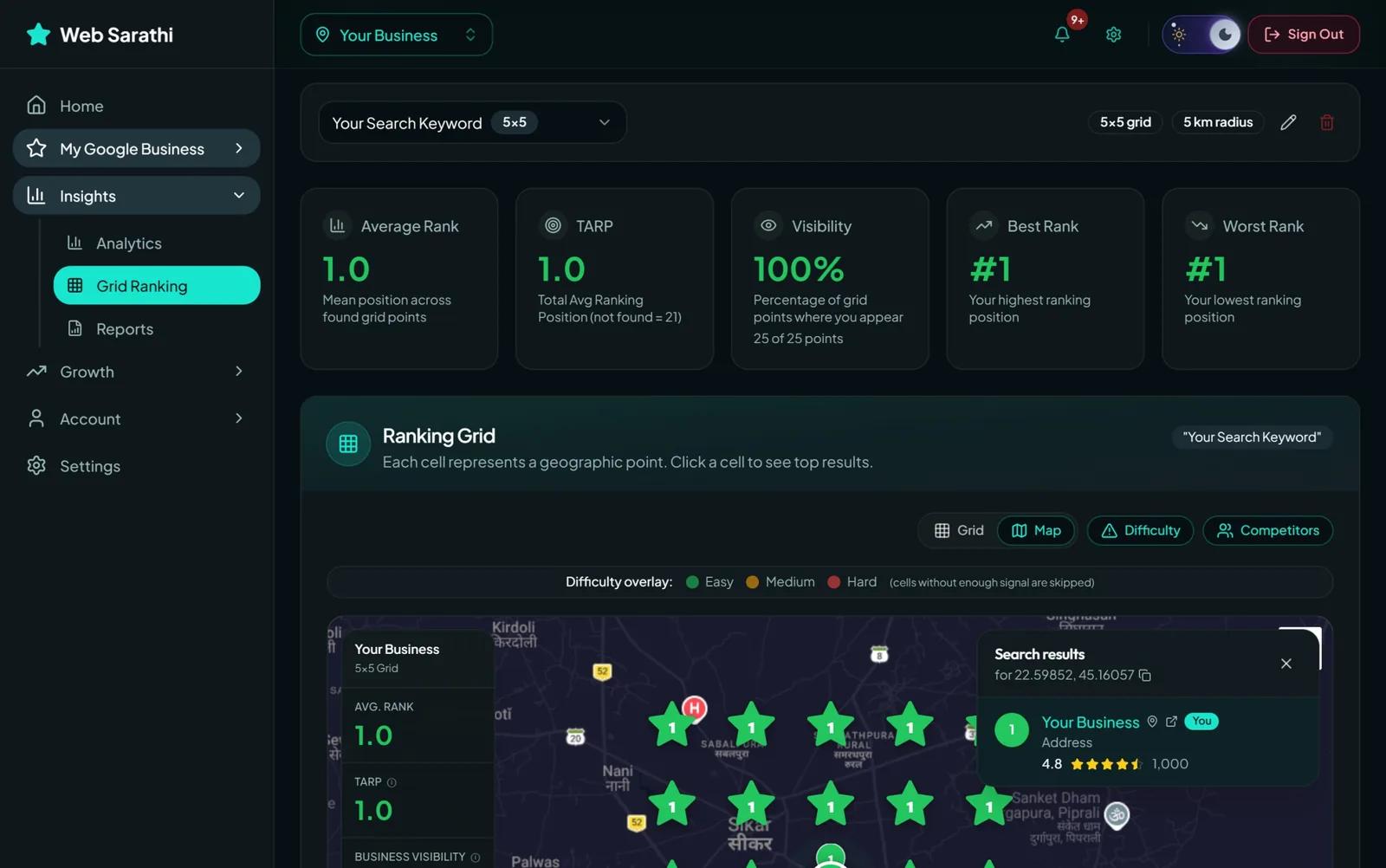
The searches you can win are the ones with a place in them, and they are lost to neglected profiles far more often than to competition. Grid ranking shows which streets actually return you.
- Measure the catchment students will genuinely travel from at six in the morning
- Track style and condition keywords separately, since they rank differently
- Judge a second studio or a new slot on coverage rather than instinct
The one day a year the whole country searches for you
On 21 June the International Day of Yoga produces a spike in yoga-related search across India that has no equivalent for any other trade in this series. Coverage is enormous, participation is organised at every level from central government to housing societies, and for roughly a week the entire country is thinking about yoga at once. Almost no individual studio does anything useful with it.
It is worth being clear-eyed about what the spike is and is not. It is not a stream of people ready to buy a membership; a great deal of the search around it is informational, ceremonial or curiosity. But it is the one moment in the year when a large number of people who have never considered a class are briefly receptive, and a small conversion rate on a very large number is still the best single day this trade gets.
The mistake studios make is the timing mistake that appears in every seasonal section of this series: they post on the day. By 21 June, anybody who was going to attend an event has already decided where. The useful window is the two to three weeks before, when housing societies, schools, offices and community groups are arranging sessions and are actively looking for a teacher to run them.
That is the real commercial opportunity and it is not a retail one. Corporate sessions, society events, school workshops and community classes around Yoga Day are paid engagements in themselves, and more importantly they put you physically in front of a few hundred people in your own catchment who are trying yoga for the first time. A studio that runs three society sessions in June has done more local marketing in a week than a year of posts achieves — and every one of those events is photographable, postable content for the rest of the year.
Set the profile up to catch the demand as well. Publish what you are doing for Yoga Day two to three weeks ahead, say plainly that you are available for society and corporate sessions and how to book one, and run a beginners’ batch starting immediately afterwards so that the people who tried it once have somewhere obvious to go while the impulse is alive. A free or introductory session in the following fortnight converts far better than the same offer in September.
Then treat the whole thing as an annual fixture rather than a surprise, because unlike almost every other seasonal opportunity in this series it is on a fixed date that never moves. The photographs and reviews from this June are what you use to secure next June’s society bookings, and studios that collect them deliberately find the second year considerably easier than the first.
Approach societies, offices and schools
This is when they are arranging a teacher, and it is the actual commercial opportunity. By the day itself every event already has somebody booked.
Publish what you are running, and that you are available
A post saying you take society and corporate sessions, and how to book one, reaches the person who has just been given the job of organising it.
Be in front of people, not on the feed
Three society sessions puts you physically in front of a few hundred neighbours trying yoga for the first time. That is more local marketing than a year of posting.
Run a beginners’ batch immediately
The impulse is alive for about a fortnight and then it is gone. An introductory batch starting now converts far better than the same offer in September.
File the photographs and chase the reviews
This June is what secures next June, and the date never moves. Studios that collect deliberately find the second year much easier than the first.
Yoga Studio SEO questions, answered
The questions Indian yoga studio businesses ask us most often.