Multi-location SEO in India: running forty profiles without forty times the work
Everything else on this site is written for somebody who runs one business. This guide is for the other job: the brand with thirty outlets, the franchisor whose franchisees each went and made their own listing, and the agency holding forty client profiles in one dashboard and being asked why branch nine has slipped.
The problems change shape entirely at scale. A single owner’s hardest question is what to do. A multi-location operator knows what to do and cannot get it done consistently across forty places, which is a completely different discipline — one of structure, permissions, standards and reporting rather than tactics.
What follows is the operational half: how bulk verification and location groups actually work and what they buy you, why duplicate listings breed in exactly this environment, how to build location pages that are not doorway pages, what to do when two of your own branches compete for the same searcher, who owns a listing when a franchisee walks, and how to answer several hundred reviews a month without sounding like a form letter.
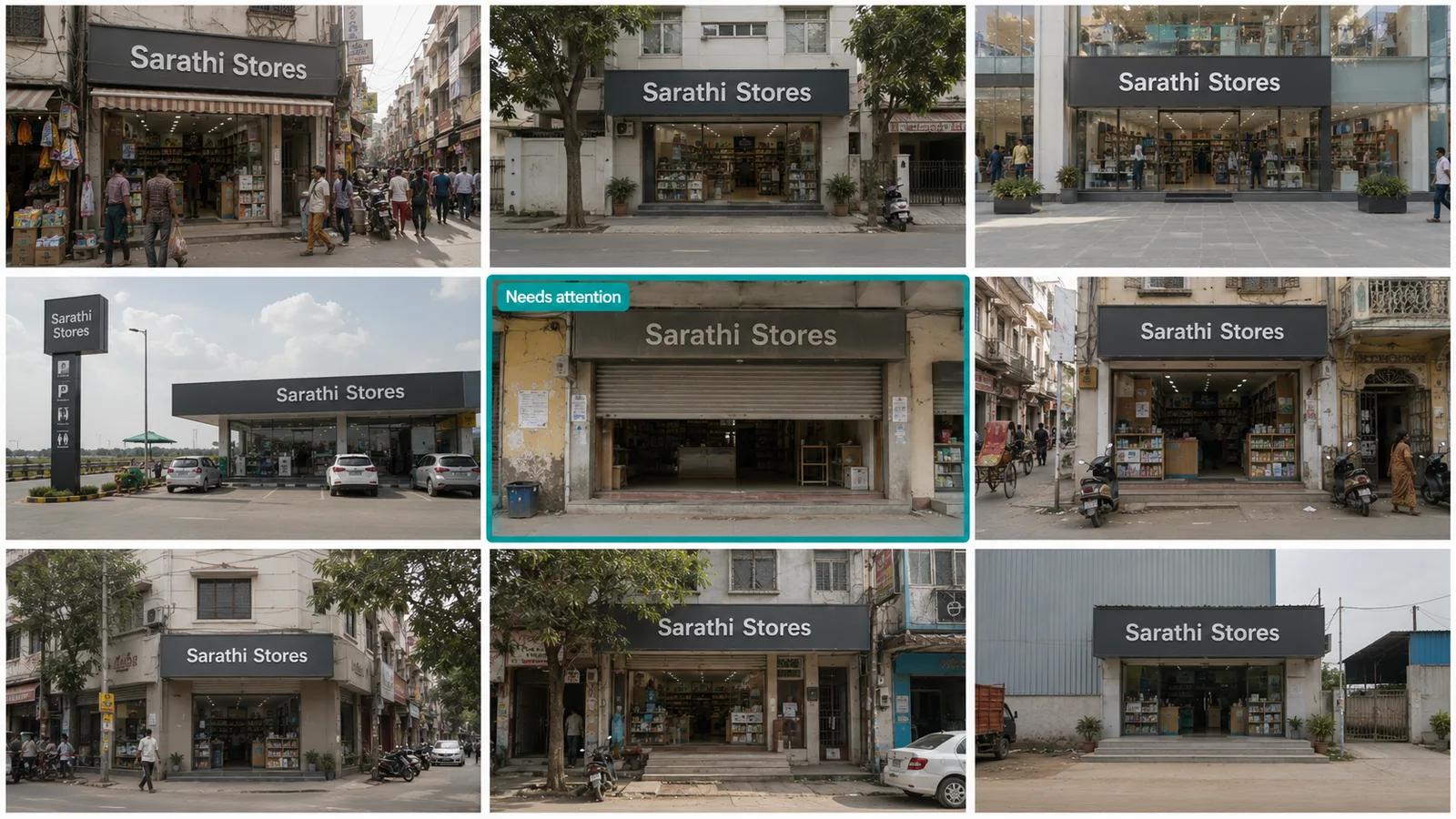
The unit of work is the location, not the brand
The most expensive misconception in multi-location marketing is that a brand ranks. Brands do not rank in local search. Individual listings rank, each one evaluated on its own relevance, its own proximity to the searcher, and its own prominence — which means a chain with thirty outlets is not running one campaign, it is running thirty, and they succeed and fail independently.
This sounds obvious and it contradicts how almost every multi-location organisation is actually structured. Budget is set centrally, reporting rolls up to a brand-level average, and the marketing team optimises the thing they can see. Meanwhile branch nine has had the wrong hours for eight months, branch fourteen has a duplicate listing eating half its reviews, and branch twenty-two is doing brilliantly for reasons nobody has examined. The average conceals all three.
The brand-level average is in fact actively misleading, because performance across locations is almost never normally distributed. A typical Indian chain has a handful of outlets carrying the network, a long middle that is fine, and a tail that is quietly broken. Improving the average is not a strategy. Finding and fixing the tail is, and it is usually cheaper than anything else on the marketing plan because the failures are mechanical rather than competitive.
What follows from this is a reporting rule worth adopting before any tactical work: never look at a brand-level number without also looking at the distribution behind it. The question is not how the network is performing, it is how many locations are below the line and which ones. That single change in how numbers are read tends to redirect more budget to higher-return work than any amount of keyword research.
It also changes what good looks like for a central team. The job is not to run thirty campaigns. It is to build a standard, make it easy to comply with, monitor compliance, and intervene where it has broken. That is an operations function that happens to be expressed through marketing surfaces, and organisations that staff it as such do dramatically better than those that treat it as content work.
How brands usually think about it
- One campaign, measured as a brand-level average
- Central team produces content and pushes it outward
- Success is the aggregate number moving up
- Underperformers are assumed to be weak markets
- Listings are treated as a marketing asset
How local search actually works
- Thirty independent listings, each ranked on its own merits
- Central team sets a standard and monitors compliance with it
- Success is how few locations sit below the line
- Underperformers are usually broken rather than unlucky
- Listings are operational infrastructure with a marketing surface
Bulk verification and location groups: what they buy and what they cost
Managing profiles one at a time stops being viable somewhere around a dozen locations. Google provides tooling for this and it is genuinely useful, but it has eligibility rules and a rigidity that catches operators out after they have committed.
Bulk verification is available to businesses with ten or more locations and lets you add, verify and manage them together rather than verifying each individually. You submit a single verification covering the whole set, Google assesses the brand relationship once, and verified status is granted across the group in a batch. Turnaround is commonly one to three weeks, and the real prize arrives afterwards: once approved, new locations inherit verification automatically rather than each one starting from zero.
The requirements are stricter than most people expect and are worth checking before you start. Service-area businesses do not qualify at all, which rules out a large share of Indian home-services and logistics operators regardless of how many vans they run. Every location under the account must be included; partial submissions are not accepted. And all locations must carry the same name when applying, with no per-branch modifiers appended — which is the requirement that most often forces a naming clean-up before anything else can proceed.
Location groups are the everyday half of this. A group lets you bulk-edit hours, categories, attributes and posts across many locations at once, which turns a change that would have taken a day of clicking into a single operation. For a chain adjusting festival hours across forty outlets, this is the difference between doing it and not doing it.
The trap in bulk editing is uniformity applied where it does not belong. Hours are genuinely local — a mall outlet and a high-street outlet do not keep the same timings, and pushing one schedule across the network to save an afternoon creates exactly the inaccurate-hours failure that costs the most traffic. Use bulk operations for the things that are genuinely identical across the brand, and keep an exception list for the things that are not.
It is worth deciding that exception list deliberately and writing it down, because otherwise it gets rediscovered by accident every time somebody runs a bulk update. In most Indian chains the genuinely brand-level fields are the categories, the primary services, the description and the brand imagery. The genuinely local fields are hours, holiday closures, phone number, photographs of the actual outlet, parking and access, and any service a particular branch does not offer. Half an hour spent classifying every field once turns bulk editing from a thing people are nervous about into a routine operation, and nervousness is the reason most networks stop using the tooling and drift back to doing everything by hand.
| Capability | Condition | What it buys |
|---|---|---|
| Bulk verification | 10 or more locations; not available to service-area businesses | One assessment for the whole set, then automatic verification for new locations |
| Single submission rule | Every location on the account must be included | No partial rollouts — clean up the whole estate before applying |
| Consistent naming rule | All locations must carry the same name, no per-branch modifiers | Usually forces a naming clean-up first, which is worth doing anyway |
| Location groups | Any number of locations | Bulk edits to hours, categories, attributes and posts in one operation |
| Turnaround | Typically one to three weeks | Plan it outside a peak trading period, not during one |
Duplicates, merges and the listings nobody remembers creating
Duplicate listings are a nuisance for a single business and a structural condition for a multi-location one. At thirty outlets you should assume duplicates exist, because the mechanisms that create them are ordinary operational events rather than mistakes anybody made.
They arrive from every direction. A franchisee creates a listing before head office gets to it. A branch manager cannot access the official profile so makes a new one. Google generates a listing from third-party data when a new outlet opens. An agency you stopped working with three years ago still holds a profile you have never seen. A relocation leaves the old address behind as a live listing. A closed outlet is never marked closed and keeps quietly ranking.
The damage is not merely untidiness. Duplicates split reviews across two averages so neither looks strong, divide whatever ranking signals the location has earned, send some customers to a page nobody monitors, and produce inconsistent information that undermines the whole location. A branch with an eleven-review official listing and a nineteen-review forgotten one is being beaten by itself.
The remedy is an audit before anything else, and it needs to run wider than your own dashboard, since the listings you cannot see are exactly the problem. Search each outlet by name and by address, check every variant of the brand name, and look specifically for the old address of anything that has moved. Then consolidate: merge where Google allows it so the review history survives, mark genuinely closed locations as permanently closed rather than deleting them, and claim what belongs to you.
Then close the tap, because an estate cleaned once will simply refill. Ownership of listing creation has to sit somewhere specific, new outlets need to be added centrally as part of opening a location rather than by whoever thinks of it first, and franchisees need a route to request changes that is easier than making their own listing. Most duplicate problems are permissions problems wearing a marketing costume.
The most reliable way to keep the tap closed is to attach listing creation to an existing operational checklist rather than to the marketing calendar. Opening a branch already involves a sequence somebody owns — the licence, the signage, the bank account, the point-of-sale terminal. Adding create and verify the listing, assign manager access to the branch, and confirm hours to that same list costs nothing and means the profile exists correctly on day one, which is before anybody at the branch has a reason to invent one. Networks that treat listing creation as a marketing task keep rediscovering duplicates; networks that treat it as part of opening a shop stop having the problem.
The listing a former agency still controls
Access outlives contracts. Any handover should transfer ownership explicitly, and an estate audit should look for profiles nobody on your side can edit.
The old address after a relocation
Moving an outlet frequently leaves the previous location live. It competes with the new one, holds the older reviews, and sends customers to an empty unit.
Franchisee-created profiles
A franchisee who cannot get a change made in a reasonable time will make their own listing. Fix the request path or you will be merging duplicates forever.
Closed outlets left live
Deleting a closed location is the wrong move — mark it permanently closed. Deletion can leave the listing visible while removing your ability to manage it.
Location pages: the fastest way to damage an entire site
Every multi-location SEO plan eventually proposes a page per location, and it is sound in principle. It is also where chains most often do real damage, because the usual implementation is a single template with the city name swapped, published forty times.
That pattern is scaled content abuse in Google’s terms, and the penalty does not stay contained. Forty near-identical thin pages drag on the credibility of the domain that hosts them, so a chain can end up ranking worse everywhere, including for its brand, as a direct result of a project intended to improve local visibility. This is the same failure mode this site warns individual businesses about, except that at scale it is faster to commit and more expensive to unwind.
The test for whether a location page deserves to exist is whether it contains information that is true only of that location. Not the city name inserted into boilerplate — genuinely local content. The actual address with a map, the actual hours including how they differ, the staff or manager at that branch, photographs of that specific outlet rather than brand stock, the parking situation, the nearest landmark and how to find the entrance, which services that branch does and does not offer, and the reviews left for that location.
Written that way, a location page is not filler. It is the most useful page on the site for somebody deciding to visit that outlet, and it happens to be unique by construction because the facts are unique. Written the other way, it is a liability that took three weeks to produce.
The scaling implication is uncomfortable and worth saying: if you cannot produce genuinely distinct content for forty locations, produce it for the twelve that matter and let the rest be listed on a well-built store locator. Twelve real pages plus a good locator outperforms forty templates, and it will not put the domain at risk. Coverage that costs you credibility is not coverage.
There is a cheap way to generate the distinct content that most brands overlook, which is to ask the branches. The manager of each outlet already knows which landmark people navigate by, which entrance customers get confused about, where the parking actually is, what the locals call the area, and which service gets asked for that the branch does not offer. A short form sent to forty managers produces forty genuinely different pages in a fortnight, at close to no cost, and it produces better copy than a central writer could invent because none of it is invented. It also has a useful side effect: the managers who never reply are a reasonable first guess at where else in the estate things are being left undone.
A page that puts the domain at risk
- One template with the city name substituted in
- Brand stock photography on every location
- The same service copy repeated verbatim across the estate
- An embedded map and nothing else that is location-specific
- Published for every outlet because coverage sounded good
A page that earns its place
- Address, hours and how this branch differs from the others
- Photographs of that outlet, inside and out, including the entrance
- The manager or team, parking, landmark and access detail
- Which services this branch does and does not offer
- Reviews left for that location, not a brand-wide feed
When two of your own branches compete for the same searcher
Once outlets sit close together, a problem appears that single-location businesses never encounter: your locations start competing with each other, and the network can lose ground while every individual branch appears to be doing everything right.
The mechanics are ordinary. Google generally shows one result per business for a given query, so two nearby branches are not additive — for a searcher standing between them, one appears and one does not. Which one wins is decided by proximity and prominence rather than by which one has capacity, so the outlet that most needs the demand is frequently the one being suppressed by its sibling four hundred metres away.
This is often mistaken for a competitor problem. A branch manager reports that they have dropped for their main term, the central team investigates competitors, and the actual cause is the new outlet that opened two months ago on the other side of the flyover. The distinguishing symptom is a drop that coincides with your own opening rather than with anything a competitor did.
Some of this is unavoidable and correct — if two outlets are genuinely that close, they are serving one catchment and the demand is what it is. What is avoidable is making it worse. Identical categories, identical service lists and identical descriptions across two adjacent branches give Google nothing to distinguish them with. Differentiating on what is actually true — one has parking and the other does not, one is open late, one does the specialist service — helps both the algorithm and the customer choose correctly.
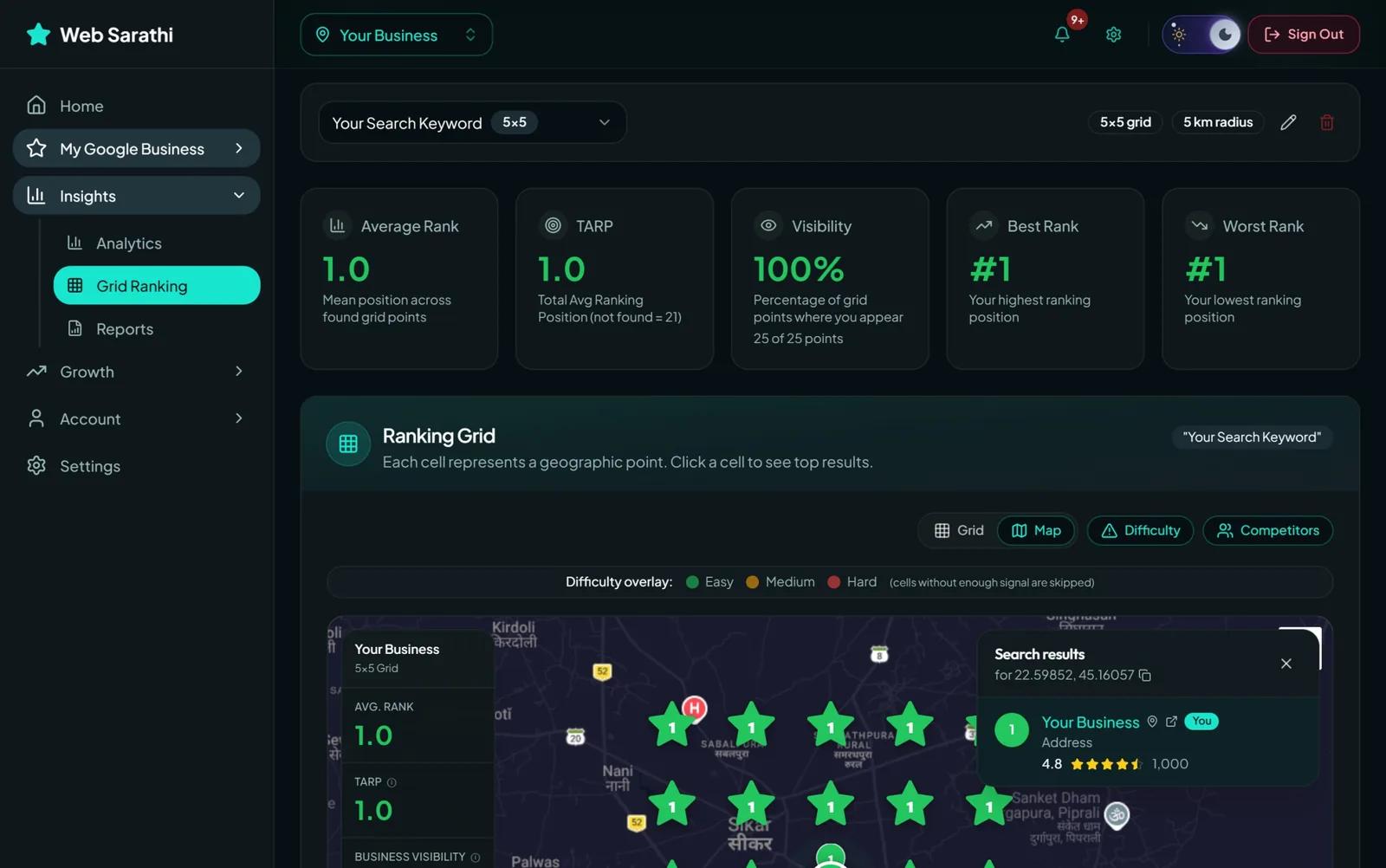
The measurement that settles these arguments is coverage rather than position. A single rank number cannot show you that two branches are trading a catchment between them. Measuring each outlet’s visibility across a grid of surrounding points does, because you can see the boundary line between them, whether it sits where you would want it, and whether the network has a genuine gap that a third location would fill or merely an overlap that a third would worsen.
| Symptom | Usual real cause | What to do |
|---|---|---|
| A branch drops right after you open a nearby one | Your own outlets competing for one catchment | Differentiate categories, services and description on what is genuinely different |
| Two branches trade positions week to week | Both are plausible answers and proximity is deciding it | Measure coverage across a grid, not position from one point |
| A location ranks well but takes few calls | Wrong or missing hours, or a number nobody answers | Check the boring fields before investigating anything competitive |
| One outlet is far ahead of comparable ones | Usually reviews and activity, occasionally a duplicate helping it | Find out what it does differently and make that the standard |
| The brand average is flat while complaints rise | A broken tail hidden inside the average | Report the distribution and the count below the line, never the mean alone |
See the boundary line between two of your own branches
A single rank number cannot show you that two outlets are trading one catchment. Grid ranking measures each location across dozens of surrounding points, so overlaps, gaps and genuine white space become visible.
- Find out whether a drop is a competitor or the branch you just opened
- Spot real coverage gaps before committing to a new location
- Compare outlets on coverage rather than on a position taken from one spot
Who owns the listing when the franchisee leaves
This section is about governance rather than search, and it is the one that costs the most when it is ignored, because the damage arrives at the worst possible moment and cannot be undone retrospectively.
A Google Business Profile carries the reviews, the photographs, the history and the ranking that a location has accumulated, sometimes over years. If that profile is owned by a franchisee, a departing manager, or an agency, then the asset belongs to them and not to the brand. When the relationship ends, a brand that never thought about this discovers it has lost the reviews for that outlet, cannot update the information a customer sees, and in the worst case is watching a former partner operate a competing business on a listing the brand built.
The structure that avoids this is not complicated. The brand entity holds primary ownership of every listing. Franchisees and branch managers get manager access, which lets them do the day-to-day work — replying to reviews, posting, adding photographs — without the ability to transfer ownership or remove the brand. Agencies get manager access too, never ownership, and access is reviewed when contracts end rather than assumed to have lapsed.
Write it into the franchise agreement rather than relying on goodwill. The clauses that matter are that the brand owns the profile, that the franchisee holds delegated access during the term, that access ends with the agreement, and that the franchisee may not create additional listings for the location. That last clause is the one that prevents a departing franchisee simply making a new profile and taking the address with them.
For an agency reading this from the other side, the same principle points the other way and is worth being explicit about with clients: take manager access, never ownership, and say so in the proposal. Holding a client’s listing hostage is a short-term retention tactic that has ended more agency relationships than it has saved, and being the agency that visibly does not do it is worth more than the leverage.
A franchisee holding primary ownership
When they leave they take the reviews, the history and control of what customers see. Ownership sits with the brand entity, always; franchisees get manager access.
Agency ownership of client profiles
Take manager access, never ownership, and state it in the proposal. Holding a listing hostage ends more relationships than it preserves.
Access that is never reviewed
Departed staff and former agencies keep access indefinitely unless somebody removes it. Review the access list on every contract end and every exit.
No clause stopping a second listing
Without it, a departing franchisee can simply create a new profile for the same address. Put the prohibition in the agreement, not in the relationship.
Answering four hundred reviews a month without sounding like a form letter
At one location, review replies are a task. At forty, they are a process problem with two failure modes that pull in opposite directions, and most organisations solve one by causing the other.
Leave it to the branches and you get inconsistency: some outlets reply within the day, some never reply, one manager argues with customers in public, and the brand has no idea what is being said in its name until something is screenshotted. Centralise it entirely and you get uniformity, which reads worse than silence — forty locations posting the identical thank-you paragraph is visible to any customer who checks two of them, and it signals that nobody is actually there.
The structure that works is neither. Centralise the standard and decentralise the writing. The centre owns the tone, the escalation rules, the response time expectation and the list of things nobody may say. The branch writes the reply, because the branch knows whether the delivery was actually late on Tuesday. Then the centre monitors compliance rather than authoring content: how many are unanswered, how old the oldest is, which locations are below standard.
Escalation matters more at scale than at one site, because the volume guarantees that genuinely serious things arrive regularly — allegations of safety, discrimination, injury or fraud. Those should never be answered by a branch manager at speed. A short written rule about what gets escalated, to whom, within how long, prevents almost every reputational incident that multi-location businesses actually suffer.
Two metrics are enough to run this. Response rate and median time to reply, reported per location rather than for the brand. Both are cheap to measure and both correlate with the thing you care about, and a location that has not answered a review in six weeks is telling you something about that branch that goes well beyond its listing.
The centre writes the standard, not the replies
Tone, response time, escalation triggers and a short list of things nobody may say publicly. One page, distributed once, is enough.
Reviews reach the branch that earned them
The person who knows what happened on Tuesday writes the reply. Central authoring produces forty identical paragraphs that any customer can spot.
Serious allegations leave the branch immediately
Safety, discrimination, injury or fraud go to a named person at the centre within a set time and are never answered at speed by a branch manager.
The centre watches compliance, not content
Response rate and median time to reply, per location. Reviewing every reply does not scale; reviewing the outliers does.
Treat a silent location as an operational signal
A branch that has not answered anything in six weeks usually has a problem that is larger than its listing. Investigate the branch, not the profile.
Every location answered, without forty identical paragraphs
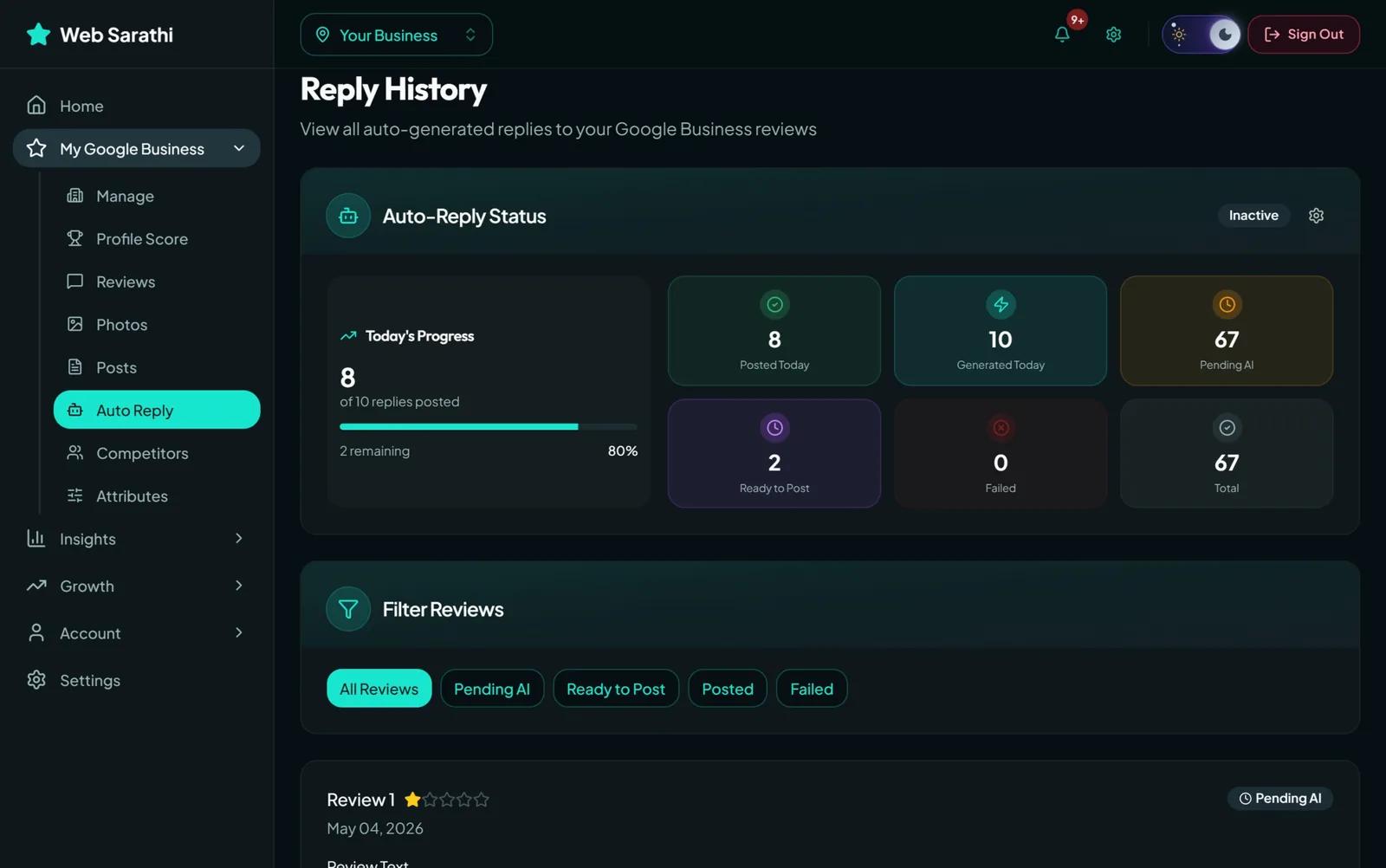
Centralised replies read as absence and branch-owned replies drift out of standard. Web Sarathi drafts a reply per review in the reviewer’s own language and routes it for approval, so the centre keeps the standard and the branch keeps the voice.
- Drafts in 34+ languages, including the regional ones customers write in
- Approval flow per location, so nothing publishes unreviewed until you allow it
- Unanswered and overdue reviews surface per branch rather than as a brand total
Reporting that survives contact with a board or a client
Multi-location reporting fails in a specific and recognisable way: it reports what is easy to aggregate rather than what the reader needs to decide something. The result is a monthly deck full of totals that nobody can act on, and a slow erosion of belief that any of this work matters.
The fix begins with the audience. A board or a client is deciding where to put money and attention, so the report has to answer three questions and can safely ignore everything else. How many locations are below standard, and which. What changed since last month, and why. What is being done about the ones that have not moved.
That is why the distribution matters more than the mean, and why per-location detail belongs in the report rather than in an appendix. A network average that improved slightly while four outlets got materially worse is a bad month being reported as a good one, and the moment a regional manager notices that before the marketing team does, the reporting has lost its authority permanently.
For agencies the same principle carries an additional obligation, which is to report the things that make you look worse. The client will eventually see the branch that has been broken for two months, and it is far better for them to have read it in your report first. Reporting your own misses is the cheapest credibility available in this business, and almost nobody does it.
Keep the operational metrics separate from the outcome metrics, and be honest about which ones you actually control. Profile completeness, response rate, time to reply, hours accuracy and the count of unresolved duplicates are things a team can be held to. Rank and call volume are outcomes that lag and that depend on things outside anybody’s control. Confusing the two produces either false confidence or unfair blame, and usually both in the same quarter.
Finally, resist the pull toward more. Multi-location reporting expands naturally, because every stakeholder who sees it asks for one more cut, and within a year the monthly pack is forty pages that nobody reads and one person spends three days building. A report that fits on two pages and names four branches will change what happens next month. A forty-page appendix will not, however complete it is. If a line has never once caused somebody to do something differently, it is decoration, and taking it out is the single cheapest improvement available to most reporting processes.
| Line | Who needs it | Why the brand average fails |
|---|---|---|
| Locations below standard, named | Operations and regional managers | A mean hides a broken tail, which is where the cheap wins are |
| Profile completeness per location | The team doing the work | Something they control, so it can be a fair target |
| Response rate and median time to reply | Central marketing and the board | Correlates with branch health, and a silent branch is a signal |
| Unresolved duplicates | Whoever owns listing governance | A total of zero at brand level hides a branch competing with itself |
| Coverage per location, not one rank number | Anyone deciding where to open next | A single position cannot show two branches trading a catchment |
| What did not improve, and why | Clients and boards, whether or not they ask | Reporting your own misses is the cheapest credibility available |
Per-location reporting that shows the tail, not the mean
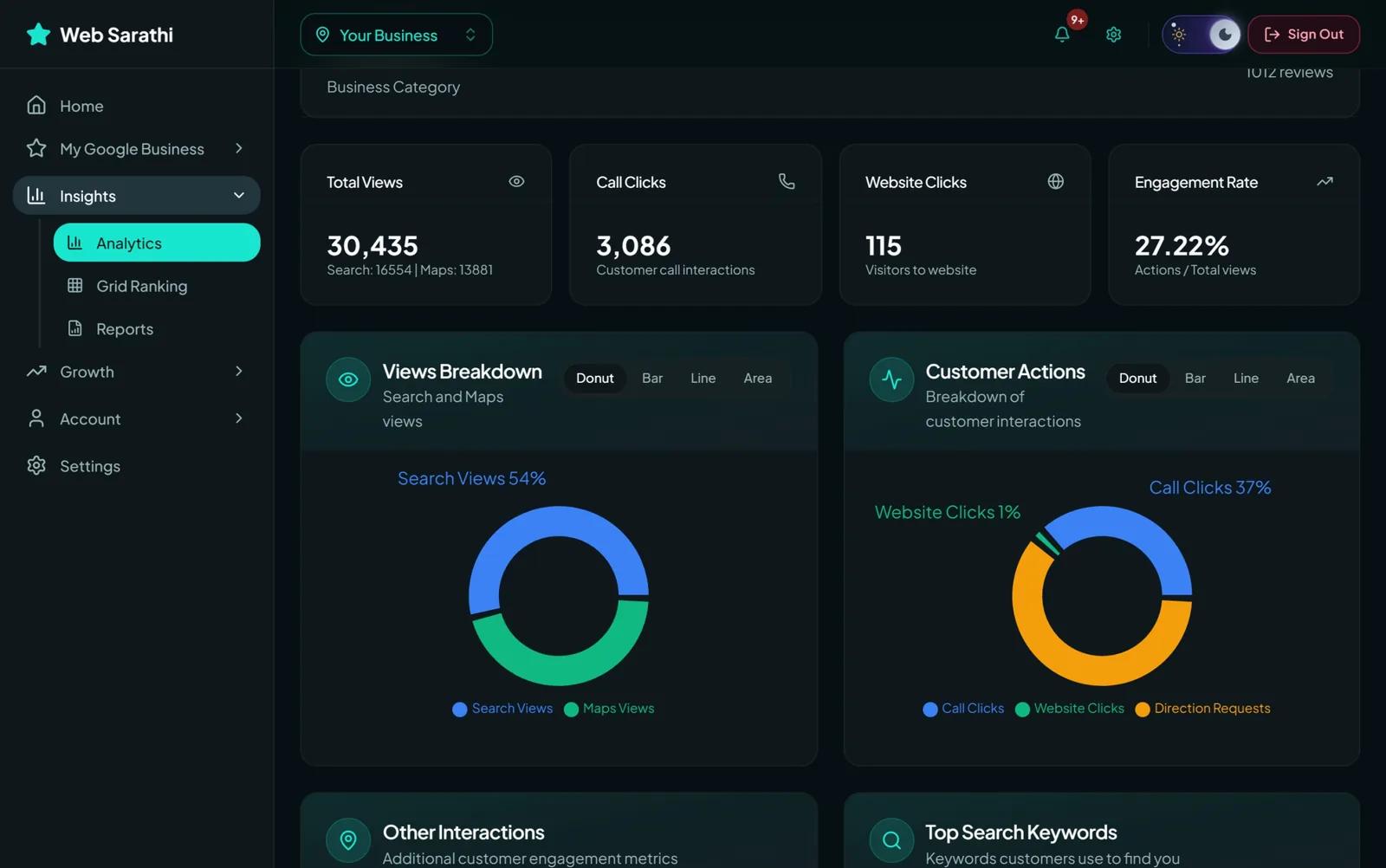
The number a board needs is how many locations are below the line and which ones. Web Sarathi reports each location separately and rolls up only where a roll-up actually means something.
- Completeness, response rate and reply time per location, not per brand
- Scheduled reports that arrive without anybody assembling a deck
- Built for handing to a client or a regional manager without editing
Multi-Location SEO questions, answered
The questions Indian multi-location businesses ask us most often.