Auto repair SEO in India: winning both the breakdown and the booked service
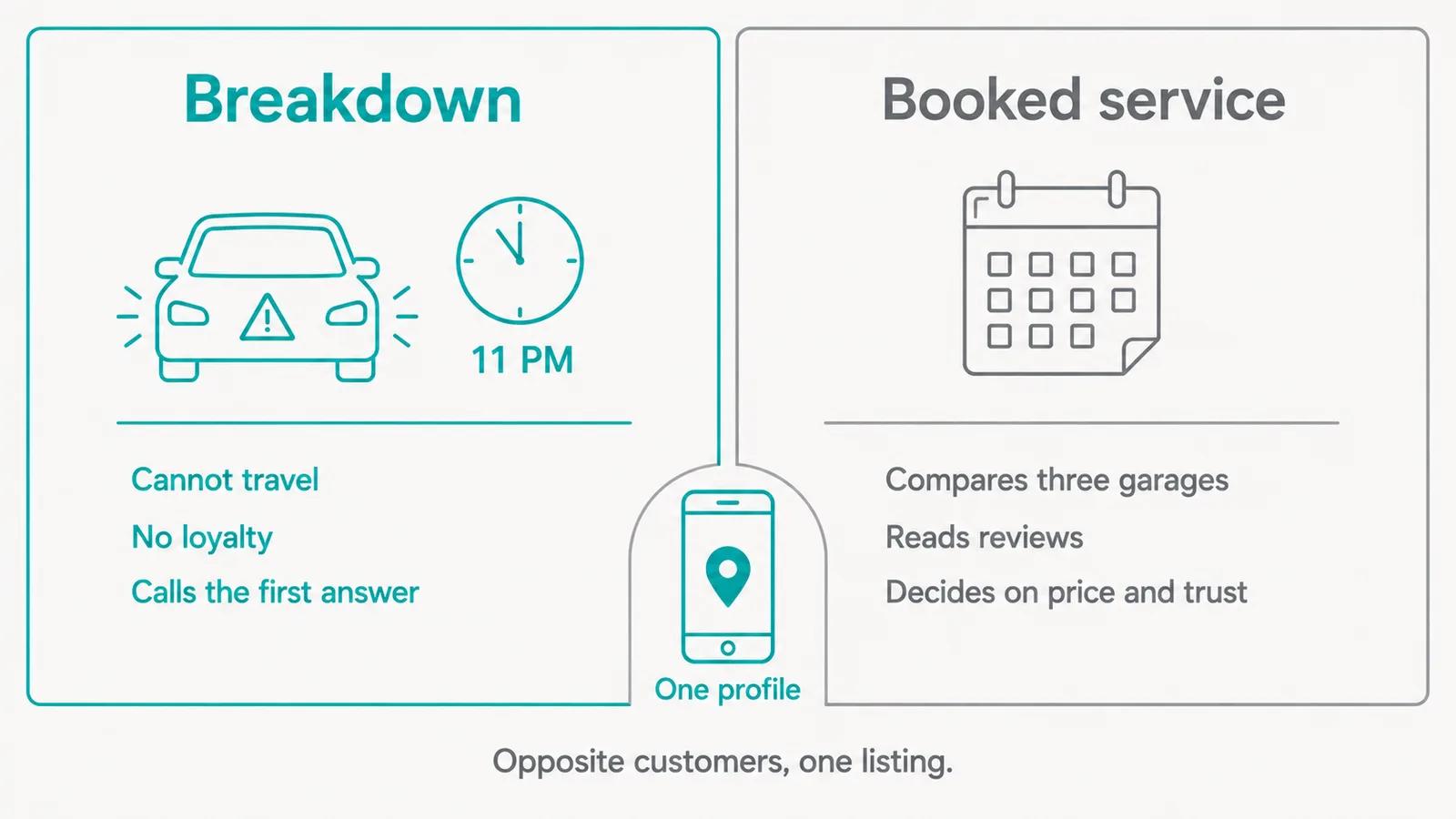
A workshop has to answer two searches that have almost nothing in common. One is made at eleven at night by somebody whose car will not start, who has no loyalty, no patience and no ability to travel — they need whoever is nearest and answers the phone. The other is made on a Sunday afternoon by somebody comparing three garages on price, brand competence and whether they will be cheated. Same listing, same category, opposite customers.
Underneath both sits the defining anxiety of the trade, which is not price. It is being sold work that was not necessary, in parts nobody can identify, at a bill that arrives after the car has already been dismantled. Every independent workshop in India competes against that suspicion before it competes against the garage down the road, and most of them market as though the suspicion did not exist.
This guide covers those two intents, why nobody searches for a garage but everybody searches for their car, what an independent workshop may legally call itself, parts and pricing transparency, insurance work, what electric vehicles and CNG retrofits did to the trade, and the review that gets written after the bill rather than after the repair.
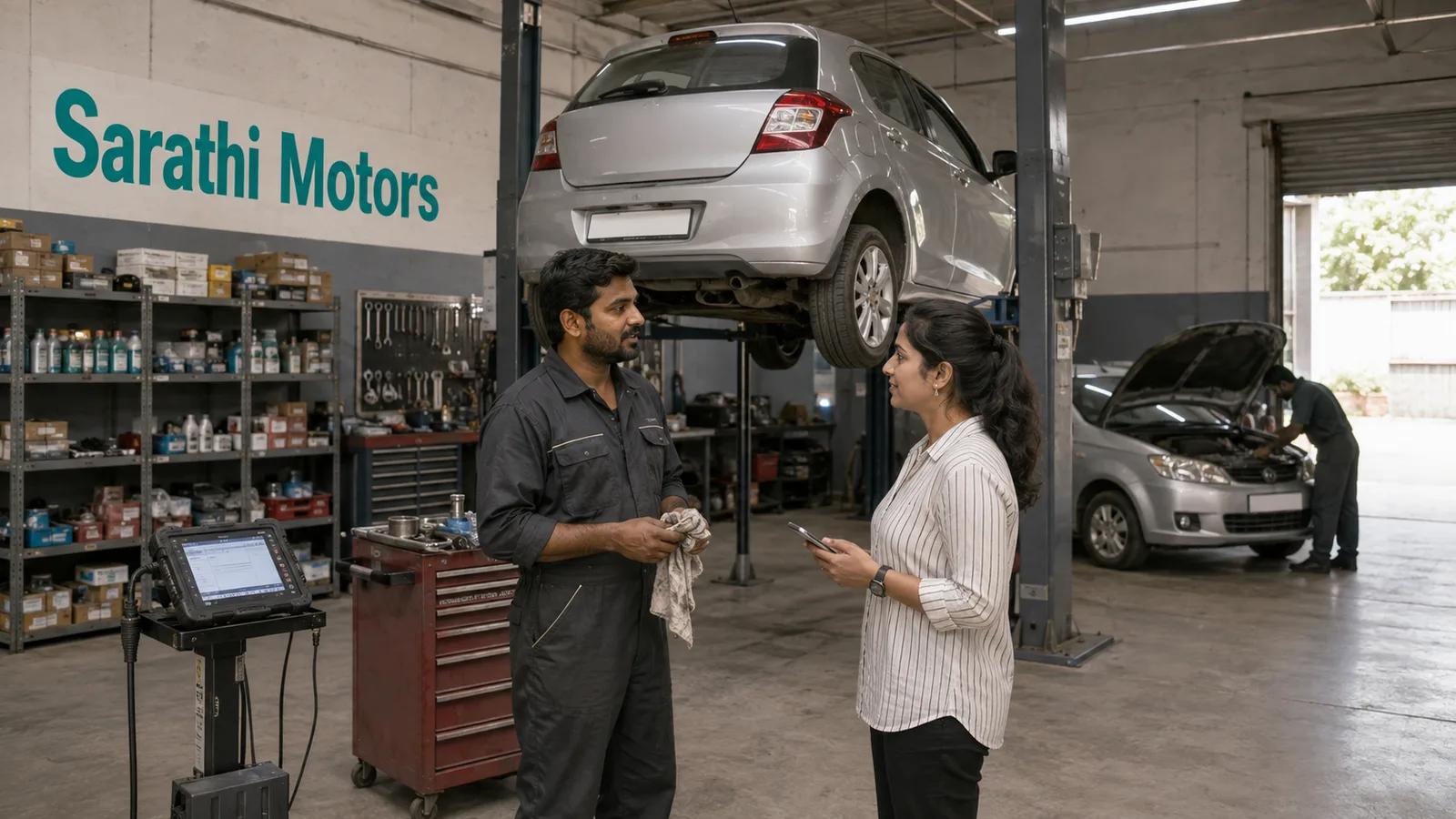
The customer who cannot drive to you, and the one choosing at leisure
The two demands on a workshop profile pull in genuinely opposite directions, and a listing tuned for one performs badly for the other. It is worth separating them before deciding what to fix, because the same effort spent on the wrong half produces nothing.
The breakdown search is an emergency, and it behaves like every emergency search: proximity, whether you are open, and whether somebody picks up. The decisive detail here is one this trade has and almost none of the others do — the customer is immobilised. A person with a burst radiator on a flyover cannot come to you. The distance that matters is not how far they would drive to reach you, it is how far you will go to reach them, which makes towing, roadside assistance and pickup the actual service being searched for, and almost nobody publishes any of it clearly.
That has practical consequences. If you offer a tow or a pickup, name it as a service, state the radius, state the charge or say it is free within a distance, and make the phone number obvious. If you have any out-of-hours capability at all — even one number that reaches a person on a Sunday — publish it as such, because the majority of your competitors are closed and invisible at exactly the hours when the most desperate searches happen. Being reachable at ten on a Sunday night is a positioning almost nobody has taken.
The booked service search is the opposite in every respect. It happens at leisure, days before anything is needed, from a person sitting at home who is going to look at three or four garages, read reviews properly, compare what a service costs, and think about whether they trust you. Proximity still matters but it is one factor among several, and they will drive twenty minutes to a workshop they believe will not cheat them.
For that customer, thoroughness wins. Reviews, and particularly recent reviews that mention the bill matching the estimate. Photographs of the actual workshop. A services list with real entries and indicative prices. Clear statements about which brands you are competent on. None of that helps the stranded driver at all, and all of it decides the scheduled job.
The useful conclusion is that these are two projects, not one, and they are won with different fields on the same profile. Hours, phone, tow radius and responsiveness win the breakdown. Services, prices, photographs and reviews win the booking. A workshop that has done only the second half will wonder why it never gets emergency calls; one that has done only the first will wonder why its bays are empty on Tuesday mornings.
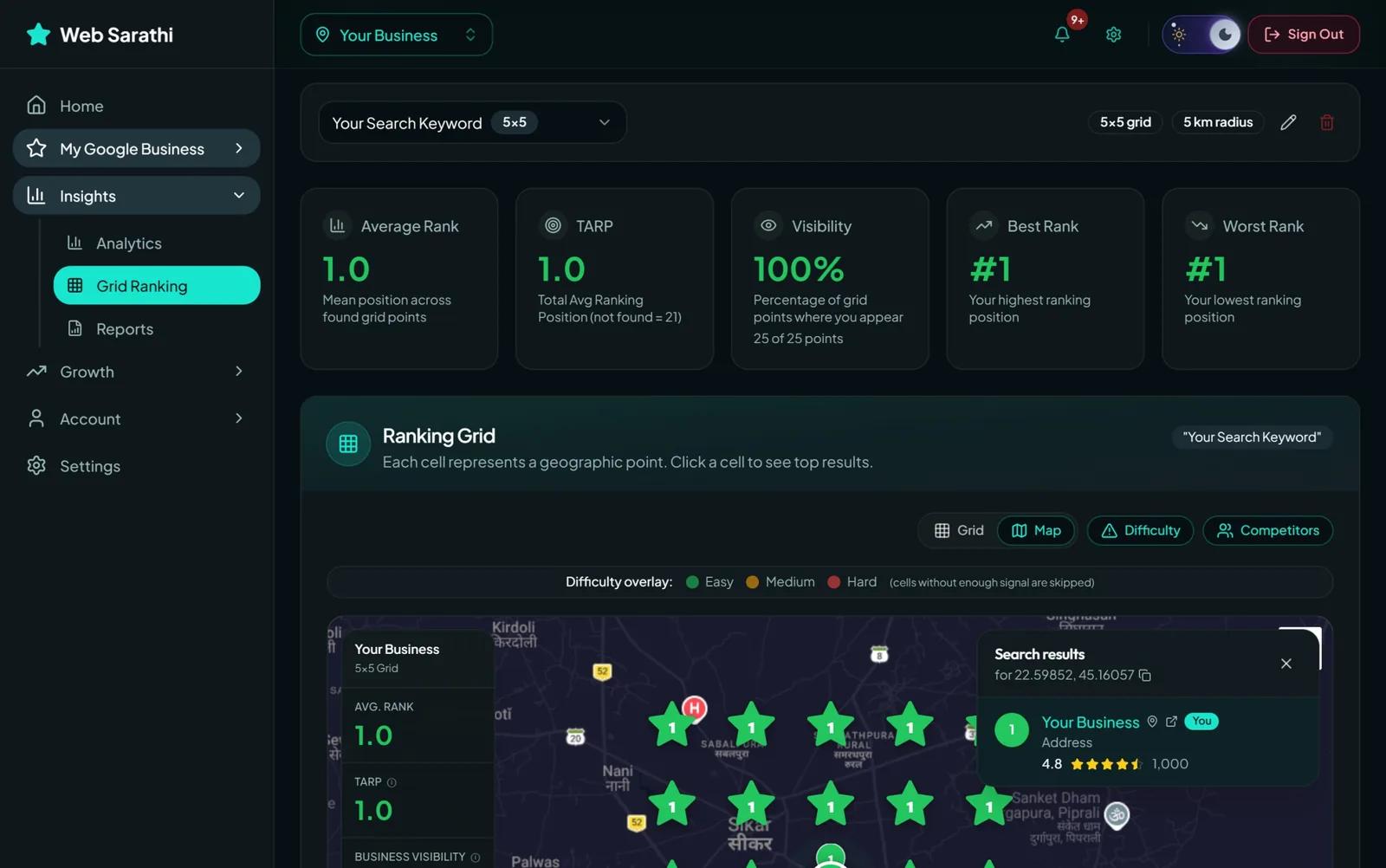
The breakdown search is proximity. Find out how far you reach.
A stranded driver takes whoever is nearest and answers. Grid ranking measures your position from dozens of points across the roads and localities you could actually reach with a tow.
- See which stretches of your area return you and which return a competitor
- Track brand and emergency keywords separately, since they rank differently
- Judge a second workshop on coverage evidence rather than instinct
Nobody searches for a garage, they search for their car
The vocabulary in this trade is organised around vehicles, not services. Almost nobody types car repair near me as their first search. They type the make, often the model, and sometimes the specific problem: Maruti service centre near me, Hyundai car repair, Swift clutch replacement, Innova service cost, car AC repair near me, denting painting near me. The brand is the noun and you are the modifier, which is the same structural pattern that governs coaching institutes and exams.
Google’s categories do not carry any of that. Auto repair shop, car repair and maintenance service, auto body shop, tyre shop, car wash and a handful of others is the whole vocabulary available, and none of them distinguishes a workshop that knows Volkswagen from one that mostly sees hatchbacks. So the category places you in the pool and everything that actually differentiates you has to live in the fields underneath.
The services list is where that happens and it is nearly always three vague words. Every job you actually do should be an entry, named the way a customer would say it: periodic service, engine oil change, brake pad replacement, clutch overhaul, suspension work, car AC service and gas refilling, denting and painting, wheel alignment and balancing, battery replacement, accidental repair, engine overhaul, computerised diagnostics, CNG kit servicing. Each of those is searched by name and each omission is a search you cannot appear for. Where a job has a fairly stable price, publish a band against it.
The description is where the brand competence goes, and this is the field that matters most in this vertical because it is the only place you can honestly say what you are good at. Naming the makes you routinely service, whether you have brand-specific diagnostic equipment, and whether you stock or can source parts for them tells the searcher the thing they are actually trying to establish. Two plain sentences do more than a paragraph about commitment to quality.
Photographs should follow the same logic. A prospect deciding whether you can handle their car is looking for evidence of capability: a two-post lift, diagnostic equipment plugged into a car, an organised parts shelf, an alignment rig, a paint booth if you have one. A tidy reception counter tells them nothing. A photograph of a scan tool connected to a car of their brand tells them almost everything.
Model-specific content is unusually productive here for the same reason it works in interior design: it is too specific for anybody large to bother with. A page on what a particular common model actually costs to service at forty thousand kilometres, what usually fails on it, and what an owner should expect to replace will be read by exactly the people who own that car in your city, and no national chain has any reason to write it.
| What they search | What they are establishing | Where you answer it |
|---|---|---|
| <Brand> service centre near me | Whether anyone nearby is competent on their specific make | The description, naming the makes you routinely handle and your diagnostic equipment |
| Car mechanic near me, at night | Who is open, who answers, and who can reach a car that cannot move | Hours, phone, and a named towing or pickup service with a stated radius |
| <Model> service cost | A number, before deciding whether to call anybody | Service entries with indicative bands, and a model page on your own site |
| Car AC repair near me | A specific job, not a general service | A named service entry — grouping it under general repair matches nothing |
| Denting painting near me | Cosmetic and often insurance-linked work with a visual outcome | A named service, before-and-after photographs, and your cashless network status |
| Car service pickup and drop | Whether they can avoid losing a day to this | A named service with the radius and charge, since almost nobody publishes it |
What an independent workshop may and may not call itself
This is the section with a legal consequence attached, and it is worth reading carefully because the line is finer than most workshop owners assume and the practice in the trade is casual.
The general principle under Indian trade mark law is that using somebody else’s registered mark is not automatically infringement when the use is honest and descriptive — Section 30 of the Trade Marks Act contemplates use of a mark to identify goods or services as those of the proprietor, provided it accords with honest practices and does not take unfair advantage of, or damage, the mark. In ordinary language, an independent garage saying it services a particular make of car is describing what it does. That is a different thing from presenting itself as part of that manufacturer’s network.
The practice that causes trouble is the second one: describing yourself as an authorised service centre when you are not, putting a manufacturer’s logo on your signage or your listing photographs, or building the manufacturer’s name into your own business name. Multi-brand workshops do all three routinely. It misleads the customer about who stands behind the work, and manufacturers do pursue it. If you are not in a manufacturer’s network, the word authorised should not appear anywhere in your marketing, and neither should their logo.
The Google-specific rule runs alongside it and is simpler. Your listing name must be the name the business trades under. Adding a manufacturer’s brand to it — the pattern where a workshop calls itself something plus a car brand plus a locality — is both a naming violation and, potentially, a trade mark problem at the same time. Listings in this category get suspended for exactly this, and the appeal takes time you would rather spend working.
What you can do, and should, is be specific and honest about competence in the fields designed for it. The description can say which makes you routinely service and what equipment you have for them. The services list can name model-specific jobs. Your reviews will naturally mention brands, which is the strongest possible signal and one you cannot be accused of manufacturing. All of that reaches the same searcher without borrowing anybody’s trade mark.
One further consideration worth knowing, because customers raise it: in India a vehicle’s manufacturer warranty is not automatically void merely because servicing was done outside the authorised network, though the position depends on the terms of the warranty and on whether a failure can be attributed to the work or the parts used. That nuance is worth handling honestly in your own words rather than either dismissing the concern or overclaiming — a workshop that explains the actual position, and keeps proper job cards and parts invoices so an owner can evidence what was done, is answering a real question that most of its competitors avoid.
Calling yourself an authorised service centre
If you are not in the manufacturer’s network, the word does not belong anywhere in your marketing. It misleads customers about who stands behind the work, and manufacturers do pursue it.
A manufacturer logo on your signage, photographs or listing
Describing which makes you service is one thing; displaying somebody else’s mark as though you were part of their network is another. Keep the logos off the board and out of the profile images.
A car brand built into your business name
That is a Google naming violation and a potential trade mark problem in the same act. Listings in this category are suspended for it regularly, and the appeal costs you the weeks you can least afford.
Dismissing the warranty question
Owners genuinely worry about it and most workshops either wave it away or overclaim. Explain the actual position in your own words, and keep job cards and parts invoices so an owner can evidence what was done.
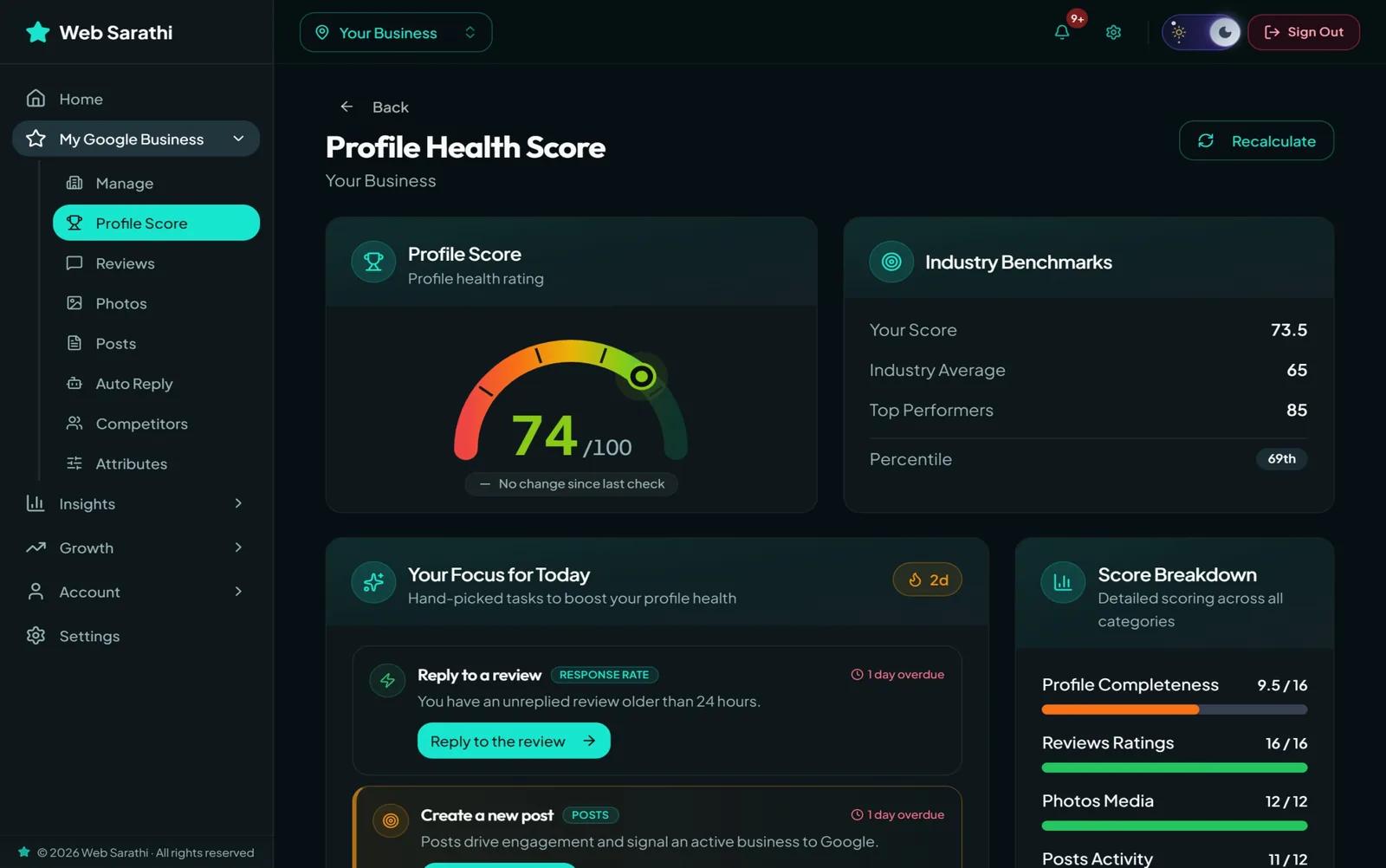
Sixty checkpoints, including the brand name in your listing
Workshops lose listings to a manufacturer name in the business name more often than to anything else, and it can be a trade mark problem in the same act. The audit finds it before somebody else does.
- Flags brand names, localities and superlatives in the listing name
- Checks name, address and phone consistency across the web
- Re-audits automatically, so a regression surfaces on its own
The fear you compete against is being sold work you did not need
Ask any car owner in India what they dislike about garages and the answer is almost never the quality of the repair. It is the suspicion that half of it was invented — that the estimate grew once the car was on the lift, that parts were replaced which did not need replacing, that a part billed as genuine was not, and that none of it can be verified by somebody who does not know what a bush or a tie rod end is.
The suspicion is worse for customers who feel least equipped to argue, which in practice means a great many women drivers and a great many first-time owners. Both groups will pay more, travel further and stay loyal for years to a workshop where they do not feel outmatched, and both are systematically underserved by an industry that markets on price and speed.
The mechanism the suspicion attaches to is parts pricing, which is genuinely opaque. The same component exists as a manufacturer-branded part, an equivalent from the original supplier in their own box, and an aftermarket part of variable quality — at three quite different prices. All three can honestly be fitted. Only one of them is what the customer imagines they are buying when the invoice says the part name and nothing else.
The competitive opportunity is to make that visible rather than to compete on the price of the ambiguity. Quote the options: this part is available at three prices, here is what each is, here is what we recommend and why. Put the choice on the estimate and let the customer make it. Workshops that do this consistently report the obvious thing — customers frequently choose the more expensive option, because what they were resisting was not the price but the feeling of being managed.
The same principle applies to the work itself. Approve additional work by message before doing it, with a photograph of the part and a one-line explanation, rather than presenting it at collection. A photograph of a worn brake pad next to a new one takes ten seconds and permanently changes the character of the conversation. Show the old parts at handover as a matter of routine, not on request. Write job cards that a non-expert can read.
All of this is operational rather than marketing, and yet it is the highest-leverage search work available to a workshop, for one reason: it is what the reviews will be about. A profile carrying twenty reviews that say the bill matched the estimate, they showed me the old parts, they called before doing extra work is answering the trade’s defining objection in the words of people who are not you. Nothing you write about yourself competes with that.
Estimate in writing, before work starts
Itemised, with labour and parts separated. A verbal figure is what the customer expects to be revised, because in this trade it usually is.
Quote the parts options, all three
Manufacturer-branded, original supplier, aftermarket — with the price and the reason for each. Customers often pick the dearer one once it is a choice rather than a decision made for them.
Approve extra work by message, with a photograph
A picture of the worn part and one line of explanation, sent before it is done. Ten seconds, and it changes the whole character of the bill conversation.
Show the old parts at handover, every time
As routine, not on request. Making it standard practice removes the suspicion instead of answering it defensively when somebody asks.
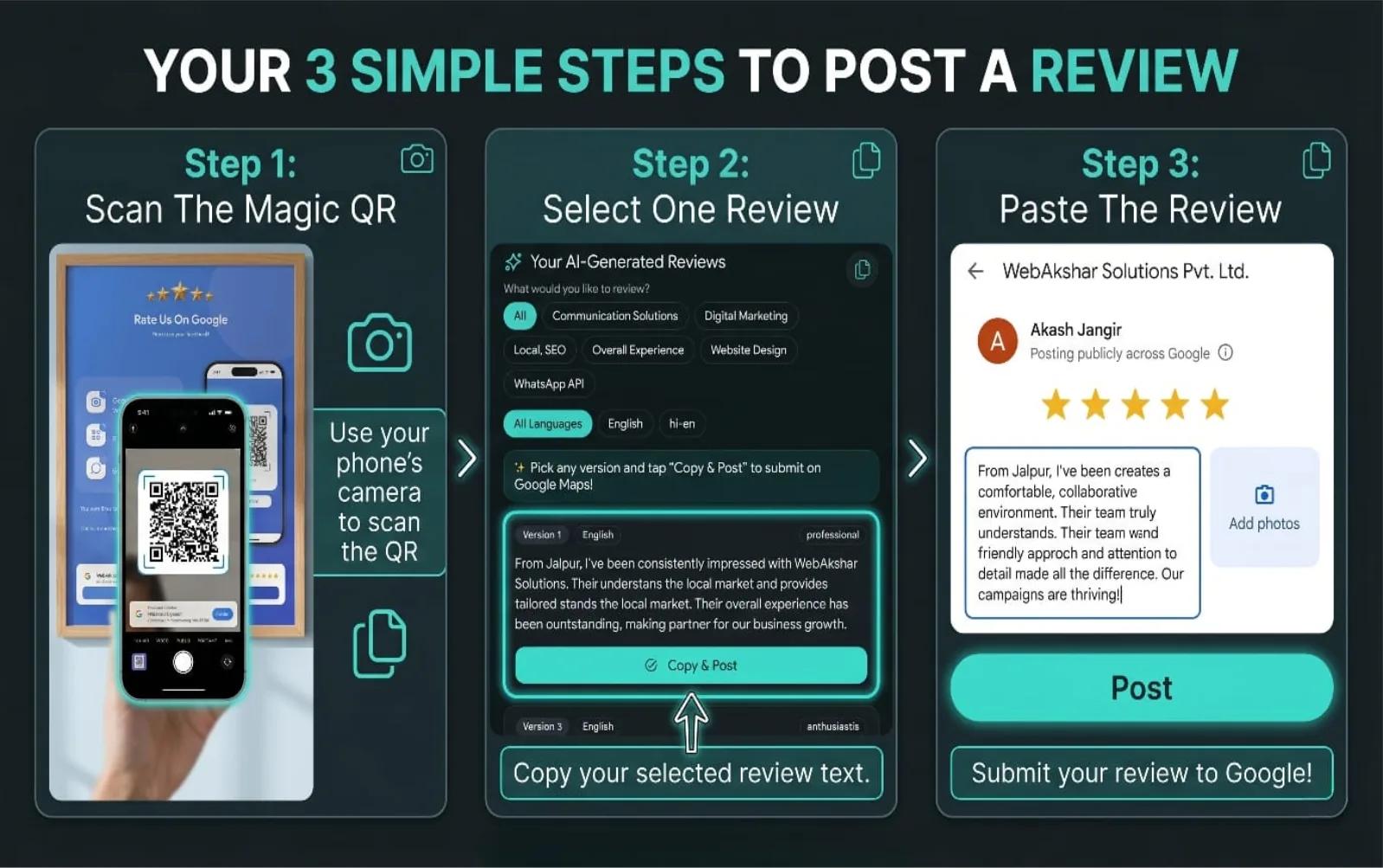
Ask for the review at collection
The customer is holding a bill that matched the estimate and looking at their own old brake pads. That is the moment, and it is what the next anxious owner needs to read.
Ask at the counter, while the invoice still matches
The emotional peak of this transaction is the moment a customer looks at a bill that is what you said it would be. It lasts about a minute, and almost nobody asks inside it.
- Scan at the counter and the review is drafted in a few taps
- Prompts for the model, the approval call and whether the bill held
- Works at the doorstep too, when a driver returns the car
Accident work, cashless networks and the searches attached to them
Accident repair is a different business inside the same workshop, and it has its own search behaviour, its own economics and its own decisive credential. It is worth treating separately rather than as a line in the services list, because a customer who has just had a collision is not running the same search as one who needs a service.
The searches themselves are distinctive: accident repair near me, denting and painting near me, car body shop, insurance claim car repair, and increasingly the insurer’s name alongside a location. They are urgent but not immediate — the car may already be immobile and towed — and they are heavily influenced by one question the customer will ask within the first two minutes of the call.
That question is whether you are on their insurer’s cashless network. If you are, the customer pays only their own excess and the insurer settles with you directly; if you are not, they pay the whole bill and then chase a reimbursement, which is a materially worse experience and a large amount of money to front. For a great many customers this single fact decides the choice of workshop, and yet very few garages state their network status anywhere a searcher can see it.
So state it. Name the insurers whose cashless network you are part of, put it in the description, name it as a service, and say plainly what the customer will and will not have to pay. If you are not on any network, say what you do instead — whether you help prepare the claim, whether you handle the surveyor visit, how long reimbursement typically takes. Silence on this point reads as a no.
The surveyor relationship is worth explaining to the customer too, because it is the part they understand least and worry about most. A short, plain description on your site of how an insurance repair actually proceeds — intimation, surveyor inspection, approval, repair, final survey, delivery — positions you as the workshop that will manage it rather than the one that will hand them forms. That is a genuine differentiator and it costs one page.
Body work is also the one part of this trade with a naturally visual proof asset, and it is badly underused. Before-and-after photographs of a repaired panel, with the customer’s permission and the registration plate obscured, are among the most persuasive images a workshop can publish. Post them regularly. A body shop with a steady stream of real repair photographs looks like a body shop that does a lot of repairs, which is precisely the impression the anxious customer is trying to form.
| Their question | Why it decides the job | What to publish |
|---|---|---|
| Are you cashless with my insurer | It is the difference between paying an excess and fronting the whole bill | The insurers you are networked with, named, in the description and services |
| Will you handle the surveyor | They do not understand the process and expect to be handed forms | A plain page describing intimation, survey, approval, repair, final survey, delivery |
| How long will it take | They are without a car and possibly paying for transport | Realistic turnaround by damage type, rather than a number you will miss |
| Will it look right afterwards | Paint match and panel alignment are what they will judge you on | Before-and-after photographs, plate obscured, published regularly |
| What if the claim is rejected | It is the outcome they are quietly dreading | What you charge if the claim fails, stated before work begins |
What electric vehicles and CNG retrofits did to the independent workshop
The independent workshop’s traditional revenue is concentrated in things an electric vehicle does not have. No engine oil, no filters, no spark plugs, no clutch, no timing belt, no exhaust, and regenerative braking that makes brake pads last considerably longer. A trade whose bread and butter is the periodic service is looking at a vehicle that barely needs one.
The high-voltage work is also largely closed to independents in practice. Battery systems, motor and power electronics require specific training, specific equipment and specific safety procedures, and manufacturers keep that work inside their own networks. An independent garage that starts opening battery packs without the training is taking a genuine physical risk, not merely a commercial one.
That is the honest bad news, and there is no point in a guide that pretends otherwise. The useful question is what remains, and the answer is more than most owners assume. Electric vehicles still have tyres, wheel alignment, suspension, steering, brakes and brake fluid, cabin filters, air conditioning, twelve-volt batteries, wipers, body work and accident repair. Bodyshop and accident work is entirely unaffected — a bumper is a bumper. And EV owners in India are frequently frustrated by long waits at manufacturer service centres for jobs any competent workshop could do in an afternoon.
So the positioning is specific rather than general, and it needs saying explicitly because customers assume the opposite. A workshop that publishes plainly that it handles tyres, alignment, suspension, brakes, air conditioning and body work on electric vehicles, and is clear that it does not touch the high-voltage system, is answering a question EV owners are actively searching and finding no answers to. Being early to that in your city is a genuinely available position.
CNG runs in the other direction and is a straightforward revenue line most workshops undersell. Retrofits, kit servicing, leak testing, cylinder testing and the periodic requirements that come with a converted vehicle are real recurring work, they are searched by name, and they are performed almost entirely by independents. If you do this work and are properly authorised for it, it deserves named service entries and a page of its own rather than a mention.
The broader point is that this is a trade in which the service mix is visibly shifting, and the profile is usually the last thing to be updated. A services list written five years ago describes a workshop that no longer exists and misses the work that is actually growing. It is worth reviewing annually against what the bays are genuinely doing.
What an EV removes from your revenue
- Engine oil, filters, spark plugs and the periodic service built around them
- Clutch, timing belt and exhaust work
- Much of the brake wear, thanks to regenerative braking
- High-voltage battery and motor work, which stays in the manufacturer network
What it leaves, and nobody advertises
- Tyres, alignment, balancing, suspension and steering
- Brake fluid, cabin filters, air conditioning and twelve-volt batteries
- Body work and accident repair, entirely unaffected
- Owners frustrated by long waits for jobs you could do in an afternoon
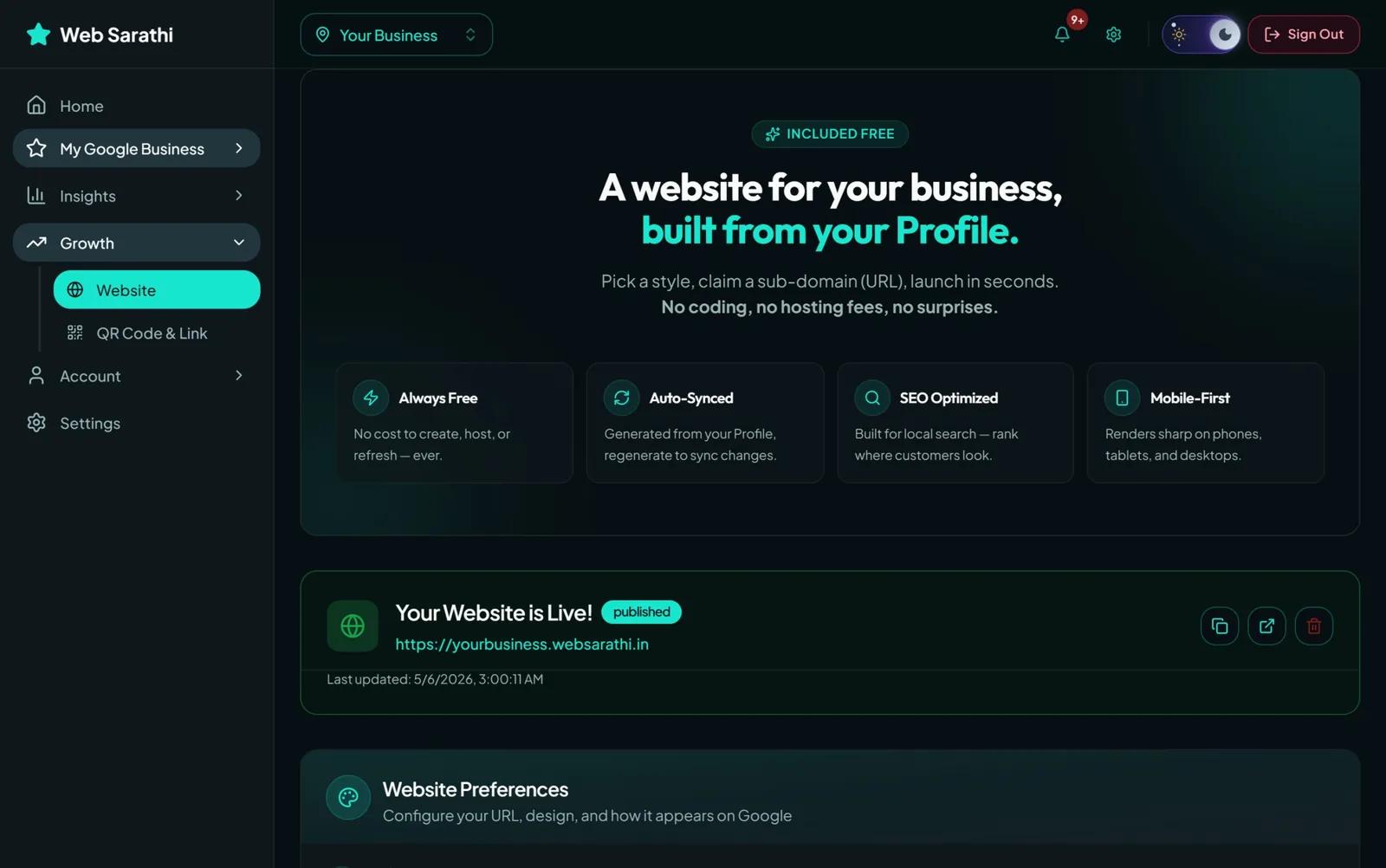
Model pages no national chain has any reason to write
What a specific common model costs to service at forty thousand kilometres, and what usually fails on it, is read by exactly the people who own that car in your city — and is far too specific for anybody large to bother with.
- A page per model or service you genuinely specialise in
- CNG, EV-safe work and accident repair each get their own
- Written from your own job cards rather than generic copy
Pickup and drop is the differentiator almost nobody publishes
A car service costs the owner more than the invoice. It costs a morning, a way of getting to work, an afternoon of waiting for a call, and a second trip to collect. For a two-car household that is an inconvenience; for a single-car household with two working adults it is the reason the service gets postponed for four months.
Pickup and drop removes the entire cost, and a large number of Indian workshops already do it informally — somebody rides over, collects the car, brings it back in the evening. Almost none of them treat it as a service that exists. It is not in the services list, not in the description, not in the photographs, and not mentioned on the phone unless the customer thinks to ask.
That is a straightforward miss, because it is searched. People look for car service pickup and drop, doorstep car service and car service at home, and those searches are made by exactly the customer segment that is hardest to win and most loyal once won: busy, willing to pay, and choosing on convenience rather than on the cheapest quote. A workshop that names the service, states the radius, states the charge or says it is free within a distance, and shows a photograph of the collection actually happening, is answering a search its competitors are not.
The same logic covers the doorstep repair work that has become common — battery replacement, minor electrical work, basic diagnostics performed at the customer’s parking spot. Where you do it, name it. Where you do not, say what you do instead. The value is in the customer knowing before they call, because the alternative is that they book the one who published it.
There is a second-order benefit that matters more than the convenience. A workshop that collects the car has a driver at the customer’s door twice, which is two more human contacts than a normal service involves, and it is a far better moment to ask for a review than a busy counter at collection time. The car has been returned clean, the day was not disrupted, and somebody is standing there handing over keys.
Publish the practical terms so the offer is credible rather than vague. How far you will collect from, what it costs, whether the driver is insured, how long before the car comes back, and whether the customer gets a call before any additional work. Every one of those is a question the interested customer has, and answering them on the profile converts an intention into a booking.
Doing pickup and drop but never publishing it
It is searched by name — car service pickup and drop, doorstep car service — by the customer segment that is hardest to win and most loyal once won. If it is not in the services list, it does not exist.
Offering it vaguely, with no radius or charge
A vague offer reads as one that will be withdrawn or billed unpredictably. State how far you collect from, what it costs, and how long before the car comes back.
A services list that describes the workshop you were five years ago
CNG work, doorstep repair, EV-safe jobs and accident work have all shifted. Review the list annually against what the bays are actually doing, or you are advertising the work that is shrinking.
Missing the review moment at the doorstep
A driver handing back a clean car at the customer’s home is a far better moment to ask than a busy counter at collection time, and it happens twice per job.
The review is written after the bill, not after the repair
The timing of a workshop review is unusual and it explains most of what appears on these profiles. The customer does not write when the car is fixed. They write after they have paid, which means the last thing they experienced before forming a public opinion was a number — and quite often a number larger than the one they were expecting.
This is why workshop reviews are so consistently about money rather than mechanics. Read the one-star reviews of any garage and they are about the estimate that grew, the part they did not authorise, the job that took three days longer than promised, and the sense of having been managed. Read the five-star ones and a striking proportion mention the same thing from the other side: the bill was what he said it would be.
That maps directly onto the operational habits described earlier, and it is worth saying explicitly that no review strategy substitutes for them. A workshop that surprises people at the counter will accumulate reviews about being surprised at the counter, however diligently it asks. The estimate in writing, the photograph before extra work, and the old parts shown at handover are the review strategy; everything else is administration.
On the asking itself, the moment is collection, and specifically the moment after the customer has looked at the invoice and it matched. That is a short window and it is the emotional peak of the entire transaction. Asking then, as a routine at the counter rather than when somebody remembers, is far more productive than a message sent three days later when the relief has faded and the car has become ordinary again.
Prompt for the specifics that answer the trade’s objection. A review saying good service does nothing for the next reader. One saying they quoted an amount, called before doing extra work, and the final bill was the same, on a named model, is doing the work — it addresses the exact fear the next visitor arrived with, in words that cannot be mistaken for yours. Most customers will write that if asked to.
When a negative review does arrive, reply on the assumption that the next customer is the audience and the reviewer is not. Do not argue the technical detail in public, because to a reader it looks like an expert overpowering a layman, which is precisely the dynamic they are afraid of. Acknowledge, state plainly what your practice is on estimates and approvals, and offer to look at it. And read the pattern rather than each instance — three reviews about the same surprise charge are one practice to change, not three replies to write.
Asking for the review days later
The window is the moment at the counter when the customer has looked at the invoice and it matched the estimate. Three days later the relief has faded and the car is ordinary again.
Arguing the technical detail in public
To a reader it looks like an expert overpowering a layman, which is exactly the dynamic they are afraid of. Acknowledge, state your practice on estimates and approvals, and move the detail offline.
Expecting review work to fix a counter problem
A workshop that surprises people at the counter will accumulate reviews about being surprised at the counter, however diligently it asks. The written estimate and the approval photograph are the review strategy.
Settling for good service as a review
It answers nothing the next reader came to find out. Prompt for the model, whether extra work was approved first, and whether the final bill matched the estimate.
Auto Repair SEO questions, answered
The questions Indian auto repair businesses ask us most often.