Pest control SEO in India: winning the call that happens in the next twenty minutes
Pest control is one of the few local trades where the customer is not shopping. They have just seen a termite trail across the door frame, or found the third cockroach of the evening in a kitchen where a two-year-old eats. They are not comparing five operators over a fortnight. They are going to call somebody in the next twenty minutes, and if it is not you it is whoever appeared above you.
That urgency shapes everything about how this trade should approach Google, and it makes the vertical unusual in two more ways. Most operators have no shopfront, which means the profile is set up completely differently from a shop or a clinic. And home services in India is one of the most heavily spammed categories on Maps, so a meaningful share of what appears above you may not be a real business at all.
This guide covers the setup that applies to a business with no public address, what to do about the fake listings competing with you, how licensing and safety concerns turn into search-visible trust, and why a seasonal pest calendar is the best content plan this industry has and almost nobody uses it.
You are a service-area business, and that changes the entire setup
Most pest control operators in India work out of a small office, a godown or the ground floor of the owner’s house, and no customer has ever visited any of them. Google has a specific configuration for exactly this situation, and getting it wrong is the most common structural mistake in the trade.
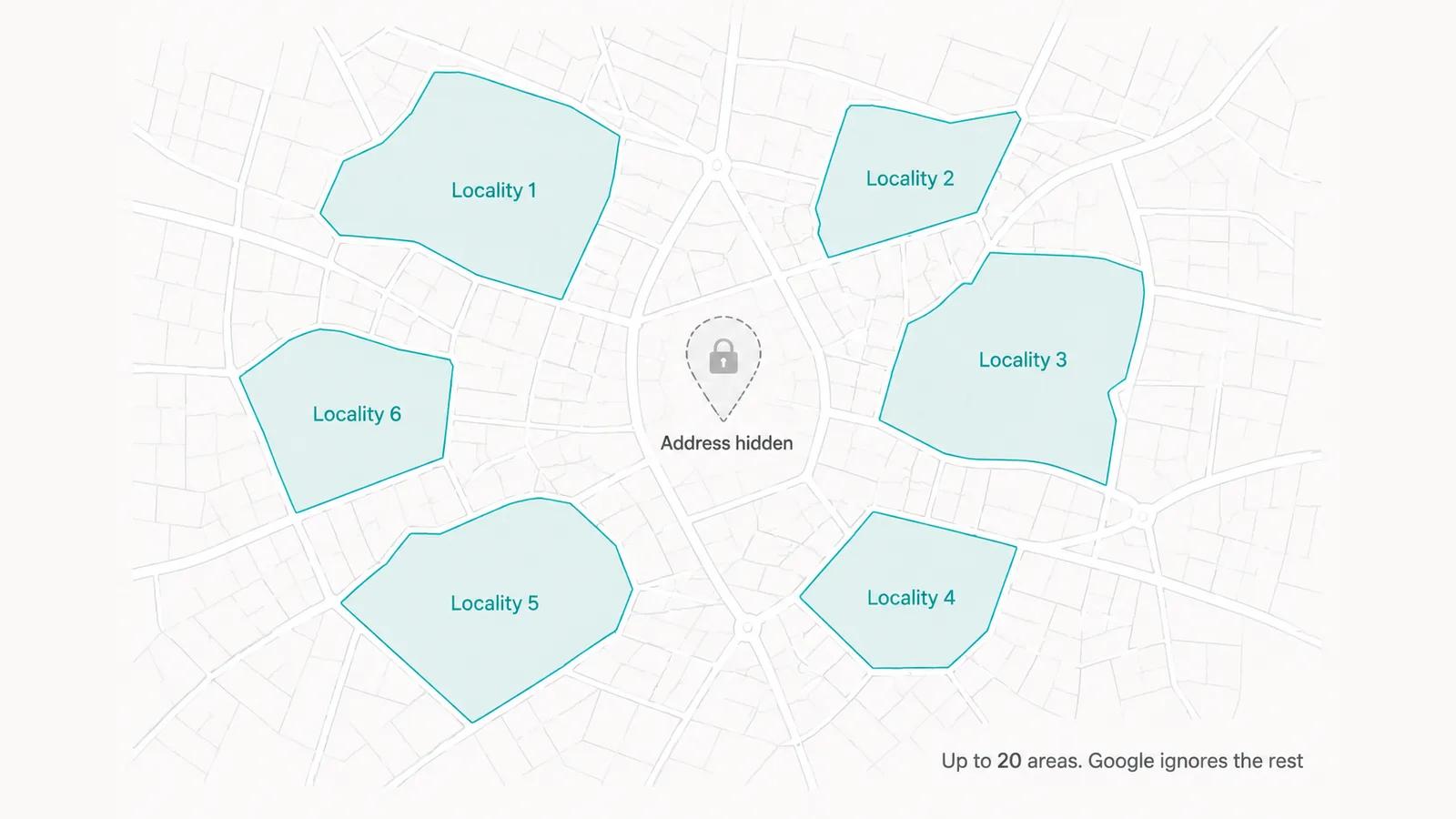
The mechanics are straightforward once somebody explains them. You enter your real address during setup, because Google needs it for verification. Then you hide it, and instead declare the areas you serve. The address still does its job behind the scenes; it simply stops being displayed to the public. What you must not do is leave a residential address on public display — that is a well-known trigger for suspension, and a suspension takes your phone silent for weeks in a business where the phone is the entire revenue mechanism.
Defining the service areas is where operators get sloppy in a way that costs them. Google works in named places — cities, towns, localities — rather than a radius drawn on a map, it accepts up to twenty of them, and it ignores whatever you list beyond that. Google also expects the coverage to be plausible, roughly within a couple of hours of driving from your base. An operator in Thane listing forty areas across three districts is not casting a wider net; they are filling twenty slots with places they cannot service and discarding the rest.
Choose the twenty deliberately. Take the areas you actually send a technician to, rank them by how much work each produced last year, and list those. A tight, credible service area that matches where your vans genuinely go outperforms an ambitious one, because relevance in this vertical is heavily geographic and an implausible footprint helps you nowhere in particular.
One more decision follows from being a service-area business: whether you also operate a genuine walk-in counter. If customers really do come to you to buy products or drop off equipment, you are a hybrid and can display the address with real hours. If they do not, do not pretend otherwise for the sake of looking established. The pretence is checkable, and being caught is far more expensive than looking small.
| Decision | Correct answer for most operators | What goes wrong otherwise |
|---|---|---|
| Public address | Hidden — entered for verification, not displayed | A visible residential address is a known suspension trigger |
| Service areas | Up to 20 named localities you genuinely cover | Anything past 20 is ignored; implausible coverage helps nowhere |
| Coverage radius | Within roughly two hours of your base | Overreach dilutes relevance without adding any real territory |
| Hours | The hours you actually answer the phone | Listed as open when nobody answers is how you collect one-star reviews |
| Primary category | Pest control service, with the specific ones as secondaries | A vague primary category costs you the searches that convert best |
See which of your service areas you actually appear in
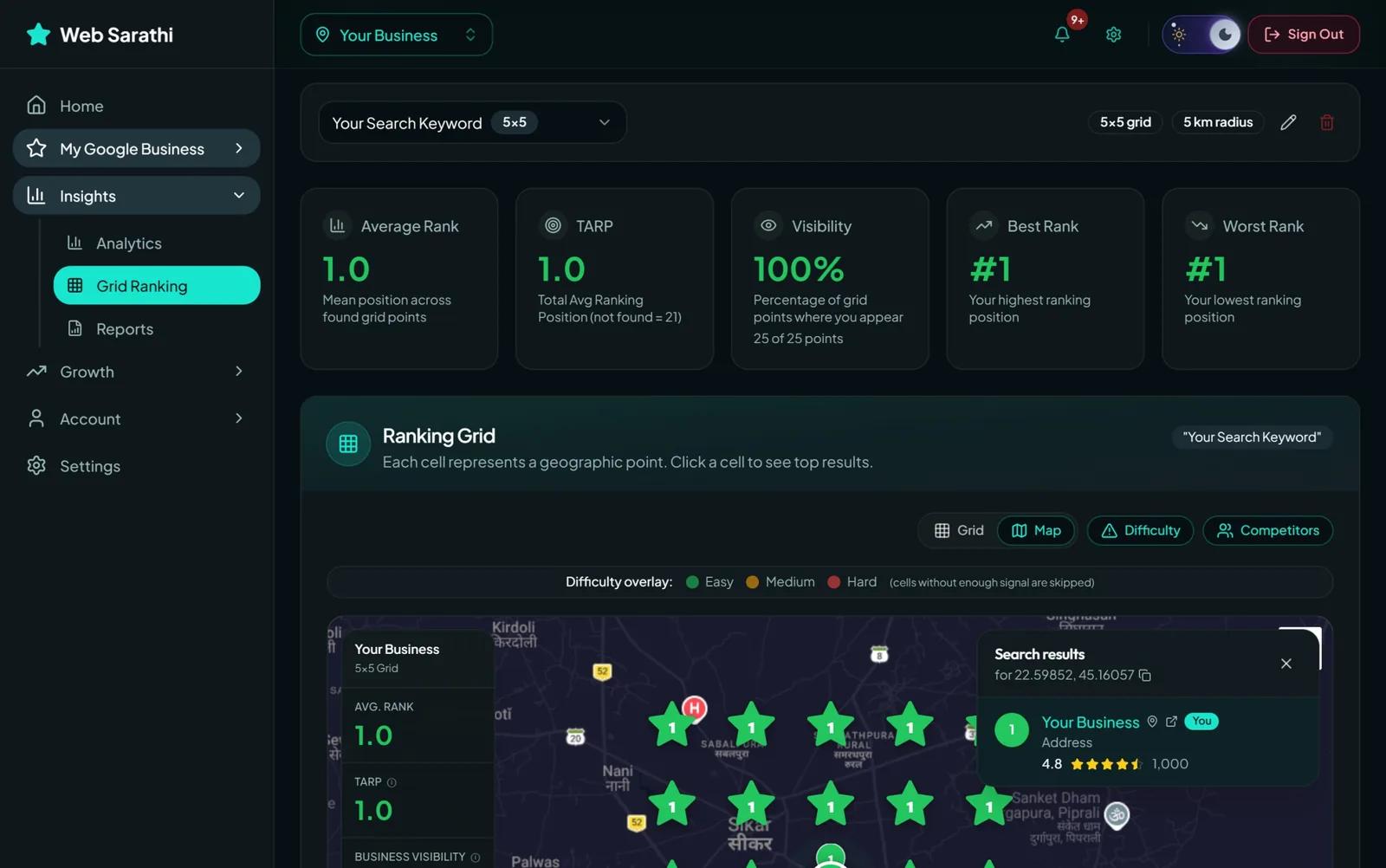
Declaring twenty localities does not mean you rank in twenty localities. Grid ranking measures your Maps position from dozens of points across your coverage and shows you where the vans could go but the calls never come from.
- Find the declared service areas you are invisible in
- Watch coverage change as reviews and activity build
- Decide where to expand on evidence rather than on ambition
The window between the search and the call is measured in minutes
Understanding the shape of demand in this trade is worth more than any individual optimisation. A person who has just discovered bedbugs is in a different psychological state from someone choosing a gym. There is disgust, some embarrassment, and a strong desire for the problem to stop existing today. They will scan the top of the results, look at two or three ratings, and call. The whole process takes minutes.
Three things follow from that, and they are all operational rather than technical. Position matters more here than in slower verticals, because there is no research phase in which a lower-ranked business can win the customer over. Reviews matter as a fast credibility check rather than as reading material — the number and the average do the work, not the prose. And the phone must be answered, because an unanswered call in this trade is not a delayed sale, it is a sale that has gone to the next listing before you have finished hearing it ring.
That last point is where most of the money leaks, and it is not really an SEO problem at all. Operators spend on visibility, generate calls during the day while the whole team is out treating properties, and let the phone ring out. Every one of those calls was paid for and every one of them converted for a competitor. Before spending anything on ranking higher, establish who answers, and what happens to a call at seven in the evening or on a Sunday morning, which is when a household actually notices an infestation.
Because the decision is fast, the elements of the listing that get read in that moment carry disproportionate weight. The rating and the review count. Whether it says open now. Whether the top of the profile makes clear you handle their specific problem — termites, bedbugs, cockroaches, rodents, mosquitoes — rather than describing you generically as a service provider. A customer who has bedbugs is looking for the word bedbugs, and finds it reassuring in a way that no amount of general professionalism replaces.
Not all demand is emergency demand, and the difference is worth planning for. Commercial contracts, housing society AMCs and pre-monsoon treatments are considered, comparison-driven purchases with committees and quotations. Those buyers read, check credentials and want to see that you are established. They are a smaller share of enquiries and a much larger share of revenue, which is why the sections on licensing and proof further down matter even though they do nothing for the panicking householder.
One cheap operational change is worth more than most ranking work in this trade: find out what actually happens to a call you miss. Ring your own listed number outside working hours and see where it goes. If the answer is a dead line, put a diverted number, a call-back message or a WhatsApp route in its place, and measure how many of those calls convert. Operators who do this frequently discover that evenings and Sunday mornings — precisely when a household notices an infestation and has time to deal with it — were producing a stream of enquiries that nobody was receiving.
The trigger
A termite trail, a rodent in the kitchen, bites on a child. There is no research phase and no shortlist — the search happens immediately after the discovery.
The scan
Top few Maps results, rating, review count, whether it says open now, and whether the listing names their specific pest. Perhaps fifteen seconds per listing.
The call
They call the first credible option. If it rings out, they call the next one and do not come back. This is where most paid-for visibility is quietly wasted.
The commitment
Price, availability today or tomorrow, and whether the treatment is safe with children and pets in the house. Answer that third one before it is asked.
The review, if anyone asks
Relief is highest immediately after treatment works. Almost no Indian operator asks at that moment, which is why review counts in this trade are so low relative to job volume.
The fake-listing problem in home services, and how to actually fight it
Home services is among the most heavily spammed categories on Google Maps anywhere in the world, and pest control is one of the worst affected inside it. If you are an honest operator wondering how six businesses you have never heard of rank above you in your own locality, the uncomfortable answer is that several of them may not exist.
The scale is not speculative. Google reported removing around seven million fake business listings in 2021, more than double the roughly three million it removed in 2018 — a number that tells you both how large the problem is and that enforcement is real, if uneven.
The patterns repeat. Listings named things like Best Termite Control Near Me followed by a locality, which is keyword stuffing rather than a business name. Clusters of profiles at addresses that turn out to be a residential flat or an empty plot, one per locality, all pointing at the same call centre. Lead generation operations that rank a network of listings and then sell the calls back to real operators, often to you. And virtual offices spun up in every suburb by a business that has one van.
The reporting route that works is the business redressal complaint form, which exists specifically for this and replaced the older community route. It lets you submit multiple listings at once with evidence and an explanation of which policy each one breaches, which matters because a bad actor rarely has just one profile. A casual report from Maps is far easier to ignore than a documented submission naming six related listings.
Two pieces of realism, though. Enforcement is inconsistent and slow, so treat reporting as maintenance rather than as strategy — an hour once a quarter with screenshots, not a crusade. And do not respond by adopting their tactics. Keyword-stuffed names and fake locality listings are the most reliably enforced violations on Maps, which means the operator who copies them is trading a slow disadvantage for the risk of losing everything at once. The durable position is being the listing that is obviously real: verifiable address behind the scenes, licence details stated, photographs of actual technicians on actual jobs, and a review base that accumulated over years.
Keyword-stuffed business names
A listing called Best Pest Control Near Me Andheri is not competing with you fairly and it is also the most reliably enforced violation on Maps. Report it, and never imitate it.
Listing clusters at one call centre
One profile per suburb, all forwarding to the same number, is the classic lead-generation pattern. Report them together through the redressal form with evidence, not one at a time from Maps.
Virtual offices in every locality
A single-van operator with eleven addresses is claiming a footprint that does not exist. Document the addresses before reporting, because the form works far better with evidence.
Buying your own leads back
Some networks rank listings purely to sell the calls to real operators. If a platform is selling you leads generated from a locality you already serve, you are funding your own competition.
Licensing, chemicals and the objection nobody says out loud
Every pest control customer in India has the same unspoken worry, and almost no operator addresses it in writing: is this stuff going to hurt my children, my pets or my food. They will not usually ask directly, because it sounds like an accusation. They will simply choose the operator who seems more likely to be careful, and the signals they use for that judgement are visible on your listing before anybody speaks.
Licensing is the strongest of those signals and the most under-used. Pest control operations in India sit under the Insecticides Act of 1968 and the Insecticides Rules of 1971. Operations using the notified fumigants — aluminium phosphide, methyl bromide, ethylene dibromide and others notified alongside them — require a licence applied for in Form VI-A, with a fee of one thousand rupees for each place of operation. The licence runs for five years and is renewed on Form VI-B after verification or inspection. The framework sits under the Central Insecticides Board and Registration Committee, with the licence commonly issued through the state agriculture department’s licensing authority.
There are competence requirements behind it too. The rules expect the applicant or a designated technical person to be a graduate in agriculture, or in science with chemistry, and a training completion certificate from the Indian Pest Control Association is part of the usual application. None of that is trivial to obtain, which is exactly why stating it plainly separates you from the operator who bought a sprayer.
So state it. Put the licence particulars on your website, reference them in your profile description, and mention safety practice in the places where customers are already anxious: what the treatment involves, how long the family should stay out, what happens with an aquarium or a cat, whether the chemicals are approved for residential use. Every one of those is a search somebody performs before they call, and answering it is both an SEO asset and the single most effective conversion argument available to you.
Do not overclaim in the other direction either. Describing treatments as fully organic or completely chemical-free when they are not is an easy claim to disprove and it produces the specific review that says the operator lied about what they sprayed. Precision reassures; vagueness and marketing language do the opposite in a trade where the customer is already suspicious.
| Signal | What it establishes | Where to state it |
|---|---|---|
| Pest control operator licence | You are licensed under the Insecticides Rules for the operations you perform | Website footer and about page, profile description, quotations |
| Qualified technical person | A graduate in agriculture or in science with chemistry oversees the work | About page, and by name on commercial proposals |
| IPCA training certification | Formal training rather than on-the-job improvisation | Website credentials block, and in AMC tenders |
| Child, pet and food safety practice | Answers the question the customer will not ask out loud | A dedicated page, profile posts, and service descriptions |
| Re-treatment warranty terms | What happens if the problem comes back, stated before they ask | Service pages, quotations and review replies |
A seasonal pest calendar is the best content plan this trade has
Most local businesses have to invent reasons to publish. Pest control does not: demand in this trade follows the Indian climate with unusual reliability, different pests peak in different months, and every one of those peaks is a set of searches you can be waiting for rather than reacting to.
The broad pattern is familiar to anyone who has run a van for a few years. Termite activity becomes visible in the warm months and again around swarming. The onset of the monsoon reliably produces cockroaches, mosquitoes and a rise in rodent activity as water moves them indoors. Damp months bring complaints about mould, silverfish and stored-grain pests. Winter shifts the mix again, and the pre-festival cleaning period produces a wave of households who suddenly notice what has been living behind the almirah.
What makes this a content plan rather than trivia is that the customer searches these things before they call anybody. Why are there suddenly so many cockroaches in the monsoon. Do termites swarm after rain. Is it safe to spray for mosquitoes with an infant at home. These are answerable questions, they recur every year, and an operator who answers them properly once owns a piece of that demand permanently.
Your own records are better than any generic calendar. Pull last year’s job sheets, count the jobs by pest by month, and you have a demand map specific to your city and your customer base. Publish two to three weeks ahead of each peak rather than during it, for the same reason a restaurant publishes before a festival: the search happens while the customer is noticing, not after they have already called someone.
The commercial side of the calendar is quieter and worth more. Housing societies, restaurants, hospitals and warehouses renew contracts and schedule pre-monsoon treatments on a predictable annual cycle. Being visible and credible in the weeks before that cycle is how AMC business is won, and that audience reads your credentials, your process and your proof rather than reacting to a five-star average.
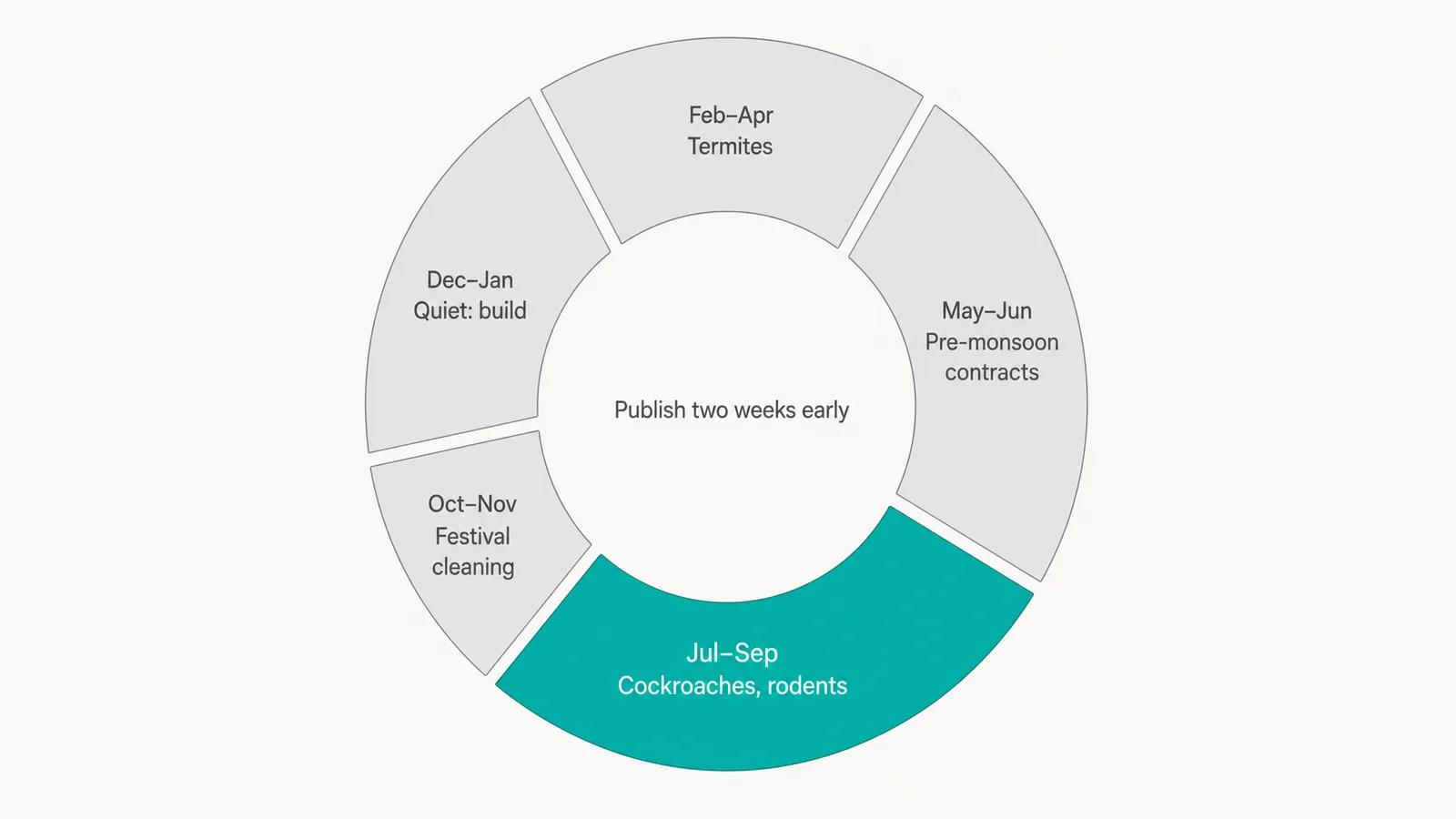
Termite season and pre-monsoon commercial planning
Termite activity becomes visible as it warms, and societies and commercial clients start scheduling pre-monsoon treatments. Publish termite identification and prevention content now.
The pre-monsoon window
The highest-value commercial weeks of the year. Buildings want treating before the rain rather than after the problem. Content and offers should be live before the first showers.
Peak residential demand
Cockroaches, mosquitoes and rodents driven indoors by water. This is the emergency-call peak — answer the phone, answer the safety questions and collect reviews while jobs are landing.
Festival cleaning uncovers everything
Households move furniture for the first time in a year and find what has been living behind it. A short, predictable spike that almost nobody publishes into.
Quiet months, so build
Write next year’s seasonal content, clear review replies, update service descriptions and photographs, and chase AMC renewals before the cycle starts again.
Getting out from under the pay-per-lead platforms
Nearly every Indian pest control operator has an arrangement with at least one lead platform — Justdial, Sulekha, an app-based home services marketplace, or a network that ranks listings and resells the calls. The arrangement usually starts as a supplement and gradually becomes the business, which is the problem.
The structural issue is not the price per lead, it is what you are buying. You are renting a customer for one transaction. The lead is typically sold to several operators at once, so you are quoting against three others within the hour and price is the only variable left. The customer belongs to the platform, the review often lands on the platform, and next year when the same household has a rodent problem they open the platform again rather than remembering your name. You paid to acquire a customer and did not get to keep them.
A Google profile inverts every one of those. The call comes to you alone rather than to a panel. The review lands somewhere you own and compounds. The customer has seen your name, and a share of them will search it directly next time. And the cost does not scale with volume — the twentieth call in a month costs you nothing extra, which is the opposite of how a lead platform behaves precisely when things are going well.
The honest version of this argument is that leaving abruptly is a mistake. Platform leads are cash flow, and cash flow pays technicians. The workable path is a shift: keep the platform running, invest the effort in the profile and the review base, and watch the mix. As the share of direct calls rises, reduce platform spend gradually rather than in one move, and expect the transition to take a couple of seasons rather than a quarter.
One thing to change immediately regardless: ask every platform-sourced customer for a Google review. The platform sold you the job, not the customer’s goodwill afterwards. Converting those jobs into reviews on a profile you own is how you turn rented demand into an asset, and it costs nothing but a habit at the end of the treatment.
A pay-per-lead platform
- The same lead is sold to several operators, so you compete on price within the hour
- Cost scales with volume — success makes the bill bigger
- The customer relationship and often the review belong to the platform
- Next year they open the app again, not your number
- Stop paying and the demand stops the same day
A profile you own
- The call comes to you alone, and price is not the only variable
- The twentieth call in a month costs nothing more than the first
- Reviews accumulate on an asset that belongs to you
- A share of customers search your name directly next time
- The position you build persists rather than switching off with the invoice
Somewhere to send the customer that is not a lead platform
Escaping pay-per-lead means having your own destination — service detail, licence particulars, safety answers and a number that reaches you. Web Sarathi builds it from your profile so there is no separate site to maintain.
- Service pages for termites, bedbugs, rodents and the rest, in your own words
- Licence details and safety practice stated where cautious customers look
- Kept in step with your profile, so hours and services never disagree
What a ranked profile is worth across a three-year contract
Pest control has an economic feature that makes visibility unusually valuable and that operators consistently undervalue when deciding what effort to spend: the lifetime value of a customer is far higher than the first job, and much of the trade is genuinely recurring.
One termite treatment is a single transaction with a warranty attached. But a household that had a good experience takes an annual general pest package. A housing society signs an annual maintenance contract and renews it for years with almost no re-selling. A restaurant needs monthly visits it cannot legally skip. A warehouse needs a documented programme for its own audits. The first job is an entry point into a relationship that is measured in years.
That changes the arithmetic on everything in this guide. If the average acquired customer is worth several times the first invoice over three years, then five additional calls a month from a better profile is not a small monthly revenue gain, it is a compounding book of recurring work. It also means the correct response to an expensive lead is not always to refuse it — it is to know your own numbers well enough to tell which leads are worth paying for and which are one-off jobs dressed as opportunities.
The commercial segment deserves deliberate attention for the same reason. It is a smaller share of enquiries, a much larger share of profit, and it buys differently: a facilities manager or society secretary reads your credentials, wants documented process, expects references, and cares that reports will arrive on time for their own audit. None of that is served by a listing optimised purely for a panicking householder, which is why credentials, service detail and proof deserve space even though they never influence an emergency call.
Report the results to those clients properly, too. An AMC renews on the strength of whether the client believes the work happened. A monthly or quarterly report that arrives without being chased does more for retention than any discount, and retention is where the margin in this business actually lives.
| Segment | First job | Typical relationship | Why visibility is worth more than it looks |
|---|---|---|---|
| Emergency household | One treatment | Often converts to an annual package | The panic call is the cheapest entry point into recurring work you will ever get |
| Housing society AMC | Tender or committee decision | Renews annually, often for years | Won on credentials and documented process, not on being first in the list |
| Restaurant or food business | Scheduled programme | Monthly, and non-optional for their compliance | Highly retentive, and they ask their peers who they use |
| Warehouse or industrial | Audited programme | Multi-year with documentation requirements | Reporting quality decides renewal more than price does |
Photographing a job nobody wants to look at
Every guide tells local businesses to add photographs. In this trade that advice needs adapting, because the subject matter is genuinely unpleasant and the instinct to post dramatic evidence backfires more often than it works.
A close-up of a bedbug infestation is compelling to you and repellent to a person eating dinner while scrolling. Worse, it aims at the wrong feeling. The customer is already disgusted — that is why they are searching. What they need is not more disgust, it is the belief that a competent, presentable person will arrive, deal with it discreetly, and not make them feel judged about the state of their kitchen.
So photograph the response rather than the problem. Uniformed technicians. Clean, maintained equipment. A van with your name on it. Protective gear worn properly. The team on a site with a housing society name visible where you have permission. Treatment in progress in a residential kitchen that looks ordinary and cared for. Documentation being handed over. All of that says careful and established, which is exactly the judgement the customer is trying to make in fifteen seconds.
Before-and-after imagery works where it can be shown tastefully — a cleared drain line, a treated wooden frame, a warehouse corner made orderly. Keep it about the outcome and the workmanship rather than the infestation itself, and never photograph inside a customer’s home without their explicit permission, which for residential work should be asked at the door and not assumed because the technician is already inside.
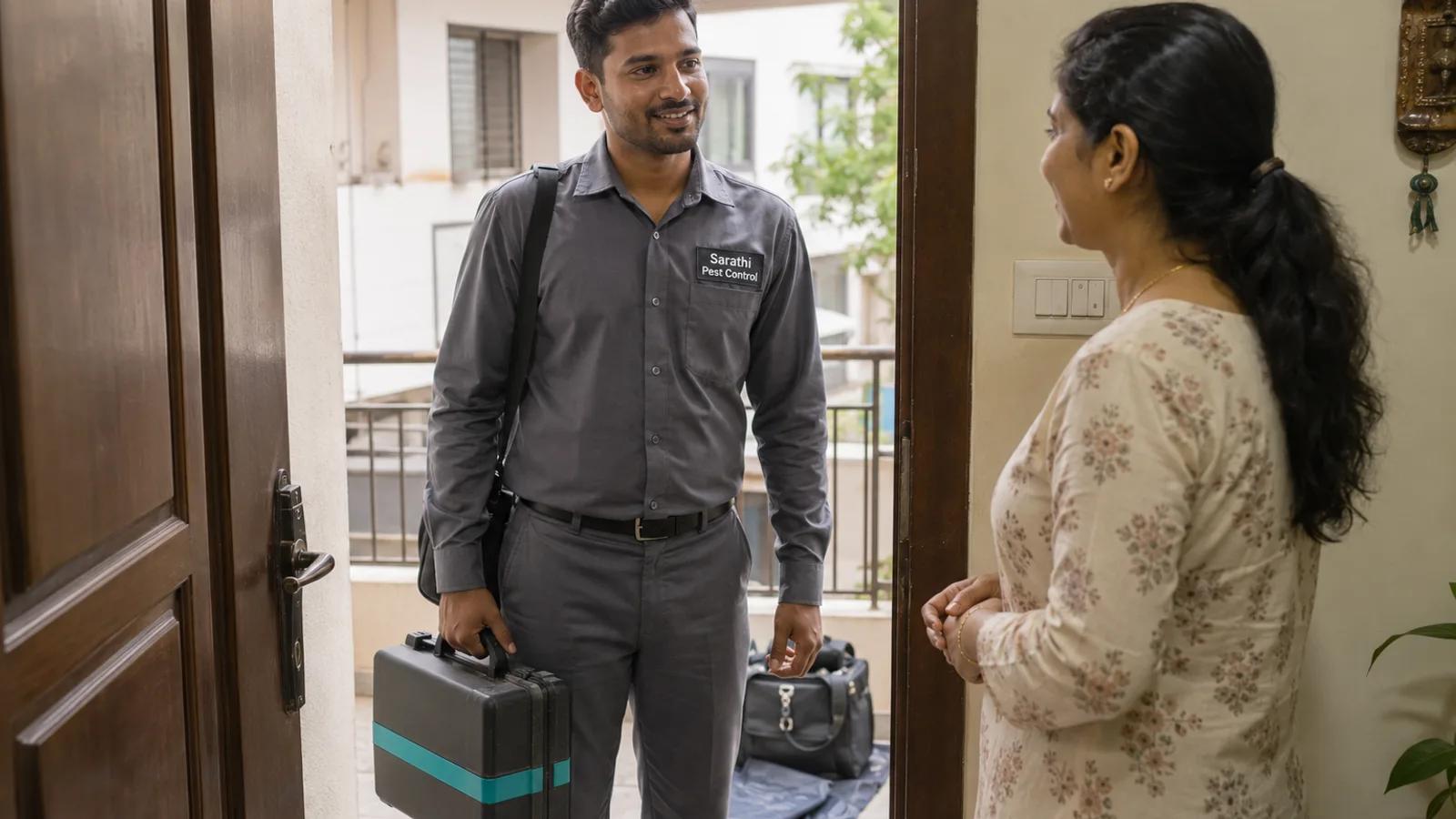
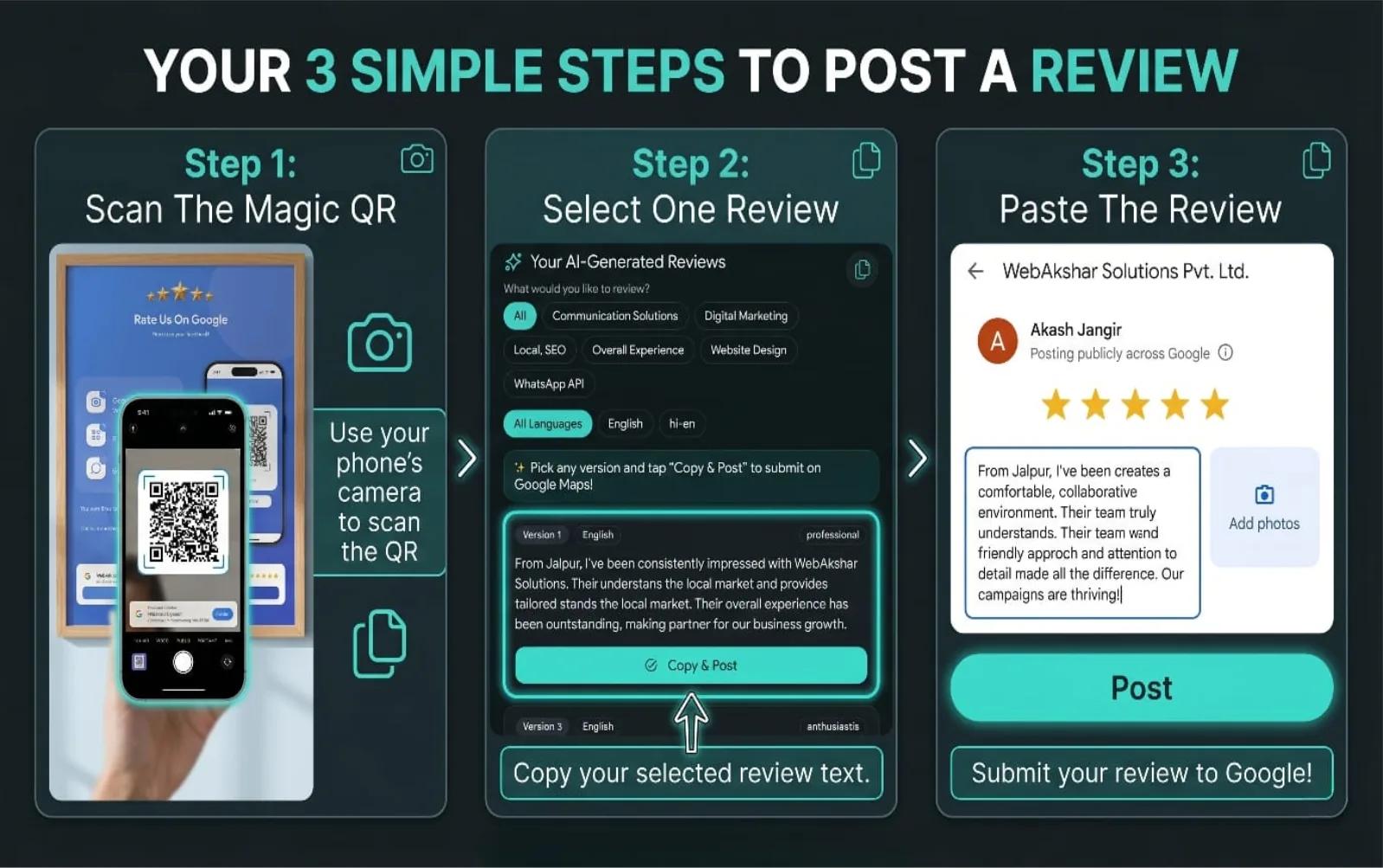
The same visit is the moment to ask for a review, and it is the moment almost every operator in India misses. The customer is standing there, the problem has just been dealt with, relief is at its highest point, and your technician is packing up. A QR code on the job card or the technician’s clipboard converts that far better than any message sent two days later, and doing it on every job is the difference between an operator with fourteen reviews after six years and one with two hundred.
Leading with infestation close-ups
They repel the scroller and add to a feeling the customer already has too much of. Show the competent response instead — uniforms, equipment, a marked van, work being done properly.
Photographing a home without asking
Residential customers are frequently embarrassed about the situation. Permission is asked at the door, in words, and a refusal is not a reason to be creative about angles.
A stock-photo gallery
Downloaded imagery of laboratory-coated technicians in a foreign kitchen reads as false to Indian customers and gives them nothing to verify. Photograph your own team and your own vans.
Never asking at the end of the job
Relief peaks the moment the treatment finishes and decays within hours. An operator who does not ask at that moment is discarding the most convertible review opportunity in the trade.
Ask while the technician is still packing up
The most convertible review moment in this trade lasts about five minutes and happens at the end of every job. A QR code on the job card turns it into a habit rather than something somebody remembers.
- Scan, pick a highlight, and the review is drafted in a few taps
- Works for platform-sourced jobs too, so rented demand builds an asset you own
- Every technician can do it without training or a follow-up message
Pest Control SEO questions, answered
The questions Indian pest control businesses ask us most often.