Coaching institute SEO in India: getting found inside the admission window
Coaching is the only trade in this series where the customer usually cannot buy outside a specific window. A gym can sell a membership in July even if July is quiet. A restaurant serves whoever walks in. A coaching institute admitting a student in September is admitting them into a batch that started in April, and everybody involved knows it is a compromise. Demand does not merely dip between cycles — for most courses it stops.
Two more things make this vertical structurally its own. The person doing the searching is frequently not the person attending, which means your listing is read by a parent evaluating safety, fees, discipline and outcomes while your product is experienced by a teenager who cares about the faculty and the batch timing. And since November 2024, what you may claim about your results has been governed by a specific set of consumer protection rules, with penalties already imposed on institutes that got it wrong.
This guide covers the admission calendar, the two searchers, the advertising rules, exam-led keywords, the demo class, result-day reviews, fee transparency, and what the online players did to your radius.

The admission window is a gate, not a season
Most local businesses have a season in the ordinary sense: demand is higher at some times than others, but a customer can always transact. Coaching does not work like that. Courses are structured as batches with a start date and a syllabus that runs to an exam, and once a batch is four weeks in, a new student joining is at a genuine disadvantage that both they and you understand. Outside the cycle, the honest answer to an enquiry is often come back in three months.
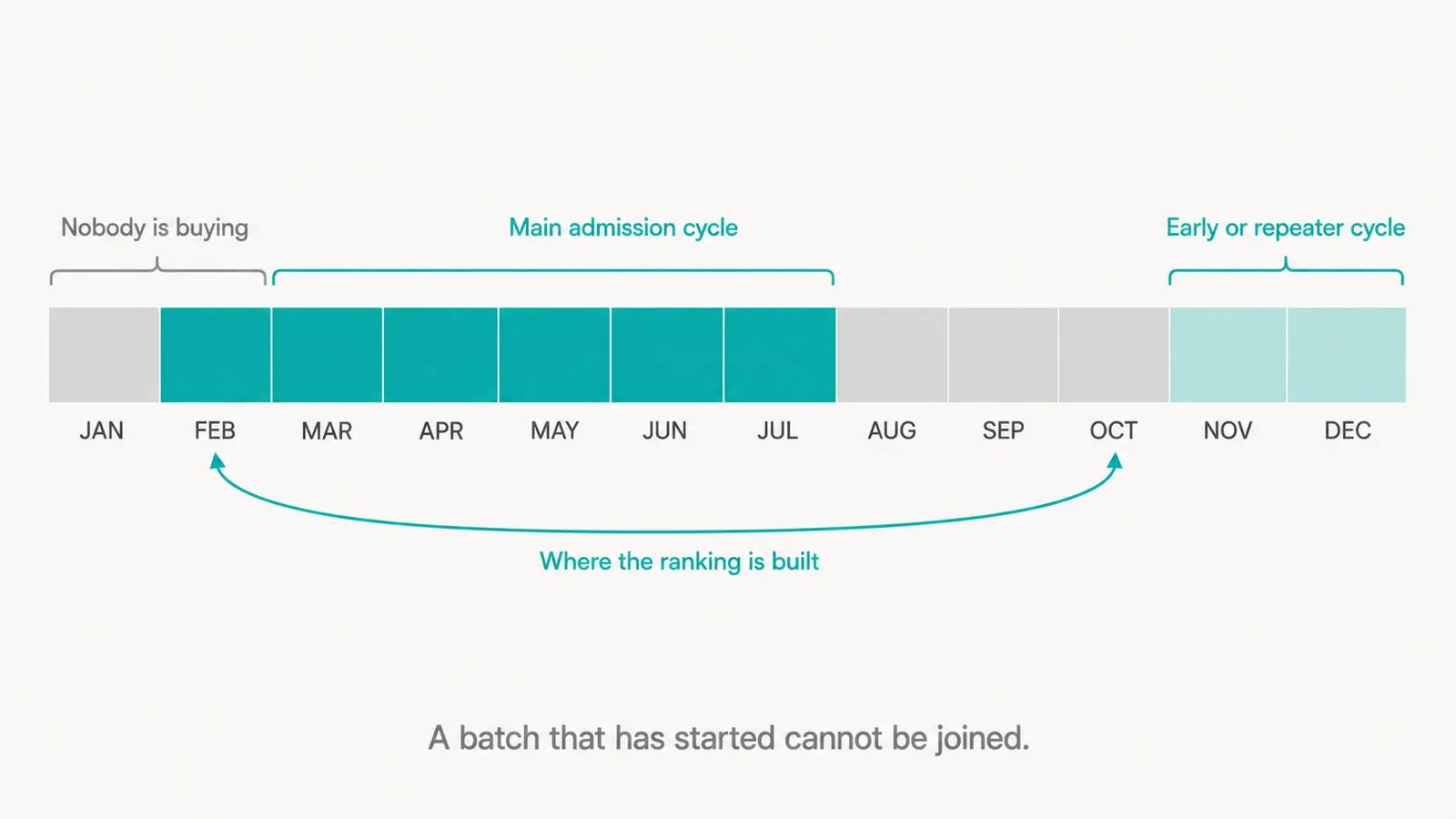
The main cycle in India runs roughly from February, when board and competitive exam results begin arriving and families start deciding, through to July when batches are running and seats are largely filled. There is a second, smaller cycle in November and December for early starters and repeaters. Between and after those, the enquiry volume is not merely lower, it is qualitatively different: mostly people who missed the window, want a crash course, or are shopping for next year.
The consequence for search work is the same as for any hard deadline: everything that takes time to move must be finished before the window opens, not during it. Reviews accumulate over months. A corrected profile does not reorder the local pack overnight. New pages take time to be crawled and to earn any position at all. If you begin in March because that is when the phone starts ringing, you are building visibility that arrives in June, for a cycle that closes in July.
The right way to hold it is that the ranking for the February cycle is built between September and January, in months when there is no admissions pressure and therefore no urgency to do it. That is uncomfortable but it is the whole discipline. The institutes that appear at the top of a local search in April are not the ones that started working in April.
The window also changes what your profile has to say at different times of year, which almost nobody manages. In peak season the listing needs batch start dates, remaining seats, the demo schedule and the fee structure, because those are the questions in front of a family deciding this week. Out of season it needs the material that persuades somebody researching early: results, faculty, what a batch is like, how the course is structured. A profile that says the same thing in December and in May is answering the December question badly for five months and the May question badly for seven.
One more consequence worth planning for. Because the cycle is short and everybody is competing inside it, paid advertising in this trade gets expensive at exactly the moment everybody needs it. Position in local search is the channel that does not reprice because your competitors decided to spend, which makes the unglamorous autumn work the cheapest admissions investment available to an institute.
Write the admission season in the months that have room for it
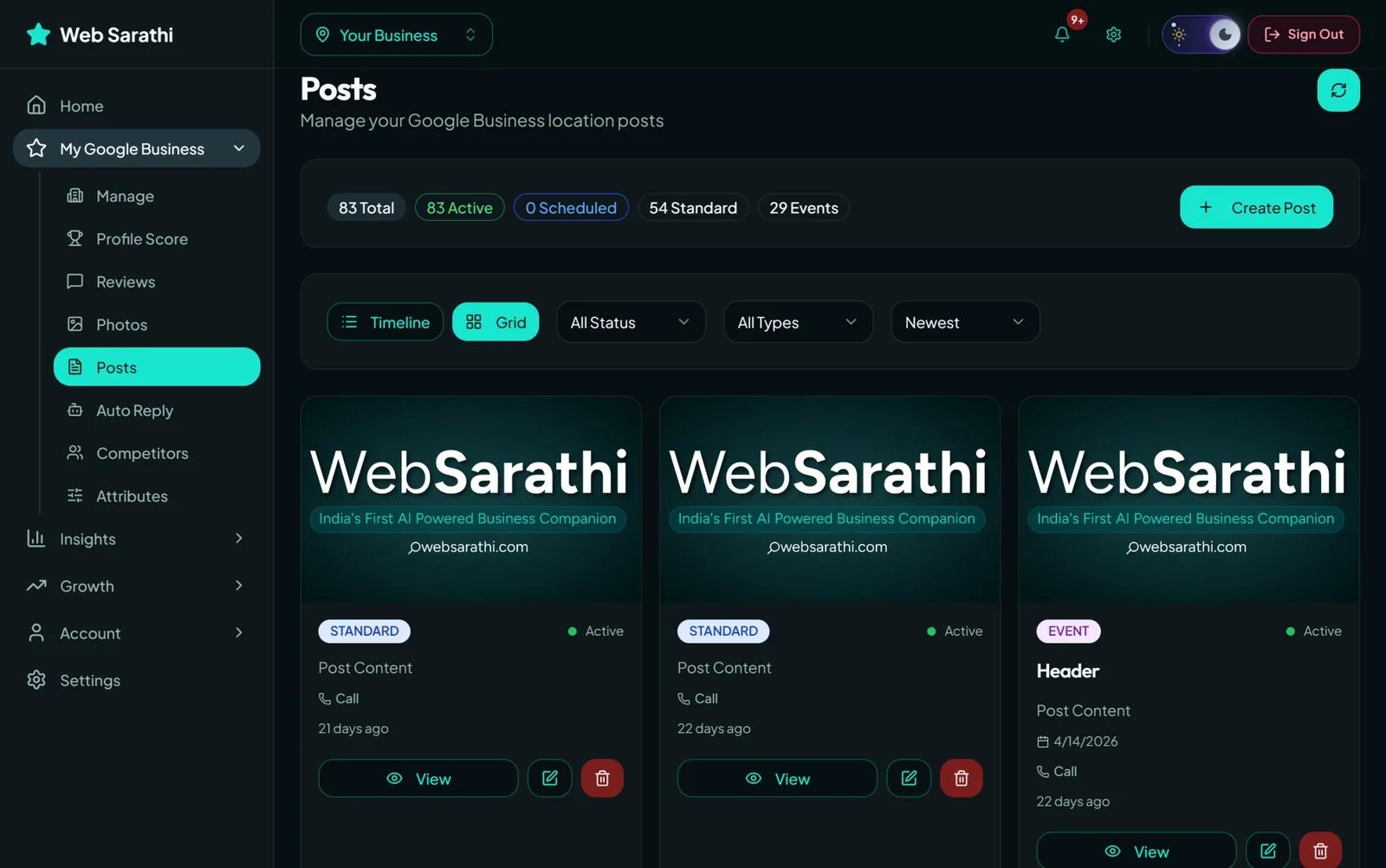
Batch dates, demo schedules, fee structures and result announcements all need publishing at exactly the moment there is no time to write them. Draft the cycle in the quiet months and schedule the run.
- Batch start dates and demo schedules live before families start deciding
- Different messages for peak season and for the researching months
- Keeps the profile active through the months nobody is buying
The person searching is usually not the person attending
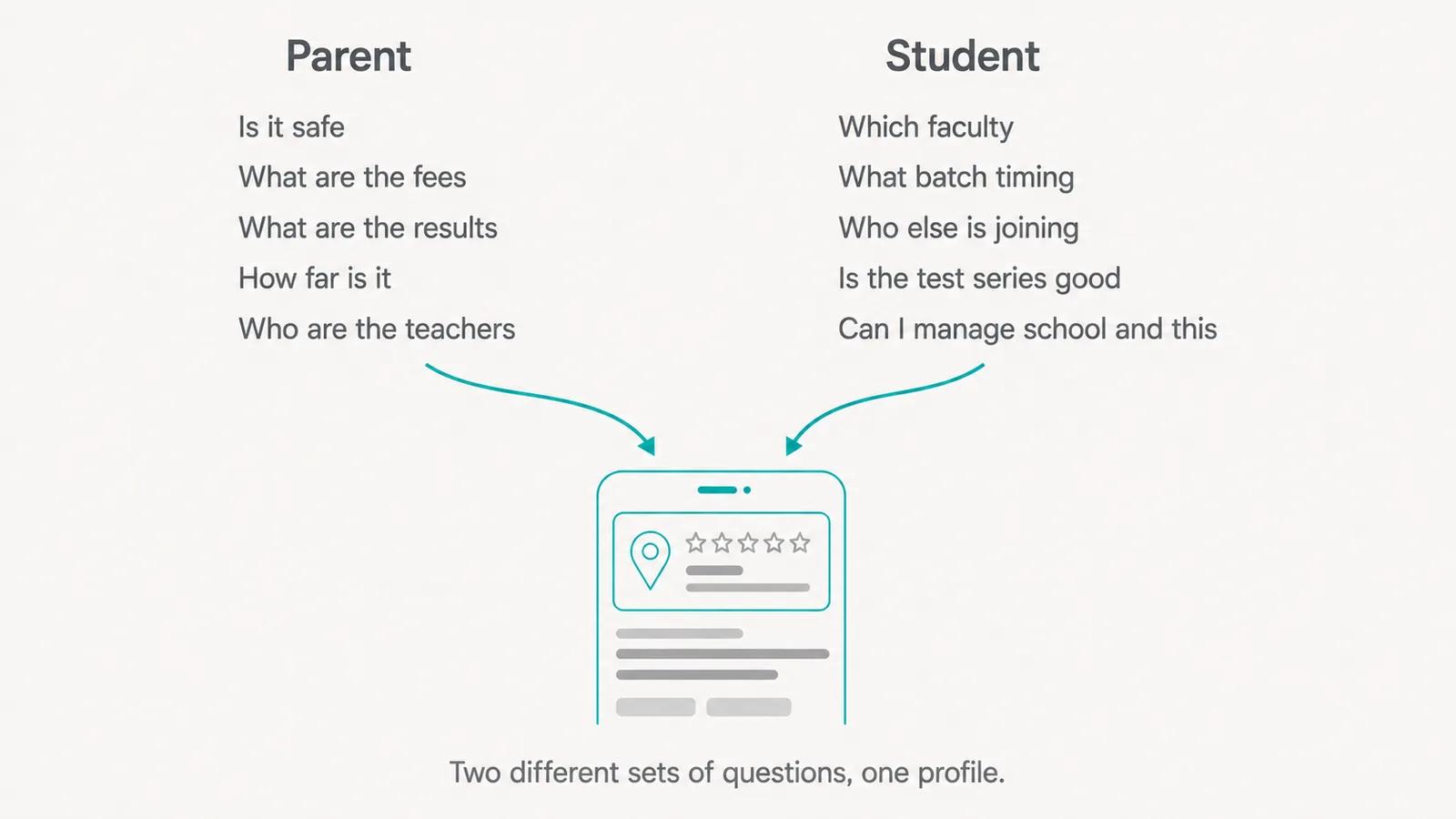
For school-level tuition and most competitive exam coaching, the search is run by a parent, the decision is negotiated between a parent and a student, and the money is paid by the parent. That split is not a detail; it means your listing is being read by two people with almost no overlap in what they want to know, and most institutes write for neither.
The parent is assessing risk and value. Is this place legitimate, how far is it and is the route safe, what do the fees actually total, are there hidden charges, what happened to students like mine, who are the teachers and what are their qualifications, is there any accountability if the child falls behind. These are the questions that decide whether a fee is paid, and they are answered by boring, concrete, verifiable information rather than by enthusiasm.
The student is assessing something else entirely: which teacher takes physics, what time the batch runs and whether it collides with school or another class, how large the batch is, whether the test series is any good, whether their friends are going, and whether the place will be miserable. Students do influence the decision heavily, and they research separately — usually on their phones, often through video and social rather than through your website.
A profile that serves both is not complicated, it is just deliberate. The description should carry the parent-facing facts plainly: which exams and boards, which classes, batch sizes, where you are, and how to reach you. The photographs should show the actual classrooms, the library or study area, the entrance and the approach from the road — a parent is genuinely trying to picture their child going there twice a week. The services list should name the courses in the words families use. And the posts, which is where the student-facing material can live, can carry faculty introductions, test schedules and the texture of what a batch is actually like.
The language question matters more here than in most verticals. A significant share of these searches, and a great many of your reviews, will be in Hindi or a regional language, especially from parents. Replying to a Hindi review in stiff English is a small signal that you did not quite read it, and it wastes the natural opportunity to have your neighbourhood’s actual vocabulary appear on your own listing. Reply in the language the person wrote in.
Finally, do not let the two audiences collapse into a single boast. The most common failure in coaching marketing is a profile that speaks only about toppers and ranks — which addresses a parent’s outcome question, ignores everything else they asked, and tells the student nothing about the thing they will actually experience four evenings a week for a year.
What the 2024 advertising rules changed about your results board
On 13 November 2024 the Central Consumer Protection Authority notified guidelines for the prevention of misleading advertisement in the coaching sector. They apply to all forms of advertisement by anybody who provides coaching or runs a coaching centre, and they extend to endorsers — the person who lends their name to a claim carries liability for it too. This is not industry guidance. It is a consumer protection instrument with penalties behind it, and penalties have already been imposed on institutes found to have advertised misleadingly.
The substance is straightforward and it is aimed squarely at the results board. False or unsubstantiated claims about courses offered and their duration, about faculty and their qualifications, about fees and refund policy, about selections, ranks and job security, and about admissions are all covered. So is manufacturing a false sense of urgency or scarcity — the last four seats banner that has been a fixture of this trade for two decades.
The disclosure requirement is the part that changes day-to-day practice most. Where you publish a successful candidate, you must prominently disclose, alongside their photograph, the rank secured, the name and duration of the course they took, and whether that course was paid for. That last element is the one that bites, because the long-standing practice of putting a free-scholarship topper on a hoarding without saying the course was free is exactly the gap the rule was written to close. And consent from the candidate to use their photograph or testimonial has to be obtained after the result is declared, not extracted at admission in a form nobody read.
Apply this everywhere the claim appears, not only to hoardings. Your Google Business Profile description, your posts, your photographs of a results board, your website banner, your WhatsApp broadcast and your Instagram posts are all advertisements for this purpose. An institute that has cleaned up its printed material and left a 100% selection line in its profile description has not complied with anything.
The practical rewrite is less painful than it sounds and it tends to improve the marketing. Replace unverifiable superlatives with specific, checkable statements: how many students from a named batch qualified, out of how many who appeared, in which year. That is both compliant and considerably more persuasive to the sceptical parent from the previous section, who has read a hundred hoardings claiming the best results in the city and discounted every one of them.
There is a defensive argument as well. Complaints in this sector frequently come from competitors rather than from consumers, and a rival institute reporting your banner is not an unusual event. Being able to substantiate every published claim, with the disclosures attached, is the cheapest form of protection available, and it costs a few hours of going through your own material with the guidelines open.
A topper photograph without the required disclosures
Where a successful candidate is shown, the rank, the course name and duration, and whether the course was paid for must be prominently disclosed alongside. This applies to your profile photographs and posts, not only to printed hoardings.
Consent taken at admission rather than after the result
The guidelines require the candidate’s consent for use of their photograph or testimonial to be obtained after the result is declared. A clause buried in an admission form signed two years earlier does not do the job.
Only four seats left, every year
Creating a false sense of urgency or scarcity is specifically covered. If the batch genuinely has four seats, say so and be able to show it. If it is a technique, remove it.
Claims about faculty qualifications you cannot substantiate
Faculty and their qualifications are named in the guidelines alongside courses, duration, fees and refund policy. Ex-IIT and ex-AIIMS descriptions that stretch what somebody actually did are exactly the kind of claim that is straightforward to disprove.
Cleaning the hoardings and forgetting the profile
Your Google Business Profile description, posts and images are advertisements for this purpose, as are your website banner and WhatsApp broadcasts. Compliance that stops at printed material is not compliance.
Nobody searches for a coaching institute, they search for an exam
The vocabulary in this trade is organised around exams and subjects, not around the service. Almost nobody types coaching institute near me. They type the name of the thing they are preparing for, plus a place: NEET coaching in a locality, JEE classes near me, CA foundation classes, class 11 physics tuition, SSC coaching, banking exam coaching, spoken English classes, NDA coaching. The exam is the noun; you are the modifier.
Google’s category system does not reflect that at all. The available labels are broad — coaching centre, tutoring service, educational institution, training centre — and none of them distinguishes an institute preparing students for a medical entrance from one running spoken English classes. So the category gets you into the right general pool, and everything that actually differentiates you has to be carried by the other fields.
The services list is where most of that work happens and it is nearly always neglected. Every course you run should be an entry, named the way a family would say it: NEET preparation, JEE Main and Advanced, class 11 and 12 physics, CBSE class 10 mathematics, CA foundation, CLAT, MHT-CET, spoken English, computer basics. Each of those is searched by name, and each one you leave out is a search you have no way of appearing for. Where you can, attach the duration and the fee, since both are questions the searcher has anyway.
The description is the second surface, and the discipline is to be specific rather than impressive. Which exams, which boards, which classes, which languages of instruction, since medium of instruction is a real filter for a large number of Indian families and is almost never stated. Two plain sentences naming the exams you prepare for will do more than a paragraph about nurturing potential.
Beyond the profile, this is a vertical with unusually good material for content, because exam-related informational demand is enormous and genuinely useful to answer. Syllabus changes, exam date announcements, cut-off trends, what to do between the board exam and the entrance, how to choose between two exams. Those searches are not admissions enquiries and should not be treated as though they were — but they build the standing of an institute that a family later finds in a local search, and they are searched by exactly the students who will be your applicants next year.
A caution on locality pages. Institutes with two or three branches often generate near-identical pages for each area with only the place name changed, which is thin duplicate content and does not work. If a branch deserves a page it needs genuinely branch-specific substance: which courses run there, which faculty teach there, the batch timings, the actual address, the local landmarks and how to reach it. If you cannot write that honestly, the branch does not need a page — it needs a properly configured profile.
| What they search | What they are really asking | Where it has to be stated |
|---|---|---|
| NEET coaching in <locality> | Is there a serious medical-entrance institute near enough to attend daily | Services list entry by exam name, plus the locality in the address and description |
| Class 11 physics tuition near me | A specific subject and year, not a full competitive programme | Subject-and-class entries listed individually, not grouped as tuition |
| Best coaching for <exam> | Comparison shopping, driven by results and reviews rather than proximity | Substantiated outcome statements and specific reviews, not superlatives |
| <Exam> coaching fees | Affordability, usually before any contact is made | Fee ranges on the site and in the services list, since silence sends them elsewhere |
| Coaching classes near me in Hindi medium | Medium of instruction, a real filter that is almost never published | The description, plainly, and the languages your teaching actually uses |
| Demo class <exam> | They are close to deciding and want to try before paying | A named demo service with a schedule and a way to book without a phone call |
Find out which localities actually see your institute
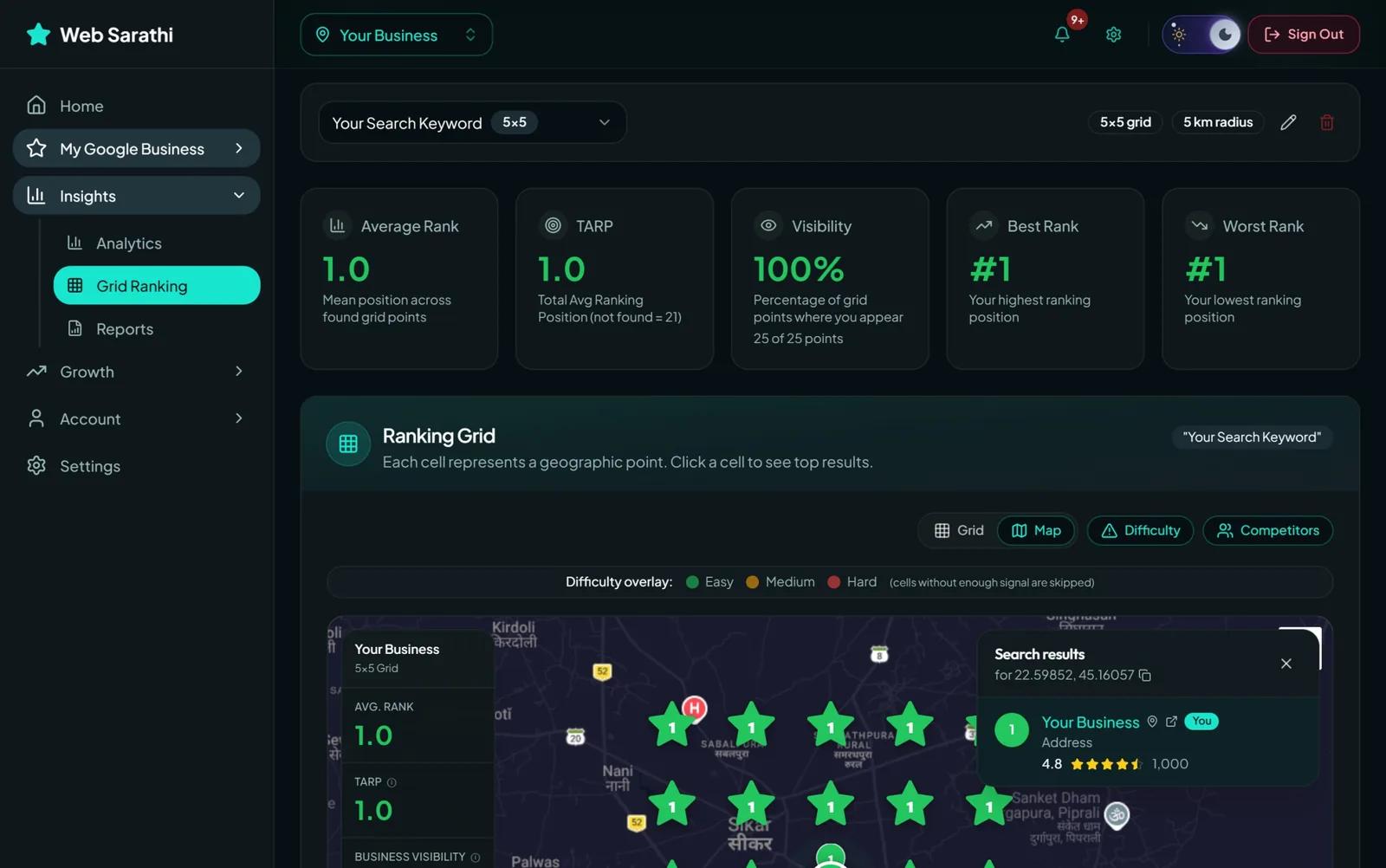
Searching from your own office always returns you at the top. Grid ranking measures your position across the residential pockets families actually search from, exam keyword by exam keyword.
- Track NEET, JEE or board keywords separately, since they rank differently
- See which societies and school catchments you are invisible in
- Judge a second branch on coverage evidence rather than instinct
The demo class is the decision, and the listing has to get them into it
Almost nobody pays a coaching fee off a listing. The decision is made after a demo class or a counselling session, when the parent has seen the building and the student has sat through a teacher. That means the profile has one commercial job, exactly as a gym profile does, and it is not to sell a course. It is to produce an attendance at a demo.
Institutes make this harder than it needs to be. The demo is rarely named as a service, the schedule is rarely published, and the terms are rarely stated. A family that wants to try a class before committing to a year and a substantial fee has to phone and ask, which is a slightly awkward call to make to a place that might say no.
So name it, and be specific. Which subject and faculty the demo covers, when it runs, how long it lasts, whether the parent may sit in, whether a counselling session is included, and whether anything is charged. Where the demo is genuinely free, say the word — it removes the suspicion that free means a sales pitch, which is the assumption most families arrive with.
Then give a route that is not a phone call. During admission season your office line is engaged, and an enquiry that cannot get through at seven in the evening does not call back, it calls the next institute. An appointment link or a WhatsApp route captures the family at the moment they decided, leaves a written record of what was asked, and does not require anybody to be free at that instant. In this market WhatsApp is not a fallback, it is where these conversations naturally happen.
What happens at the demo then decides everything, and one part of it belongs in this guide: it is your best and least-used moment to ask for a review. The instinct is to ask at the end of the year, after the result, which is far too late and heavily filtered by whether the student got in. A parent who has just watched a good class, been shown the building and had their questions answered properly is at the most positive point in the relationship, whether or not they enrol. Even a review from a family that chose elsewhere is honest, useful and legitimate — they genuinely attended and formed a view.
Track the demo funnel, because it is measurable and almost nobody measures it. How many enquiries arrived, how many were answered within the hour, how many attended a demo, how many enrolled. In a business where the entire year is decided in a few months, knowing which of those steps is leaking is worth more than any amount of additional traffic.
Name the demo as a service, with terms
Subject, faculty, day and time, duration, whether a parent may sit in, whether anything is charged. Vagueness is read as a sales trap, and a suspected trap is not worth a phone call.
Publish the schedule, and keep it current
A demo timetable in your posts and services turns an enquiry into an attendance without a conversation. A schedule from last season does the opposite.
Offer a route that is not the office line
In season your phone is engaged, and the family that cannot get through at seven in the evening calls somebody else. An appointment link or WhatsApp captures the decision at the moment it happens.
Reply the same evening
Families shortlist three institutes in one sitting. The first sensible reply is talking to somebody who has not yet formed a preference.
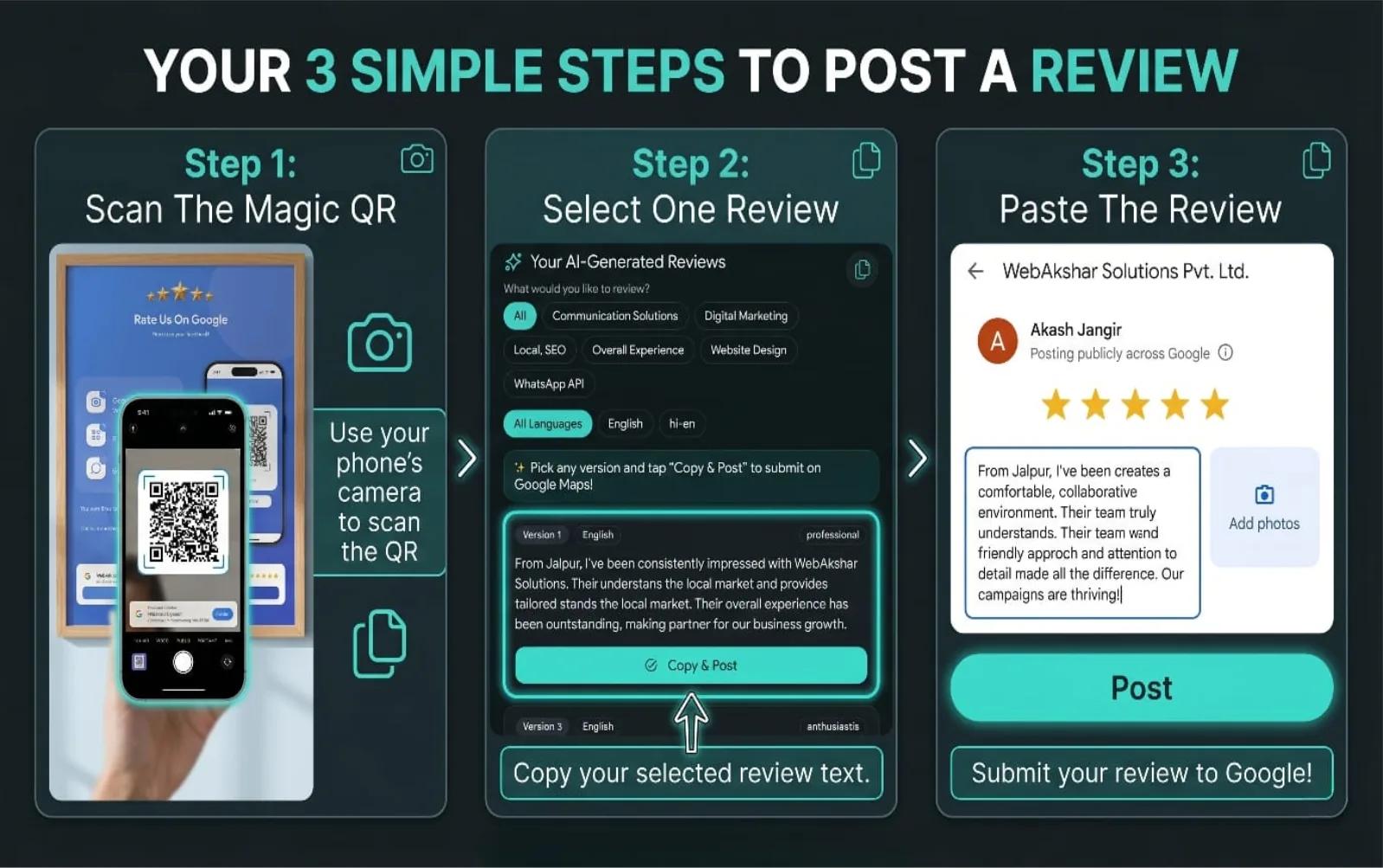
Ask for the review after the demo, not after the result
This is the most positive moment in the relationship, and it happens whether or not they enrol. A review from a family that chose elsewhere is still honest and still yours to have asked for.
Ask after the demo, not after the result
A parent who has just watched a good class and had their questions answered is at the most positive point in the relationship — and it happens whether or not they enrol.
- Scan at reception, pick a highlight, and the review is drafted in a few taps
- Spreads reviews across the year instead of clustering them on result day
- Works for families who chose elsewhere, whose view is honest and still useful
Reviews arrive on result day, from both directions at once
Review behaviour in this trade is unlike anything else in this series, because it is triggered by a single public event that happens to everybody simultaneously. When a board or entrance result is announced, a large number of your students and their families find out within hours whether a year of expensive effort worked. Both kinds of review are written that week.
The families whose child did well are genuinely grateful and will say so warmly, but they are also busy, distracted and celebrating, and the impulse passes quickly. The families whose child did not are, understandably, looking for an explanation, and an institute that took a substantial fee is an available one. Neither group is behaving unreasonably. But the second group writes faster and at greater length, which is why so many coaching profiles carry a cluster of one-star reviews dated within a few days of a result.
The first thing to do about it is to stop being surprised by it. The result date is public and known months in advance, which makes this the most predictable reputational event any business in this series faces. Plan for the week: know when the announcement is, have somebody responsible for watching the profile, and have the successful families lined up to be asked at the moment they are happiest rather than a fortnight later when it has worn off.
The second is to reply to the difficult ones with more care than any other review you will write, because they are read by next year’s parents. Do not dispute the outcome, do not cite the student’s attendance or marks, and above all do not identify the student or discuss their performance — you are being read by a parent imagining their own child in that thread. Acknowledge the disappointment, describe what support exists rather than defending the past, and offer a route to talk. A defensive reply to a grieving family is the single most damaging thing on a coaching profile.
The third is to accept that some of what appears will not be from students at all. This sector has a genuine problem with reviews left by rivals, and with agencies selling positive reviews, and both are visible to anyone who looks. Report what is clearly fake through the proper route, do not respond to it publicly at length, and never buy any yourself — purchased reviews are removable, are increasingly detectable, and in a trade already under advertising scrutiny they are a bad risk on top of an ineffective one.
The structural defence against all of it is volume and recency spread across the year rather than concentrated at results. An institute with a steady flow of reviews from demo attendees, current parents at term ends, and students at course completion absorbs a bad result week as a wobble. An institute whose entire review history is three result-day clusters has a rating that is really a record of three exam outcomes.
Discussing a student’s marks or attendance in a public reply
Next year’s parents are reading it and imagining their own child in that thread. Acknowledge the disappointment, say what support exists, and move the specifics to a private conversation.
Letting the whole review history sit on three result days
A rating built only from result weeks is a record of three exam outcomes, not of your teaching. Spread the asking across demos, term ends and course completions so a bad week is a wobble rather than the whole picture.
Buying reviews to bury a bad cluster
They are removable, increasingly detectable, and a poor risk for a sector already under advertising scrutiny. The visible pattern of ten glowing reviews in one week also persuades nobody who is paying attention.
Asking only the students who did well
It produces a thin, obviously curated profile and misses the largest honest source you have — families who attended a demo and formed a genuine view, including those who enrolled elsewhere.
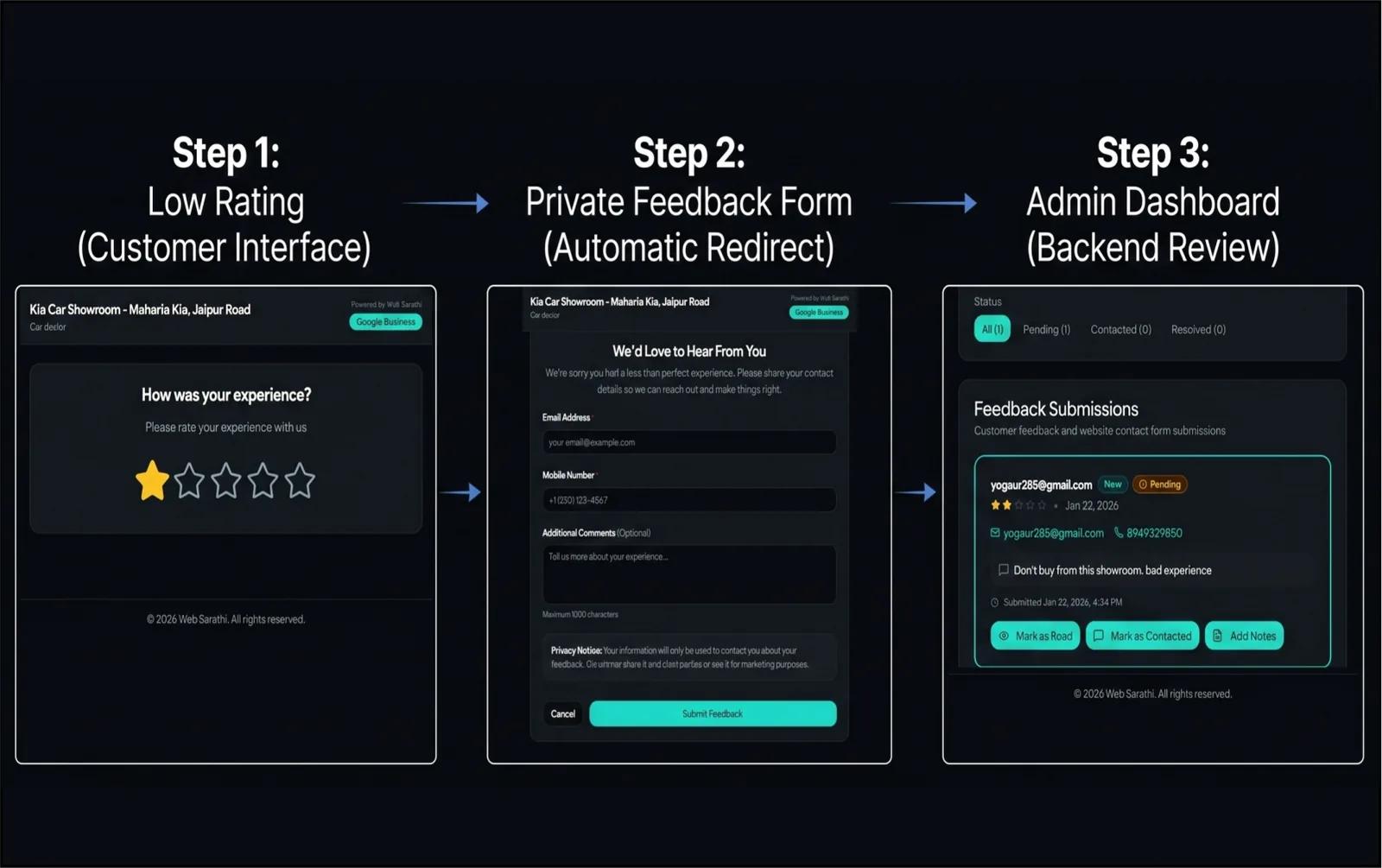
Result week is predictable. Be ready for it.
The most damaging reviews a coaching institute receives all arrive in the same few days, from families who have just had bad news. Review Shield routes unhappy feedback to you first, so the conversation can happen privately.
- Unhappy feedback reaches you instead of going straight to public
- Replies drafted carefully, without discussing any student’s performance
- Answers in the language the family wrote in, 34+ supported
Publishing fees in a trade that treats fees as a negotiation
Coaching fees are traditionally quoted in person, adjusted per family, and discounted against scholarship tests, sibling enrolments, early payment and negotiation. Publishing a number feels like giving away the only leverage in the conversation, and most institutes therefore publish nothing at all.
The cost of that silence has grown, for two separate reasons. The first is competitive: a family comparing four institutes will get numbers from the online players immediately, because those publish openly, and the local institute that will not say becomes the one that seems expensive. The second is regulatory: fees and refund policy are among the things the 2024 guidelines specifically cover, which means whatever you do say about them now has to be accurate and substantiable.
The workable position is a published range with the structure explained rather than a single figure. Say what the annual fee band is for each course, what it includes — number of hours, test series, study material, doubt sessions — and what is charged separately. Say how instalments work. Say what the refund position is if a student withdraws in the first month, and be honest if it is nothing. Families are not expecting coaching to be cheap; they are trying to establish whether it is within reach and whether they are about to be surprised.
This is also where scholarship and discount practice needs care, because it intersects directly with the advertising rules. A scholarship test that is really a discount mechanism is fine as a commercial practice, but the moment a scholarship student appears on your results board, the rule about disclosing whether the course was paid for applies. Keep the two straight: what you charge, what you waived, and what you say publicly about who succeeded.
The related field almost no institute fills is what happens if things go wrong. What is the policy if a student needs to switch batches, if a faculty member leaves mid-course, if the student falls ill for a month, if the family relocates. A parent handing over a year of fees for a service delivered over ten months is asking exactly these questions internally and asking none of them out loud. An institute that answers them unprompted differentiates itself from every competitor on the street, at zero cost.
Fee transparency also has a quiet effect on the review problem from the previous section. A meaningful share of angry coaching reviews are about money — a discount that was verbal and then not honoured, a refund refused, material charged for separately after the fee was described as all-inclusive. Publishing the structure and applying it consistently removes most of that category before it is written.
| The question | What happens if you do not answer it | What to publish |
|---|---|---|
| What does the year cost | They assume the worst and compare you against an online player who published a number | An annual band per course, stated plainly |
| What is included | Every separate charge later reads as a hidden one | Hours, test series, study material, doubt sessions — and what is extra |
| Can we pay in instalments | Families who could afford you in three parts rule you out in one | The instalment structure and any charge attached to it |
| What if we withdraw | The refund conversation happens for the first time during an argument | The refund position, honestly, even where the answer is nothing |
| What if the teacher leaves | The parent worries about it silently and chooses somebody who addressed it | A stated policy on faculty changes and batch switches |
Online coaching removed your radius, and local is how you take it back
For most of the history of this trade, geography was the moat. A family in a tier-two city chose among the institutes they could reach, and the famous coaching centres in the big preparation hubs were relevant only to people willing to relocate. Large online platforms dismantled that. A student anywhere can now buy a course from a national brand with production values, recognisable faculty and a price a local institute cannot match.
The honest response is not to pretend it did not happen, and not to try to become a video platform. It is to recognise that the online players competed away one specific thing — access to content and to well-known teachers — and that they did not compete away the things families were actually paying a local institute for. Supervision, attendance, discipline, a room without a phone in it, a teacher who notices when a particular student has gone quiet for a fortnight, other students working in the same room, and somebody a parent can walk in and speak to.
Those are the strongest possible arguments for a physical institute and they are almost never made explicitly. Coaching websites and profiles in this country compete on results and faculty pedigree — the exact ground the national players own — and stay silent about the presence, accountability and structure that is the reason a family chose local in the first place. Say it plainly. Batch size. Attendance reporting to parents. Doubt sessions with a person. Parent-teacher meetings. Somebody who calls when a student misses three classes.
The hybrid position is worth thinking about carefully rather than adopting because everybody else did. Recorded backup for missed classes, an online doubt channel and digital test series genuinely improve a local offering. Moving the core teaching online mostly converts your differentiated product into an undifferentiated one, competing on price and production quality against companies with far more of both. Use online to support the room, not to replace it.
For search specifically, this makes local intent your defensible ground. A national platform can outrank you for a broad exam query and it is not worth trying to prevent. It cannot own coaching near me in your locality, or the parent who wants to see the building, or the family that has decided their child needs somewhere to go rather than another screen. Those searches are yours to lose, and they are lost mainly through neglected profiles rather than through competition.
It also changes what a review is worth. Reviews of an online course are about content and platform. Reviews of your institute are about a place, a person and a room — the aspects a family choosing local is trying to evaluate and cannot evaluate from a website. A steady flow of reviews mentioning the teacher, the batch and how the child was actually handled is the most direct evidence available for the thing you are selling and the online alternative is not.
What the online platforms won
- Access to well-known faculty from anywhere
- Production quality and recorded lectures on demand
- A price a local institute cannot match
- Broad, national exam keywords
What they did not, and you should say out loud
- A room, a fixed time, and no phone in it
- Somebody who notices when one student goes quiet
- Attendance a parent actually hears about
- A person to walk in and speak to, and a local search you can own
Coaching Institute SEO questions, answered
The questions Indian coaching institute businesses ask us most often.