Travel agency SEO in India: ranking for the walk-in and the package at the same time
A tours and travel business in India is really two businesses wearing one signboard. One of them sells things that happen in your own city — visa filing, passport assistance, forex, ticketing, a taxi to the airport — and is searched for exactly the way a chemist is searched for, by somebody nearby who wants it today. The other sells a week in Ladakh to somebody who has never been to your street and never will.
Almost every ranking problem travel agents describe comes from trying to serve both of those with one undifferentiated profile and one page of website copy. The searches behave differently, the buying windows are months apart, the competition is completely different, and the thing that convinces the buyer is not the same thing in each case.
This guide separates the two, then works through what actually moves each: accreditation signals that do genuine trust work in a trade full of people who have been cheated, the booking window that decides when your content has to exist, the reviews you have to collect from a customer who is a thousand kilometres away when the trip ends, and how to compete with MakeMyTrip by declining to compete with MakeMyTrip.
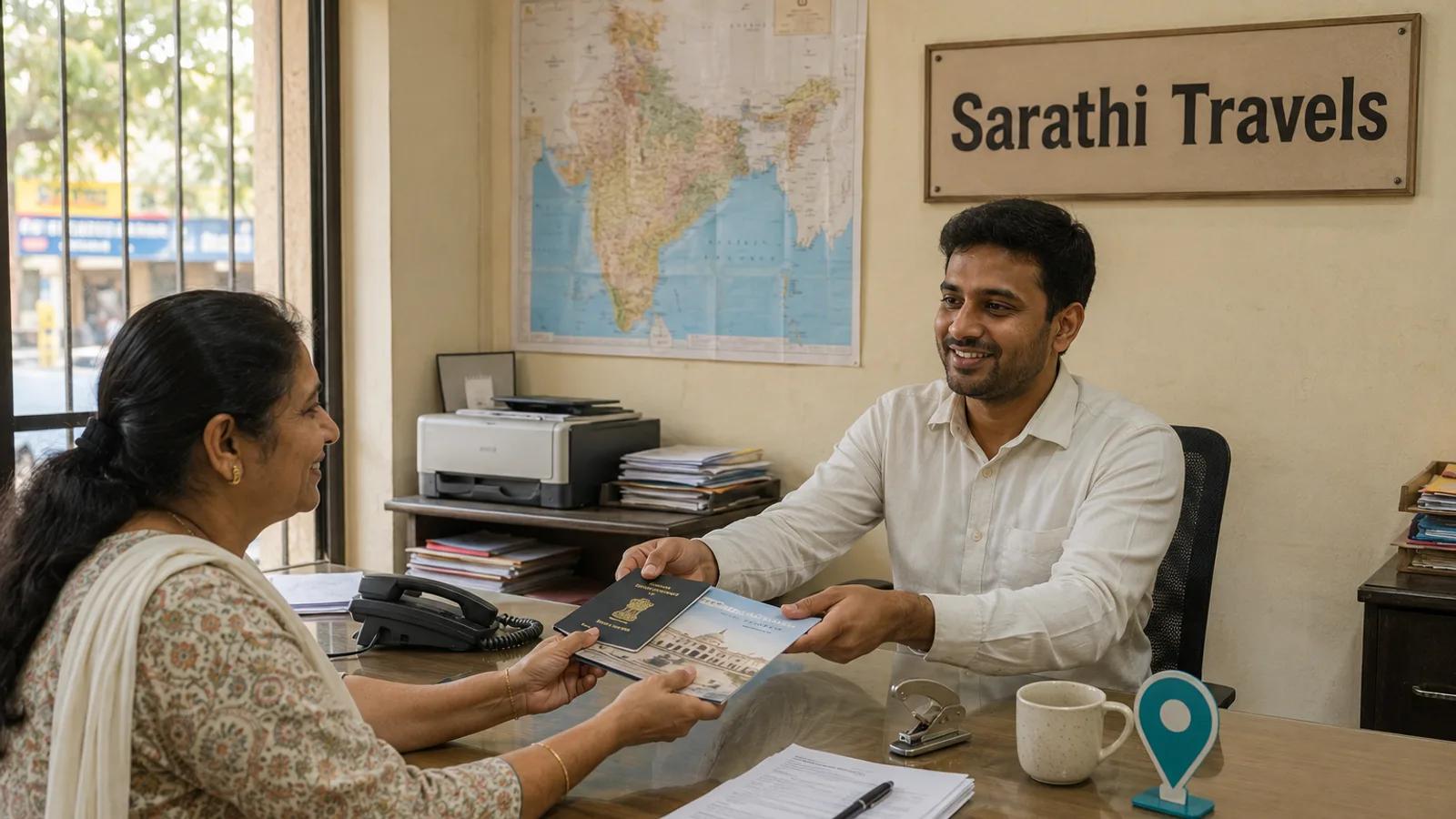
Two businesses, one signboard: the walk-in desk and the package
Start by separating them on paper, because everything downstream depends on it. The first business is local and transactional. Somebody in your city needs a Schengen appointment, a passport reissue, forex before Thursday, a Tatkal ticket, a car to the airport at four in the morning. They search "travel agent near me" or "visa agent in Kothrud", they want somebody close, open and reachable, and they will decide in about ten minutes.
The second business is national and considered. A family in Surat is planning ten days in Kerala for December. They are not searching for a travel agent near them at all — they are searching for the trip. They will read for two weeks, collect three quotations, ask about hotels they have never heard of, and pay a deposit to somebody they have never met. Proximity does almost nothing here. Credibility does everything.
These two funnels want opposite things from your Google Business Profile. The walk-in funnel is won on the ordinary local mechanics: correct category, complete services, real hours, phone that gets answered, reviews from local customers, and a pin that puts you inside the neighbourhood people search. It is unglamorous and it is where the reliable, repeating revenue in most Indian agencies actually comes from.
The package funnel is won on evidence. Photographs of trips you actually ran. Itineraries with real detail. Reviews that name destinations rather than saying good service. Accreditation that a nervous buyer can verify. And, critically, content that exists on a website rather than only inside a profile, because this buyer is reading, comparing and searching for the destination rather than for you.
The mistake almost every agency makes is to let the glamorous half swallow the profile. The listing fills with Bali and Baku, the description talks about dream holidays, and the visa and ticketing services — which are what a person two streets away is actually searching for — appear nowhere. Then the agency concludes that Google does not send them business, when in fact Google was never told what half the business is.
There is a cash-flow argument for the split as well, and it is the one that usually persuades owners. Package revenue is lumpy, seasonal and slow to collect, with deposits taken months before the balance and margins that vary with every supplier negotiation. Visa, passport, forex and ticketing revenue is small, immediate, repeatable and almost entirely local. Agencies that survive lean years generally do so on the second kind, and agencies that neglect their profile for the second kind are neglecting the part of the business that pays salaries in a bad season. Treating them as one undifferentiated thing on your listing is not just an SEO error, it is a business-model error made visible in public.
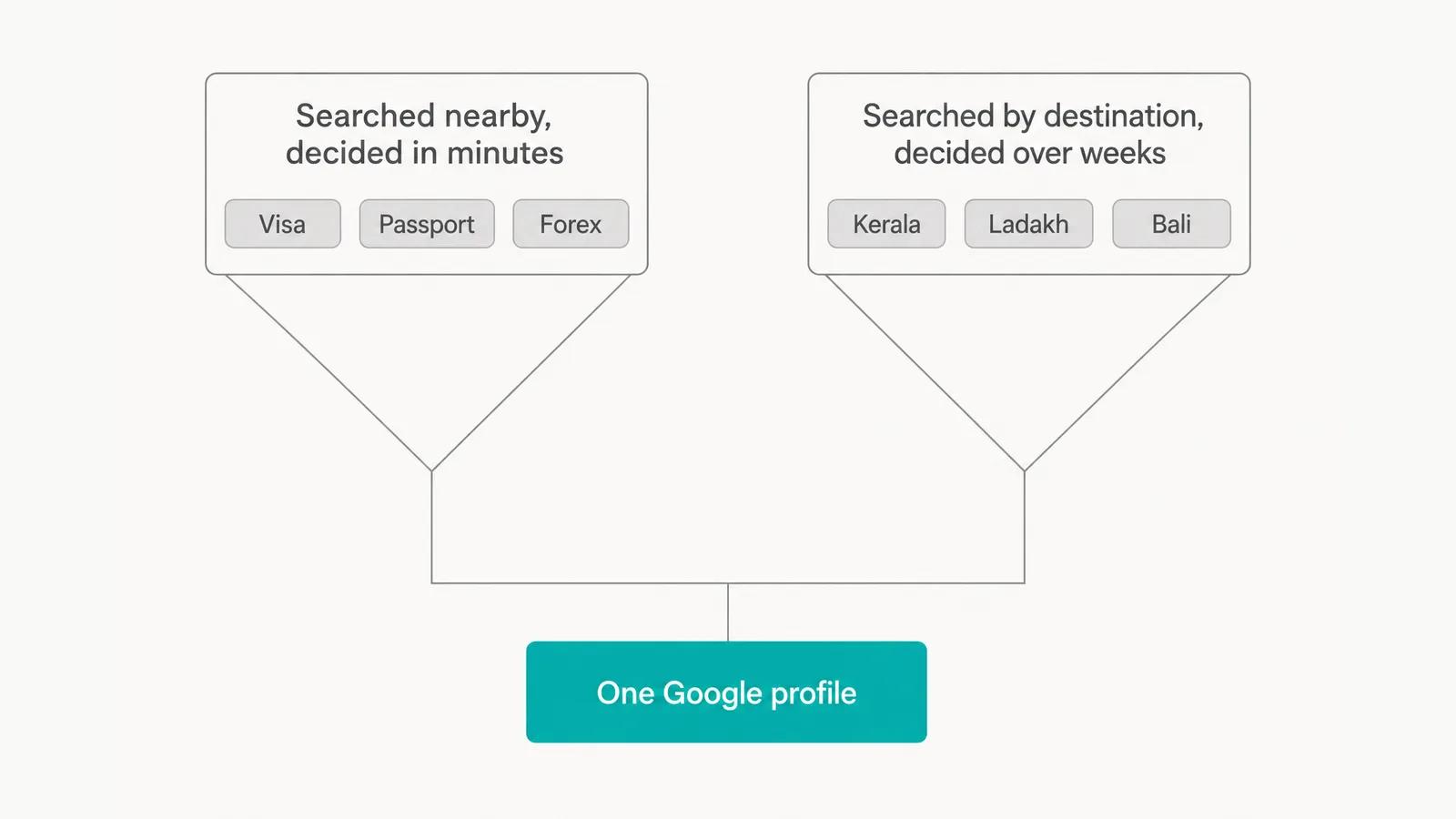
The walk-in desk
- Searched locally: visa agent, passport agent, forex, air ticket booking
- Decided in minutes, usually on a phone, usually nearby
- Won on proximity, hours, completeness and a phone that is answered
- Repeat business, small tickets, steady margin
- Lives and dies on your Google Business Profile
The package business
- Searched by destination: Kerala packages, Ladakh bike trip, Bali honeymoon
- Considered over weeks, with three quotations and a nervous deposit
- Won on evidence, itinerary detail and verifiable credibility
- Occasional, large tickets, seasonal
- Needs real website content, not only a profile
The booking window and the travel window are months apart
Retail and restaurants deal in immediate intent. Travel deals in planning intent, and the gap between the two is the single most useful piece of timing knowledge in this trade. Somebody searching for a Ladakh itinerary in March is travelling in June. A family researching Kerala in September is going in December. The peak of the search and the peak of the travel are different months, and content that goes live during the travel peak has missed the entire purchasing decision.
That is why the standard Indian agency posting pattern fails. Photographs of the group that just came back from Kashmir are published in June, when everybody who was going to book Kashmir has already gone. The same photographs published the previous February, when people were deciding, would have been worth something. Nothing about the content was wrong except when it existed.
The other consequence is that your quiet months are not quiet. The weeks when nobody is travelling are precisely the weeks when everybody is deciding, which makes them the highest-value weeks of your year for being visible. An agency that goes quiet in its own off-season is invisible during the exact window in which next season is being chosen.
This is also what makes travel content genuinely worth writing, in a way that most local businesses cannot claim. A page answering how many days you actually need in Meghalaya, what a Kerala trip costs for a family of four in December, or whether a Schengen appointment is realistic in eight weeks, is read months before anybody books and is still being read next year. That is a real asset. A post announcing that your office is closed for Holi is not.
Work backwards from your own booking data rather than from a generic calendar. Look at when deposits were actually taken for last year’s big departures, subtract the research period your customers describe, and that is when the content needs to be live — usually two to four months earlier than any agency instinctively expects.
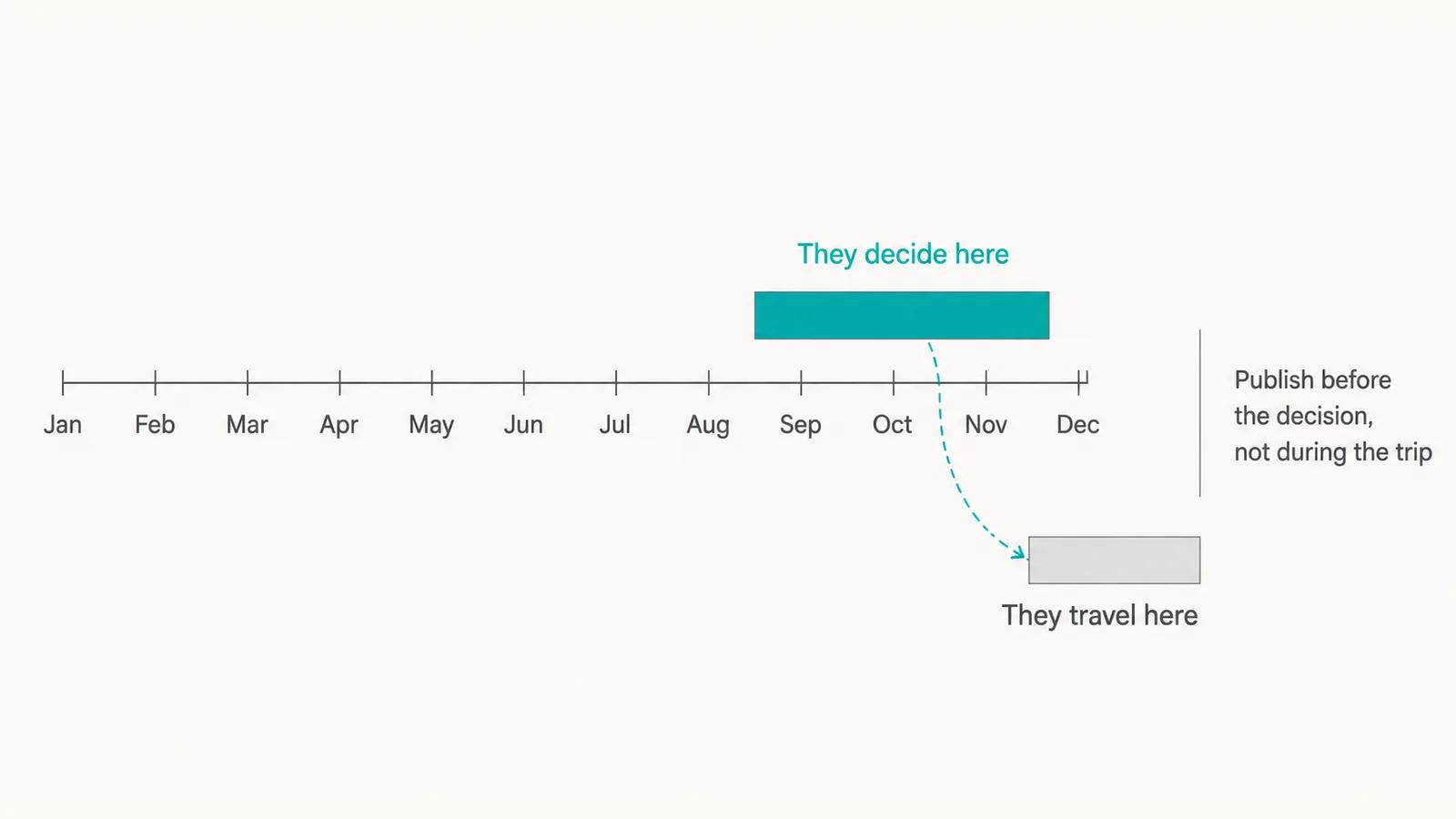
The summer season is decided
Hill stations, Ladakh, Kashmir, Europe for the school holidays and Char Dham planning all get researched here. Your summer content needs to exist now, not in May when the groups depart.
Summer travels; the monsoon and festival season is researched
You are operating and simultaneously being shortlisted for the next wave. Publishing evidence from live trips while they are running feeds both.
The winter book opens
Kerala, Rajasthan, Goa, Andamans, Southeast Asia and year-end travel are chosen in these months. This is the most commercially valuable content window in an Indian agency’s year.
Peak departures, peak review opportunity
The largest volume of satisfied customers you will have all year, most of whom will never be asked for a review. Collect deliberately here or lose a year of proof.
The walk-in desk does not follow any of this
Visa, passport, forex and ticketing demand is steady and local. Do not let package seasonality determine how much attention that half of the profile receives.
Accreditation as a working trust asset, not a plaque on the wall
Travel is one of the few local trades where the customer hands over a large sum of money for something that does not exist yet and cannot be inspected. Everybody in India knows somebody who lost a deposit to an agency that stopped answering the phone. That fear is the real competition, and it is why accreditation does more commercial work in this vertical than in almost any other.
The credentials that mean something are worth naming precisely, because agencies tend to display them vaguely. IATA accreditation is the one that matters for air ticketing — the business either holds authorisation or acts as an agent for a carrier that does. The Travel Agents Association of India, incorporated in 1951, is the oldest and largest industry association. IATO members are largely recognised by the Ministry of Tourism, and Ministry of Tourism recognition itself is voluntary rather than compulsory, which is exactly why holding it is a signal.
That recognition has real requirements behind it, and knowing them helps you present it properly. The scheme expects a minimum office space of about 150 square feet, reduced to 100 for hilly areas above a thousand metres, at least four staff of whom one holds an AICTE-accredited degree in tourism and travel management or has equivalent experience with an IATA or UFTAA agency, and a capital requirement in the region of three lakh rupees, reduced substantially for the North-East and for remote and rural areas. A buyer who checks will find that these things are not trivially obtained.
The SEO-relevant part is that none of this helps you if it lives only on a certificate in the office. State the credentials on your website with the registration or accreditation number, state them in your Google Business Profile description, and reference them naturally where they are relevant — a visa services page, a page about how deposits are held. Consistency across those places is what a cautious buyer is actually checking when they search your name.
If you hold none of these, do not invent them. Fabricating an IATA number is an unusually easy lie to check and an unusually damaging one to be caught in. Build the equivalent from what you do have: registered business details, GST registration, years in operation, named staff, an office somebody can visit, and a review base that reads like real trips.
It is worth being deliberate about how you present money as well, because that is what the fear is really about. State how deposits are held, what the cancellation terms are, what happens if a supplier fails, and what the customer receives as confirmation. Almost no Indian agency writes any of this down, which means the buyer comparing three quotations has no way to distinguish the careful operator from the risky one and falls back on price. An agency that publishes its terms plainly is not exposing itself; it is removing the only objection that was stopping a cautious family from choosing the more expensive quotation.
| Credential | What it signifies | Where it should be visible |
|---|---|---|
| IATA accreditation | Authorisation to issue air tickets, or agency for a carrier that holds it | Website footer with the number, profile description, ticketing pages |
| Ministry of Tourism recognition | Voluntary scheme with office, staffing, qualification and capital requirements | Website about page with the certificate reference, profile description |
| IATO membership | Inbound tour operator body; active members largely MoT-recognised | Website, and pages aimed at inbound or foreign clients |
| TAAI membership | India’s oldest travel association, founded 1951 | Website footer and quotation documents |
| GST and registered business details | The baseline anyone can verify before paying a deposit | Invoices, quotations, website footer |
Which services deserve a page, and which just belong on the profile
Agencies routinely make one of two opposite mistakes. Either everything is crammed into a single page called Services that lists forty things in a row, or somebody builds forty near-identical pages differing only by a swapped destination name. The first is invisible. The second is the scaled-content pattern Google explicitly acts against, and it will drag down the pages that were genuinely good.
The test that resolves it is simple: does this service have its own distinct set of questions that a person actually asks? If yes, it deserves a page, because there is something real to write. If the only difference between two pages would be a place name, it does not — those belong together on one page that covers the category honestly.
By that test, visa assistance for a specific country usually earns a page: the documents, the appointment reality, the timelines, the common rejection reasons and the fee structure are genuinely different for Schengen and for a US visa, and people search those questions in enormous numbers. So does passport assistance, so does forex, and so does a flagship itinerary you actually operate and can describe day by day with real hotels and real drive times.
What does not earn a page is a destination you have never sent anybody to, assembled from a supplier brochure. It will read like every other page on the internet about that destination, it will not rank, and it takes credibility away from the pages where you had something to say. Four pages you can defend beat forty you cannot.
Separately from the website, fill in the services list on the Google profile properly — and put the local, transactional services in it. Visa assistance, passport services, air ticketing, foreign exchange, travel insurance, airport transfer, group tours. Each entry is a phrase Google can match to a local search, and this is precisely the half of your business that agencies forget to declare because it is less exciting than the packages.
| What you offer | Own page? | Why |
|---|---|---|
| Schengen visa assistance | Yes | Distinct documents, appointment reality, timelines and rejection reasons that people search for by name |
| Passport and PCC assistance | Yes | High local search volume with concrete, answerable process questions |
| A flagship itinerary you actually operate | Yes | You can write real days, real hotels, real drive times — nobody else has that copy |
| Twelve destinations from a supplier brochure | No | Interchangeable pages are the scaled-content pattern Google acts against |
| Forex, insurance, airport transfer | Profile services | Transactional local demand that mostly converts straight from the listing |
| Corporate and MICE travel | Yes, if you do it | A different buyer entirely, searching different words, comparing capability not price |
A real site for the half of your business that a profile cannot carry
The package buyer reads before they enquire, and a Google profile has nowhere to put an itinerary. Web Sarathi builds a proper site from your profile, so your services, destinations and credentials sit somewhere a nervous buyer can actually read them.
- Service and destination pages that exist independently of your listing
- Credentials, registration details and contact routes stated where buyers check
- Kept in step with the profile, so hours and services never contradict each other
Collecting reviews when the trip ends two thousand kilometres away
Travel produces the strongest emotional peak of any local service and captures almost none of it. The customer is happiest somewhere around day four of the holiday, standing in front of the thing they came to see. You are in an office in another state. By the time they are home, unpacked and back at work, the feeling has flattened into a general sense that it went fine — which is the mood in which nobody writes anything.
So timing is the whole problem. The best moment to ask is inside the trip or on the day it ends, not a week later. An agency that sends a message on the final evening, while the customer is at the airport with a phone full of photographs and nothing to do, gets a fundamentally different response rate to one that emails an invoice-style follow-up ten days on.
Ask for the specific rather than the general. A review saying good service and nice packages is worth very little to the next buyer, who is nervous about a particular destination. A review that names the destination, the month, the composition of the group and one concrete thing that went right is exactly what the next family reads before paying a deposit. You get those by asking for them explicitly — mention the trip, and suggest they say where they went and who they went with.
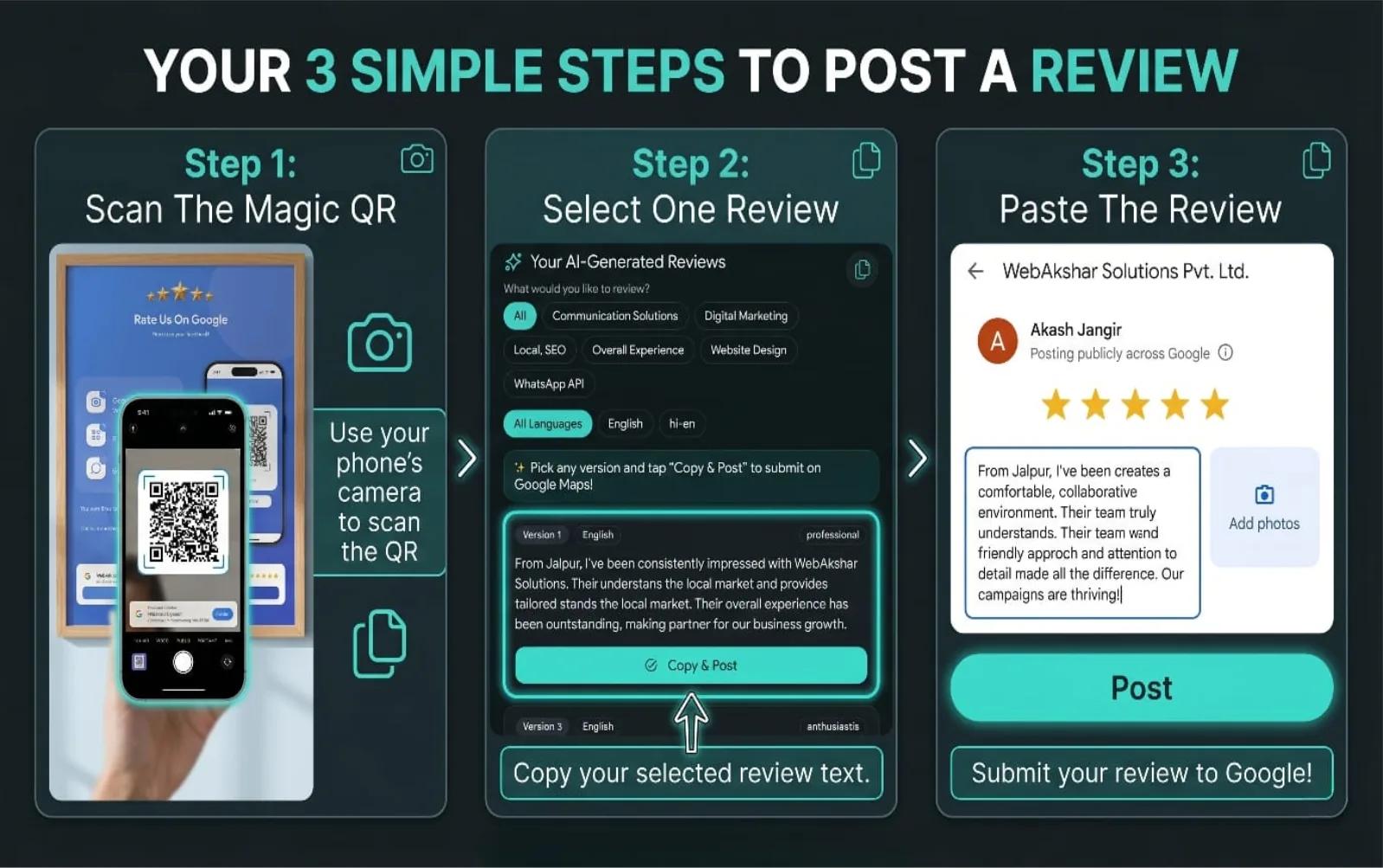
The walk-in half of the business is easier and almost universally neglected. Somebody whose visa came through, whose Tatkal ticket you rescued, or who got forex sorted in twenty minutes is standing at your counter, relieved, right now. A QR code on the desk collects those, and they are the reviews that do the heavy lifting on local searches for visa and passport work.
Both halves need the same thing behind them: a habit rather than a campaign. Agencies that decide to collect reviews at the end of the season collect nothing, because at the end of the season everybody is exhausted. Agencies that ask every single customer at a fixed moment accumulate quietly and end up with a review base that reads like an operating business.
The counter moment, for local services
Visa collected, ticket issued, forex handed over. Relief is at its highest right here, and a QR code on the desk converts it far better than any message sent later.
The peak you are not present for
A short check-in message while the customer is actually there does two jobs: it catches problems early enough to fix them, and it puts you in mind at the emotional high point.
The single best time to ask
Airport, station or last night. Photographs are fresh, the trip is complete, and there is nothing else to do. Ask here, and ask for specifics.
One reminder, then stop
A single polite follow-up recovers a useful share. A third message annoys somebody who might otherwise have recommended you at a family gathering.
Reply to every one, naming the trip
A reply that says which destination and month makes the review more useful to the next reader, and shows a nervous buyer that somebody is actually at the other end.
Ask at the counter, and at the end of the trip
Reviews in travel are lost to timing rather than to unhappiness. A QR code at the desk catches the visa and ticketing customer at the moment of relief, and a prompt at the end of a trip catches the traveller while the photographs are still fresh.
- Scan, pick a highlight, and the review is drafted in a few taps
- Prompts the traveller to name the destination and month, which is what the next buyer reads
- Works for the counter half and the package half without two separate systems
WhatsApp is your conversion channel, and it hides your best data
Almost no Indian travel enquiry converts through a form. It converts on WhatsApp, in a conversation that runs over several days, with an itinerary PDF, a voice note, a hotel change and a payment screenshot. That is not a workaround, it is genuinely the right channel for this trade, and any advice that tells you to push customers into a web form is written for a different country.
It does, however, create a measurement blind spot that leads agencies to draw wrong conclusions about their marketing. The click that started it is invisible. The customer tapped a number on your Maps listing, saved it, messaged you two days later, and closed a ninety thousand rupee booking three weeks after that. Your analytics show no conversion at all, so the channel that produced your best booking of the month appears to have produced nothing.
The result is agencies concluding that Google does not work while it is quietly producing their revenue, and shifting budget to whatever channel happens to be measurable. The fix is not sophisticated tooling. It is one question in your enquiry script, asked consistently: where did you find us. Written down and tallied every month, that beats any attribution model available to a business this size.
A second, cheaper fix: make sure the profile actually offers the route the customer wants. If your listed number is a landline that goes to a desk phone, a customer who wanted to message you simply leaves. Put a number that receives WhatsApp on the profile and treat responsiveness on it as an operational commitment, because a two-hour reply delay during someone’s planning evening loses the enquiry to whoever answered first.
And keep the loop closed back to Google. The customer you converted on WhatsApp is the customer who should be asked for a Google review at the end of their trip, because that is the surface where the next stranger finds you. An agency with a thriving WhatsApp practice and eleven Google reviews has been converting demand without ever reinvesting any of it into the thing that generated it.
A landline on the profile
If the number cannot receive a message, a large share of enquiries evaporate silently. Publish a number that takes WhatsApp and make sure somebody is on it.
Concluding Google does not work because analytics is empty
WhatsApp conversions are invisible to web analytics by design. Ask every enquirer where they found you and tally it monthly, or you will defund the channel that is feeding you.
Slow first response during planning hours
Travel enquiries are usually sent in the evening while the family is discussing it. Whoever replies inside that window usually gets the quotation accepted.
Never converting a WhatsApp customer into a public review
Every closed booking is proof that only exists in a private chat. Unless you ask, that proof never reaches the next stranger comparing three agencies.
Competing with MakeMyTrip by declining to compete with MakeMyTrip
A small agency will not outrank an online travel agency for "Kerala package". That fight is over, the budgets are not comparable, and pursuing it is the most common way Indian agencies waste money on search. The useful question is not how to beat them, but which searches they are structurally bad at.
They are bad at anything requiring a person. Visa documentation for a slightly unusual case. A senior citizens group where somebody needs to arrange wheelchair assistance at three airports. A pilgrimage with specific dietary requirements. A multi-family trip where the itinerary changes twice. These are searched by people who have already discovered that a booking platform cannot help them, and they arrive pre-sold on the idea of talking to a human.
They are bad at genuine local presence. Nobody drives to MakeMyTrip when their passport application is stuck. The whole visa, passport, forex and ticketing side of your business is defended by geography, and it is the half you are most likely to be under-declaring on your own profile.
They are bad at specific, operated knowledge. A platform cannot tell you which of two Munnar properties has the road that becomes unusable in heavy rain, or that the Ladakh itinerary everybody sells has an acclimatisation problem on day two. If you actually operate trips, you know things no aggregator can write, and those are exactly the pages that earn links, get read for years, and convert the buyer who is nervous.
And they are bad at accountability. The reason a family pays more to a local agency is that there is somebody to call at eleven at night when a connection is missed. Say that, plainly, where a buyer can see it — and back it with reviews that describe a moment when it happened. That is a competitive position a platform cannot copy, which is more than can be said for price.
The practical discipline this implies is a list. Write down the last thirty enquiries you converted and the last thirty you lost, and mark against each one why. Agencies that do this almost always find the same pattern: the wins clustered around complexity, reassurance and local presence, and the losses clustered around straightforward itineraries where the customer only wanted the cheapest number. That list tells you which pages to write, which services to declare on your profile, and — just as usefully — which enquiries to stop chasing, because competing for the second group is what makes a small agency feel like it is working very hard for very little.
Searches the platforms own
- Generic destination package terms with enormous volume
- Cheapest flight and hotel comparison
- Anything answerable by a price grid and a filter
- Brand terms for the platforms themselves
Searches you can genuinely win
- Visa, passport, forex and ticketing help in your own city
- Complicated group travel, seniors, pilgrimage, accessibility
- Operated-itinerary questions only somebody who runs the trip can answer
- Your own name, once enough people have been told to look you up
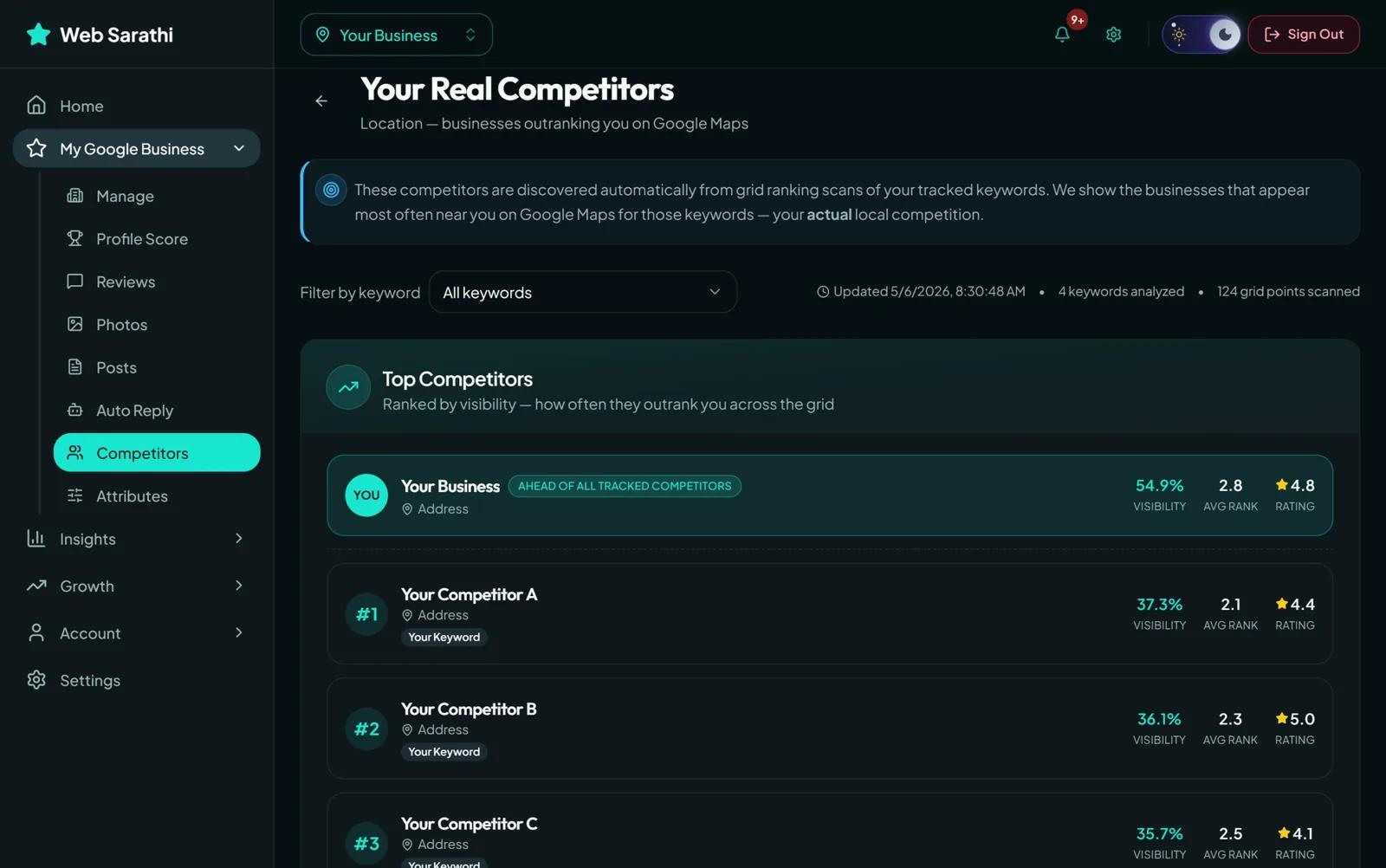
Watch the three agencies you are actually losing to
The platforms are not your realistic competition on local searches — the other three agencies in your area are. Track their profiles, review growth and posting cadence so you know whether you are gaining or drifting.
- See who is ahead of you on the searches that actually convert locally
- Watch review velocity, not just review count, which is what moves position
- Get told when a competitor makes a change worth reacting to
Building the year backwards from your two selling seasons
Most agencies plan their marketing forwards from today, which produces content that arrives after the decision. Planning backwards from when money is actually committed produces the opposite, and it is the only scheduling discipline that matters in this trade.
Take your two biggest departure periods, whatever they are for your business — for many Indian agencies that is the summer run and the October to January run. Work back three to four months from each and mark that as the week the corresponding content and offers must be live. Everything else on the calendar arranges itself around those two anchors.
Then split the year into build weeks and operate weeks, and accept that you cannot do both at once. Build weeks are for writing the destination pages, reshooting, updating the services list, and clearing review replies. Operate weeks are for running the trips and collecting proof from them. Agencies that try to write itinerary pages during peak departures write nothing and then blame the season.
Keep one thing running continuously through both: the local half. Visa and passport demand does not care what season your packages are in, and it is the revenue that pays the rent when the package pipeline is empty. That means the services list, the local reviews, the hours and the phone are a year-round obligation rather than something that gets attention when packages are quiet.
Finally, measure something. Not vanity metrics — two numbers. How many enquiries arrived, and where each said it came from. An agency that has those two columns for twelve months knows more about its own marketing than one that has spent the same year buying reports.
Mark the two departure peaks from last year’s ledger
Use actual deposits taken, not impressions of when you were busy. The ledger and the memory usually disagree by several weeks.
Subtract the research window
Three to four months for a considered domestic trip, longer for international. That date is when your content and offers have to already exist.
Block the build weeks and defend them
Destination pages, itinerary detail, photographs, profile services, review replies. These do not happen during operations, so they must be scheduled outside them.
Collect proof during departures
Peak departure weeks are your only source of fresh photographs and specific reviews. Collect them while the trips are running, not from memory in January.
Keep the local desk warm all year
Services list complete, hours accurate, WhatsApp answered, counter reviews collected. This is the half that does not have a season and pays for the half that does.
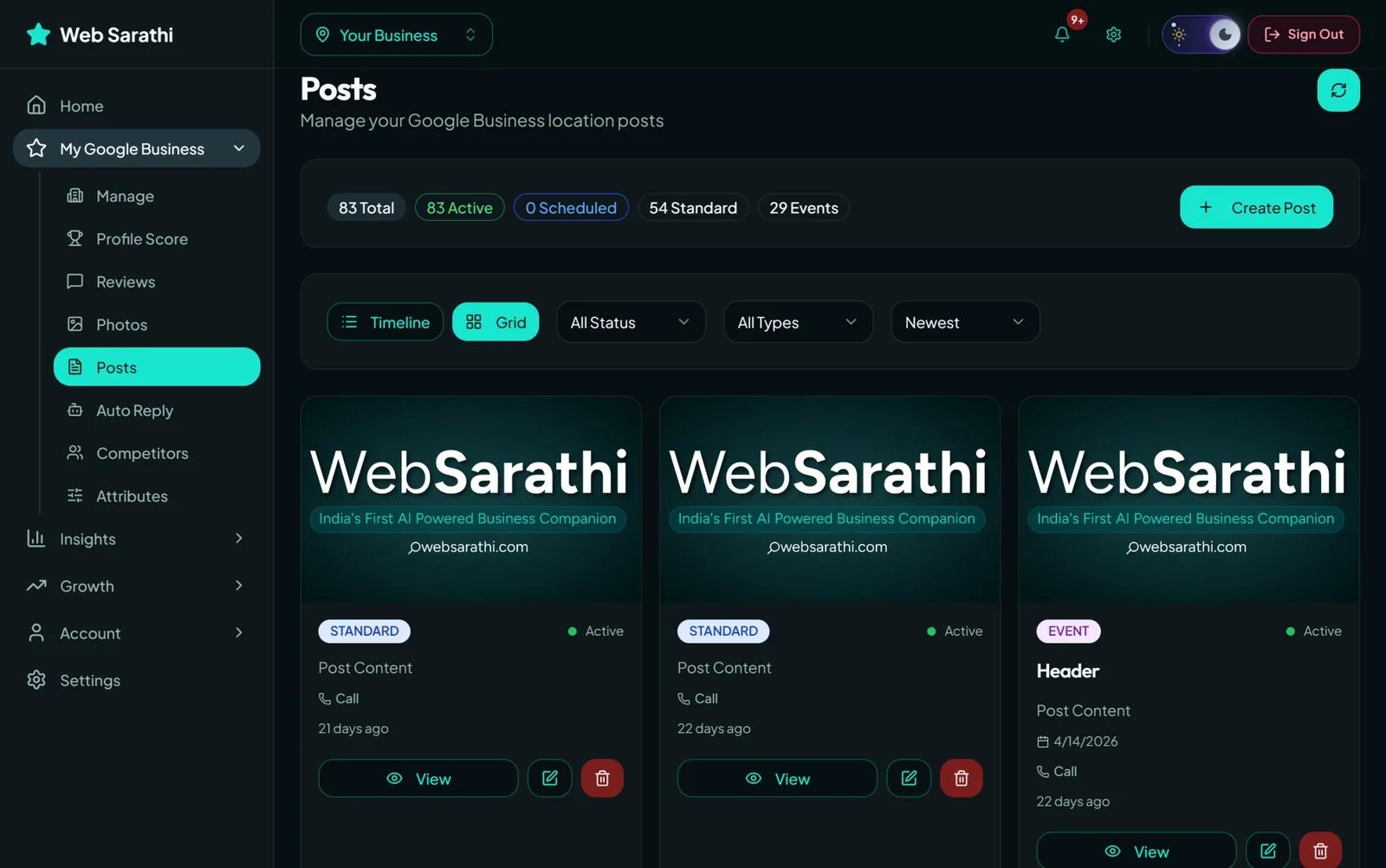
Publish the season three months before it departs
Travel content has to be live when people are deciding, which is never when you have time to write it. Draft a season in a build week and schedule the whole run against your departure calendar.
- Schedule months ahead so content lands in the research window, not the travel window
- Drafts built around your destinations and departure dates rather than generic filler
- Keeps the profile active through your off-season, when next season is being chosen
Travel Agency SEO questions, answered
The questions Indian travel agency businesses ask us most often.