Gym SEO in India: winning the six weeks that decide your membership year
Gyms sit at an odd intersection of local search. The customer will not travel — a gym fifteen minutes away gets used for a fortnight and then quietly abandoned, and most people know that about themselves before they sign. But the thing they are buying is a twelve-month, several-thousand-rupee commitment they will research properly. Small radius, large decision. Very few local businesses have to be both the nearest option and the most convincing one.
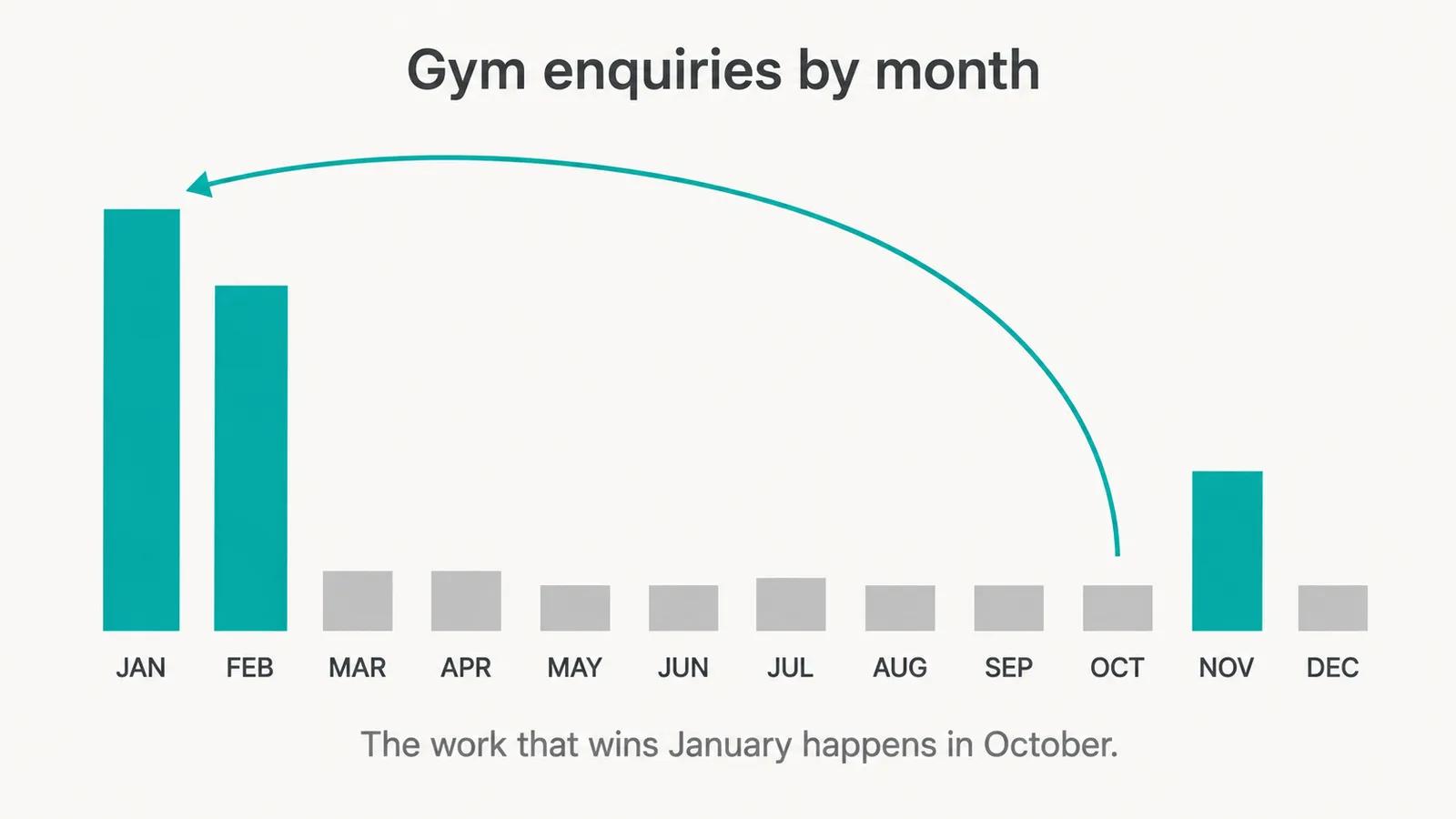
On top of that sits a demand curve unlike anything else in this series. Gym enquiries are not seasonal in the way a restaurant or a salon is seasonal. They cluster into roughly six weeks at the start of the calendar year, with a second, smaller lift once the festival season ends. Everything else is a long flat middle. A gym that is invisible in the first week of January has not lost a week of trade; it has lost a share of annual contracts that will not be on the market again for a year.
This guide is about both of those facts and what they imply — for hours, categories, photographs, trials, contract reviews, and the pass apps now reselling your floor. Work through it in order if you are starting from a neglected profile.

Your acquisition year is decided in about six weeks
Almost every local business has a season. What makes this trade different is not that demand rises and falls, it is what a missed peak actually costs. A restaurant that is invisible during Diwali loses Diwali; the following weekend still arrives and the tables still fill. A gym that is invisible in the first week of January has not lost a week of revenue. It has lost a share of twelve-month contracts, and those particular customers are not coming back to the market until roughly the same week next year.
That single asymmetry should reorganise how you think about the calendar. The useful mental model is not a busy season and a quiet season, it is one narrow buying window with a long preparation period attached to the front of it. The work that decides whether you win January is done in October and November — reviews collected, photographs refreshed, hours corrected, prices made discoverable, the trial route made to actually work. In January itself there is no lead time left. Reviews you start asking for on the second of January arrive in February, when the window has closed.
There is a second reason the preparation months matter more than the peak. In January, everybody advertises. Every gym within three kilometres runs a New Year offer, the cost of paid reach rises because your competitors have all decided to spend at once, and the feed is noise. Organic position in local search is the one channel that does not get more expensive because other people are bidding. A ranking you earned in October costs you nothing in January, which is precisely when it is worth the most.
The flat middle of the year is therefore not dead time, it is cheap time. Review velocity built through the monsoon is what your listing is judged on in January. Photographs taken in August are the photographs a prospect scrolls in the first week of the new year. Nothing about that work is urgent when you are doing it, which is exactly why it does not get done.
The smaller post-festival lift is worth planning for separately. It behaves differently — shorter, less price-driven, and populated by people reacting to a specific fortnight of eating rather than to a resolution. The messaging that works there is closer to a reset than to a transformation, and it wants a shorter, cheaper commitment on offer, because these are people who do not yet trust themselves with an annual plan.
Build the review base nobody is competing for
Reviews collected in the flat middle of the year are the ones your listing is judged on in January. There is no way to acquire them retrospectively, and asking in January produces reviews in February.
Reshoot the floor and fix the fields
Equipment photographs, hours including any January extension, services with prices, and the trial route tested end to end on a phone. All of it is dull, and all of it takes weeks to matter.
Catch the post-festival lift
A shorter, cheaper commitment on offer, published before the festival week ends rather than after. These prospects want a reset, not a transformation.
Publish the January offer early
People decide over the last week of December. An offer that goes live on the second of January arrives after a meaningful share of the decision has already been made.
Convert, and do not start new projects
The window is for trials, floor time and signing. Nothing you begin here will influence how you rank inside it — the ranking was settled months ago.
Draft January in October, when you still have the time
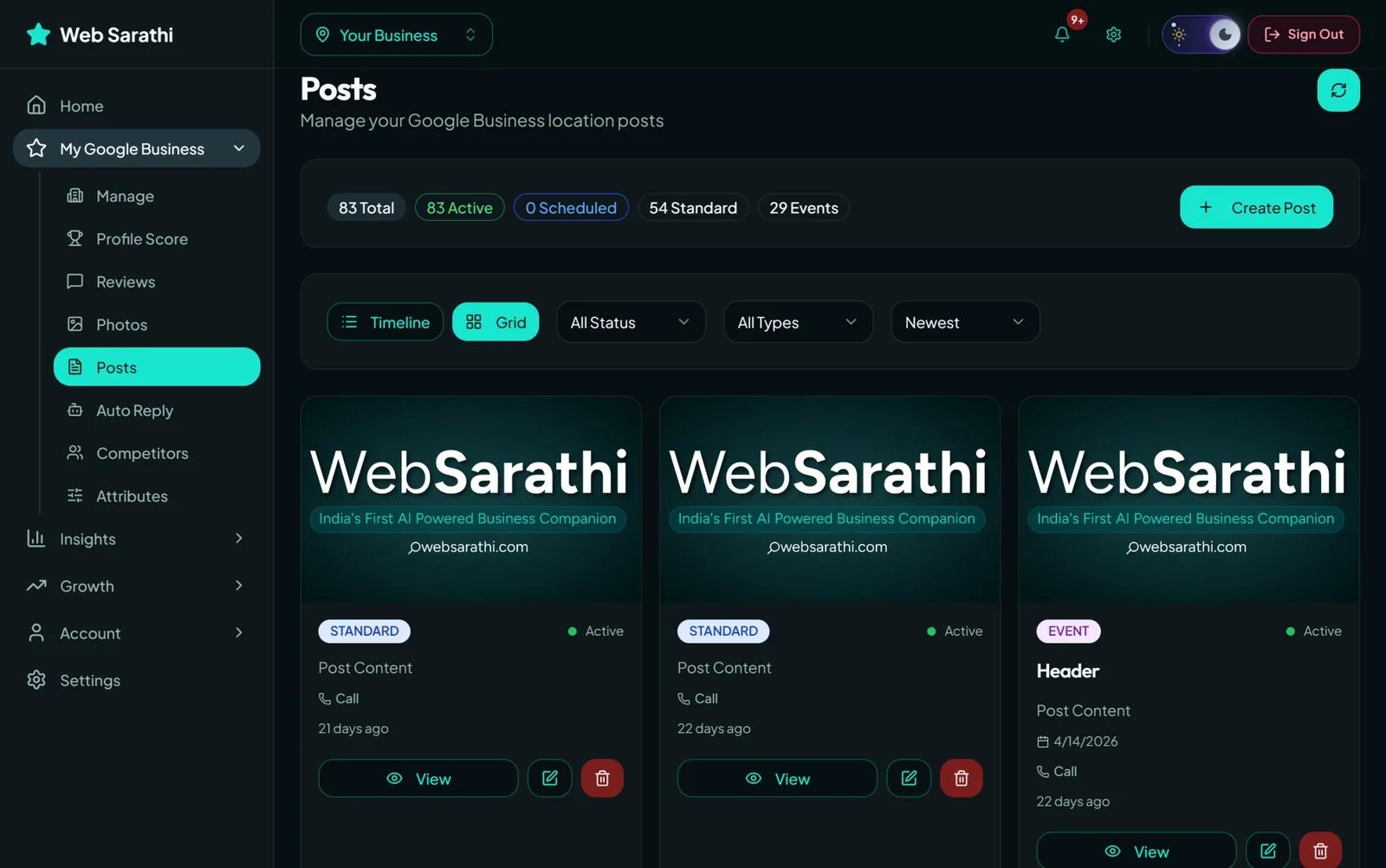
The six weeks that sell your year are the six weeks with no capacity to publish anything. Write the season in a quiet fortnight and schedule the whole run against the calendar.
- New Year and post-festival offers live before the decision is made, not after
- Drafts built around your own services, prices and hours rather than generic filler
- Keeps the profile visibly active through the flat middle of the year
Selling a twelve-month commitment inside a two-kilometre radius
Two facts about this trade do not normally sit together, and holding both at once is most of the strategy. The first is that distance is close to decisive. A gym beyond about ten or fifteen minutes from home, office or the route between them gets visited enthusiastically for a fortnight and then not at all. Prospects understand this about themselves, which is why gym searches are overwhelmingly proximity-led even among people who are otherwise happy to travel for quality.
The second is that the purchase is large and locked in. A quarterly or annual membership is several thousand to several tens of thousands of rupees, frequently non-refundable, and it commits a person to a daily habit in a specific building. That is a researched decision. People read reviews, scroll photographs, ask friends, and visit two or three places before signing.
Most local businesses are one or the other. A salon is small-radius and low-stakes, so convenience decides almost everything. A wedding photographer is high-stakes and city-wide, so reputation decides almost everything. A gym is both at once, and your listing therefore has to do two jobs that pull in different directions: be the nearest credible option, and survive the scrutiny of somebody making a commitment they are slightly nervous about.
The first implication is that broad ambition is mostly wasted effort. Ranking for a city-level term is a vanity result — the person who searched it is not going to travel to you, and the traffic converts at close to nothing. The commercially meaningful question is much narrower: in each residential pocket, office complex and society within your genuine catchment, do you appear, and where?
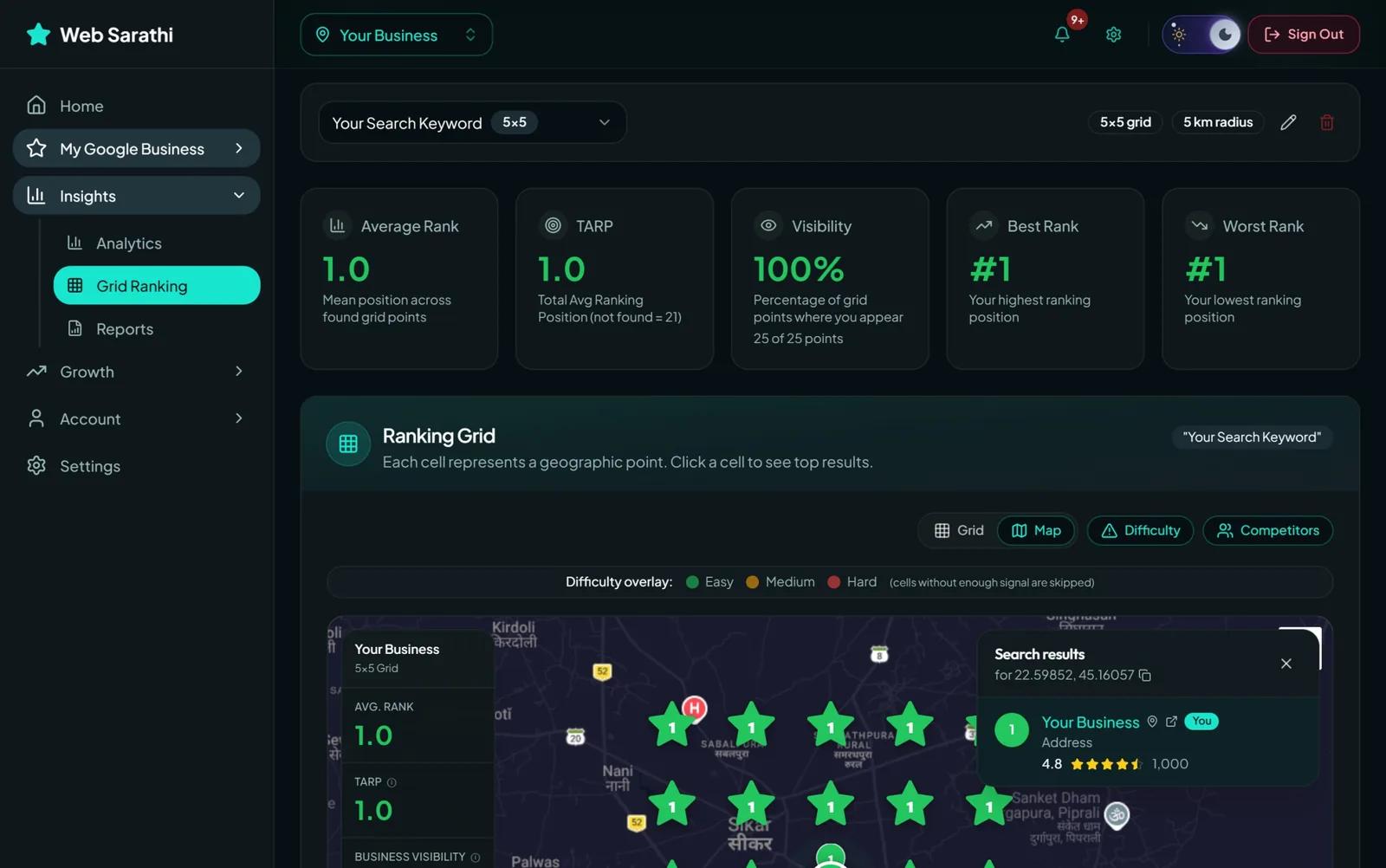
That is not a question you can answer from behind the reception desk. Searching your own keyword while standing on your own pin returns you at the top, every time, which is how owners convince themselves the marketing is fine while the induction diary stays empty. The person who actually matters is in a housing society nine hundred metres away, on the far side of a main road, and the three results they are shown are a different three. Measuring position across a grid of points around the gym, rather than from one search, is the only way to see the catchment you really have — and it is usually smaller and more lopsided than the owner expects, because a competitor with more reviews owns one side of the road.
The second implication is that inside that small radius, thoroughness beats everything. When the decision is researched, a thin profile loses to a complete one even when the thin one is closer. Photograph count, review recency, correct hours, a discoverable price and a trial that can be booked without a phone call are not hygiene items here. They are the comparison the prospect is actually running.
| Distance from your door | What that prospect is doing | What settles it |
|---|---|---|
| Under 1 km | Deciding between you and one or two obvious neighbours | Reviews, recency, photographs of the actual floor, and whether the price is findable |
| 1–2 km | Weighing you against a closer gym they are not impressed by | Whether you are visibly better enough to justify five extra minutes, every day, for a year |
| 2–4 km | Only considering you if something specific pulls them — equipment, a coach, ladies hours | A named specialism the nearer options do not have, stated plainly on the profile |
| Beyond 4 km | Almost certainly not going to become a member who attends | Nothing. Chasing this distance is how gyms waste advertising budgets |
See the catchment you have, not the one you assume
Searching from your own reception always returns you at the top, because you are standing on the pin. Grid ranking measures your position from dozens of points across the two kilometres that actually decide memberships.
- Find the societies and office blocks where you do not appear at all
- Track a keyword week by week through the run-up to January
- Judge a second location on coverage evidence rather than instinct
Opening time is a market segment, not an operating detail
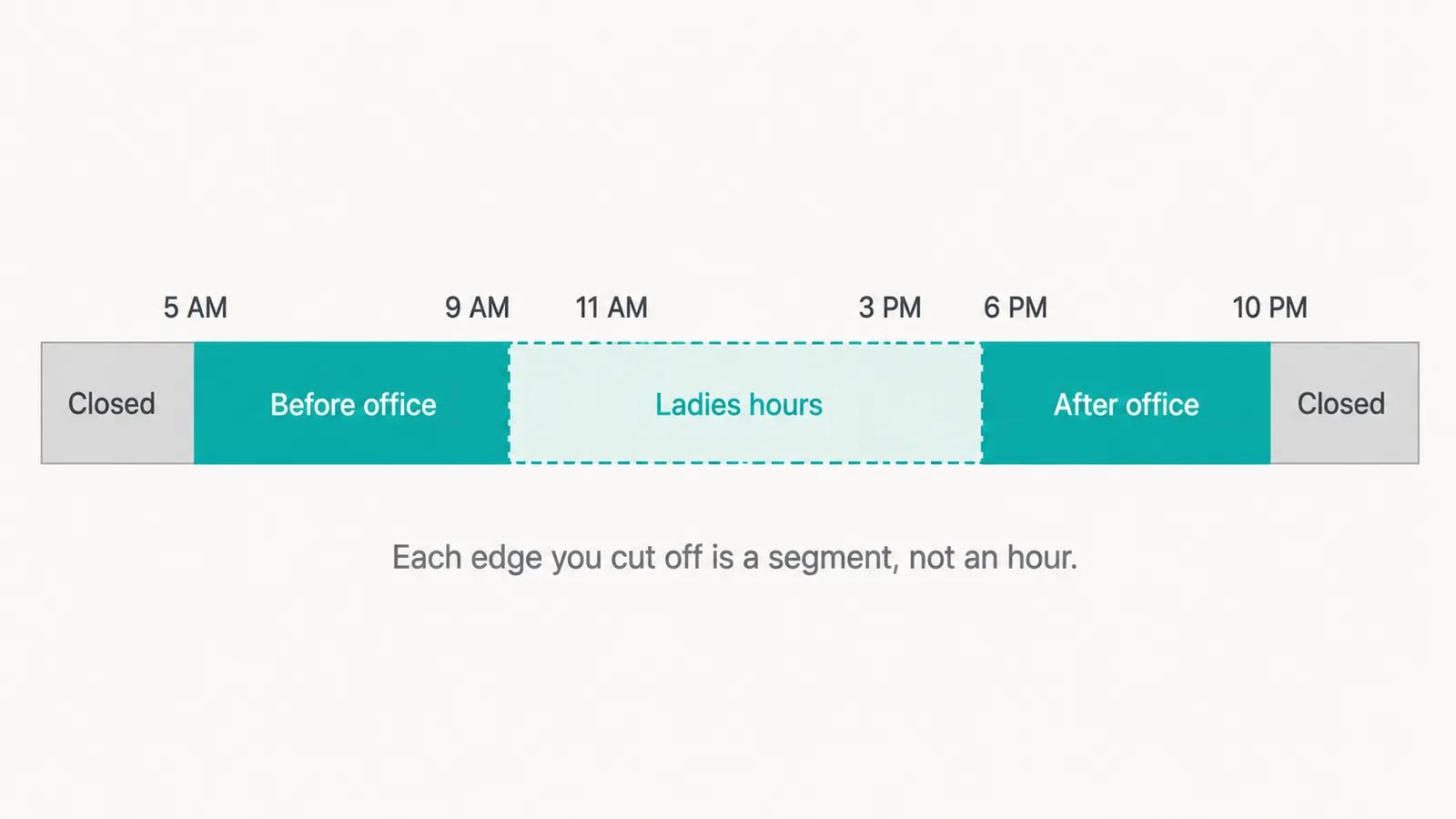
In most verticals, opening hours are hygiene: get them right so nobody turns up to a closed door. In this one they segment the market, and the edges of the day are where the segmentation happens. A gym that opens at six has written off everybody who needs to train before an eight-thirty office start. A gym that shuts at nine has written off the person who leaves work at eight forty-five, and the shift worker entirely. Those are not marginal hours; in most Indian cities they are two of the three densest bands of gym attendance there are.
Google treats hours as a filter before it treats them as anything else. Searches carrying an open-now intent, and the filters a user applies in Maps, remove closed businesses from consideration rather than ranking them lower. So hours that are wrong on your profile do not cost you a little visibility; they remove you from a set of results you would otherwise have won, silently, at exactly the times of day your customers are searching.
The India-specific version of this, and the one most often left unpublished, is women-only provision. Ladies hours, a ladies-only floor, women trainers, or a separate entrance are among the most searched constraints in this trade and among the least often stated on a profile. A woman looking for a gym is frequently not looking for a gym in general, she is looking for a specific window or a separate section, and a listing that does not mention it reads as a no. Use the attributes Google offers, and then say it plainly in the description as well, because attributes are easy to miss and a sentence is not.
Two things routinely go stale. The first is the January extension: gyms very often add early or late hours for the peak weeks and never publish them, which means the extra capacity generates no additional search visibility at all. The second is public holidays. A gym with no special hours set for Holi, Diwali or Independence Day either turns people away at the door or shows as open when it is not, and both produce the same result — a first impression of a business that does not have its details together.
Audit hours against the actual door rather than against the intention. Ask the floor staff what time the shutter really goes up on a Sunday, whether the last entry is genuinely at closing time or twenty minutes before, and whether the ladies session shifted at some point and nobody updated anything. This is a ten-minute exercise that most gyms have never done, and it corrects a filter that is working against them at the busiest hours of the day.
| Band | Who is searching | What the profile must show |
|---|---|---|
| 5 am – 7 am | Office workers training before the commute, and older members | The genuine opening time, not the one on an old signboard |
| 11 am – 4 pm | Homemakers, remote workers, and women looking for a quieter floor | Ladies hours or a women-only section, stated in attributes and in the description |
| 6 pm – 10 pm | The largest band of all, and the most crowded | Honest closing time, plus a photograph of the floor at this hour |
| After 10 pm | Shift workers, hospitality and IT staff, delivery riders | Late or 24-hour operation, which almost no competitor will be publishing |
| Public holidays | People with an unexpected free morning | Special hours set in advance, so you are neither closed nor wrongly shown as open |
Gym, studio or trainer: the label that decides which searches you can win
Google offers a surprisingly crowded set of labels for this trade — gym, fitness centre, physical fitness programme, personal trainer, yoga studio, boxing gym, martial arts school, sports club, weight loss service and more. They are not synonyms and they are not decoration. The primary category is one of the strongest inputs into which queries you are eligible to appear for at all, which means the label is doing more work than most of the optimisation people spend money on.
The most common mistake is aspirational rather than careless. A neighbourhood gym rebrands as a fitness studio because it sounds premium and charges better, sets the category to match, and quietly steps out of the category that most of its actual customers are searching. The person nearby is typing gym near me. If your primary category says you are something else, you have opted out of the query that describes you.
The workable structure is simple. Set the primary category to the thing an ordinary person standing outside your door would call you. Add secondary categories only for specialisms you genuinely run — a real personal training service, an actual boxing programme, a yoga class with its own schedule and instructor. Secondary categories broaden your eligibility, but they also shape what Google thinks you are, and a gym that lists yoga studio because of one Saturday class has muddied its own primary signal for no gain.
The services list is a separate field and it is the most under-used surface in this vertical. Personal training, strength training, weight loss programme, group classes, cardio, functional training, CrossFit, Zumba, aerobics, diet and nutrition consultation, physiotherapy, steam and sauna, and any specific coaching you offer are all searched by name. A services list that reads gym, fitness, health in three words matches almost none of them. Fill it out entry by entry, in the words your customers actually use, and put a price or a band against anything you sell separately.
Two things to avoid, both of which get profiles into trouble rather than merely underperforming. Do not append keywords or a locality to your business name — the name field should be your signage and nothing else, and keyword stuffing there is among the most reliably enforced violations there is. And do not list services you do not actually deliver on the premises. A physiotherapist who visits on Thursdays is not a physiotherapy service, and the gap between the listing and the reality is what a verification check is designed to find.
An aspirational primary category
Calling yourself a fitness studio because it sounds premium removes you from the gym searches your neighbours are actually typing. Set the primary to what a person outside your door would call you, and put the ambition in the description.
Secondary categories for things you barely do
One Saturday yoga class does not make you a yoga studio. Every extra category shifts what Google thinks the business is, so add them for real programmes with their own schedule and instructor, and not otherwise.
Locality or superlatives in the business name
Appending Best Gym or a neighbourhood name to the listing name is a straightforward violation and one of the most consistently enforced. The name field is your signboard. Everything else belongs in the other fields.
A services list of three generic words
Gym, fitness, health matches almost nothing anybody searches. Personal training, weight loss programme, CrossFit, Zumba and diet consultation are each searched by name, and each one you leave out is a query you cannot appear for.
Photograph the floor, because the floor is what they are buying
This vertical is unusual in what the customer is actually evaluating. A restaurant prospect is judging food and atmosphere; a salon prospect is judging cleanliness and skill. A gym prospect is judging physical capital — how much equipment there is, whether it is in working order, how much space there is between machines, how crowded it gets, whether the changing room is somewhere they would willingly undress.
Those are specific, answerable questions, and a photograph answers them faster and more convincingly than any sentence you can write. Is there a squat rack, or three treadmills shared by forty people? Is it air-conditioned? Is there parking? Are the dumbbells rusting? Will there be a queue for a bench at seven in the evening? Every one of those is being asked silently by somebody comparing you against the gym down the road.
The typical gym profile answers none of them. A logo, one exterior shot of the signboard, and a stock photograph of a dumbbell that was never taken in your building. That is not an under-optimised listing, it is an unanswered comparison, and the prospect resolves it by choosing the gym whose floor they can see.
Shoot the floor wide, so the scale of the room is visible. Shoot the free-weights area and the cardio row separately. Shoot the changing room and the washroom, which is the question nobody asks out loud and everybody wants answered. Shoot reception, and shoot the parking. Then do the thing almost no gym is willing to do: shoot the floor at seven in the evening, honestly, with people in it. A photograph showing a reasonably busy floor answers the crowding question far more credibly than a claim, and an empty gym photographed at three in the afternoon reads as a gym nobody goes to.
Put people in the frame, with their permission. Members training make a gym look alive, and a prospect is partly trying to work out whether people like them go there — which is why an all-male photo set quietly costs you women members, and a set full of very advanced lifters costs you beginners. Ask before you post, keep it to people who are comfortable being seen, and never publish a photograph taken in a changing area regardless of who is in it.
Finally, keep them current. Equipment gets replaced and floors get refitted, and a gym running on 2021 photographs is underselling an investment it already paid for. Adding photographs regularly also keeps the profile visibly active, which matters in a trade where a stale listing and a struggling business look identical from the outside.
| What they want to know | The photograph that answers it | Usual state |
|---|---|---|
| How much equipment is there really | A wide shot of the main floor showing the full length of the room | A close-up of one machine, or a stock image |
| Will I have to queue at 7 pm | The floor photographed honestly at its busiest hour, with members in it | An empty floor shot at 3 pm, which reads as deserted |
| Is the changing room usable | The changing room and washroom, clean and lit | Never photographed, and it is the question people most want answered |
| Do people like me train here | A representative mix of members, with consent | One demographic only, quietly excluding everybody else |
| Where do I park | The parking area and the approach from the road | Missing, so a prospect assumes there is none |
| Is the equipment maintained | Recent, well-lit shots of the free weights and cardio rows | Photographs three or four years old, underselling a floor that has since been refitted |
The free trial is the conversion event, so stop hiding it
Practically nobody buys a gym membership straight off a listing. The decision is made on the floor, after a trial session or a day pass, usually within a few minutes of walking in and seeing whether the place feels right. That means your profile has exactly one commercial job, and it is not to sell a membership. It is to produce a visit.
Once you accept that, a lot of common practice looks strange. Gyms routinely do not mention a trial anywhere on the listing, do not name it as a service, do not state its terms, and answer the question with call for details. The prospect standing on a footpath comparing three gyms is not going to call three strangers to find out whether they can look around.
The phone is a bigger obstacle here than owners think, for a reason specific to this trade. The person who would answer is usually on the floor with a client, so calls get missed at exactly the busiest hours. And the caller is mildly self-conscious — asking a gym whether you can come and try is a small act of exposure for somebody who has decided they are unfit. A non-voice route removes a real barrier rather than a theoretical one.
So name the trial as a service with plain terms: one free session, valid on weekdays, bring indoor shoes, no card needed. State whether an induction is included and roughly how long it takes. Then give a route that is not a phone call — an appointment link into whatever booking tool you use, or a WhatsApp link, which in this market converts well, leaves a written record and does not require anybody to be free at that instant.
Test the whole path on a phone yourself before you call it live. A large share of appointment links land on a desktop-only page, a login wall or a form demanding an OTP that nobody waits for. A channel that looks open and behaves closed converts worse than not offering one, because the prospect has already decided to act and you have wasted the decision.
The trial is also the right moment to ask for a review, and almost nobody does. The instinct is to ask at renewal, which is both late and the point at which the member has already had a year to accumulate small grievances. Somebody who has just had a good first session, been shown around properly and felt welcome is at the most positive point in the entire relationship. Asking then, as a routine rather than when it occurs to somebody, is the single cheapest source of review velocity this trade has.
Name the trial as a service, with terms
One free session, weekdays, bring indoor shoes, induction included, no card. Vagueness here is read as a catch, and a suspected catch is not worth a phone call to resolve.
Put a non-voice route on the profile
The appointment link field, pointing at a booking page or a WhatsApp conversation. Not only the website field — the appointment link is the one a prospect in a hurry taps.
Complete a booking on your own phone
This is where most gyms discover their link is a desktop-only page or a login wall. If you have not personally booked a trial through it, it is not live.
Give the channel an owner and a response time
A WhatsApp enquiry answered in ten minutes converts. The same enquiry answered next morning has usually already trialled somewhere else.
Ask for the review at the end of the trial
Not at renewal. The trial is the most positive point in the relationship, and making the ask a routine at that moment is the cheapest review velocity available to a gym.
Ask at the end of the trial, not at renewal
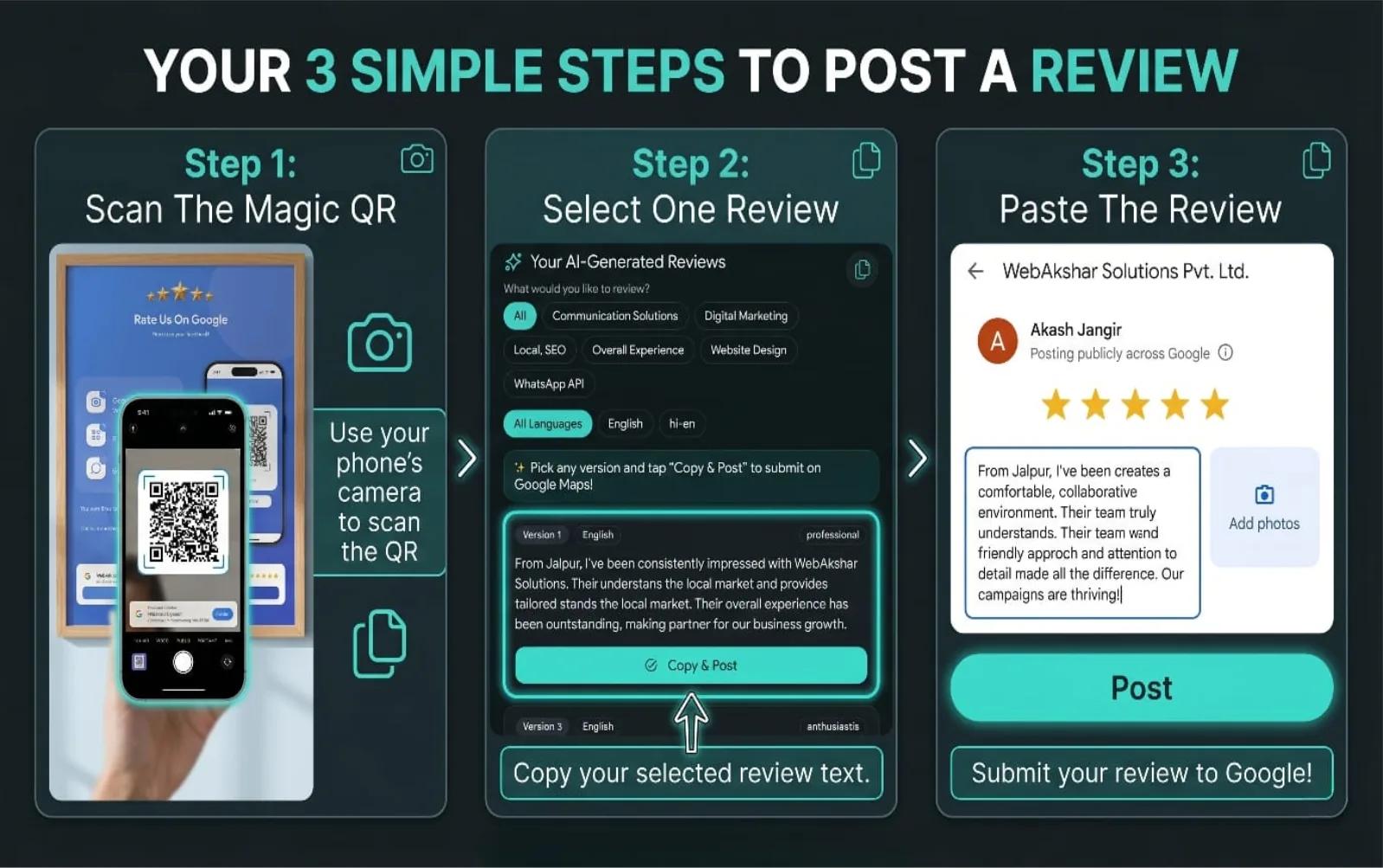
The most positive moment in a gym relationship is the first good session, and it is the moment almost nobody asks. A QR code at reception turns it into a routine rather than something somebody remembers.
- Scan, pick a highlight, and the review is drafted in a few taps
- Works for pass-platform visitors too, and that review stays on your listing
- Builds velocity through the quiet months, which is what January is judged on
The one-star review in this trade is almost never about fitness
Read the negative reviews of any established Indian gym and a pattern appears immediately. Very few of them are about the training, the equipment or the coaches. They are about money, and specifically about what happened when somebody tried to stop: a refund refused, a freeze that was promised verbally and then not honoured, a transfer that was not allowed, an annual plan the member believed was monthly, a trainer who left mid-package, or a branch that shut with time still on the card.
This is a structural consequence of the business model rather than a customer service failure. You sell a long contract to people whose attendance decays sharply after the first few weeks, and a proportion of them will eventually want out. Which means your angriest reviewers are, almost by definition, people you have already stopped serving — the reputational risk sits entirely in the segment that has stopped walking through the door and that you therefore never see.
That reframes the problem. This is a policy question before it is a reply question, and the gyms with the strongest ratings in a given area are frequently not the best-equipped ones. They are the ones with a written freeze and refund policy that is stated before the money changes hands, applied consistently, and honoured by whoever is at the desk on a Tuesday.
So publish it. Put the terms in the description, on the website, and into the enquiry conversation before somebody pays. Say how long a freeze can run and how many times a year, what happens if a member relocates, whether a membership can be transferred, and what the position is on refunds. A gym that states an unfavourable policy clearly gets fewer one-star reviews than a gym with a generous policy that nobody knew about, because the review is generated by the surprise rather than by the terms.
When you do reply, remember who the reply is for. The reviewer has already decided; the audience is the next prospect reading the thread. Acknowledge the person, state the relevant policy factually and without heat, and offer a specific offline route to sort it out. Do not argue the arithmetic in public, do not imply the person is lying, and never dispute whether they were a member — that reads as a business hiding from its own customers, and it is more damaging than the original complaint.
The pattern in the complaints is more valuable than any individual reply. Three separate reviews about the same freeze rule are not three problems to answer, they are one policy to change. Gyms that track what their negative reviews are actually about, rather than treating each as an isolated fire, tend to find that a small number of terms are generating most of the damage.
A refund and freeze policy that exists only verbally
Whatever was said at the counter is not what the member remembers three months later. An unfavourable policy stated in writing before payment generates far fewer one-star reviews than a generous one nobody was told about.
Disputing in public whether somebody was a member
It reads as a business hiding from its own customers, and the next prospect is the person reading it. Acknowledge, state the policy plainly, and move the specifics to a phone call or a WhatsApp thread.
Selling an annual plan that sounds monthly
Quoting a per-month figure for a twelve-month locked contract is the single most reliable source of angry reviews in this trade. State the total, the term and the lock-in in the same breath as the monthly number.
Answering each complaint and never reading the pattern
Three reviews about the same rule are one policy problem, not three replies. The complaints are the cheapest product research a gym gets, and most owners never aggregate them.
Only asking for reviews at renewal
By renewal a member has had a year to accumulate small grievances, and the ones who left — your unhappiest cohort — are never asked at all. The trial and the first month are when goodwill is highest.
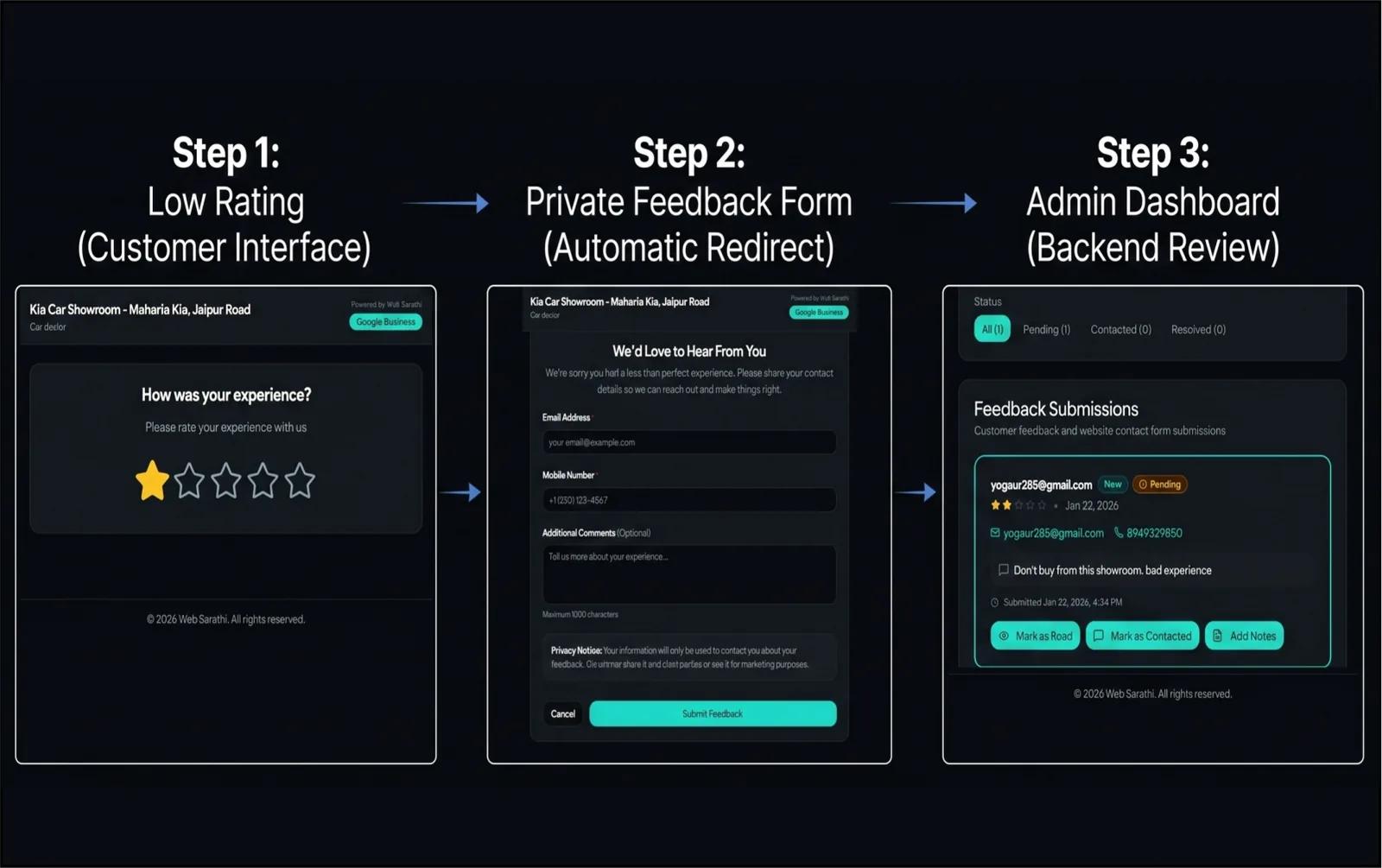
Catch the refund complaint before it becomes a one-star review
The damaging reviews in this trade come from members on their way out, about money rather than fitness. Review Shield routes unhappy feedback to you first, so the conversation happens privately while it can still be resolved.
- Unhappy feedback reaches you instead of going straight to public
- The recurring complaints surface as a pattern, which is a policy to fix
- Replies drafted in the reviewer’s own language, 34+ supported
When a pass app resells your floor at a price you did not set
Multi-gym pass apps and aggregated fitness memberships have become a meaningful channel in Indian cities, and the pitch made to owners is reasonable on its face: you have unsold capacity in the middle of the day, we will fill it, you get paid for space that was empty anyway. For a new gym with an empty floor and no reviews, that is a genuinely useful thing to be offered.
The economics are worth understanding precisely, because they are not the same as a food aggregator taking a commission on an order you would otherwise have taken yourself. A pass platform is not taking a cut of your sale. It is making the sale, at its price, and renting out your floor to fulfil it. The customer is theirs. The payment relationship is theirs. The app they open every day is theirs. You are the venue.
There is a third cost that almost nobody counts, and it is the one that belongs in a guide about search. These platforms rank aggressively for exactly the terms you want — gym near me, gyms in a named locality — and the page they rank with is a directory page listing you among a dozen alternatives. Every visit you fulfil strengthens the inventory and the review base of a competitor that outranks you for your own keywords. You are paying, in floor time and wear, to improve the thing standing between you and the customer.
None of that is an argument for refusing them. Off-peak capacity genuinely is worth something, a new gym needs bodies on the floor to look alive in photographs, and there are prospects who would never have found you otherwise. It is an argument for treating a pass platform as one channel with a ceiling rather than as a growth strategy, and for building the direct channel in parallel from the first day rather than when the platform changes its rates.
The direct channel is your own profile, and it is the one asset in this arrangement that stays yours. Two habits do most of the work. First, every pass visitor who walks through the door is a person you may convert to a direct membership — they have already solved the hardest problem, which is turning up. Second, and more importantly, nothing prevents you from asking a pass visitor for a Google review of your gym. They trained in your building, on your equipment, with your coaches. That review sits on your listing permanently, long after whatever the platform is charging this quarter has changed.
Track the split deliberately: how many people who train here are yours, and how many are somebody else’s customer using your floor. A gym where that ratio is drifting the wrong way has a revenue problem arriving in about a year, and the ratio is far easier to correct while the direct channel still exists than after it has been allowed to wither.
A member you acquired directly
- Pays you the price you set, on your terms
- Found you through your listing, which you keep
- Can be asked for a review that stays on your profile
- Renews with you, and the renewal conversation is yours to have
- Their attendance data tells you about your own business
A visit fulfilled for a pass platform
- Paid for at the platform’s rate, decided without you
- Found the platform, which ranks for the terms you want
- Can still be asked for a review — the one thing worth taking
- Renews with the platform, which may send them elsewhere
- Their behaviour is data the platform keeps
Gym SEO questions, answered
The questions Indian gym businesses ask us most often.