Dental clinic SEO in India: winning the patient who is comparing prices and dreading the chair
Dentistry occupies a position no other branch of medicine does. Half of what a modern Indian practice sells is clinical — a filling, a root canal, an extraction, a patient in pain who wants it to stop. The other half is consumer retail: aligners, veneers, whitening, smile design. Elective, price-shopped, financed on instalments, compared across three clinics, and marketed in ways no physician could contemplate. One profile, one waiting room, two entirely different purchases.
Underneath both sits a barrier this trade has almost to itself. Patients do not put off seeing a cardiologist because they are frightened of the room. They routinely put off seeing a dentist for years for exactly that reason, and a meaningful share of the people searching for you right now are looking for permission rather than for a price. Marketing that treats dental anxiety as a footnote is arguing with the wrong objection.
And unlike almost every other medical service in India, essentially none of this is being claimed on insurance. The patient is paying the whole amount out of their own pocket, which makes cost the question they research first and the one your competitors are already answering.
This guide covers those three, plus the aligner brands advertising past you, the specialists who visit your chair twice a week, smile photography and where it stops, the six-month recall almost nobody uses, and the patient who flies in. The general conduct-rule and confidentiality questions that govern every medical practice are covered in the clinic guide in this series rather than repeated here.
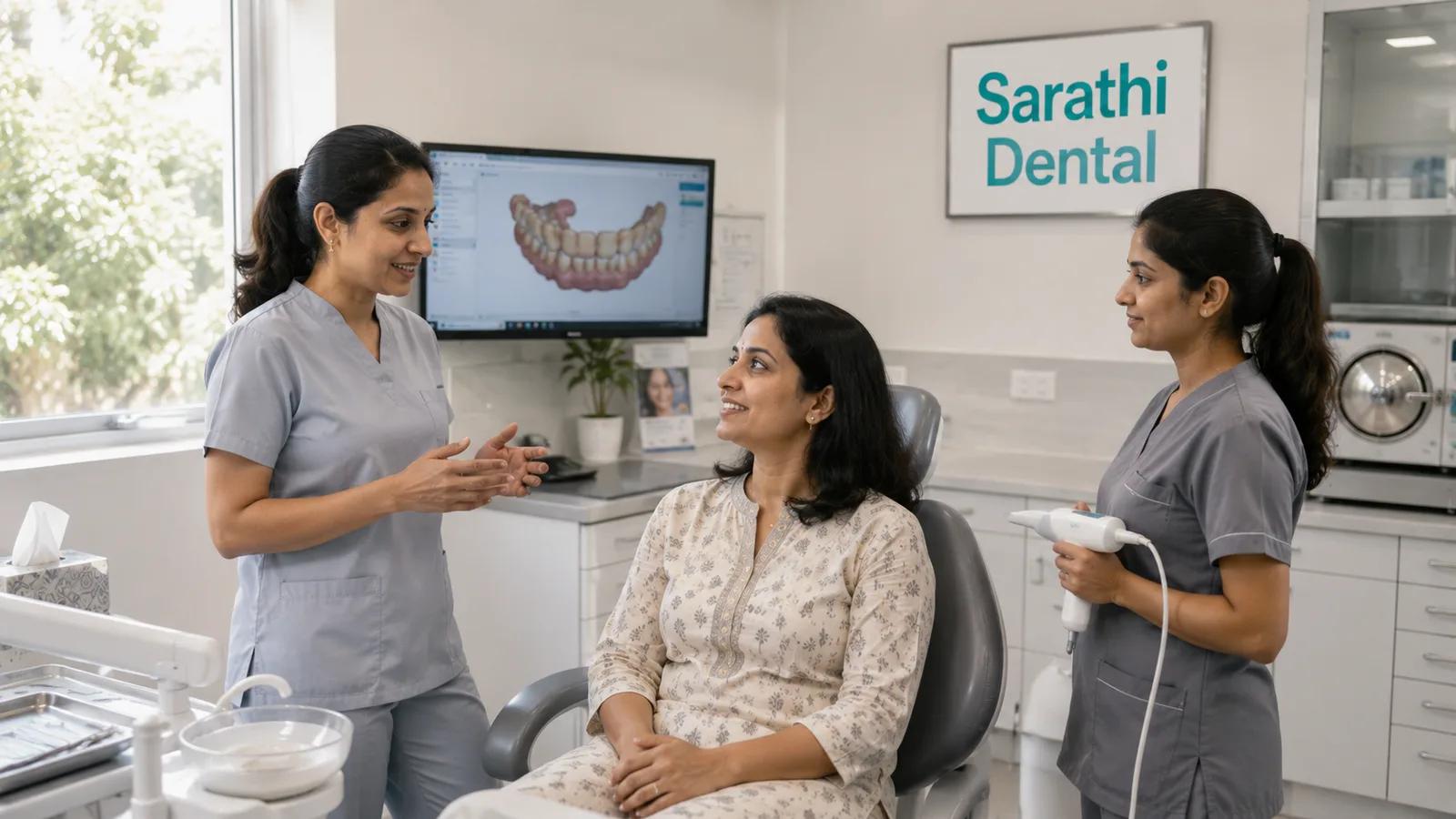
The only branch of medicine that is also a retail category
Most healthcare marketing advice starts from the assumption that the patient has a problem and is looking for competence. That describes half of dentistry accurately and the other half not at all, and the two halves behave so differently that treating them as one audience is the most common strategic error in this trade.
The clinical half is ordinary medicine. Somebody has toothache, a chipped tooth, a swelling, a crown that came off. They are not comparing five clinics, they are not researching for a fortnight, and price is a secondary consideration to being seen soon by somebody competent. Proximity and availability decide most of it, and the search happens within hours of the problem starting.
The elective half is a consumer purchase in every respect that matters. Aligners, veneers, whitening, smile design and cosmetic bonding are wanted rather than needed. The patient has been thinking about it for months, will compare several clinics, will look closely at photographs of previous work, will ask about instalments, and may travel across the city for the right practice. That is a buying process with far more in common with the interior design guide in this series than with the clinic one.
The commercial consequence is that these two halves want opposite things from your listing, and most dental profiles serve neither properly. The clinical patient wants hours, a phone that answers, whether you take walk-ins and how fast you can see them. The elective patient wants photographs, prices, treatment detail and evidence of aesthetic judgement. A profile weighted entirely to one is invisible to the other.
It also changes what your competitors are. On the clinical side you are competing with three other practices within two kilometres. On the elective side you are competing with clinics across the city, with direct-to-consumer aligner brands, and increasingly with the idea of doing nothing at all — which is why the elective half responds to reassurance and evidence in a way the clinical half never needs.
Everything else in this guide follows from holding both at once. The practical rule is that the profile fields split cleanly: hours, phone, walk-in policy and emergency availability belong to the clinical patient; the services list, prices, photographs and posts belong mostly to the elective one. Neither has to be sacrificed, but somebody has to decide deliberately rather than letting whichever half the dentist finds more interesting take over the whole thing.
The clinical patient
- Searches within hours of the problem starting
- Decides on proximity, availability and whether the phone is answered
- Compares almost nothing — they want it to stop
- Competitors are the three practices within two kilometres
- Wants hours, a walk-in policy and how soon you can see them
The elective patient
- Has been thinking about it for months before searching
- Compares several clinics, closely, on evidence of previous work
- Will travel across the city and will ask about instalments
- Competitors include aligner brands and doing nothing at all
- Wants photographs, prices, treatment detail and reassurance
What you are competing against is fear, not the clinic down the road
Dental anxiety is not a marketing abstraction. It is the single largest reason people who need treatment do not get it, and it operates at an intensity no other clinical field has to contend with. Nobody delays a blood test for eight years because of the room. A very large number of adults have delayed dental treatment for exactly that long, and many of them are now in the position of needing considerably more work than they would have, which makes them more anxious still.
That has a specific and under-appreciated consequence for search. A meaningful share of the people who type a dental query are not choosing between clinics. They are trying to decide whether to go at all, and what they are looking for on your profile is not a credential. It is permission — some sign that the experience will not be what they are imagining, and that they will not be judged for having left it this long.
Almost no dental marketing in India speaks to that. The vocabulary is state-of-the-art equipment, world-class treatment, experienced doctors — all of which addresses competence, which was not the objection. The patient never doubted you were competent. They doubted they could sit through it.
What answers the objection is concrete and slightly unglamorous. Say plainly what you do about pain and about nervous patients: how anaesthesia is handled, whether you offer sedation, whether a patient can stop you mid-procedure with an agreed signal, whether a first appointment can be a conversation with nothing done at all. That last one is the most powerful sentence available to a dental practice and hardly any of them say it. A consultation where nothing happens costs you twenty minutes and converts the patient who has been avoiding this for six years.
The photographs matter here too, and dental practices consistently choose the wrong ones. A close-up of an instrument tray or a patient lying back under a light with a mask over their face is an image of the thing being feared. A photograph of a person sitting upright in the chair, in normal clothes, having a conversation with the dentist, is an image of the thing being promised. Both are honest. Only one of them helps.
Your reviews are the most credible channel for this and can be prompted for it directly. A review saying the treatment was successful is worth less here than one saying I had been putting this off for years and it was nothing like I expected. Ask nervous patients, after a good experience, to say exactly that — it is true, it is theirs, and it speaks to the objection your own copy cannot address without sounding defensive.
Marketing competence at a patient who is scared
State-of-the-art equipment and experienced doctors answer an objection nobody raised. The patient never doubted you were competent; they doubted they could sit through it.
Photographs of the thing being feared
An instrument tray, a mask, a patient reclined under a light. All honest, all pictures of the fear. A person sitting upright and talking to the dentist is a picture of the promise.
Not offering a consultation where nothing is done
It costs twenty minutes and it converts the patient who has avoided this for six years. It is the single most useful sentence a dental practice can put on its profile, and almost none of them do.
Never mentioning pain management at all
How anaesthesia is handled, whether sedation is available, whether a patient can stop you mid-procedure with an agreed signal. Silence on this reads as an answer, and not a good one.
Nobody is claiming this on insurance, so the price is the decision
In most Indian healthcare, cost is mediated. There is a policy, or a corporate plan, or a government scheme, or at minimum a widely understood band that the patient is not really shopping. Routine dentistry has almost none of that. The patient is paying the entire amount themselves, from their own account, usually without warning, and often for something they had not budgeted for at all.
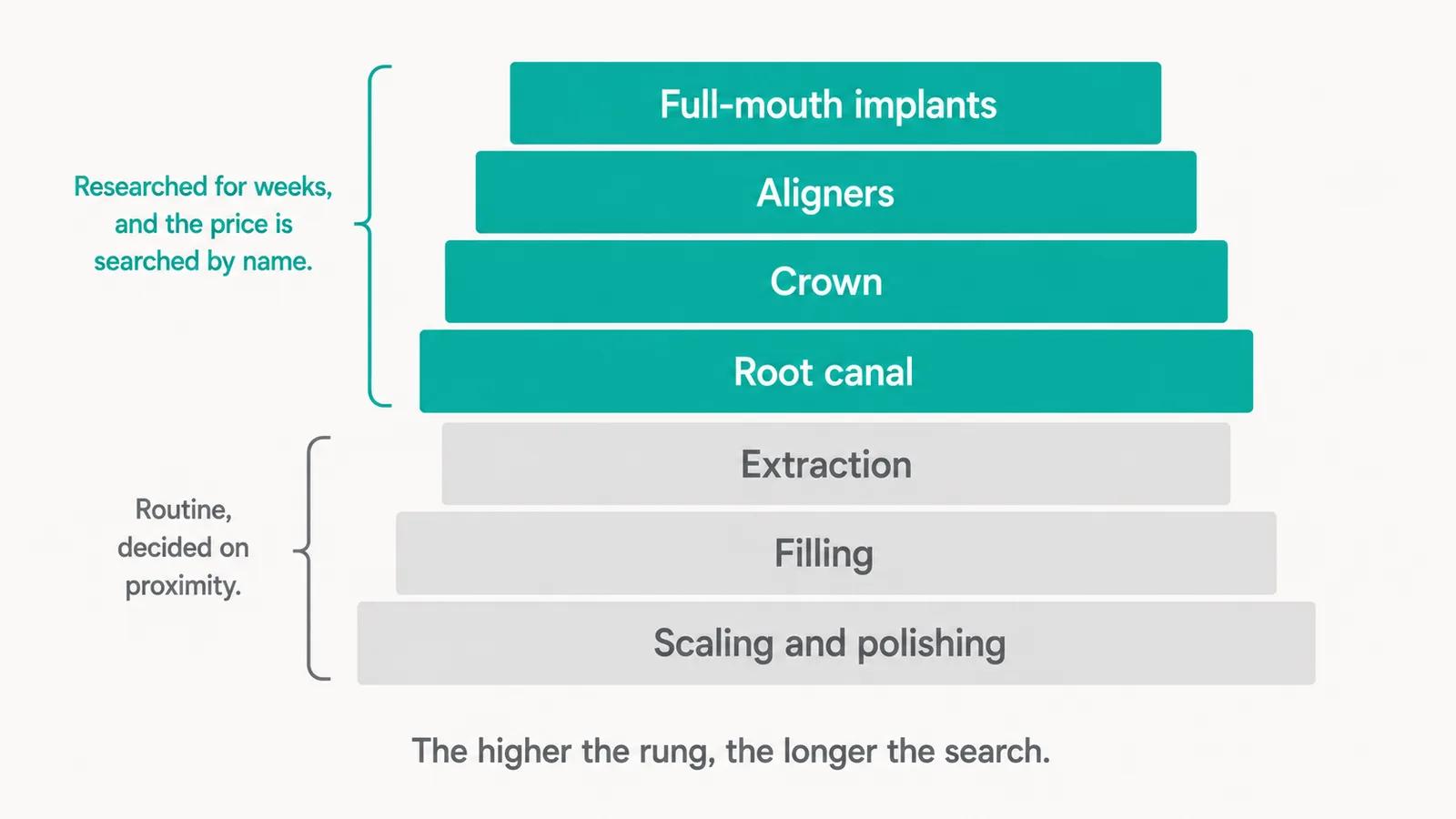
That single fact makes dentistry the most price-transparent branch of medicine in the country by necessity rather than by choice. Search volume for dental implant cost, root canal charges, braces price, and aligner cost is substantial and consistent, and it comes from people who fully intend to have the treatment and are working out whether they can. Refusing to answer does not keep them; it sends them to whoever will.
The objection to publishing is the same one salons make and it fails for the same reason, with an extra wrinkle. Yes, the number genuinely varies — a root canal on a molar with four canals is not a root canal on an incisor, and an implant case with a bone graft is not a straightforward one. But a range with the variables stated is not a quote, and patients understand that perfectly well. What they cannot accept is a clinic that treats the question as impolite.
So publish bands, per treatment, with the two or three things that move the number. Scaling and polishing. A composite filling. Root canal, by tooth type, and whether a crown is included. Crowns, by material. Aligners, by case complexity and duration. Implants, per tooth, and whether that includes the crown and any grafting. Say what a consultation costs, or that it is free. Say whether an X-ray is charged separately, because the surprise line on the bill is where the bad review comes from in every trade in this series.
Instalments deserve their own mention because they change the decision more than a discount does. A large share of elective dental work in India is now financed, and a patient who cannot write a cheque for an implant can very often manage a monthly figure. If you offer no-cost EMI or work with a financing partner, that is not a footnote — it is the thing that converts, and it belongs on the profile and the treatment pages rather than being mentioned at the counter after the patient has already decided against it.
One caution. Publishing a price and then quoting a different one at the chair is worse than publishing nothing, and it is the origin of the most damaging category of dental review. If the band is genuine, honour it; if a case falls outside it, explain why before starting rather than after.
| What they search | What they are working out | What to publish |
|---|---|---|
| Root canal cost | Whether they can afford to fix a tooth that is hurting now | A band by tooth type, and whether the crown is included or extra |
| Dental implant cost | A large, planned, entirely self-funded decision | Per-tooth range, what is included, grafting, and the instalment option |
| Braces or aligners price | Comparing you against a direct-to-consumer brand advertising a monthly figure | Range by complexity and duration, and what the monthly equivalent works out at |
| Teeth cleaning charges | A low-value routine job, usually a first visit to a new clinic | A flat price, because ambiguity here loses a patient worth years of recall |
| Dentist consultation fee | Whether it costs anything just to be looked at and told the truth | The fee, or that it is free — and whether an X-ray is charged separately |
Treatment pages that answer the price question honestly
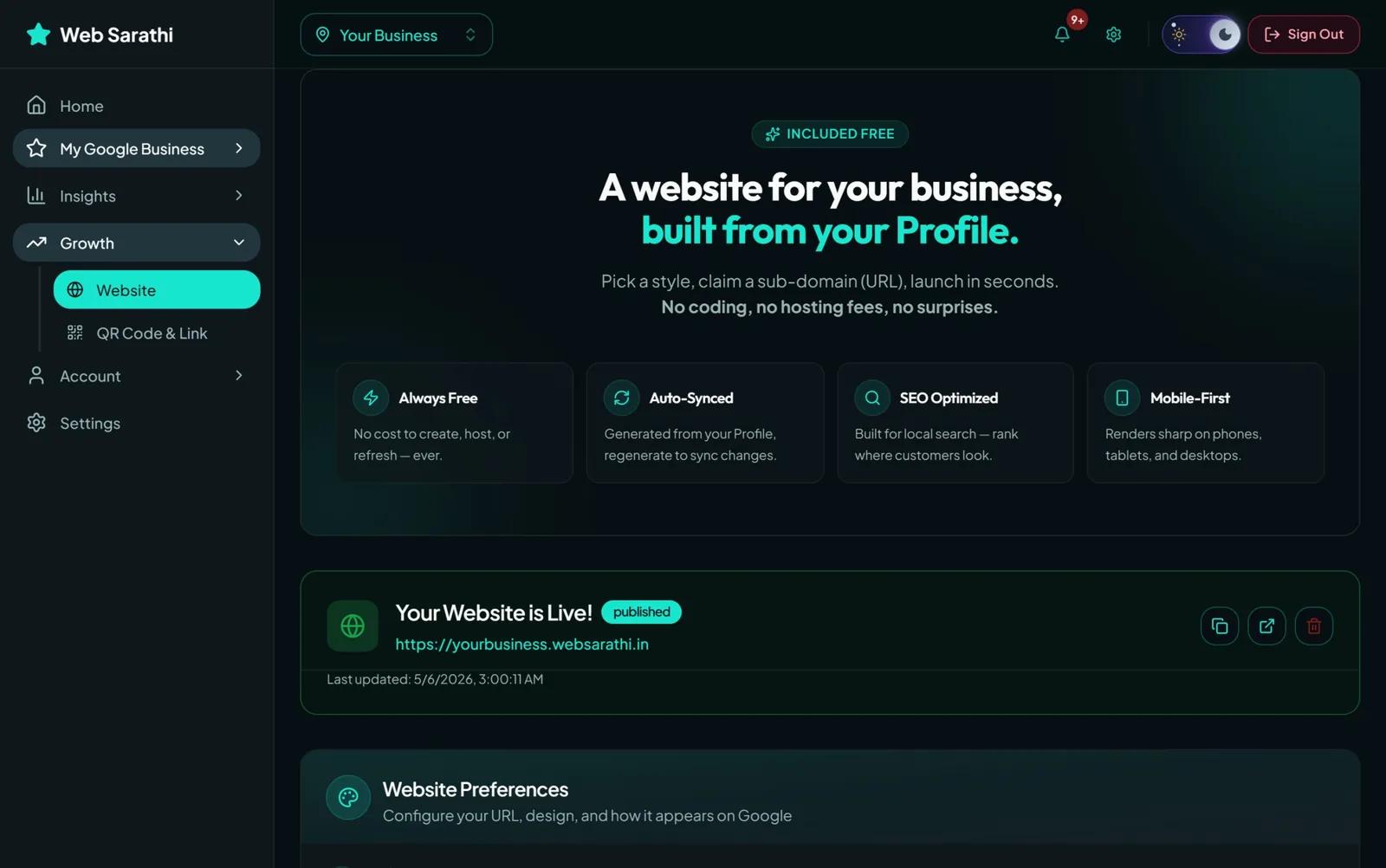
Cost searches are the largest dental demand there is, and refusing to answer sends the patient to whoever will. Treatment pages carry the bands, the variables and the instalment option in one place.
- A page per treatment, with a range and what moves the number
- Comparison content aligners and braces brands will not write
- Mirrors the services on your profile, which is a relevance signal
The aligner brands are advertising to your patients, not to you
Clear aligners changed the competitive position of the ordinary Indian dental practice more than any clinical development of the last decade, and not because of the appliance. It is because aligners are the first dental treatment that a consumer brand can market directly, at national scale, on television and social media, straight past the dentist.
The model varies but the shape is consistent. A brand builds consumer demand for a monthly figure and a set of before-and-after images, captures the patient, and then delivers the treatment through partner clinics or visiting dentists — quite possibly through you. The patient believes they have bought from the brand. Your chair, your time and your clinical responsibility fulfil it, and the relationship, the payment and the review all belong to somebody else.
This is the same structure the interior design and packers guides describe, with one important difference: here the fulfilment involves a clinician carrying professional responsibility for an outcome marketed by a company that is not a clinician. That is worth thinking about carefully before signing, quite separately from the commercial terms.
The commercial position is straightforward enough. For a practice with empty chairs and no orthodontic reputation, partner volume is real work. What it does not do is accumulate: the next patient in that same neighbourhood will see the same advertisement and find the same brand, and your name never enters the process. Three years of it produces a practice with revenue and no independent demand for the highest-margin treatment it offers.
The defensible ground is the ground a national brand cannot occupy, and in this case it is unusually strong: you can examine the patient. A direct-to-consumer aligner process is optimised for cases that fit a workflow, and a great many patients who enquire are not straightforward — they have gum disease that must be treated first, teeth that need extraction, a bite that will not resolve with aligners alone, or a case that genuinely needs fixed appliances. A clinic that publishes an honest page about which cases aligners suit and which they do not is answering the question the advertising deliberately does not raise, and it reaches the patient at the moment they are looking for a second opinion.
Practically: list aligners and orthodontics as named services with your own price range and the monthly equivalent, publish your own cases with consent, and write the comparison content — aligners against fixed braces, what happens if a case is more complex than it looked, what the retention phase involves and what it costs. The brand will not write any of that, because all of it complicates a simple offer.
A case that arrives through a brand
- The patient chose the advertisement, not the clinic
- Price and plan set by somebody who did not examine anybody
- Payment and the relationship sit with the brand
- The review, if there is one, lands on their name
- Your clinical responsibility, their marketing claim
A case that arrives through your own profile
- The patient chose a clinician they could look up
- Plan and price set after an actual examination
- You keep the patient, the recall and the referrals that follow
- The review sits on your listing and works for years
- You can say honestly when aligners are the wrong answer
One chair, several specialists, and a profile that mentions none of them
The typical Indian dental practice is a general dentist with a small number of specialists who visit — an endodontist on Tuesdays, an oral surgeon for extractions, an orthodontist twice a month, a periodontist or an implantologist as cases require. It is an efficient structure and it means a single small clinic can genuinely offer treatment across most of dentistry.
Almost none of that appears on the profile. The listing says Dental Clinic, the description talks about comprehensive dental care, and a patient searching for an endodontist or a root canal specialist near me has no way of discovering that one visits your chair every Tuesday. The capability exists, the demand exists, and nothing connects them.
The searches are specific and worth listing because practices consistently underestimate how granular they are. Root canal specialist, orthodontist near me, oral surgeon, wisdom tooth removal, pediatric dentist, kids dentist near me, gum specialist, dental implant specialist, and increasingly the treatment name alone. Each of those is a distinct query and each maps to a service entry you probably could fill and have not.
The services list is where this is fixed and it takes an afternoon. Enter each treatment individually in the words patients use: root canal treatment, wisdom tooth extraction, dental implants, braces, clear aligners, teeth whitening, dental crowns and bridges, dentures, gum treatment, scaling and polishing, children’s dentistry, smile design, full-mouth rehabilitation. Attach a price band where you can. Then say in the description which specialists attend and, if it is stable, which days.
Categories deserve a moment of thought too. Dentist and dental clinic are the obvious primary options, and the secondary categories include orthodontist, oral surgeon, endodontist, periodontist, pediatric dentist, dental implants periodontist and cosmetic dentist. Add the ones that reflect a genuine, regularly available capability. Do not add a specialist category for somebody who came once — the profile is claiming a service, and a patient who books on that basis and finds nobody there writes exactly the review you would expect.
Where a visiting specialist is a genuine draw in their own right, their name is worth carrying in the description and the posts, because patients do search practitioners by name and a referral frequently arrives as a name with no clinic attached. That said, resist the temptation to create separate listings for each visiting specialist at your address. Co-located duplicate profiles are treated as spam, and the enforcement usually takes the real listing down with the extras.
| The search | What the practice usually has | What has to be published |
|---|---|---|
| Root canal specialist near me | A visiting endodontist on fixed days | Root canal treatment as a named service, endodontist as a secondary category |
| Orthodontist near me | An orthodontist attending twice a month | Braces and aligners as separate services, plus the days if they are stable |
| Wisdom tooth removal | An oral surgeon called in for cases | The procedure named individually, with a price band and recovery guidance |
| Kids dentist near me | A dentist comfortable with children, rarely stated | Children’s dentistry as a service, and photographs of a child-friendly room |
| Dental implant specialist | An implantologist for planned cases | Implants named, with per-tooth pricing, grafting and the instalment option |
The clinical patient is not travelling. Find out how far you reach.
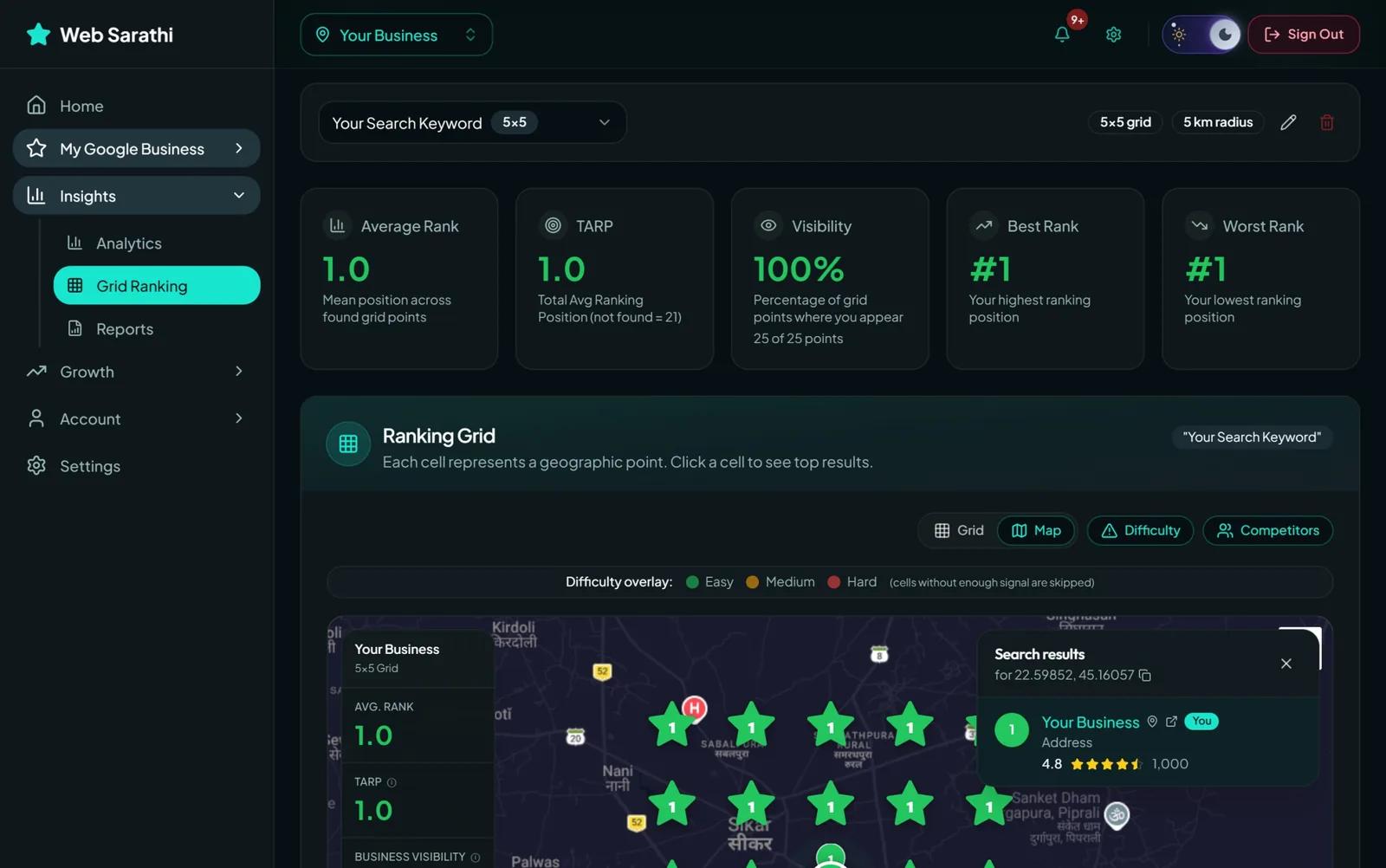
Toothache is a proximity search made within hours. Grid ranking measures your position from dozens of points around the practice, so you can see which streets return you and which return the clinic two junctions away.
- Separate the emergency keywords from the elective ones — they rank differently
- See the residential pockets where you do not appear at all
- Judge a second surgery on coverage evidence rather than instinct
Before-and-after smiles, consent, and the line dentistry cannot cross
The elective half of this business is sold on photographs and nothing else comes close. A patient considering veneers, aligners or smile design is trying to answer one question — can these people produce a result I would be happy with — and no amount of writing answers it. Your own completed cases are the only evidence that does.
Which puts dentistry in an awkward position, because those photographs are clinical images of an identifiable person, produced in the course of treatment, and using them for marketing is a different act from taking them for records. Two things have to be right before anything is published.
The first is consent, and it has to be specific rather than general. A form signed at registration authorising treatment does not authorise publication. Ask separately, in writing, at the point the case is finished and the patient is pleased: whether the images may be used, whether the face may be shown or only the mouth, whether the practice may name them, and whether the consent may be withdrawn later. Most patients say yes to some version. Almost all of them object to discovering it afterwards.
The second is what the images are allowed to claim. Medical and dental advertising in India is constrained — the professional conduct rules that govern practitioners are covered in the clinic guide in this series and apply here in full — and a before-and-after set carries an implicit promise about outcomes. Keep it factual: this patient, this treatment, this duration, this result. Avoid anything that reads as a guarantee, avoid retouching beyond correcting exposure, and do not present a laboratory mock-up or a digital smile preview as though it were a photograph of a finished case. That last one is common and it is the version patients feel most deceived by.
On the craft, the practical points are small and make an enormous difference. Shoot the before and the after under the same light, at the same angle, at the same distance, with the same lens. A great deal of dental before-and-after imagery online is unpersuasive precisely because the after is better lit and better framed, which a viewer registers as manipulation even when the clinical result is genuine. Consistency reads as honesty.
Where consent is refused or you would rather not ask, there is still plenty to photograph that most practices neglect: the surgery itself, clean and well lit; the sterilisation area, which answers a question a lot of patients have and never ask; the waiting area; the team. And the profile benefits from a steady flow of new images regardless of what they show, because a practice posting recent photographs looks like a practice that is busy, and one whose most recent image is four years old does not.
Ask separately, when the case is finished
A treatment consent form is not a publication consent. Ask in writing at the point the patient is pleased with the result, which is also when they are most likely to agree.
Name what the consent covers
Face or mouth only, whether they may be named, which platforms, and that it may be withdrawn. Most patients say yes to a version; almost all object to finding out afterwards.
Shoot both frames identically
Same light, angle, distance and lens. A better-lit after reads as manipulation to a viewer even when the clinical result is entirely genuine.
Label a mock-up as a mock-up
A digital smile preview presented as a finished case is the version patients feel most deceived by, and it is common enough that many now assume it.
Keep publishing even without faces
The surgery, the sterilisation area, the team. A practice posting recent photographs looks busy; one whose newest image is four years old looks closed.
The six-month recall is a review engine most practices never switch on
Dentistry has something the rest of medicine does not: a clinically justified reason to contact every patient twice a year, forever. The six-month check-up and cleaning is not a marketing invention, it is standard preventive practice, and it means a dental patient is one of the few healthcare relationships with a natural recurring appointment built into it.
Set against the trades in this series, that is a strong position. A real estate agent sees a buyer once a decade. An interior designer completes five projects a year. A dental practice has a legitimate reason to be in touch with several hundred people every six months and, in most Indian practices, does nothing with it at all. The recall exists in the appointment book as an intention and is never actually run.
The commercial case is obvious and the search case is the one that gets missed. Review recency is a live ranking input, and it is what separates two profiles with similar review counts. A practice running a genuine recall has a steady, predictable stream of patients passing through reception in a good mood, having had twenty minutes of cleaning rather than an hour of drilling — which is the single easiest moment to ask for a review that exists anywhere in this guide.
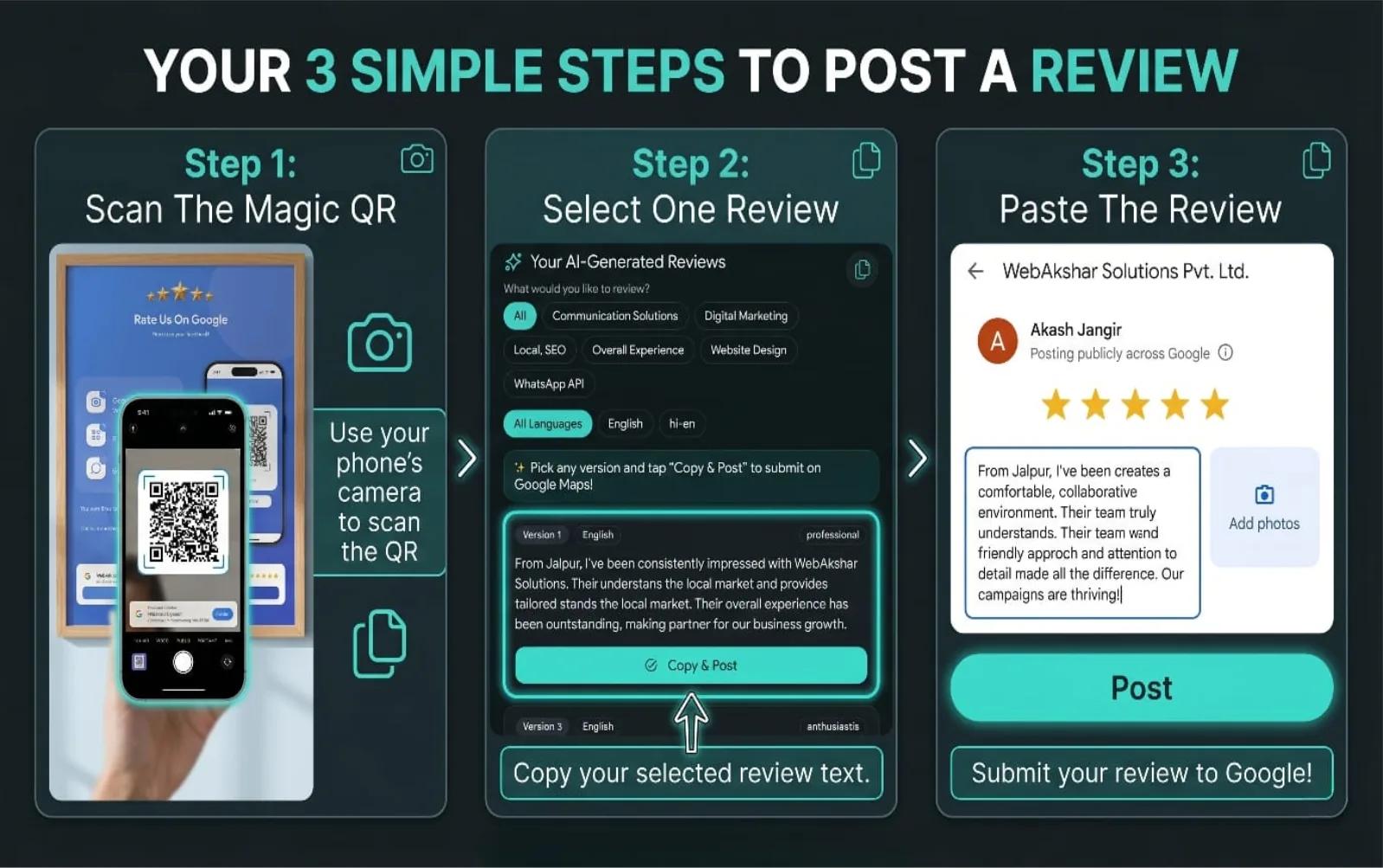
The mechanics are unglamorous. Keep a list. Contact people at six months by whatever channel they actually respond to, which in India is overwhelmingly WhatsApp rather than email. Make the message about their teeth rather than about your diary. And ask for the review at the end of the hygiene appointment, at the counter, with a code rather than a promise to send a link — the same pattern that works in every other trade here, applied to the one healthcare relationship that offers it repeatedly.
It also fixes the review-mix problem that dental profiles tend to have. Left alone, the reviews a practice accumulates skew towards big, emotional cases — the implant that changed somebody’s life, the emergency handled at ten at night — with very little in between. Those are excellent and they are not what most searchers are shopping for. A steady layer of ordinary reviews about routine visits, in ordinary language, is what makes a profile read as a practice people actually use rather than one that occasionally does something dramatic.
One boundary worth naming, since this is healthcare. A recall is a clinical reminder and should read like one. It is not an opportunity to market elective treatment to somebody who came in for a cleaning, and patients notice immediately when a health reminder is really an advertisement. The conduct rules that govern how a practitioner may solicit are covered in the clinic guide; the practical version is that the message should be one a patient would be glad to receive if they thought about who sent it and why.
A recall list that exists only as an intention
Most Indian practices have the clinical justification to contact several hundred patients twice a year and never do it. It is the strongest recurring relationship in healthcare and it is usually left in the appointment book.
Asking for the review after difficult treatment
The hygiene appointment is twenty minutes and pleasant. The root canal was an hour and was not. Ask at the easy one, which happens twice as often anyway.
A review profile made only of dramatic cases
Implants that changed a life and emergencies at ten at night are excellent and are not what most searchers are shopping for. Ordinary reviews about routine visits are what make a practice read as one people actually use.
Turning a clinical reminder into an advertisement
Patients notice instantly when a health message is really a promotion for elective treatment, and it costs more trust than the treatment is worth. Send a reminder a patient would be glad to receive.
Ask after the cleaning, not after the root canal
The hygiene appointment is twenty pleasant minutes and it happens twice a year, which makes it the easiest review moment in healthcare. A code at reception turns it into a routine.
- Scan at the counter and the review is drafted in a few taps
- Builds the layer of ordinary reviews a profile of dramatic cases lacks
- Recency is a live ranking input, and recall supplies it on a schedule
The patient who flies in, and whether you actually want them
India is a genuine destination for dental treatment. The arithmetic is not subtle: a full-mouth rehabilitation, a set of implants or extensive crown work can cost a fraction here of what it costs in Western Europe, North America or the Gulf, and the standard of work at a good Indian practice is entirely comparable. That produces a real stream of patients — NRIs timing treatment around a visit home, and foreign patients travelling specifically for it.
The searches are distinct and they are not local searches at all. Dental implants cost in India, best dental clinic in a named city for foreigners, dental tourism packages, full mouth rehabilitation India. Nothing about your Google Business Profile’s proximity to anybody helps you here, because the person searching is four thousand kilometres away. This is a website and content problem, and it is one of the few places in this series where organic content genuinely outranks the local listing in importance.
The NRI segment is the more accessible half and is worth separating from the rest. An NRI patient usually has a family connection to the city, may already know your practice by reputation, and is working within a fixed three or four week visit. Their real anxiety is not cost or quality — it is scheduling. Can the treatment be completed inside the window, what happens if something needs adjustment after they leave, and who handles a problem in month four. A practice that answers those three questions plainly on a page is doing something almost none of its competitors have bothered to.
Before pursuing any of it, it is worth being honest about whether you want it, because the operational demands are real. Treatment has to be compressed into a short window, which changes sequencing and sometimes clinical decisions. Follow-up is difficult and warranty questions are awkward when the patient is in another country. Communication may cross languages and time zones. And the cases are large, which means a dissatisfied outcome is a large problem. A small practice without the chair time or the appetite for that is entirely reasonable to leave it alone.
If you do want it, the content that works is specific and administrative rather than promotional: realistic treatment timelines for a compressed schedule, what can and cannot be finished in three weeks, a clear position on what happens if adjustment is needed after departure, whether you coordinate with a dentist in their country, and honest pricing in a currency they think in. Add practical detail about the city — where to stay near the clinic, how far from the airport — because that is genuinely what somebody planning this is trying to work out.
One thing not to do, and it is common enough to be worth stating: do not describe treatment as a package alongside sightseeing, and do not present clinical work in the register of a holiday offer. It reads badly to serious patients, it sits uncomfortably with the conduct expectations on a practitioner, and the patients it attracts are the ones most likely to be disappointed by the reality of oral surgery on a schedule.
| Patient | What decides it | Where the work goes |
|---|---|---|
| Local clinical | Proximity, hours, and whether the phone was answered | The Google profile — hours, phone, walk-in policy, emergency availability |
| Local elective | Photographs of previous cases, price bands and instalments | The profile plus treatment pages, and consented before-and-after work |
| NRI, visiting | Whether it can be finished inside a three-week window | A page on compressed scheduling and what happens after they fly back |
| International | Cost comparison, and evidence the standard is genuinely equivalent | Content and website entirely — your pin helps you not at all here |
Dental Clinic SEO questions, answered
The questions Indian dental clinic businesses ask us most often.