Restaurant SEO in India: how to win Google Maps when the aggregator owns the search
A restaurant in India competes for attention in a way almost no other local business does. Your customer does not usually open Google and type your cuisine. They open Zomato or Swiggy, where the ranking is bought, the discount is compulsory, and roughly a quarter to a third of the bill leaves before you have paid for the atmosphere or the staff.
That makes Google an unusual asset for you. It is the one high-intent surface where a customer can find you, look at you and decide to come to you without a marketplace standing in the middle taking a cut. This guide is about winning it: the hours and menu accuracy that decide whether you appear at all, the photo problem that is worse for restaurants than for anybody else, handling review volume that would drown a plumber, and the specific Google rules that catch out cloud kitchens and multi-brand operators.
None of it argues that you should leave the aggregators. It argues that the covers you can win without them are the most profitable covers you will serve this year.
Your real competitor is the aggregator app, not the restaurant next door
Ask an owner who they compete with and they will name the place across the road. Look at where the orders actually come from and the answer is different: you compete with an app that has already decided which twelve restaurants a hungry person sees, and you are paying that app for the privilege of being one of them.
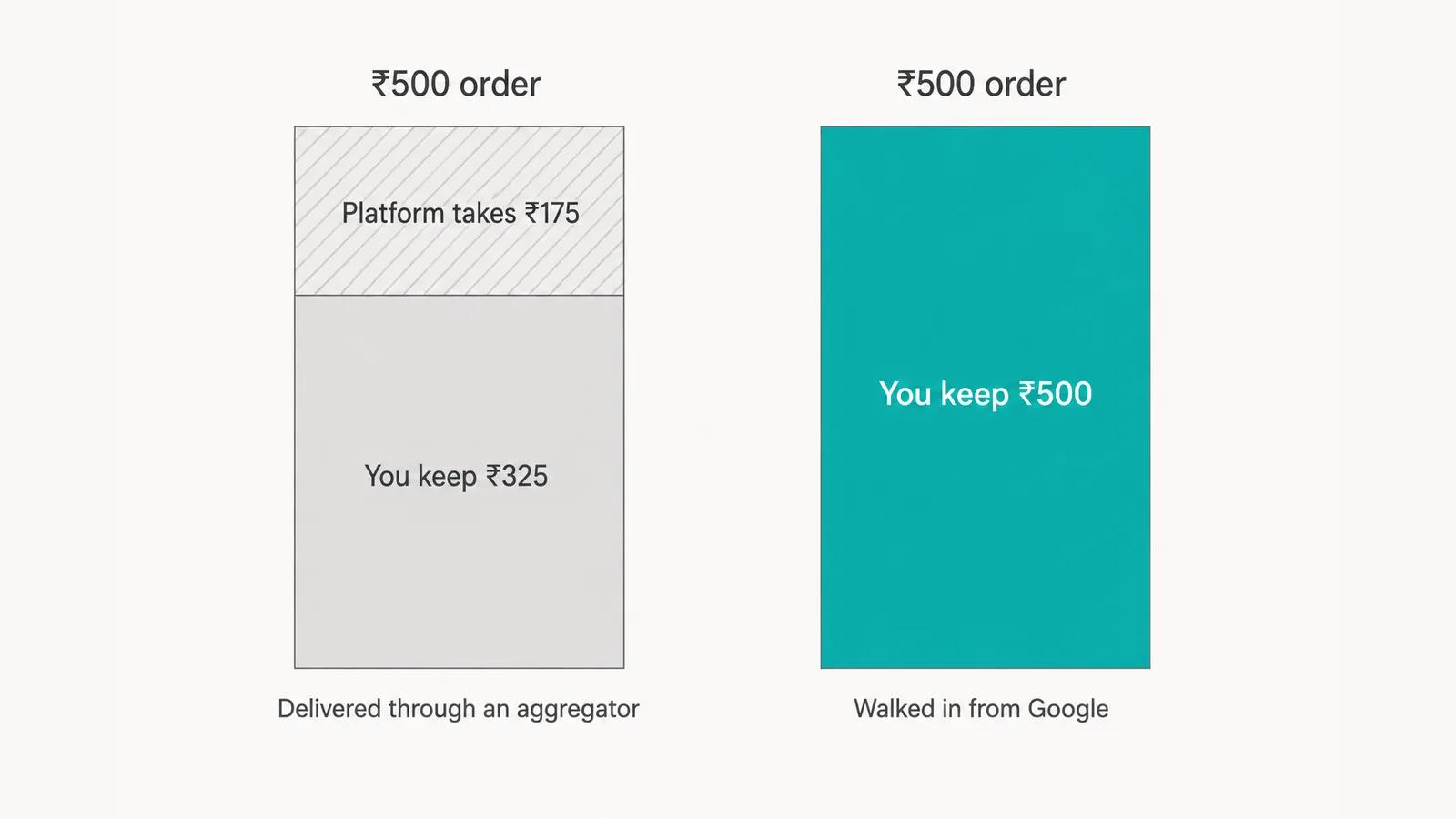
The economics are worth stating plainly because they are what makes everything else in this guide worth an afternoon. Base commissions in 2026 run in the region of eighteen to twenty-eight per cent on Zomato and seventeen to twenty-five on Swiggy, varying by city, cuisine, outlet age and how hard you negotiated. On top of that sit per-order platform fees, GST charged on the commission itself, and the discounts you are effectively required to fund to stay visible in the listing. Stack it up and the effective deduction commonly lands somewhere between a quarter and a third of the order value.
On a five hundred rupee order that can mean taking home somewhere near three hundred and twenty-five rupees, out of which you still have to buy the food, pay the kitchen and light the room. It is not a scandal — the platforms deliver real demand and real logistics — but it does mean the marginal profitability of an aggregator cover and a walk-in cover are not remotely the same number, and any marketing decision that treats them as equivalent is wrong.
Google sits in a different place in the funnel and that is exactly why it is valuable. Someone searching "cafe near me" or "best biryani in Kondapur" on Maps has intent and no marketplace between them and you. They see your rating, your photographs, your hours and your location, and then they either call, get directions or leave. There is no commission event anywhere in that chain.
The realistic goal is not to replace the aggregators. It is to make sure that the customer who is going to eat out anyway, and who is deciding where on their phone, finds you at the top of a surface where the whole bill stays in your till. For most independent restaurants that is a handful of covers a day, and a handful of covers a day at full margin is a materially different business.
| Channel | What comes off the top | Roughly what you keep | What it costs to win |
|---|---|---|---|
| Zomato / Swiggy delivery | Commission, platform fee, GST on commission, funded discounts | ₹325–375 | Ad spend and discounting inside the app |
| Aggregator dine-out deal | Platform cut plus the discount you agreed to | ₹375–425 | A permanent price expectation that is hard to unwind |
| Walk-in from Google Maps | Nothing | ₹500 | The profile work in this guide |
| Direct call or your own ordering link | Payment gateway only | ₹485–500 | Being findable, and picking up the phone |
Open now is a filter before it is a ranking factor
Restaurant search has a property that most local verticals do not: an enormous share of it is immediate. Someone is hungry, they are nearby, they are deciding in the next four minutes. Google knows this, which is why hours are not a piece of profile housekeeping for a restaurant — they are a gate.
When a customer filters to open now, or simply searches at nine at night, a restaurant whose hours say it closed at eight is not ranked lower. It is removed. This is the single most common way Indian restaurants lose search traffic they had already earned, and it happens invisibly, because the owner is standing in a full room at nine and has no way of knowing about the twelve people who never saw them.
The problems compound in this trade specifically. Kitchens close before the restaurant does. Lunch service ends and dinner service starts, and a profile with a single continuous window tells a customer at four in the afternoon that you are serving when the kitchen is cold. Sunday is different. The bar runs later than the kitchen. Almost none of that is reflected in the average Indian restaurant profile, which carries one set of timings entered on the day the listing was created.
Then there are the exceptions, which matter more here than anywhere else. Holi, Diwali, a local bandh, a staff wedding, the day the municipality cuts the water. Special hours exist as a field precisely for this and are almost never used, so customers arrive at a closed shutter, and a portion of them leave a one-star review about it — which costs you far more than the closure did.
Fix this once with a structure that matches operations rather than aspiration: separate lunch and dinner windows if that is how you actually run, a different Sunday, and a standing habit of entering special hours the moment a closure is decided rather than the morning it happens.
It is worth understanding why this field carries so much more weight for restaurants than for other trades. Google is not merely displaying your timings, it is using them to decide whether you are a valid answer to a query being asked right now. A hardware shop that is shut at nine at night is still a reasonable result for somebody planning tomorrow. A restaurant that is shut at nine is not an answer to a person who wants to eat at nine, so Google removes it rather than ranking it low. That is why hours accuracy behaves like an on-off switch here and like a quality signal everywhere else, and why it is the first thing to fix rather than the last.
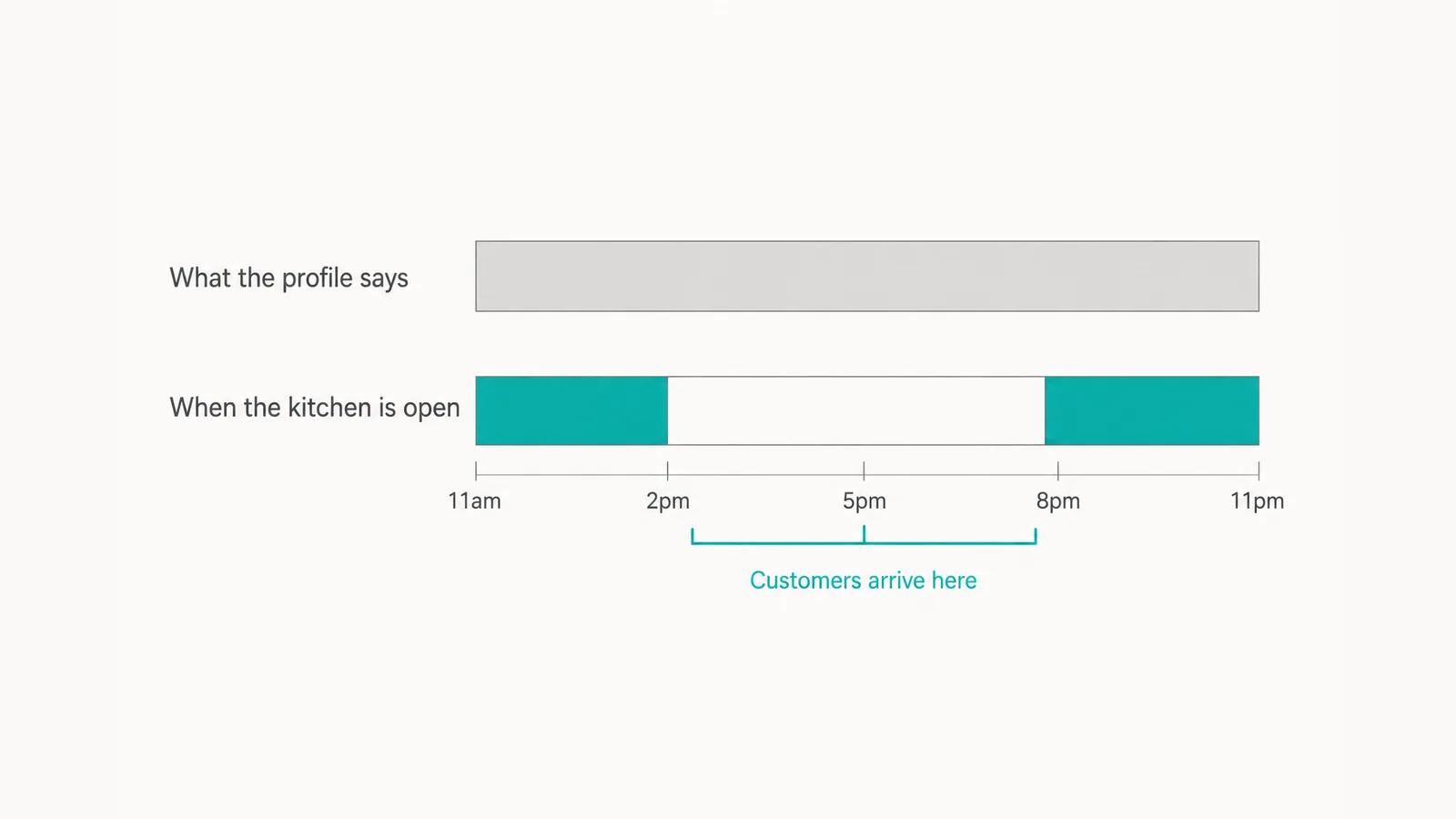
One continuous window when you run two services
A profile saying 11am to 11pm when the kitchen shuts from 4 to 7 sends customers to a closed kitchen and collects the reviews that follow. Split the windows.
Hours that were true at launch
Most restaurant profiles carry the timings entered on the day they were created. If you extended weekend service eighteen months ago and never updated the profile, Google has been hiding you at the busiest hour of your week.
Festival closures never entered
Special hours take thirty seconds and prevent the specific review that says the place was shut. Enter them when the closure is decided, not on the day.
A last-order time nobody publishes
If the kitchen stops taking orders forty-five minutes before close, say so in the profile description. The alternative is a customer who arrives at 10:50 and reviews you at 11:10.
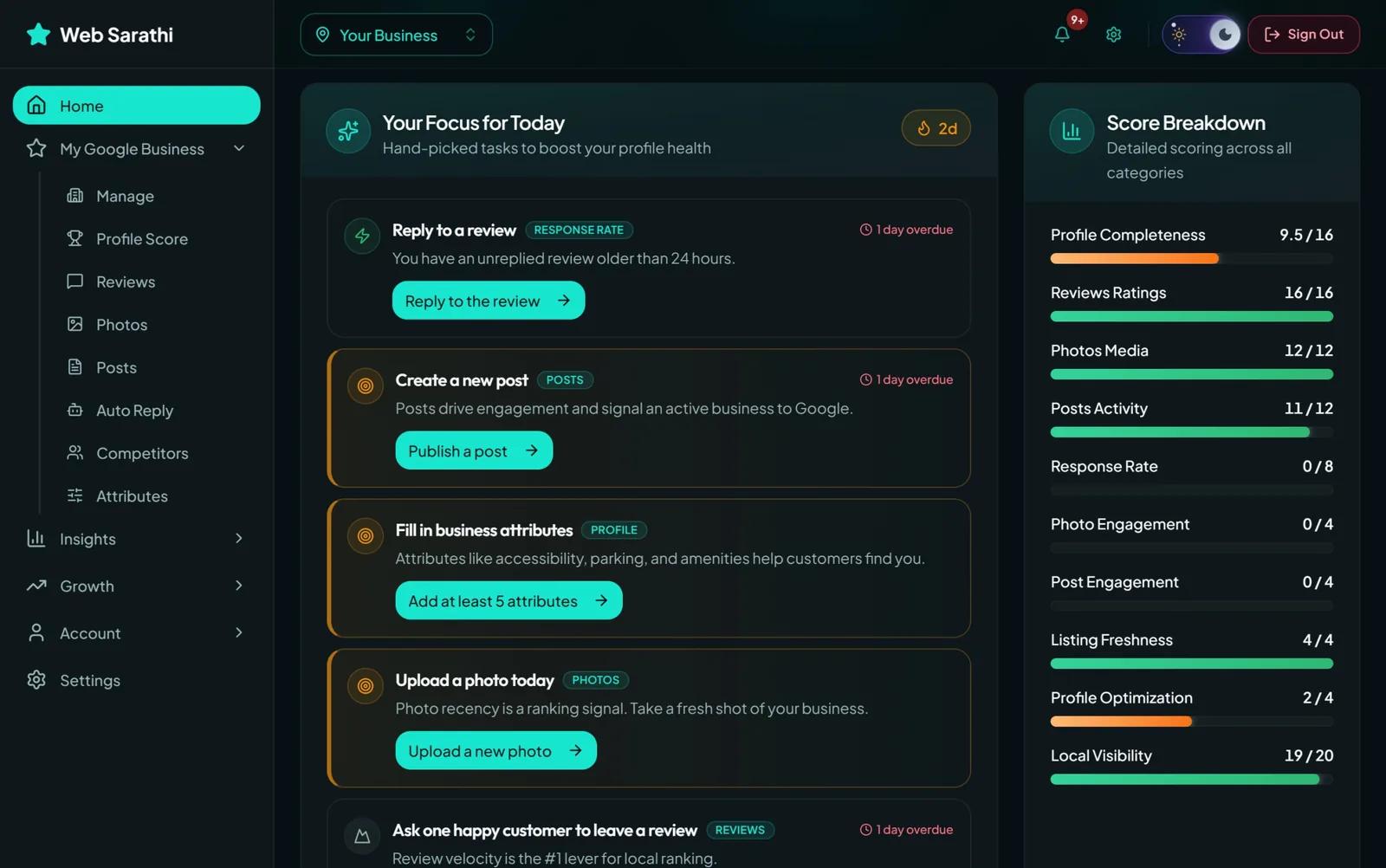
One list a day, so the profile never goes stale
Nobody running a kitchen is going to remember to check hours, add a photograph and answer a review. Web Sarathi turns all of it into a single short list each morning, ordered by what actually costs you covers.
- Surfaces stale hours and missing special hours before a festival, not after
- Ordered by impact, so twenty minutes goes to the expensive things first
- Works on a phone, between services, which is when it will actually get done
Why a restaurant profile goes stale faster than any other
Every local business benefits from fresh photographs. For restaurants the effect is sharper and the decay is faster, for a reason specific to the trade: your customers photograph their food. A dentist collects almost no user images. A busy cafe collects them continuously, which means the gallery a prospective customer scrolls is substantially not yours, and it drifts further out of your hands every month you do not add to it.
That cuts both ways. Customer photographs are credibility you could never buy, and they are also the badly-lit plate shot taken at eleven at night that now sits at the top of your gallery. You cannot remove it. You can out-supply it, and that is the entire strategy: a steady flow of your own images, taken deliberately, so that what a stranger sees first is the version of your restaurant you would choose.
Shoot what the customer is deciding on. The room as it looks when it is full, not empty at eleven in the morning. The signature dish as it is actually plated, not as it was styled for the launch menu. The counter, the frontage at night so somebody can find the door, the seating so a family can tell whether there is room for six, the parking situation. These answer real questions. A plate on a slate against a black background answers none of them.
Cadence beats production value here. A restaurant that adds a few honest photographs every week reads as open and busy. One that posted twenty beautiful images at launch in 2023 and nothing since reads as closed, and a meaningful number of customers genuinely assume it is. In a trade with a high failure rate, looking alive is itself a ranking-adjacent asset.
The same logic applies to posts. A restaurant has genuine news every single week — a seasonal ingredient, a festival special, a new dessert, extended weekend hours — which is more than most businesses can say, and it is why the profiles that stay active in this vertical tend to be restaurants that decided once to make it somebody’s job rather than restaurants with more time.
One dish, shot at service
Whatever came out of the pass looking best today, in the light of the room, plated the way a customer will actually receive it. Thirty seconds on a phone is enough.
The room, occupied
A full room is the single most persuasive photograph a restaurant can publish, and it is the one nobody takes because everyone is busy when it exists.
A post tied to the weekend
The special, the extended hours, the thing that runs out by nine. Published on Friday morning, when people are deciding about Friday night.
Frontage, counter and parking
Refresh the practical photographs that help a stranger find the door and judge whether to bring the family. These age quietly and matter more than anyone expects.
The high-volume review problem, and the one bad night
Most local businesses struggle to collect reviews. Restaurants have the opposite problem, and it is genuinely harder. You serve hundreds of people a week, a fraction of them write something, and the flow never stops. The work is not collection, it is handling — and the specific risk is that a single bad service night produces a cluster of angry reviews within twenty-four hours that visibly drags an average built over two years.
Speed is the whole game. A complaint answered the same day reads as a restaurant that is paying attention, and it frequently converts the complainant into somebody who comes back. The same complaint answered three weeks later reads as a restaurant that does not care, and by then it has been read by several hundred people deciding where to eat. Nothing else in restaurant reputation management has a return like reply latency.
What a reply is for is also widely misunderstood. You are almost never writing to the reviewer. You are writing to the next fifty people who read that review while deciding whether to book, and what they are assessing is your temperament. An owner who argues about whether the wait was really forty minutes loses those fifty people regardless of who was right. An owner who says the wait was unacceptable on Saturday, that the second station was down, and that it has been fixed, wins a surprising number of them.
Because the volume is high and the tone must be consistent, this is one of the few places where restaurants genuinely benefit from a system rather than an owner with good intentions. Every review answered, in the language it was written in, within hours rather than weeks, is a materially different operation from the one most Indian independents run.
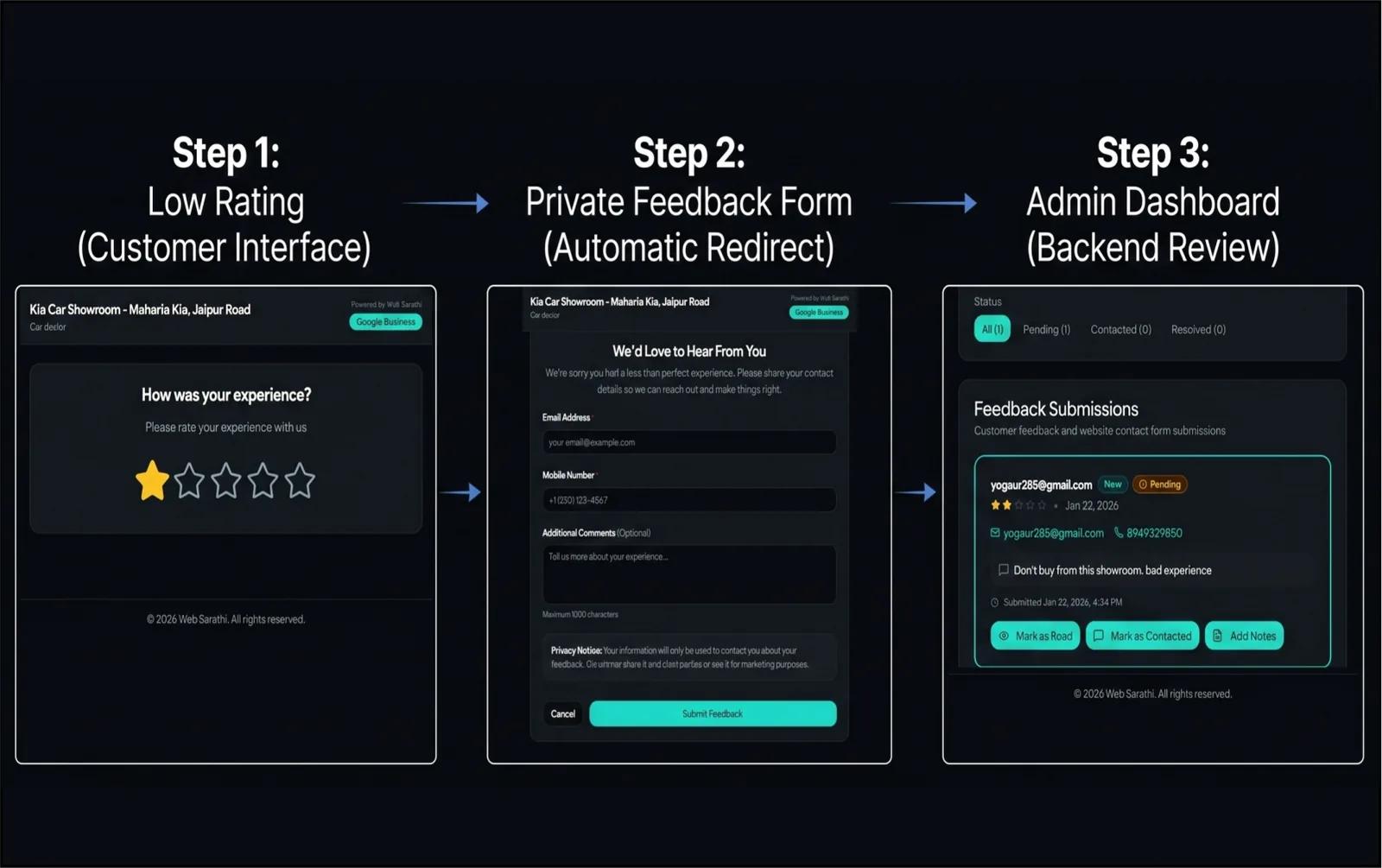
The other half of the problem is prevention. A meaningful share of one-star reviews are written by a customer who wanted to complain to somebody in the building and could not find anybody to complain to. Giving unhappy diners a route that reaches you before it reaches Google — a QR code on the bill, a number that actually gets answered — resolves a proportion of them privately, which is better for the customer and better for you than a public argument.
How most restaurants handle reviews
- Replies happen when the owner has a quiet evening, which is never
- The angry ones get answered first and defensively
- Positive reviews are ignored entirely, so nobody sees a live owner
- A bad Saturday produces four reviews and no response for a month
- Nobody asks a happy customer for anything
What actually works
- Every review answered within hours, in the language it was written in
- Replies written for the next fifty readers, not for the reviewer
- Complaints acknowledged specifically, with what changed
- An in-house route for unhappy diners that reaches you before Google does
- A standing prompt at the bill so happy customers actually write
Catch the complaint before it becomes a one-star review
A large share of angry restaurant reviews come from a diner who wanted to tell somebody in the building and could not find anybody. Review Shield gives them a route that reaches you first, and drafts a reply to everything that still lands in public.
- Unhappy diners reach you privately instead of writing it on Google
- Every public review drafted for reply within the hour, in the reviewer’s language
- A bad Saturday stops turning into a month of unanswered complaints
Cloud kitchens, shared addresses and several brands at one pin
A large share of new Indian food businesses are not restaurants in the traditional sense. They are two or three delivery brands running out of one kitchen, or a counter inside a shared facility, or a dine-in restaurant that also operates a separate delivery-only label. This is where Google’s rules stop being generic advice and start being the difference between a listing that ranks and a listing that gets removed.
The rules are more permissive than most operators assume, and stricter in the specific ways that catch people out. Multiple businesses at one address may each have their own profile if they are genuinely distinct businesses with different names and clearly visible separate signage. Multiple virtual brands out of one kitchen are permitted, subject to additional verification. Co-located food brands each need permanent separate signage, and should only display the address if they offer pick-up to all customers.
The delivery-only case is the one operators get wrong most often. A brand that exists only for delivery is permitted a profile if it has distinct branded packaging and a distinct website, and it must add service areas and hide the address rather than displaying a kitchen customers cannot visit. Operators who instead publish the kitchen address for four brands, with no signage and no pick-up, are creating exactly the pattern Google removes listings for.
The temptation in a low-margin trade is obvious: more listings look like more visibility. In practice a cluster of thin, near-identical profiles at one address competes with itself, dilutes whatever reviews you collect across several averages, and puts every one of them at risk together. One brand with genuine signage, real packaging, its own site and a real review base outperforms four ghosts, and it survives.
If you run a legitimate multi-brand operation, the work is documentation rather than cleverness. Photograph the signage. Keep the packaging distinct and photographable. Give each brand a real website, not a page anchor. Then verification, when it comes, is a formality rather than a crisis.
Four brands, one address, no signage
Co-located food brands need permanent separate signage to hold separate profiles. Without it you are running the exact pattern Google removes, and removals tend to arrive for all of them at once.
A delivery-only brand showing the kitchen address
If customers cannot collect from you, the address should be hidden and service areas set instead. Publishing a kitchen nobody can visit is a guideline breach and a stream of confused arrivals.
Brands with no distinct packaging or website
These are the two evidence items that separate a legitimate virtual brand from a duplicate listing. If you cannot produce them, you do not yet have a second business in Google’s terms.
Keyword-stuffed brand names
Naming a listing Best Biryani Near Me Andheri is not a growth tactic, it is the most reliably enforced violation on Google Maps. Use the name on the signage and the packaging.
Festival weeks, exam weeks and the demand you can see coming
Restaurant demand in India is not a smooth line with a weekend bump. It is a series of sharp, predictable, culturally specific spikes and troughs, and the profiles that do well are the ones publishing into the spike a few days before it lands rather than reacting to it afterwards.
Some of the pattern is obvious. Diwali, Eid, Christmas and New Year drive group dining and pre-booking. Navratri produces a large, specific, and very poorly served demand for particular food, and the restaurants that publish a Navratri menu ahead of it capture searches nobody else has bothered to answer. Long weekends fill anything near a highway. Wedding season fills anything with a function room and empties the casual places at the same time.
Some of it is local and only you know it. The exam fortnight that empties a college-area cafe. The month the nearby office park runs a shutdown. The monsoon week when nobody walks anywhere and delivery triples. A restaurant that has run for three years already holds this calendar in the owner’s head; almost none of them have ever written it down and turned it into a posting schedule.
The practical form this takes is unglamorous. Sit down once with a year planner, mark the fifteen dates that visibly move your covers, and decide what you will publish for each and when. Then schedule it. The reason most restaurants do not do this is not disagreement — it is that the week before Diwali is exactly when nobody has an hour spare, which is precisely the argument for having done it in August.
Two operational details ride along with this. Update special hours for every festival closure at the same time you plan the posts, because those are the same dates. And if you take bookings for these weeks, make sure the route to book is unmissable on the profile, because a customer planning a Diwali dinner three days out will not chase a number that goes unanswered.
Decide the offer and set the hours
Festival menu, group booking terms, and any closure entered as special hours. Two weeks out, while there is still slack to change your mind.
Publish the first post and refresh photographs
This is when planning searches for the date begin. A post published on the day of the festival has missed almost everyone who was deciding.
Second post, with the practical detail
Timings, whether walk-ins are possible, parking, and the number to call. The customer at this stage is resolving logistics, not being persuaded.
Answer everything the same day
Calls, messages and reviews. Festival-week reviews are disproportionately read, because the next festival brings the next wave of people deciding.
Post the evidence, then plan the next spike
The full room, the dish that sold out. It is credibility for the next occasion, and it takes ten minutes while it is fresh.
What one place in the local pack is worth, per cover
It is worth closing with arithmetic, because restaurant owners are asked to invest attention in things whose payoff is described vaguely, and the payoff here is not vague at all.
The local pack shows three results. Attention drops steeply after the first, and the searcher in this vertical is unusually decisive — they are hungry, nearby, and choosing in minutes rather than comparing over days. Moving from position six, where you are on a second screen nobody scrolls to, into the visible three is not an incremental improvement in impressions. It is the difference between being in the choice set and not being in it.
Put a number on it in your own terms. If the change brings five additional walk-in covers a day at an average bill of six hundred rupees, that is three thousand rupees a day of revenue on which you paid no commission and no discount. Across a month that is around ninety thousand rupees, at a margin closer to your dine-in margin than to your delivery margin. Against that, the work in this guide is an afternoon of setup and about twenty minutes a day.
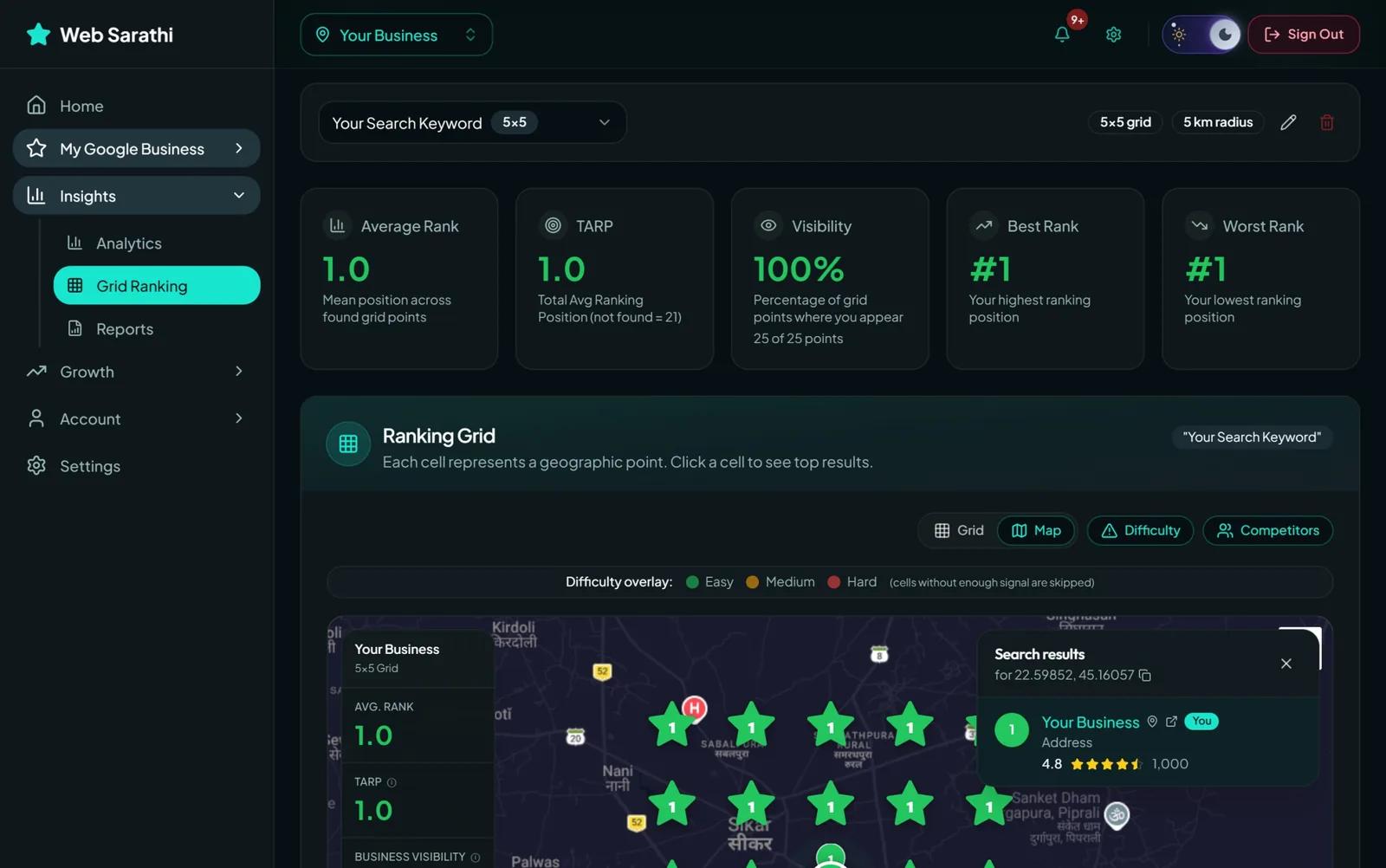
The reason to be sceptical of your own estimate of where you currently stand is that you almost certainly measure it wrong. Owners check their ranking by searching from inside the restaurant, where they are standing on the pin and always look excellent. The customer who matters is two kilometres away in a different part of the neighbourhood, and your position in their result is a number you have never seen.
Measuring rank across a grid of surrounding points is what turns this from an argument into a spreadsheet. You find out which streets you own, which you are invisible on, and whether the competitor you worry about is actually beating you or merely closer to where you happened to check. Almost every restaurant that runs this the first time discovers their catchment is smaller than they believed — which is unpleasant, and is the only honest starting point for improving it.
One last piece of arithmetic that owners rarely run: the covers you win this way are not marginal covers, they are the most profitable ones on your books. A delivery order arrives with a commission already deducted, no beverage attached in most cases, and packaging costs on top. A walk-in orders drinks, stays longer, occasionally brings four people instead of two, and pays the full menu price. If your delivery contribution margin is materially thinner than your dine-in margin, and for most Indian independents it is, then five walk-in covers a day are worth considerably more than the five delivery orders they superficially resemble. That gap is the actual return on the work in this guide, and it is larger than the revenue line suggests.
| Assumption | Value | Why it matters |
|---|---|---|
| Additional walk-in covers per day | 5 | A modest gain from entering the visible three |
| Average bill per cover | ₹600 | Use your own, including beverages |
| Additional revenue per month | ≈ ₹90,000 | No commission, no funded discount |
| Commission avoided versus the same value delivered | ₹22,500–31,500 | At a 25–35% effective aggregator deduction |
| Effort required | One afternoon, then ~20 minutes a day | Hours, menu, photos, replies, posts |
Find out which streets you are actually invisible on
Searching from behind your own counter tells you nothing. Grid ranking measures your Maps position from dozens of points around the restaurant and returns a heat map of your real catchment.
- See how far your visibility actually reaches, street by street
- Track a dish or cuisine keyword over weeks instead of guessing
- Compare honestly against the neighbour you assume is beating you
Restaurant SEO questions, answered
The questions Indian restaurant businesses ask us most often.