Hotel SEO in India: rank on Google and take back the booking the OTA is charging you for
Almost every guide to hotel SEO you will find was written for a market where the traveller books direct by default and the online travel agency is one channel among several. In India the marketplace is the default. MakeMyTrip is where the search begins for a very large share of domestic leisure travel, and by the time a guest reaches your own website they have usually already seen your room, your rate and three competitors on somebody else’s page.
So this guide is not really about ranking for the phrase "hotel in Lonavala". It is about the specific mechanics of how Google surfaces hotels — which is a different product from the ordinary local pack — and about using those mechanics to move a slice of your business from a channel that takes a fifth of the room rate to one that takes almost nothing.
Read it in order if you are starting from a neglected profile. If the basics are already right, the sections on free booking links, hotel attributes and shoulder-season work are where the money is.

What an OTA booking actually costs you, per room night
Every serious conversation about hotel marketing in India ends up at the commission line, so it is worth starting there. The reason search traffic is worth chasing is not a ranking position. It is the margin you stop giving away when a guest books with you instead of through a marketplace, and that number is large enough to fund everything else in this guide several times over.
The published ranges are broadly consistent. MakeMyTrip sits somewhere between roughly twelve and twenty-five per cent depending on property category, city and which promotional programmes you have opted into, with budget properties in tier-two and tier-three cities commonly landing at the upper end of that band. Booking.com runs at roughly fifteen to twenty per cent, and its Preferred Partner tier costs more in exchange for visibility. A booking taken through your own engine costs you a payment gateway fee of two to three per cent and nothing else.
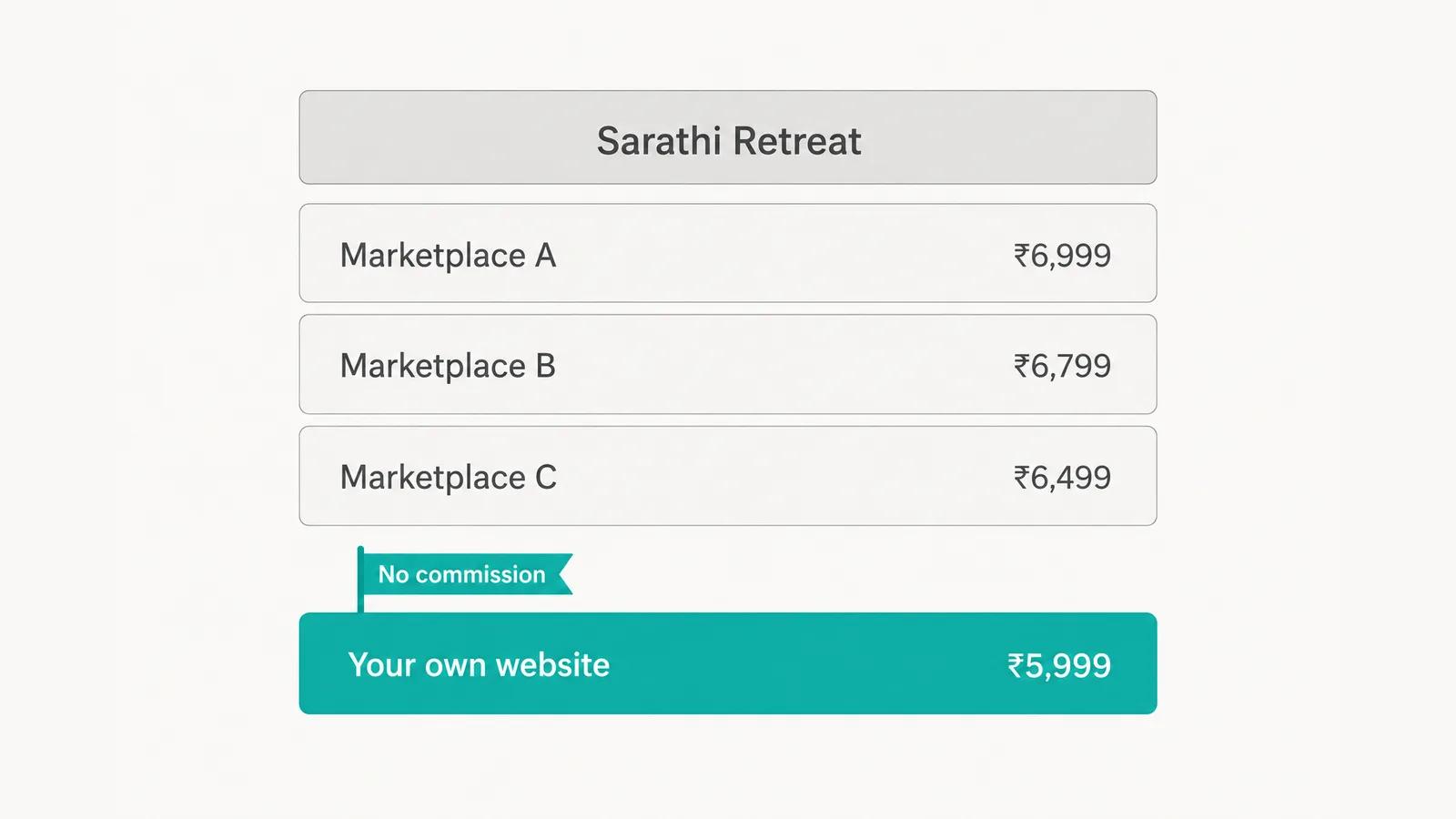
Put a single room through that. On a five thousand rupee room night at twenty per cent, the marketplace keeps a thousand rupees and you bank four thousand. The identical booking taken directly costs you about a hundred and twenty-five rupees in gateway charges. The eight hundred and seventy-five rupee gap is not a marketing budget you have to find — it is margin that already exists inside the transaction and is currently walking out of the building.
Now scale it to a property. Forty rooms at sixty per cent occupancy is twenty-four occupied rooms a night. If half of those arrive through a marketplace, you are giving away in the region of ten and a half thousand rupees a night, which is a little over three lakh rupees a month, every month, on rooms you had already sold. Shifting even a fifth of that volume to direct is worth more than most Indian independents spend on marketing in a year.
None of which is an argument for delisting. The marketplaces genuinely produce demand you would never have reached, and the billboard effect is real: a meaningful share of guests discover you on MakeMyTrip and then search your property name on Google before booking. That branded search is the single most valuable query your hotel will ever own, and it is the one most Indian properties quietly lose — because when the guest arrives, Google shows them a row of marketplace rates and no direct option at all. The rest of this guide is largely about fixing that.
| Channel | Typical deduction | You keep on ₹5,000 | What it costs to win |
|---|---|---|---|
| MakeMyTrip | 12–25%, plus GST charged on the commission itself | ₹3,750–4,400 | Rate parity, promo opt-ins and permanent price pressure |
| Booking.com | 15–20%, more on Preferred Partner | ₹4,000–4,250 | Paying for placement to stay visible against neighbours |
| Google free booking link | Nil to Google | ₹4,850–4,900 | Connectivity setup and honest rate parity |
| Your own site or phone | 2–3% gateway, or nothing on cash | ₹4,850–5,000 | Being the profile the guest finds and trusts |
Hotel search is a different Google product from ordinary local search
This is the single most useful thing to understand, and it is what generic local SEO advice gets wrong about hotels every time. Search for a dentist and Google shows a three-result local pack: name, rating, address, directions. Search for a hotel and you get something else entirely — a travel module with a date picker, a price row, a filter rail down the side, a map that redraws as you pan, and a class rating sitting under the review stars.
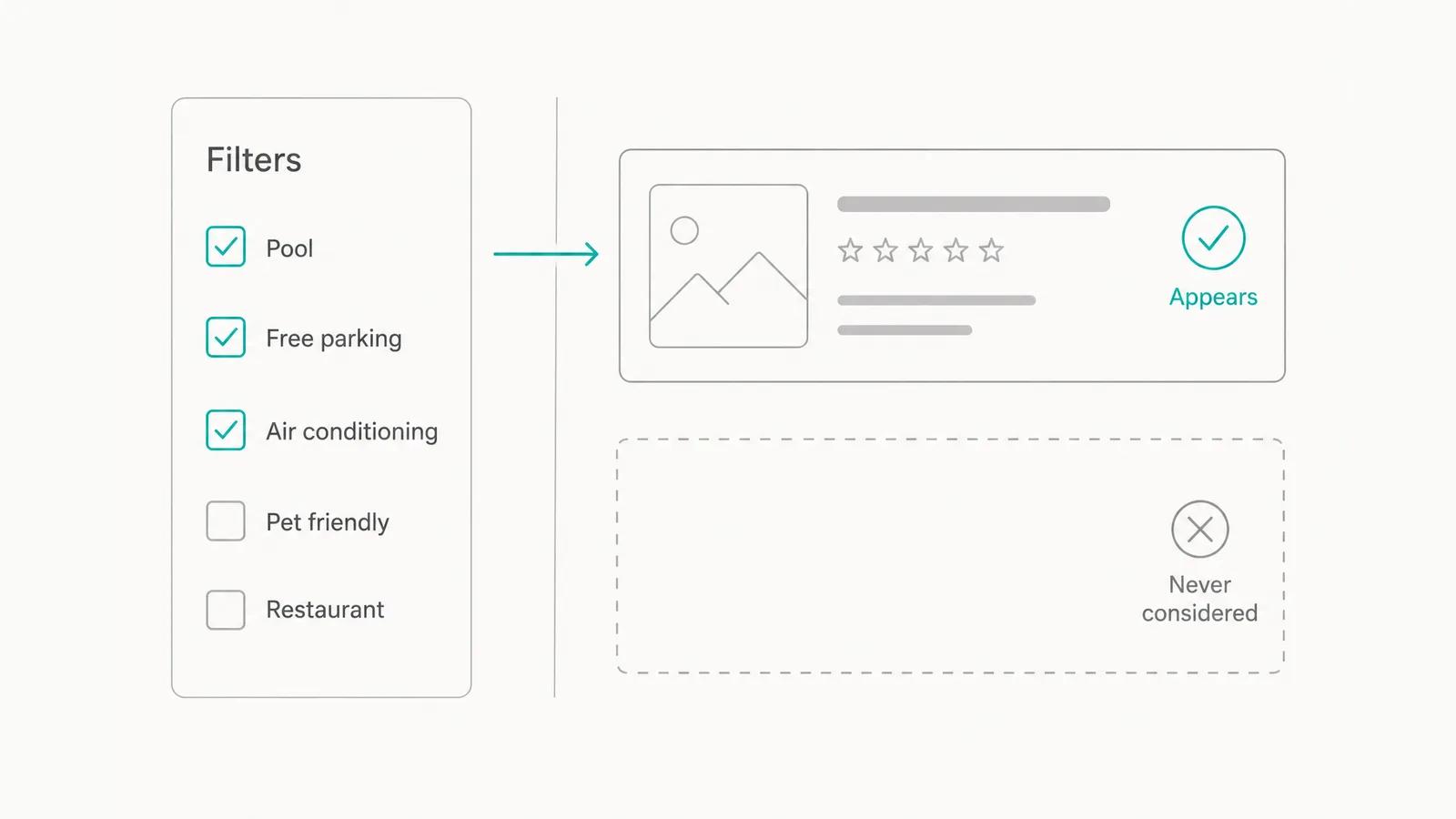
That module is not ranking your profile the way it ranks a dentist. It is running a query against a structured inventory of properties, filtered by the dates the traveller entered, the price band they dragged the slider to, and the amenity boxes they ticked. Keywords matter far less here than in almost any other vertical. Structured data about your property matters far more.
The practical consequence is that most of what loses an Indian hotel visibility is not a ranking failure at all. It is an exclusion. A traveller filters for a pool and free parking, your attributes are half blank, and you are simply not in the set that gets ranked. You did not come eleventh. You were never a candidate, and no amount of keyword work on your website changes that.
The class rating deserves a specific warning, because owners burn a lot of energy on it. Google draws hotel class from a mix of third-party partners, its own research, feedback from hoteliers and machine-learned inference over attributes like price, location, room size and amenities. It is not a field you fill in. You can submit feedback and you can influence the inputs by getting your attributes and room data accurate, but you cannot set it, and a property claiming five stars on its own website while Google shows three has an evidence problem rather than a form-filling problem.
The same applies to your rate. Google reads price signals from whichever channels are connected to it. If the only connected sources are marketplaces, the only prices a traveller sees are marketplace prices, and your own rate — the one you actually want them to book — is not in the comparison at all.
How Google treats an ordinary local business
- Three-result local pack, ranked mostly on relevance, distance and prominence
- Keywords in the profile and on the website do real ranking work
- No dates, no price and no filters between the searcher and you
- Reviews are the main quality signal a searcher compares
- Being incomplete costs you position
How Google treats a hotel
- A travel module with dates, a price row, filters and a live map
- Structured property data outweighs keyword work
- Availability and rates arrive through connectivity, not typing
- Class rating is inferred by Google and cannot be set by you
- Being incomplete gets you excluded from the result set entirely
Free booking links: the channel most Indian independents never switched on
Google shows a row of booking options under a hotel listing. For years every row in it was paid. Free booking links changed that: your own direct rate can appear in that row alongside the marketplaces, and Google takes no commission on a booking that comes through it. For an independent property this is the highest-leverage single change available, and a surprising number of Indian hotels have simply never turned it on.
It is not a checkbox inside your Business Profile, which is why it gets missed. Rates and availability have to arrive through connectivity — your booking engine, channel manager or property management system has to be an integration partner with Google Hotel Center. The larger channel managers used in India, SiteMinder, STAAH, AxisRooms and their peers, all have this. If you are running a property on spreadsheets and a phone, this is the concrete reason to buy a booking engine, and it usually pays for itself inside a quarter.
There is a trap in it that nobody warns owners about. Free booking links make your pricing publicly comparable, side by side, in the moment of decision. If your direct rate is higher than your marketplace rate — which happens constantly, because owners load taxes differently on the direct engine, or forget that the marketplace is discounting into the same room — you have just spent effort to prove to the guest that booking with you is a bad idea. Get rate parity honest before you switch this on, not after.
The other detail that quietly breaks the feed is tax and fee configuration. Google compares what the traveller will actually pay. A direct rate that displays excluding GST next to a marketplace rate that displays including it looks cheaper in your dashboard and looks like a bait-and-switch to the guest at checkout. Apply taxes and fees correctly to the website reservation source and let the comparison be honest.
Once free links are live and converting, paid Hotel Ads become a rational thing to layer on for peak weeks, because you now know what a direct booking is worth to you and you have somewhere to send the click. Doing it in the other order — buying ads for a property with no direct channel — is how hotels conclude that Google does not work for them.
Claim and verify the property profile
Hotel name, address, city, PIN, phone and website have to be correct and consistent before anything downstream will connect. A property trading under two names, an old one on signage and a new one on the profile, stalls here.
Confirm your booking engine is a Google connectivity partner
Ask your channel manager or PMS vendor directly whether they push to Google Hotel Center. If the answer is no, that is a vendor decision to revisit rather than a reason to abandon the channel.
Fix rate parity before you expose it
Your direct rate should be at worst equal to the cheapest marketplace rate for the same room and date, and ideally better once you add a value inclusion the marketplace cannot match, such as breakfast or a late check-out.
Configure taxes and fees on the direct source
The number Google shows must be the number the guest pays. Under-declaring here converts worse than not being listed at all, because it breaks trust at the last step.
Switch the link on and watch the branded query
The first movement usually shows up on searches for your own property name — guests who found you on a marketplace and came to Google to check you out. That is the traffic you were previously handing back.
The hotel-only profile fields most properties leave blank
A Google Business Profile for a hotel carries a set of fields no other business type has, and they do work that owners consistently underestimate because they look like trivia. They are not trivia. They are the inputs to the filter rail, and the filter rail decides whether you appear at all.
Check-in and check-out times are the clearest example of a field that looks administrative and behaves like a conversion lever. A family driving down from Pune to a Konkan resort on a Saturday morning is filtering on arrival practicality. Leaving it blank does not make you flexible, it makes you unanswerable, and the property next door that filled it in gets the enquiry.
Hotel attributes are the big one. This is where you declare amenities at the property and inside the room — pool, free parking, air conditioning, restaurant, pet policy, conference space, EV charging, accessibility features. Every one of those is a filter a traveller can tick, and every blank box is a search you have opted out of. Working through the whole attribute list once, properly, is an afternoon of somebody’s time and it is the highest-return afternoon available to most Indian independents.
The word most properties get wrong here is honest. Ticking the pool box because there is a plunge pool that has been dry since the monsoon does not win you a booking, it wins you a one-star review with a photograph attached, and hotel reviews are read far more carefully than restaurant reviews because the purchase is larger and less reversible. Overclaiming in attributes shows up in your rating within a season.
Finally, keep the description doing real work. It is not a ranking lever in the hotel module the way it is for a plumber, but it is read by a human deciding between you and two neighbours, and it is the one place you can say the things attributes cannot express: that you are eleven minutes from the fort gate, that the west-facing rooms get the sunset, that the kitchen does Malvani properly.
| Field | What it actually controls | Typical state |
|---|---|---|
| Check-in / check-out times | Answers the arrival question and feeds practicality filters | Blank, or wrong since the last policy change |
| Hotel attributes | Filter eligibility — pool, parking, AC, pets, conference, accessibility | A handful ticked out of dozens available |
| Room-level amenities | Filters applied inside the room, and guest expectations at booking | Almost always untouched |
| Class rating | Shown under your review stars; inferred by Google, not set by you | Disputed by the owner, unchanged for years |
| Booking link | Puts your own rate into the comparison row | Absent, so only marketplace rates appear |
| Description | Persuades the human comparing three properties | Copied from a brochure written a decade ago |
Photography is inventory, not decoration
For a hotel, photographs are not marketing assets sitting alongside the product. They are the only version of the product a guest can inspect before paying. Nobody books a room they cannot see, and the comparison a traveller runs on a travel module is overwhelmingly visual: they scan images, discard the properties that look tired, and only then read anything.
The failure mode in Indian independents is not usually an absence of photographs. It is a set taken once, at handover, in whatever light the photographer had, and never refreshed — so the profile shows a lobby with furniture you replaced in 2021 and a garden in a season the guest will never see. Meanwhile guests upload their own images continuously, and those accumulate faster than yours, which means the visual impression of your property drifts steadily out of your control.
Shoot to answer questions rather than to look impressive. A traveller wants to know what the actual room looks like from the door, what the bathroom is like, whether the pool is a real pool, what the view from the balcony is, what breakfast consists of, and where the property sits in relation to the thing they came for. Every one of those is a photograph. None of them is a wide-angle lobby shot at dusk.
Photograph each room type separately and label it. A property selling four categories with one gallery is asking the guest to guess which room the price applies to, and guests resolve that ambiguity by assuming the worst or by leaving. This is also the cheapest defence against the most damaging review a hotel can collect, which is not that the room was small but that the room was nothing like the pictures.
And keep adding. A property that uploads a handful of images every month reads as operating and cared for. One that has added nothing since 2023 reads, correctly, as a property where nobody is watching — and that impression reaches the guest long before any ranking factor does.
Wide-angle rooms that do not exist
An ultra-wide lens makes a fourteen-square-metre room look like twenty-five. It converts better and it produces exactly the review that costs you the next ten bookings. Shoot honestly, at a normal focal length.
One gallery for four room types
If a guest cannot tell which photographs belong to the category they are paying for, they assume the good ones belong to the expensive one. Separate and label every category.
Guest photos outnumbering yours
You cannot remove an unflattering guest photograph, but you can out-supply it. A steady monthly upload keeps your own imagery dominant in the gallery a traveller actually scrolls.
No photograph of the approach
Resorts outside town lose bookings to the fear of the last four kilometres. A picture of the gate, the road and the parking removes an objection nobody says out loud.
Four review platforms, and the trade-off nobody mentions
Hotels are unusual in carrying serious review inventory on several platforms at once. Google, TripAdvisor, MakeMyTrip and Booking.com all hold ratings for the same property, all of them visible to a guest who does five minutes of diligence, and only one of them feeds the map this guide is about.
The structural point is that marketplace reviews can generally only be written by people who booked through that marketplace. That produces a consequence which sounds obvious once stated and which almost nobody plans for: every booking you successfully move from MakeMyTrip to direct is a MakeMyTrip review you will never receive. Shift your mix aggressively and your marketplace rating stops growing, ages, and slides down their sort order — while your Google rating climbs.
That is a real trade-off, not a reason to stop. The right response is deliberate sequencing: grow Google reviews hard from every guest regardless of channel, keep enough marketplace volume flowing to hold your standing there, and understand that you are managing a transition rather than flipping a switch.
The collection moment for a hotel is unusually good and unusually badly used. You have the guest physically present at check-out, satisfied or not, with the stay fresh, and you have their phone number. Almost every Indian property wastes this by asking nobody, or by asking through a printed card nobody photographs. Asking at the desk, with a QR code the guest scans while the bill prints, converts several times better than any message sent after they have driven home.
Replies matter more here than in most verticals because hotel reviews are read, not just counted. A prospective guest comparing three properties will read the two-star reviews specifically, and what they are really assessing is not the complaint but your response to it. A defensive reply loses the booking. A specific, unbothered reply that names what was fixed frequently wins it, including from the person who reads the complaint and decides you sound like people who handle things.
| Platform | Who reads it | Feeds Maps ranking | Can you ask for reviews |
|---|---|---|---|
| Anyone searching your name or your area | Yes, directly | Yes, from every guest, any channel | |
| TripAdvisor | Research-heavy and inbound travellers | No | Yes, but conversion is poor without a prompt |
| MakeMyTrip | Domestic travellers already in the funnel | No | Only from guests who booked there |
| Booking.com | Inbound and corporate travellers | No | Only from guests who booked there |
Every review answered, in the language the guest wrote in
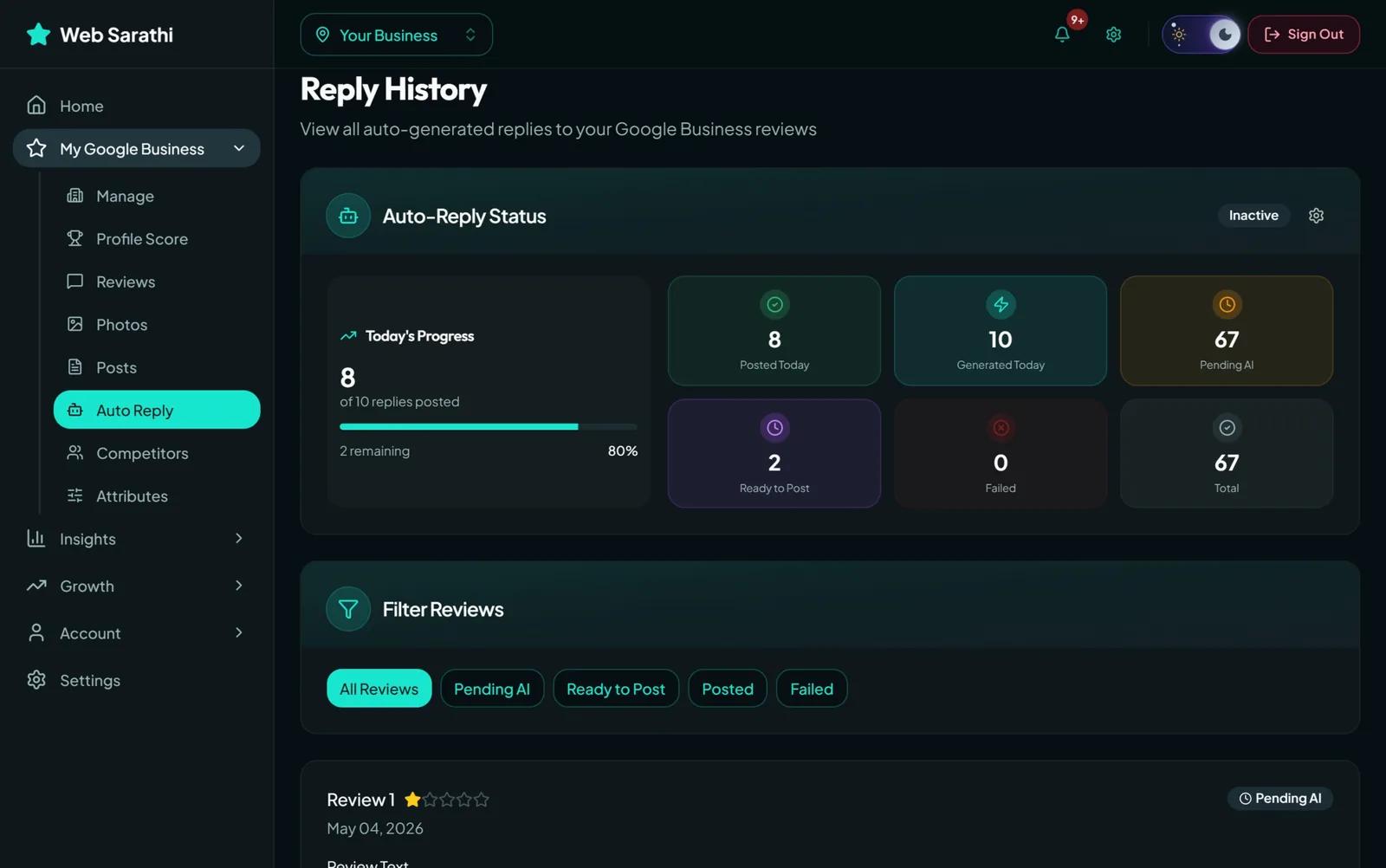
Hotel reviews are read rather than counted, and the reply is what a prospective guest is really assessing. Web Sarathi drafts a reply to every review as it lands — specific to what the guest said, in their language — and holds it for your approval.
- Drafts in 34+ languages, including the regional ones your guests write in
- Nothing publishes without approval until you choose to trust it
- The two-star reviews, which prospects read first, never sit unanswered for a week
Selling a season you cannot move
A salon can sell a slow Tuesday. A hotel cannot sell last night. Unsold room nights are gone permanently, which makes the timing of demand capture matter more in this vertical than in almost any other, and it changes what a marketing calendar is for. You are not trying to generate demand evenly. You are trying to be visible in the window when a specific season is being planned, and to fill the weeks nobody is planning at all.
The domestic leisure booking window in India is short and clustered. Hill stations and beach properties are searched hard from around September as the post-monsoon season opens, long weekends drive a spike two to four weeks ahead, school holidays produce a longer lead, and wedding season converts through relationships and phone calls rather than search. A resort that starts posting its Diwali package in the week of Diwali has missed the search entirely.
The corollary is that the off-season is not downtime, it is production time. The quiet weeks are when the photographs get reshot, the attributes get completed, the review backlog gets replies, and the content for the coming season gets written. Properties that treat the monsoon as a shutdown arrive at the season with the same profile they had last year and wonder why the same competitor is above them.
Post against the calendar rather than against your own news. Guests searching in early October do not care that you have repainted the annexe. They care whether you are open, what the road is like, whether the waterfall is running, and what a two-night package costs. The properties that win these weeks are the ones answering the traveller’s actual question in the week they are asking it.
One caution specific to seasonality: do not let your hours, availability or contact number drift during a closure. A property that goes dark for the monsoon and leaves everything stale is teaching Google and travellers alike that its information cannot be relied on, and that impression does not reset when you reopen.
Monsoon and low season — build, do not broadcast
Reshoot rooms, complete the attribute list, clear the unanswered review backlog, and write the season content. This is the only stretch of the year with enough slack to do it properly.
The season opens in search before it opens in reality
Planning searches for October and November travel start now. Packages, rates and season photographs need to be live before the demand arrives, not in response to it.
Peak, long weekends and the festival run
Publish against specific dates rather than in general. Long-weekend demand concentrates two to four weeks ahead, which is a narrow and very predictable window to be visible in.
Weddings, corporate offsites and shoulder weekends
A different buyer with different search behaviour — often a planner or an administrator comparing capacity and function space rather than room photographs. Your conference and event attributes earn their keep here.
Summer split — hills fill, plains empty
Whichever side of that you are on, the answer is the same: know which weeks you are structurally short on, and put your offer and your posting effort there rather than spreading it evenly.
Ranking for the landmark when you are forty minutes out of town
Resorts have a geography problem city hotels do not. The guest searches "resorts near Igatpuri" or "farm stay near Bangalore" from a flat in another city, and Google is weighing proximity — but proximity to what? Sometimes to the searcher, who is two hundred kilometres away. Sometimes to the named place, which you are pleasantly but inconveniently outside of. A property twenty-five kilometres up a ghat road is competing against properties inside the town for a search that names the town.
You cannot move the pin, and you should not try. Properties that fake a town-centre address get suspended, and a suspension in the middle of your season is a far worse outcome than ranking fourth. What you can do is make the relationship between your property and the landmark unambiguous everywhere Google reads about you: in the description, in the service and package names, in post copy, in review replies where it is natural, and on your own site.
Be specific about which landmark, too. Near Bangalore is a claim four thousand properties make. Thirty-two minutes from Nandi Hills, on the Chikkaballapur road, is a claim only you make, and it is the one that matches how a guest who has already chosen the destination actually searches.
The measurement problem underneath this is why so many owners misjudge their own position. You search your property from the reception desk, see yourself at the top, and conclude you are ranking. Of course you are — you are standing on the pin. The searcher who matters is in Koramangala or Andheri deciding where to go this weekend, and your position in their result is a completely different number you have never seen.
This is what rank tracking across a grid of points is for. Instead of one self-flattering result, you get your position measured from dozens of locations across the region your guests actually search from, which turns "we rank well" into a map with numbers on it — usually an uncomfortable one the first time, and the first honest picture of demand geography most owners have ever had.
Things you cannot change
- Your physical distance from the landmark guests search for
- How Google weighs proximity in that specific query
- Marketplace listings outranking you on generic destination terms
- The class rating Google has inferred for your property
Things entirely in your hands
- Naming the landmark, the drive time and the road, consistently, everywhere
- Packages named for the destination rather than for the room type
- Photographs of the approach that answer the unspoken objection
- Actually measuring your rank from where guests search, not from reception
Your real position, measured from where guests actually search
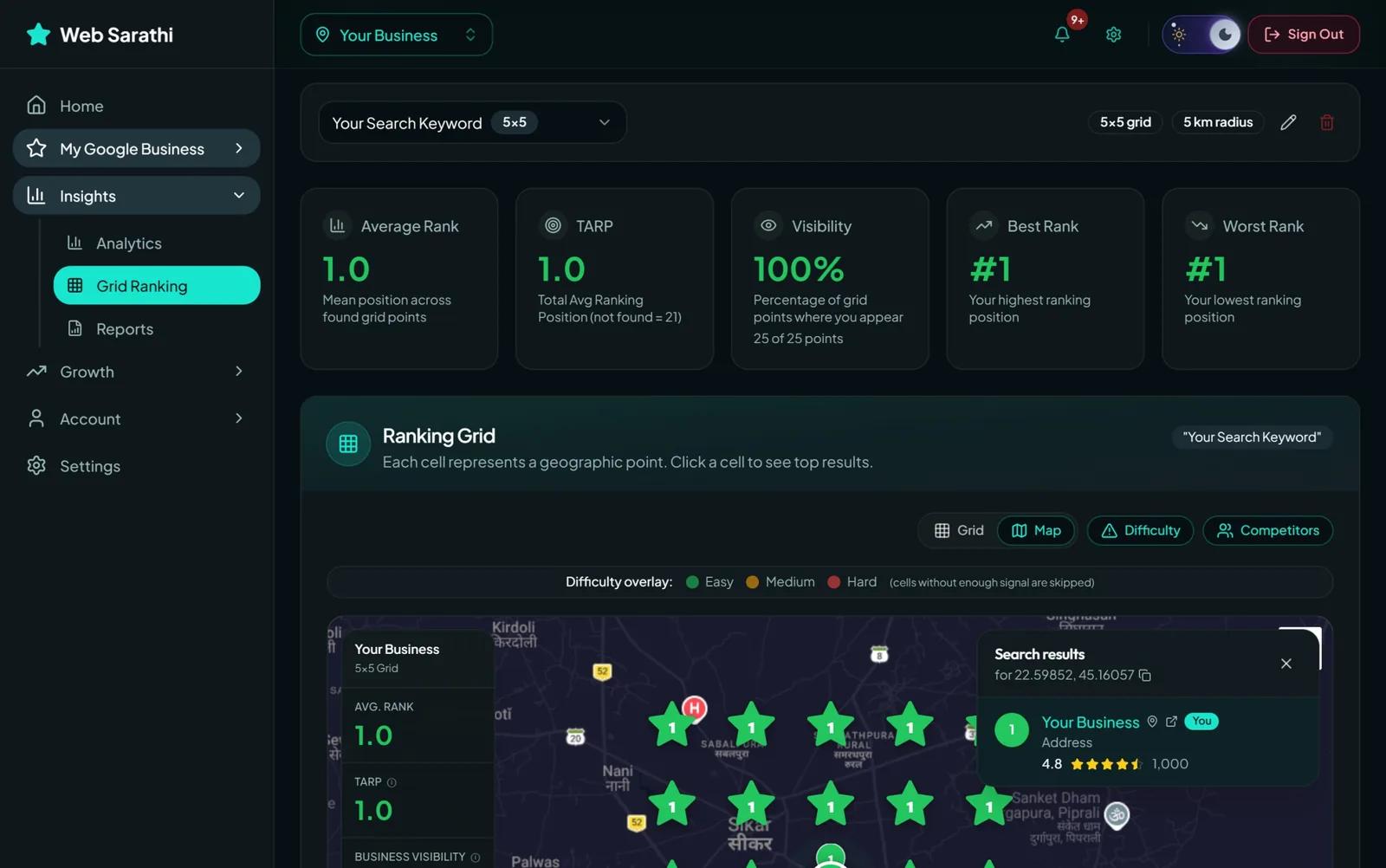
The result you see from reception is the least useful data point available to you. Grid ranking measures your Maps position from dozens of points across the region your guests search from, and returns it as a heat map you can read at a glance.
- See exactly which parts of your catchment you are invisible in
- Track a destination keyword over time instead of guessing
- Compare your coverage against the property that keeps outranking you
A shoulder-season work plan for a neglected property profile
Most of the work in this guide is a poor fit for peak weeks, when the front desk is drowning and nobody has an afternoon for attribute lists. It fits the shoulder season perfectly, and doing it there means arriving at the next peak with a profile materially better than the one your neighbour still has.
The sequence matters, because the items compound. Fixing attributes before fixing rate parity gets you into filtered results with a price that loses. Buying ads before free links are live sends paid clicks to a page with no direct booking option. Do them in the order below and each step makes the next one worth more.
Budget roughly one afternoon a week for six to eight weeks. That is a genuinely realistic ask for an owner-run property, and it is enough. The mistake is not underinvesting, it is starting a full rebuild in October and abandoning it half-finished when the season lands.
What none of this needs is an agency retainer to begin. Every item below can be done by the person who already runs the front office, provided somebody has told them what the items are and in what order — which is most of what a retainer buys in this vertical anyway.
Claim, verify and correct the fundamentals
One property, one profile, one name, one phone number, one website. Merge or close duplicates left over from a previous manager, an old brand, or a channel manager that created its own listing.
Complete the entire attribute list, honestly
Property amenities and in-room amenities, every box, either ticked or deliberately left off. This is the single afternoon with the highest return in the whole plan.
Reshoot, by room category
Each category from the door, the bathroom, the view, the pool as it actually is, breakfast, and the approach road. Normal focal length. Label everything.
Fix rate parity, then switch on the free booking link
Direct rate at worst equal to the cheapest marketplace rate, taxes configured to match what the guest pays, then connect through your channel manager and get your own price into the comparison row.
Clear the review backlog and start asking at check-out
Reply to everything unanswered, oldest damage first. Put a QR code on the reception desk and make asking part of the check-out script rather than something somebody remembers.
Publish the season, then measure honestly
Packages and dates for the coming season, live before demand arrives. Then run a grid scan so that from here on you are looking at your real position across the region rather than the one you see from the desk.
The season published before the demand arrives
Season packages need to be live weeks ahead of the search, which is exactly when the property is busiest doing something else. Draft the season once in the quiet weeks and schedule the whole run.
- Schedule weeks ahead so the calendar does not depend on somebody remembering
- Drafts written around your packages, dates and destination rather than generic filler
- Keeps the profile visibly active through the off-season, when most properties go dark
Hotel SEO questions, answered
The questions Indian hotel businesses ask us most often.