Interior design SEO in India: getting enquiries when nobody visits your office
Interior design breaks the assumption that every other guide in this series is built on. Local search ranks a business from a verified pin, on the premise that the pin is where the service happens and that proximity therefore tells a customer something useful. For a designer it tells them almost nothing. Your client will never come to your office before hiring you, and probably not afterwards either. The work happens in their flat, which may be eighteen kilometres away, and they do not care where you sit.
So you are being ranked on a signal that is largely irrelevant to your customer, while competing against venture-funded platforms that have solved the problem with money. Meanwhile the actual purchase is a several-lakh commitment, paid substantially in advance, to somebody found on the internet — which makes trust the thing you are really being judged on, and makes your portfolio, which lives inside other people’s private homes, both your most valuable asset and the one you have the least clear right to publish.
This guide covers those four problems and the ones that follow from them: cost keywords and what they are really for, naming what you sell, the review that arrives nine months late, and turning a listing into an enquiry rather than a booking.

A pin nobody visits, ranking a business nobody comes to
Every local ranking system is built on a reasonable assumption: the business sits somewhere, the customer goes there, so distance between the two is useful information. It holds for a clinic, a restaurant, a gym. It does not hold for you. The overwhelming majority of interior design clients never see the studio before they sign, and a good number never see it at all, because every meeting that matters happens at the site, in a flat that is not yours.
That produces a specific and slightly absurd situation. You are ranked in a given locality according to how close your office is to the searcher, for a service where your proximity to them changes nothing about the quality, price or feasibility of the job. A designer in one part of the city will happily take a project on the other side of it. The customer knows this. Google is nevertheless using the distance between two points as though it mattered.
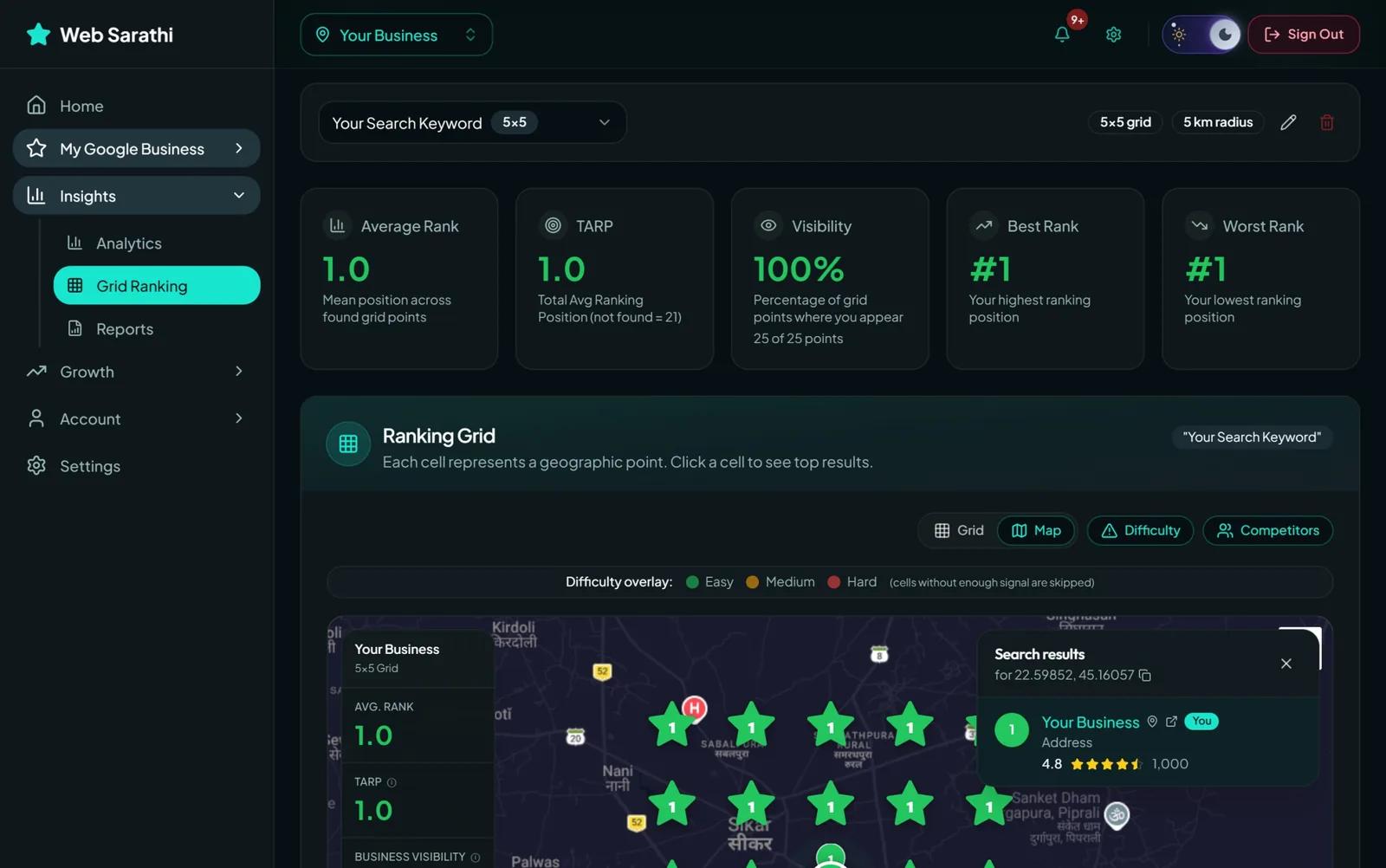
The practical consequence is that your visibility is far narrower than your willingness to work. Ask most studios where their projects are and they will describe a spread across the whole metropolitan area. Ask where they appear in local search and, measured honestly, it is usually a modest area around the office and very little beyond. The gap between those two maps is the commercial problem in this vertical, and almost nobody has actually looked at it, because you cannot see it by searching from your own desk — standing on your own pin returns you at the top every time.
Two responses are available and they work together. The first is to stop treating the office pin as the only thing you have. A studio that publishes genuinely substantial, genuinely different pages about the projects and localities it works in gives Google reasons to associate the business with those areas that have nothing to do with the pin — and unlike a service-area trade, you have real material to do it with, because you have photographs and floor plans and a story for each one.
The second is to be honest about where the pin should be. Designers frequently register at a home address, then hide it, then wonder why nothing works. If you have a real studio with signage where clients could come, use it and let it be visible; the address is a trust signal in a category where trust is the whole sale. If you genuinely work from home and meet only at sites, the service-area configuration exists for exactly that, and using it properly is better than a hidden address that satisfies neither the ranking system nor a nervous client trying to verify you are real.
What none of this can do is turn distance into a non-factor. It will keep working against you in places you are far from. The useful adjustment is to stop measuring success as a city-wide ranking and start measuring it as coverage of the specific pockets where the flats you want to work on are actually being handed over — new towers, recently possessed societies, redevelopment clusters. That is a much smaller and much more achievable target than a city.
What local ranking assumes
- The customer travels to the business premises
- Distance to the pin is useful information for the searcher
- The address is where the service is delivered
- A wider catchment means a longer, less convenient journey
How interior design actually works
- The designer travels to the client, every time
- Distance to your office tells the client nothing they care about
- The service is delivered inside the client’s home
- A project eighteen kilometres away is completely ordinary
Measure the gap between where you work and where you appear
You will take a project anywhere in the city. Your listing is visible in a fraction of it. Grid ranking measures your position across dozens of points so you can see which possession clusters you are actually reaching.
- Compare your real visibility against the localities you genuinely serve
- Find the new-possession pockets where you do not appear at all
- Track a locality keyword over weeks rather than guessing from your own desk
The funded platforms own the generic search, and what to do instead
Search any generic interior term in an Indian city and the first page is largely occupied by well-funded national platforms, plus a layer of listing directories. This is not a failure of your SEO. Those companies have spent heavily and for years on exactly the terms you want, and no independent studio is going to outspend them on a head term like interior designers in a major city.
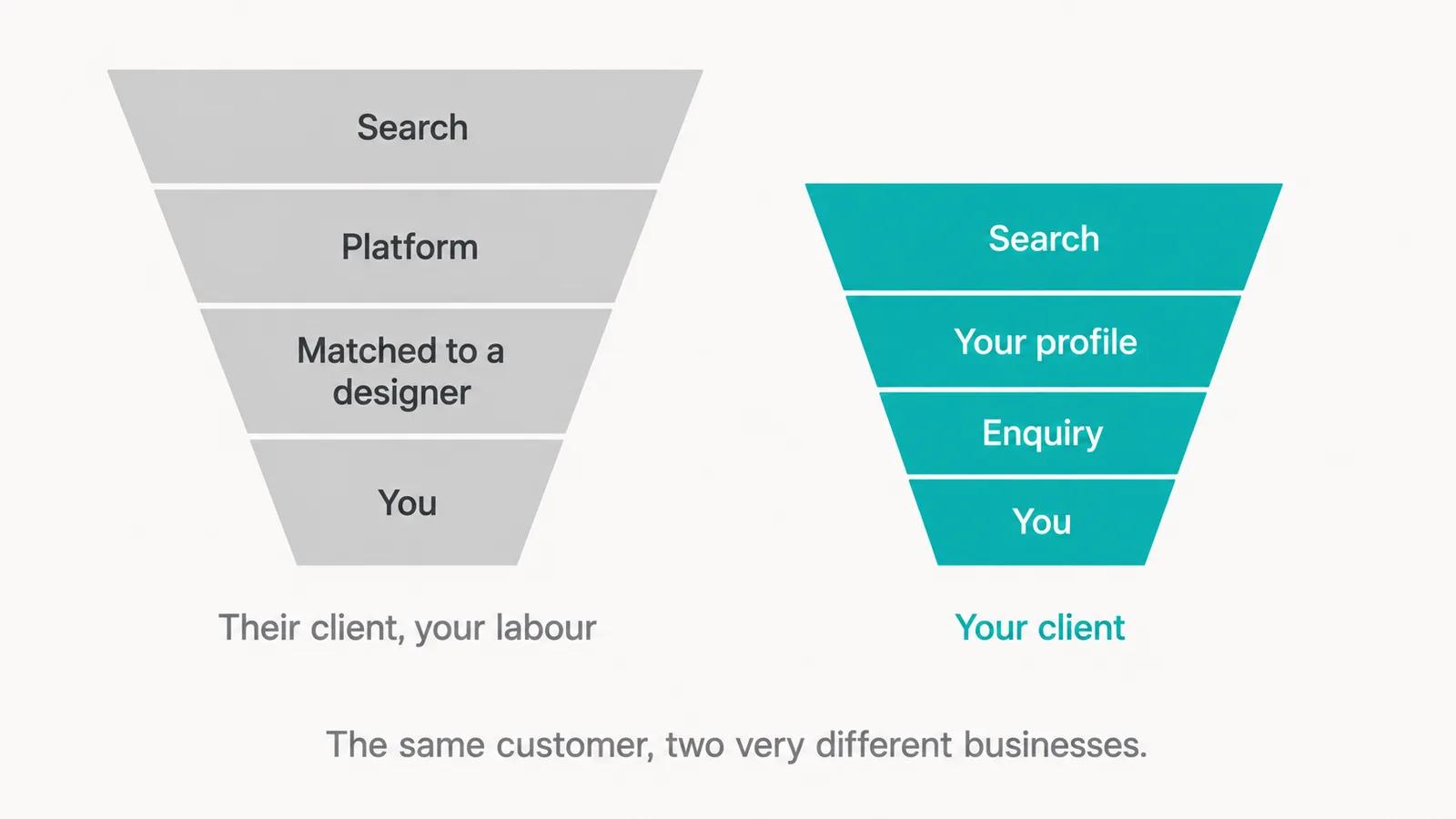
It is worth being precise about the relationship, because it differs from the aggregator problem in other trades. A food delivery platform takes a commission on an order that a restaurant would often have received anyway. A design platform does something else: it acquires the customer, owns the relationship and the payment, and then subcontracts the actual design and execution to independent professionals — quite possibly to you. You are not losing a margin on your own sale. You are being hired as capacity on somebody else’s.
For a new studio that can be a rational trade, in the same way any subcontracting is. The problem is that it is a trade with no accumulation. The client is theirs, the reviews are on their platform, the case study belongs to their portfolio, and the next customer in that same building will search and find them again. Three years of that produces a business with revenue and no independent demand, which is a fragile position to be in when the platform changes its rates.
The escape is not to compete on the head terms. It is to compete where scale is a disadvantage rather than an advantage, which is anything specific. A national platform cannot write convincingly about the standard layout problems of a particular tower, or what the society committee will and will not permit, or what a 2 BHK in a named locality actually costs to do properly at three different levels of finish. You can, because you have done four of them.
That specificity is also what the customer is searching for once they get past the first, vaguest search. The head term is where research begins; it is not where the enquiry is made. By the time somebody is ready to contact a designer they are searching something much narrower — a project type, a locality, a budget, a specific room — and those searches are winnable, are not worth a national marketing budget to defend, and bring a visitor who is already most of the way to deciding.
One caution on directories. Being listed on a few reputable ones is fine and occasionally sends real work. Buying leads from them at volume tends to produce the same dependency as the platforms, plus a shared inbox of enquiries also sent to four competitors, which forces a price conversation before anyone has seen your work. That is close to the worst possible starting position for a category where you are trying to be trusted rather than cheap.
Project pages the platforms have no reason to write
You cannot outspend a funded platform on a head term. You can beat it on specificity — a named tower, a configuration, a locality, a real budget — because it is not worth their marketing budget to defend.
- A real project page per job, not a social post that vanishes in a week
- Locality and service pages that give Google reasons beyond your office pin
- Built from your own work, so it is evidence rather than copy
Your portfolio lives in somebody else’s home, and you need permission
In almost every other vertical, the business photographs itself. A restaurant shoots its own dining room, a gym its own floor, a salon its own chairs. An interior designer has nothing of their own to photograph. Your entire portfolio, the single most persuasive asset you own, consists of the private homes of people who paid you and then moved in.
This is not a small legal or ethical footnote — it is a working constraint that shapes what you can publish and when. The client owns the property. They may not want photographs of their bedroom on the internet, they may not want their address identifiable, and they may be perfectly happy for the living room to appear and horrified at the idea of the child’s room appearing. None of that is unreasonable, and finding out after publication is a bad way to end a relationship with somebody who might otherwise have referred you.
The fix is procedural and takes about ten minutes if you do it at the right moment. Put photography permission into the contract at the start, when the client is enthusiastic and the question is abstract, rather than at handover when they are tired and thinking about moving in. Ask for specifics: which rooms, whether the building or locality may be named, whether people may appear, and whether the client is willing to be quoted. Offer the option of an unidentified project, which most people accept happily, because the objection is nearly always to being identified rather than to the photographs existing.
Then shoot properly, once, at the right time. The window between the snag list being cleared and the client moving their own possessions in is short and it is the only time the space will look like the design rather than like a home. Book a photographer for that day; phone photographs of a finished interior in mixed lighting undersell work that took four months and several lakh rupees to produce, and this is one of the few places in this guide where spending money is clearly correct.
Publish the photographs where they do you good, which means on your own site as a real project page with a description, not only on social platforms where they are unfindable a week later. Add the honest, useful details a prospect is actually looking for: the configuration, the approximate area, the scope you handled, the timeline it genuinely took, and the level of finish. A gallery of beautiful unlabelled images is a mood board. A gallery with that context is the evidence somebody needs to decide you can do their flat.
Google Business Profile photographs are a separate and much weaker surface for this, but not a useless one. Post project images there too, since a profile with recent, real work looks like an operating studio and one with a logo and two stock renders does not. Keep the identifying details out of the profile captions unless you have permission covering that as well.
Put permission in the contract, at signing
Ask when the client is enthusiastic and the question is hypothetical, not at handover when they are exhausted. Name the rooms, whether the building may be identified, and whether people may appear.
Offer the unidentified option
Most objections are to being identified rather than to the photographs existing. A project published without the client’s name, flat number or society usually gets an easy yes.
Shoot in the window before they move in
After the snags are cleared and before the possessions arrive. It is a matter of days, it will not come back, and it is the only time the space looks like the design.
Publish it as a project page, not just a post
On your own site, with configuration, area, scope, timeline and finish level. A social post is invisible within a week; a project page keeps working for years.
Ask for the review in the same conversation
The handover is the one moment the client is looking at finished work and feeling good about it. It is also the last moment before they stop thinking about you.
Cost searches are the largest demand here and the worst use of a listing
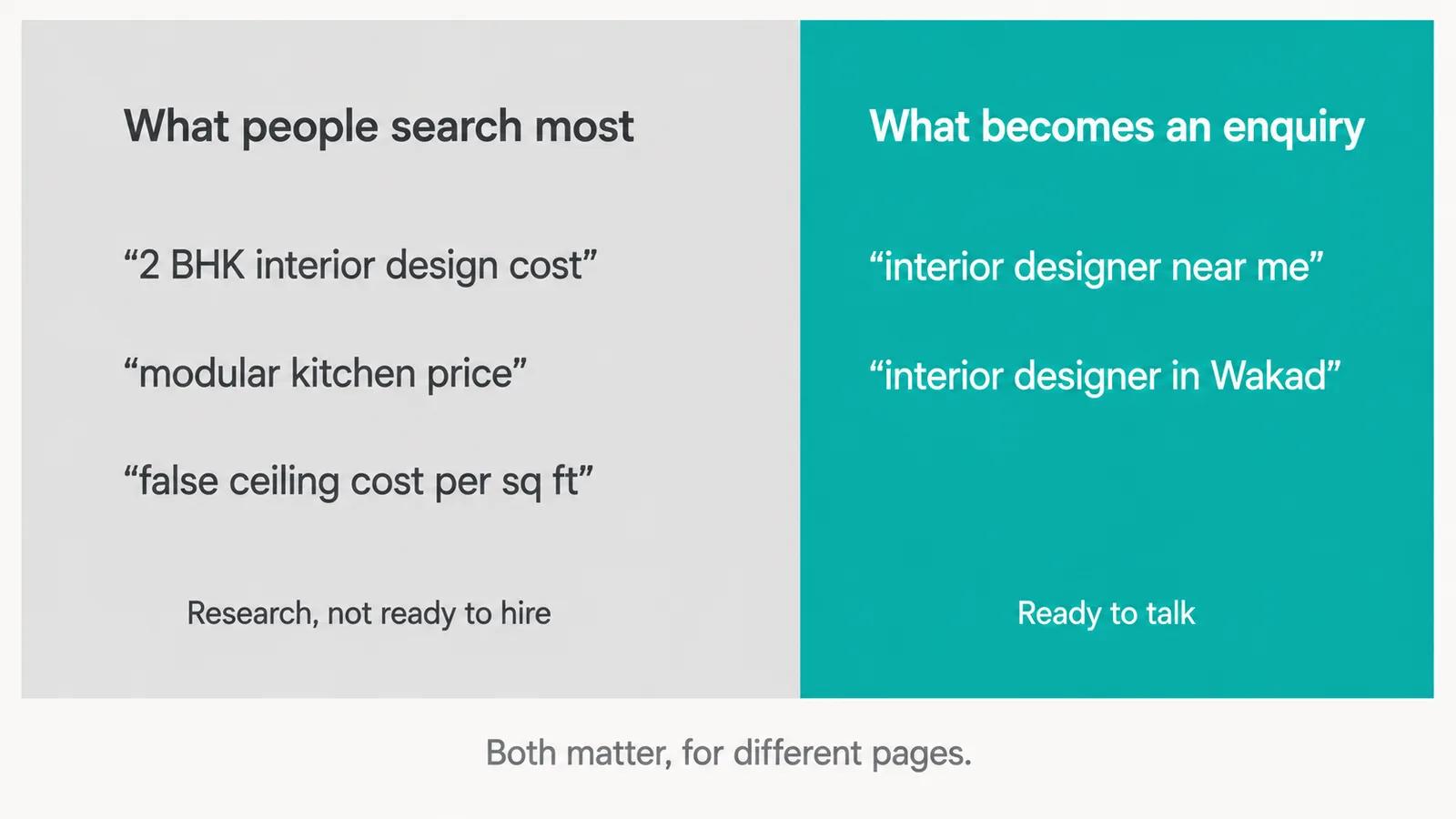
The largest search demand in this trade by a wide margin is about money. What does it cost to do a 2 BHK, what is the price per square foot for a false ceiling, what does a modular kitchen cost, what is a reasonable rate for turnkey work. Those searches dwarf the number of people typing interior designer near me, and the temptation is to chase them with the listing and the home page.
That is a mistake, and it is worth understanding why rather than just avoiding it. Somebody searching what a kitchen costs is not looking for a designer yet. They are establishing whether the project is affordable at all, often months before they intend to start, frequently before possession of the flat. They are researching. A local listing shown to that person converts poorly, and a home page written to catch them converts poorly too, because it is answering a question the visitor asked before they were ready to hire anybody.
The correct home for that demand is content, and it is genuinely valuable content because almost nobody in this industry answers the question honestly. The pages that exist are either evasive — every price is on request — or national averages that are useless in a specific city. A studio willing to publish real ranges for its own market, with the assumptions stated and the variables explained, is providing something rare, and it earns the thing that matters far more than the traffic: being the person whose numbers the customer trusted while they were deciding.
Write those pages with the actual variables, because that is what makes them credible and what stops them being wrong. Say what changes the number — carcass material, hardware brand, shutter finish, whether the civil work is included, whether the building charges for lift access and debris removal, whether it is a fresh possession or a renovation with demolition. A number with its assumptions attached is useful. A number without them generates an angry phone call three months later.
And then give that reader somewhere to go, which is the step most people skip. Somebody who has read your honest cost breakdown is warm, informed and not yet in the market. The right offer is not book a designer, it is something small and low-commitment: a rough estimate for their configuration, a checklist for what to ask before possession, a call when they are closer. Capture them at the stage they are actually at.
The narrower commercial searches — a designer in a named locality, a specific project type, turnkey work for a particular tower — are where the listing and the local pages do their work. There are far fewer of them, they convert at a completely different rate, and they are the ones worth measuring position on. Judging your local search performance by whether you rank for a cost keyword is measuring the wrong thing entirely.
The advance-payment problem, and the trust signals that answer it
Consider what you are actually asking of a stranger. They found you on the internet. They are about to hand over a substantial share of several lakh rupees before any work happens, give you keys to an empty flat they have just spent their savings on, and wait months for a result they cannot inspect in advance. Every person who has ever hired a designer in India has been warned by a relative about somebody who took an advance and disappeared, or who started well and abandoned the site half-finished.
That anxiety, not your design sensibility, is the thing standing between an enquiry and a signature. Most studios market as though the competition were aesthetic — better renders, nicer photographs, a more refined feed. The competition is largely about credibility, and the studio that resolves the fear fastest wins jobs from studios with better portfolios.
Which makes a set of otherwise unglamorous signals disproportionately valuable. A verified profile with a real, visible address. A landline or a business number rather than only a personal mobile. A registered entity name that matches across your website, your invoices and your listing. Photographs of an actual studio with people in it. Named team members. A company registration or GST number published without being asked. None of these are marketing; all of them answer the question the visitor is silently asking, which is whether you will still exist in November.
Reviews carry more weight here than in almost any vertical, and a specific kind of review does the work. Generic praise is close to worthless. What a nervous prospect is reading for is evidence about process: did the designer stick to the quoted number, did they finish on time, what happened when something went wrong, were they reachable in month four. A handful of reviews that address those points directly outperforms a large pile of five-star one-liners, which is worth telling clients when you ask.
One warning specific to this trade, and it is a legal one rather than a marketing one. Under the Architects Act, only a person registered with the Council of Architecture may use the title and style of architect. The Supreme Court has clarified that unregistered people may practise architectural work — design, supervision and so on — but the title itself is protected, and misuse is a punishable offence. Interior design studios describe themselves as architects on listings and websites very casually. If nobody in the firm is registered, take the word out of your business name, your categories, your page titles and your descriptions. It is a genuine legal exposure, and it is also the kind of overclaim that damages exactly the credibility you are trying to build.
Finally, publish how you take money. A stated payment schedule tied to milestones — a booking amount, a stage on design sign-off, stages against execution, a retention until snags are cleared — is one of the most reassuring things you can put on a website, and almost nobody does it. It signals that the process is a process, and it quietly distinguishes you from the operator the client’s relative warned them about.
Calling yourself an architect without registration
The title is protected under the Architects Act and only a person registered with the Council of Architecture may use it. Unregistered professionals may do the work, but not carry the title. Remove it from the business name, categories, titles and descriptions.
A hidden address and a personal mobile as the only contact
To a prospect about to pay a large advance to a stranger, that combination reads exactly as it would to you. A real address, a business number and a registered entity name shown consistently answer the question they are too polite to ask.
Renders presented as photographs of completed work
Prospects have learned to spot it, and once they do, everything else on the page becomes suspect. Label renders as renders. A real photograph of a modest finished flat outperforms a beautiful render of one that does not exist.
Prices only on request, everywhere
In a category with a trust problem, refusing to indicate any number reads as something to hide rather than as premium positioning. Ranges with the variables stated do more for credibility than any amount of design language.
Publishing a client’s home without written permission
It is their property and their privacy, and the first you will hear about it is a complaint. Take permission at contract signing, name the rooms it covers, and offer the unidentified version most clients are happy to accept.
Turnkey, execution or consultation: naming the thing you actually sell
Interior design is sold in several quite different shapes, and customers routinely do not know which one they are asking for. Some studios do design only and hand over drawings. Some do design plus procurement and supervise somebody else’s contractor. Some do full turnkey, taking the flat and returning it finished. Some do modular kitchens and wardrobes and nothing else. The price difference between these is enormous and the word interior designer covers all of them.
This is a search problem before it is a sales problem. A person who wants a turnkey job and a person who wants drawings for their own contractor use very similar words and end up on the same pages, and the studio that has not said which one it does gets both, wastes time on the wrong one, and loses the right one to somebody clearer. Stating the model plainly in the description, in the services list and on the site filters the enquiries you receive in exactly the way you want.
The services field on the profile is where this can be made explicit and it is almost always left near-empty. Turnkey interior design, modular kitchen, wardrobe design, false ceiling, painting and finishing, civil work, furniture design, space planning, 3D visualisation, vastu consultation, commercial and office interiors, and design consultation are all searched by name and are all distinct offers. Listing them individually, with an indicative range where you can, does two things at once: it matches more of the searches people actually run, and it tells the visitor what kind of firm you are before they call.
Category choice matters for the same reason. Interior designer, interior architect, furniture store, kitchen furniture store, general contractor and home builder are different labels with different query pools attached. A turnkey firm that has set itself up as a furniture retailer will keep appearing next to showrooms, and a design-only consultancy categorised as a general contractor will keep getting calls about civil work it does not do. Pick the primary that matches the majority of your revenue and add secondaries only for work you genuinely take on.
Commercial and residential are worth separating explicitly if you do both. An office fit-out buyer is a different person with a different timeline, a different decision process and different objections, and they are not reassured by a portfolio of bedrooms. If commercial is a real line of business it deserves its own page and its own project set, not a paragraph on a residential site.
The point of all of this is not completeness for its own sake. It is that an enquiry from somebody who understood what you sell before they contacted you is worth several from people who did not, and the filtering can be done by the profile and the site rather than by you, on the phone, one conversation at a time.
| Model | What the client is buying | What has to be obvious on the profile |
|---|---|---|
| Design consultation | Drawings, specifications and advice for their own contractor to execute | That execution is not included, and what the deliverable set actually contains |
| Design and procurement | Design plus sourcing, with supervision of somebody else’s execution team | Who holds responsibility for site quality, and what supervision means in practice |
| Full turnkey | Handing over keys and getting a finished flat back | Scope boundaries, the payment schedule against milestones, and a realistic timeline |
| Modular only | A kitchen and wardrobes, usually against a per-unit or per-square-foot rate | That it is modular rather than full interiors, plus materials, brands and warranty |
A review that arrives nine months later, usually about the timeline
Review supply in this trade is unusually difficult, and for reasons that compound. The project takes three to nine months, so each client can produce a review only once and only at the end. You may complete a handful of projects a year, so the natural volume is a fraction of what a salon or a cafe generates in a month. And the point at which the review becomes possible is the point at which everyone involved is most tired.
Worse, the emotional arc works against you. Enthusiasm peaks at the design presentation, months before there is anything to review. By handover the client has lived through a delay, a material substitution, at least one cost revision, and the general attrition of a construction project. The finished flat may be beautiful and the memory of getting there is mixed. A review requested in that state gets an honest four stars with a sentence about the timeline.
Some of this is a delivery problem rather than a review problem, and it is worth saying plainly: the most common complaint about interior designers in India is the schedule, and the second is the final bill exceeding the quote. No review strategy compensates for either. What a good process does is remove the surprise — a schedule with named stages, a change-order process where every variation is priced and approved in writing, and a weekly update even in the weeks when nothing has happened. Most timeline anger is about not being told, not about the delay itself.
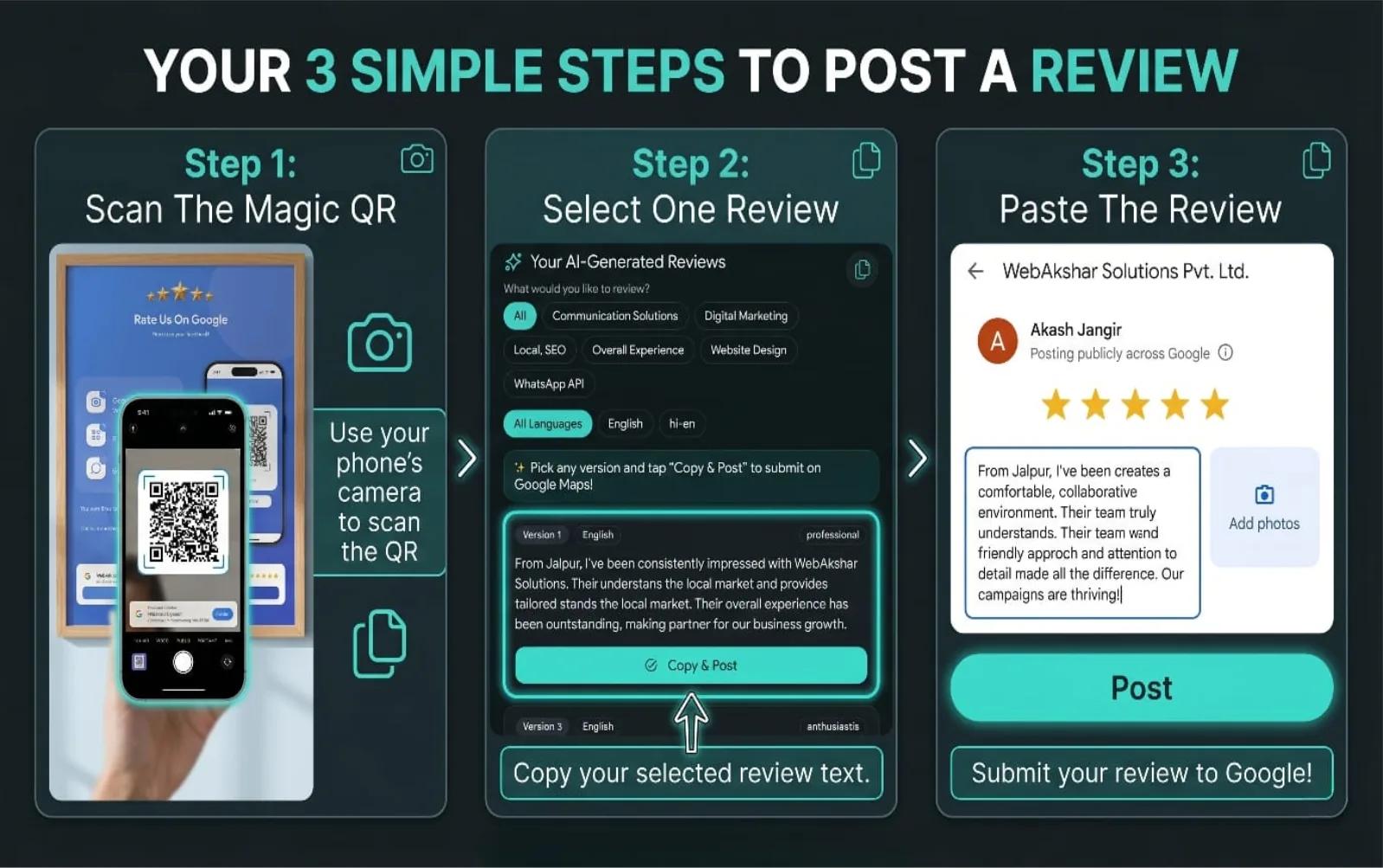
On the mechanics of asking, timing is everything. The right moment is the handover walkthrough, when the client is standing in a finished space seeing it properly for the first time. That is the peak, and it lasts about a week before they move in and the space stops being your work and starts being their home. Ask then, in person, and make it easy — a link or a code on the spot rather than a promise to send something later, which never survives contact with a move.
Because volume will always be low, each review has to work harder, and what you want is specificity. Ask the client to mention what you actually did — the configuration, the locality, the scope, whether the budget held. A review saying the team completed our 3 BHK in a named area within the quoted budget is worth a dozen saying great work. It reads as real, it carries the vocabulary a future prospect will search, and it addresses the exact anxiety the next visitor arrives with.
Do not neglect the sources beyond completed clients, because the trade has more of them than most. Vendors, contractors, consultants and site engineers you work with regularly are legitimate reviewers of a working relationship. So is a client whose project you scoped, quoted honestly and advised against — that person often thinks better of you than one you actually invoiced. None of that is a substitute for client reviews, and all of it helps a profile that would otherwise gain four entries a year.
Asking for the review after they move in
The window is the handover walkthrough and the week after. Once possessions arrive the space stops being your project and becomes their home, and the request feels like an intrusion into it.
Treating timeline complaints as a reputation problem
They are a communication problem in almost every case. Named stages, priced change orders in writing, and a weekly update even in dead weeks remove most of the anger, which is about not being told rather than about the delay.
Settling for five words of praise
With four to ten reviews a year, each one has to carry weight. Ask clients to name the configuration, the locality and whether the budget held. Specific reviews answer the next prospect’s actual fear; generic ones answer nothing.
Ignoring vendors, contractors and unconverted enquiries
They are real working relationships and legitimate reviewers, and in a trade with four completions a year they matter. The prospect you advised honestly and did not invoice frequently thinks more of you than one you did.
Catch the review at the handover walkthrough
Four completions a year means every review has to count, and the only good moment lasts about a week. A code on the spot beats a promise to send a link later, which never survives a house move.
- Asked at the walkthrough, when the client is looking at finished work
- Prompts for the specifics — configuration, locality, whether budget held
- Works for vendors and contractors too, which this trade badly needs
The enquiry, not the booking, is what this profile has to produce
It is worth being clear about what success looks like here, because it is different from most of this series. A restaurant profile is trying to produce a visit. A salon profile is trying to produce a booking. An interior design profile is trying to produce a conversation — a first message from somebody who has just got possession of a flat and does not yet know what they want, what it costs or who to trust. Everything on the listing should be judged by whether it makes that first message more likely.
That reframes several fields. The website link matters more than usual, because the visitor will absolutely go and look at your work before contacting you and the profile cannot carry a portfolio. The photographs matter, but as a credibility check rather than a selection tool. The description matters because it is where you say what kind of firm you are in plain words. And the contact route matters enormously, because the first contact in this trade is almost never a phone call.
People do not ring an interior designer cold. They send a message, usually in the evening, usually on WhatsApp, often with a floor plan photographed off a builder’s brochure. Any profile that offers only a phone number is asking for a level of commitment the visitor is not ready for, and the enquiry simply goes to whoever made it easier. A WhatsApp route on the profile is not a compromise in this market, it is the primary channel, and it has the useful property of leaving a written record of what was asked.
Response time then does more work than anything else on this page. Somebody who has just taken possession is contacting three or four studios in the same evening. The one that replies within the hour, with a sensible question rather than a rate card, is talking to a person who has not yet formed an opinion. The one that replies the next afternoon is entering a conversation that already has a frontrunner.
And that first reply should not be a price. The visitor cannot be quoted meaningfully yet and knows it; what they want is evidence that you understood their situation. Asking the configuration, the possession date, whether they need a kitchen or the whole flat, and what level of finish they have in mind does more to win the job than any number, and it produces the information you would have needed anyway.
Track this rather than assuming it. Most studios have no idea how many enquiries arrive, how many go unanswered past an hour, or which page the person had been reading. In a business that needs a small number of large projects a year, a handful of enquiries lost to a slow evening reply is not a rounding error, it is a meaningful share of the year — and unlike your ranking, it is entirely within your control from tomorrow morning.
Make the first contact a message, not a call
Nobody rings a designer cold. A WhatsApp or enquiry route on the profile matches how this decision actually starts, and leaves a written record of what was asked.
Reply inside the hour, in the evening
A newly possessed flat owner is messaging three studios the same night. The first sensible reply is talking to somebody with no frontrunner yet.
Ask, do not quote
Configuration, possession date, scope, finish level. A number given before you know those is either wrong or so wide it is meaningless, and it makes the conversation about price immediately.
Send one relevant project, not the whole portfolio
A completed flat of the same configuration in a comparable building does more than a gallery of forty images. It answers the real question, which is whether you have done this before.
Count what arrives and what you lost
Enquiries received, replied within the hour, converted to a site visit. In a business of a few large projects a year, a slow evening is not a rounding error.
Interior Design SEO questions, answered
The questions Indian interior design businesses ask us most often.