Packers and movers SEO in India: getting found for the route, not just the pin
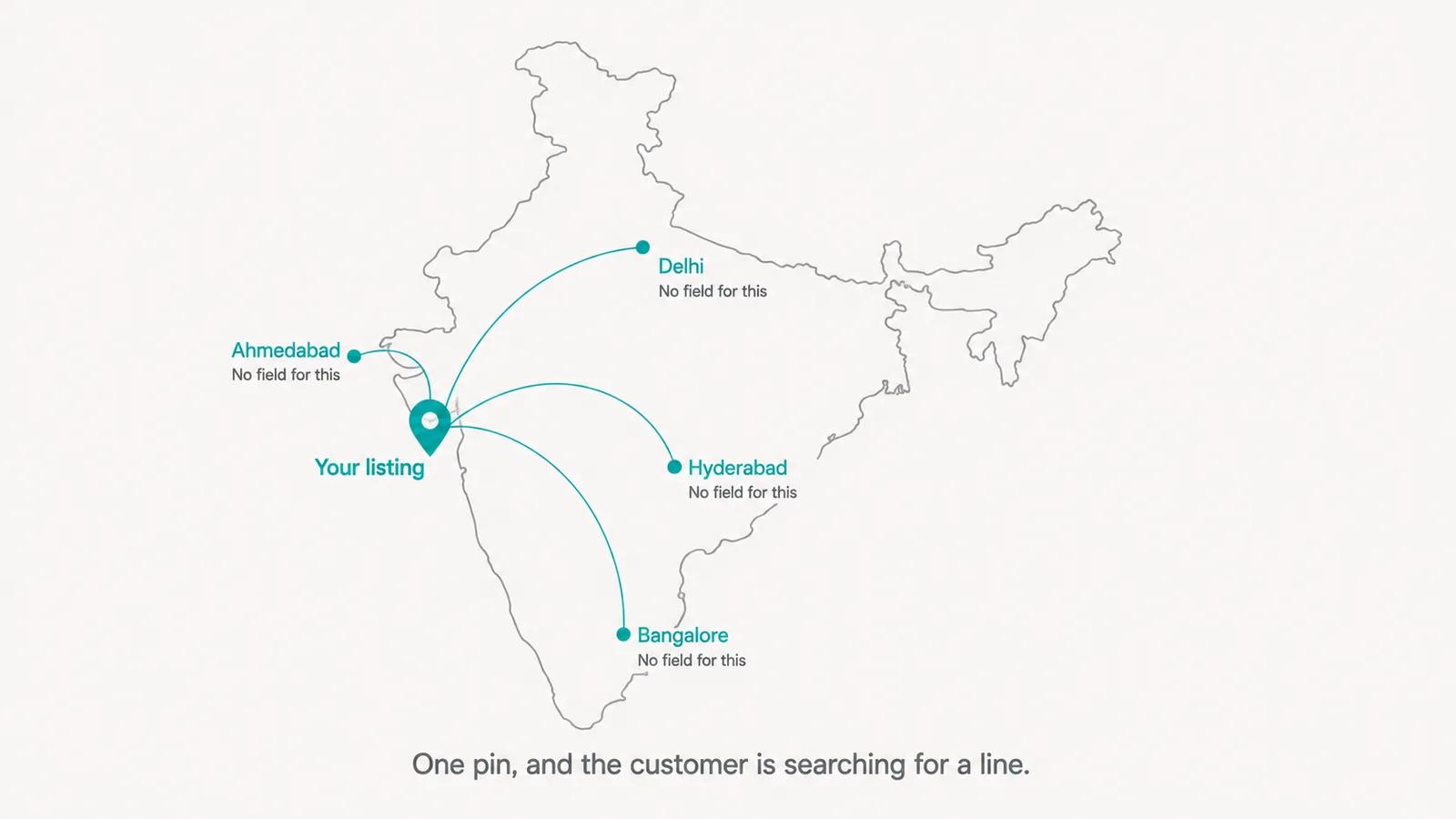
Every other business in this series sits somewhere and serves the area around it. You do not. A mover serves a line between two points, and the search that matters most in this trade names both of them: packers and movers from Pune to Bangalore. Google Business Profile has one pin, no concept of a destination, and no field anywhere that says where you can take somebody. The single largest visibility problem in this vertical is that the thing you sell does not fit the shape of the thing you are listed in.
The second problem is that you inherit a reputation you did not earn. This trade has one of the worst fraud records of any local service in India — advances taken and goods held for more money at delivery, companies that exist only as a phone number, near-identical names cloned from established firms, certificates that were never issued. Every enquiry you receive has been warned about all of it by somebody. You are not competing on price or even on service first. You are competing on whether the customer believes you are real.
This guide covers both, and what follows from them: naming, the quote you genuinely cannot give over the phone, the certificates customers now ask for, the lead resellers, the delivery crew who make your last impression, and a season that ends when the rain starts.

You do not serve an area, you serve a route
Local search is built to answer a question of the form: what is near me. It ranks businesses by relevance, distance and prominence, on the assumption that the customer wants something in their vicinity. That assumption fits a clinic or a bakery perfectly. It fits a mover only halfway, because half of what your customer wants to know is about somewhere else entirely.
The searches in this trade come in two shapes and they behave very differently. The local one — packers and movers near me, packers and movers in a named suburb — is a proximity question and the ordinary rules apply. The intercity one names an origin and a destination, and there is no field on your profile, no attribute, no category and no setting that lets you say which destinations you actually serve. Google is matching that query mostly on the words it can find about you elsewhere, which means anything it knows about your routes has to come from your website, because your listing cannot carry it.
That single fact should reorganise how you split your effort. Your Google Business Profile is the instrument for the origin half of the problem — being the visible, credible, well-reviewed mover in the areas you pick up from. Your website is the only instrument you have for the destination half, and it is the reason a mover needs real pages in a way that a salon does not. A page per major route you genuinely run, written with actual substance about that route — transit time, what the vehicle is, what the documentation involves, what the common problems are on that corridor — is the only way to appear for a query with two cities in it.
Be honest about which routes are real. The temptation is to generate a page for every city pair in India, which produces hundreds of near-identical pages with the place names swapped. That is thin duplicate content, it does not rank, and at scale it looks exactly like what it is. Ten route pages you can write truthfully because you run those routes will do more than four hundred generated ones, and they will not put the rest of the site at risk.
The service-area configuration on your profile is worth setting properly, but understand what it is telling Google. It describes where you will travel to collect, not where you will deliver to. A mover in Pune who lists service areas across half of Maharashtra is describing a pickup radius, and no amount of listing Bangalore as a service area makes that profile a Bangalore business — it makes it a profile claiming an area it cannot substantiate, which is a different problem. Set it to the pickup catchment you honestly cover, and let the route pages carry the destinations.
The local half deserves real attention too, and it is the half most operators neglect while chasing intercity keywords. Local shifting — a household moving three kilometres, an office moving one floor, a single bed and a fridge — is higher volume, more frequent, less price-warred, and decided almost entirely on who appears nearby with reviews. It is also where a strong profile pays off fastest, because it is a proximity search and proximity searches are what a profile is actually built to win.
The local shifting search
- Proximity decides it, so the profile is the main instrument
- Higher frequency, smaller jobs, less of a price war
- Won with reviews, photographs and being visibly nearby
- Your Google listing can carry almost the whole argument
The intercity route search
- Names two cities, and your profile has a field for neither
- Lower frequency, larger jobs, fiercely price-compared
- Won with route pages that say something true about that corridor
- Your website has to do the work the listing structurally cannot
Route pages, because your listing has no field for a destination
The intercity search names two cities and your profile can only answer for one. Route pages are the only instrument that reaches the other half of the query — and they only work if they say something true.
- A page per route you genuinely run, with transit times and real detail
- Local shifting and service pages for the proximity half of the demand
- Written from your own operations rather than generated per city pair

Every enquiry arrives already frightened, and that is the market you are in
It is worth stating the commercial position plainly, because most marketing in this trade is written as though it were not true. Your prospect has been told, by a relative or a colleague or an article they read while researching, that movers take an advance and vanish, that the truck arrives and the price doubles, that goods are held until an extra payment is made, that the company whose name they called turns out to be four men with a rented van. Some of that happens often enough to be a genuine pattern rather than a rumour.
So the first thing your listing has to establish is not that you are good. It is that you exist. An honest operator competing in this category is doing something closer to identity verification than to advertising, and the marketing instinct — polished language, superlatives, stock photographs of smiling uniformed staff who are obviously not your staff — actively works against it, because that is precisely what the fraudulent listings also look like.
What answers the fear is specificity and verifiability, and almost all of it is free. A real, findable address rather than a hidden one. Photographs of your actual godown, your actual trucks with your actual registration plates visible, your actual crew. A landline alongside the mobile number. A registered company name that matches your GST registration, your invoices, your website and your listing without variation. The year you started. The names of the people who run it. None of this is persuasive writing; all of it is checkable, which is the point.
The photographs deserve particular attention because this is one of the few trades where documentary, slightly unglamorous images outperform good ones. A prospect looking at a picture of your loading bay with three named trucks in it is doing something specific: confirming that there is a company here. A generic image of a cardboard box on a white background tells them nothing and is exactly what a listing with nothing behind it would use.
Reviews carry more weight here than in almost any vertical for the same reason, and what makes them useful is detail rather than praise. Five words of thanks does very little. A review that names the route, says what was moved, mentions that the final bill matched the quote and that nothing was damaged is doing the verification work the reader came to do. It is worth asking customers for exactly that, because most people will write what they are prompted to write.
One difficult and unavoidable point: some of what appears on your profile will not be from customers at all. This category has a real problem with planted negative reviews from competitors and with purchased positive ones, and both are visible to anybody paying attention. Report the clearly fake through the proper channel, reply to the plausible ones calmly on the record, and never buy any — in a trade where your entire proposition is that you are the honest one, being caught with bought reviews destroys the only asset you were building.
A hidden address and a mobile number as the only contact
That is precisely the profile of the operator your customer was warned about. A findable address, a landline alongside the mobile, and a registered name that matches your GST and your invoices cost nothing and do most of the reassurance.
Stock photographs instead of your own godown and trucks
Generic imagery is what a listing with nothing behind it uses. A plain photograph of your loading bay with registration plates visible is less attractive and far more persuasive, because it can be checked.
Superlatives where verifiable facts would do
Best and most trusted are what every fraudulent listing also says. Year established, number of trucks, named directors and a real address are duller and they are the things a nervous customer is actually looking for.
Buying reviews to get started faster
In a trade where your entire proposition is that you are the honest one, purchased reviews are removable, increasingly detectable, and they destroy the only asset you were building. The visible pattern persuades nobody who is paying attention.
Why so many firms in this trade have nearly the same name
Anybody who has searched for movers in an Indian city has noticed it: a dozen companies whose names differ from a well-known firm by one word, one spelling, or the addition of India, Cargo, Logistics or Worldwide. This is not coincidence and it is not a naming shortage. It is a deliberate strategy, aimed at customers who half-remember a brand they were recommended and pick whichever result looks closest.
Whether or not you have ever done it, it creates three problems you have to manage. The first is that customers arrive confused about who they have actually called, and a proportion of the complaints attached to that name in their memory belong to somebody else. The second is that if a larger firm holds a registered trade mark and considers your name too close to theirs, that is a legal exposure rather than a marketing one, and it can arrive years after you have built a reputation on it. The third is a search problem: a name that is nearly identical to a stronger brand means you compete for your own name against them, and you will lose.
The Google-specific version of this is stricter than most operators realise. Your listing name must be the name the business actually trades under — the one on your signage, your registration and your invoices. Appending your city, a route, a keyword or a superlative to it is a straightforward policy violation and one of the most consistently enforced there is. Packers and movers listings are suspended for this constantly, and the appeal is slow at exactly the moment you cannot afford to be invisible.
Two consequences follow. If you have a distinctive name, protect it: use it identically everywhere, register the trade mark if the business is worth anything, and check periodically whether somebody has opened a listing that shades into it. If you are choosing a name now, choose a distinctive one even though a derivative one feels like a shortcut to credibility. The derivative name buys you a few misdirected calls in year one and caps what the business can ever become, because you cannot build a searchable brand out of somebody else’s.
Where a competitor has cloned your listing outright — your name, your photographs, sometimes your address with a different phone number — that is a fake listing rather than a naming dispute, and it should be reported through Google’s redressal process with evidence rather than argued about. It is worth checking for periodically, because the operator doing it will not tell you and the calls it intercepts are calls you never knew existed.
Finally, keep the name consistent across the lead platforms, directories and social profiles you appear on. Inconsistent name, address and phone details across the web are a recognised source of scrutiny for any listing, and in a category that is already policed for fraud, giving a reviewer three different versions of who you are is an avoidable risk.
| The decision | The short-term effect | What it costs later |
|---|---|---|
| A name shaded off a well-known brand | A handful of misdirected calls from half-remembered recommendations | You compete for your own name and lose, and carry a trade mark exposure indefinitely |
| City or keyword appended to the listing name | A brief feeling that the listing is better optimised | A policy violation that is reliably enforced, and a suspension appeal at the worst moment |
| Different name versions across directories | Nothing visible at all | Inconsistent details are a recognised trigger for scrutiny in a category already policed for fraud |
| A distinctive name used identically everywhere | Slower recognition in the first year | Nothing. It is the only version that can become a brand you own |
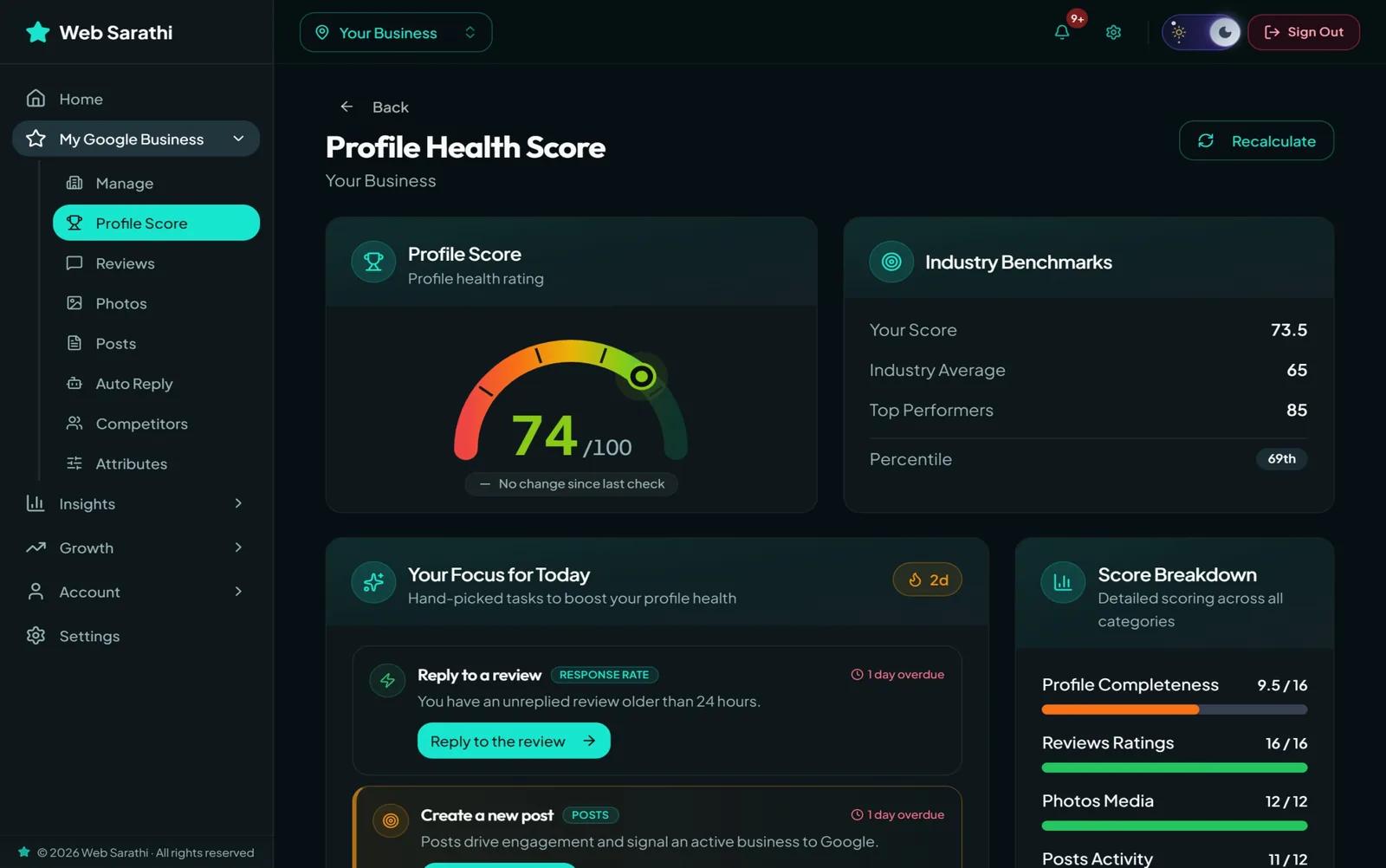
Sixty checkpoints, including the ones that get listings suspended
Movers lose listings to keyword-stuffed names and inconsistent details more than to anything else, and the appeal is slow at exactly the wrong moment. The audit finds those before Google does.
- Flags names carrying a city, a route or a superlative
- Checks name, address and phone consistency across the web
- Re-audits automatically, so a regression surfaces on its own
The survey problem: a price nobody can honestly give over the phone
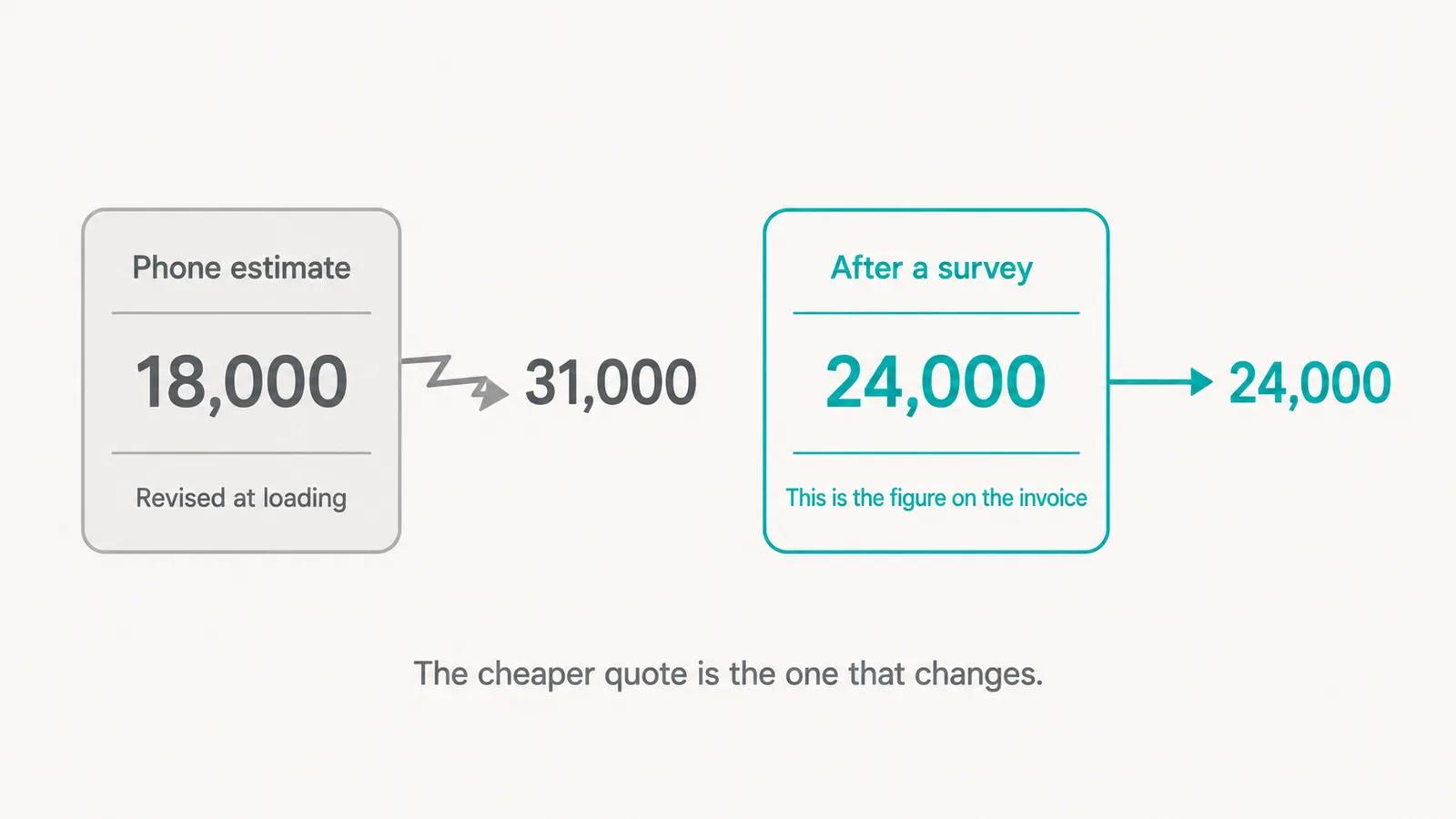
Most guides in this series argue for publishing prices, and for salons and gyms that advice is straightforwardly right. Here it inverts, and it is worth understanding why rather than simply copying the advice across. A move genuinely cannot be priced accurately without knowing the volume, the floor, whether there is a lift, whether the truck can reach the building, how much packing material is needed, what is fragile, and what the access is like at the other end. A number given before any of that is known is a guess.
The industry has resolved this in the worst possible way. The customary practice is a low telephone estimate to win the enquiry, followed by a revision at loading when the goods are already half in the truck and the customer has no alternative. That practice is the direct cause of most of the fear described earlier, and it means the operator who quotes honestly on the phone sounds expensive next to three operators who are not quoting honestly at all.
The way out is not to publish a price. It is to publish the method, which almost nobody does. Explain on your site and in your profile how a quote is produced: that a survey happens first, that it can be done by video in twenty minutes, what the survey establishes, what is included in the figure, what could change it, and that the figure given after the survey is the figure on the invoice. That last sentence, stated plainly and then honoured, is a stronger commercial position than any discount.
The video survey deserves specific mention because it removes the friction that used to make in-person surveys impractical for small jobs. A customer walking through their flat on a video call for twenty minutes gives you enough to quote properly, costs you nothing in travel, and — this is the part operators miss — is itself a trust exercise. They have now spoken to a person, seen a face, and watched somebody take their move seriously. A large share of enquiries convert during that call rather than after the quote arrives.
Where you can publish numbers, do. Indicative bands for common local jobs — a one-bedroom shift within the city, a two-bedroom, an office of a certain size — with the assumptions stated, give the researching customer something to anchor on without committing you to a figure for a job you have not seen. Silence on price sends people to the three sites that will name one, however unreliable those numbers turn out to be.
And put the difficult things in writing before the truck arrives, not after: what happens if the lift is out, what the charge is for a longer carry, what packing material costs, what the position is on a delayed delivery, and what the insurance actually covers. Every one of those is a conversation that otherwise happens on a staircase with a family standing around, which is where reviews in this trade are really written.
Say on the profile that quoting starts with a survey
Not as a refusal to answer, but as the reason your number will hold. A customer who has been quoted three times over the phone recognises the difference immediately.
Offer a video survey and make it easy
Twenty minutes on a call gives you volume, access and fragility. It converts more enquiries than the quote does, because it is the first time the customer has spoken to a person.
Publish indicative bands for common local jobs
One-bedroom, two-bedroom, a small office, with the assumptions stated. Silence sends the researcher to whoever will name a figure, reliable or not.
Put the variables in writing before loading day
Lift out of order, long carry, extra packing material, delayed delivery, what the insurance covers. These are the conversations that otherwise happen on a staircase.
Hold the number, and say that you do
The figure after the survey is the figure on the invoice. Stated plainly and then honoured, it is a stronger position in this trade than any discount.
Registration, insurance and the certificates customers have learned to ask for
Customers in this trade have become considerably more informed over the last few years, and a set of specific documents now gets asked about by name. Being able to produce them, and publishing that you can, is one of the cheapest differentiators available — and being vague about them reads, fairly or not, as evasion.
The IBA reference is the one most often misunderstood on both sides. The Indian Banks Association maintains a list of movers approved for the purpose of bank employee relocation, which is what banks use when reimbursing a transferred employee. It is a real thing and a genuine credential to hold. It is not a government licence, it is not a consumer protection guarantee, and it does not certify that a mover is honest with the general public. It is also widely claimed by firms that do not hold it, which is why customers who care are increasingly checking directly with IBA rather than trusting a certificate image on a website. If you hold it, say so accurately. If you do not, claiming it is a misrepresentation that is trivially disproved.
The documents that do apply to everybody are less glamorous and more important. GST registration, with the number published rather than described. A company or firm registration under whatever structure you actually operate. Vehicle documents and, if you run goods carriers, the transport permits that go with them. These establish that there is a legal entity behind the phone number, which is the question underneath every enquiry.
Transit insurance is the one that matters most to the customer and is most often fudged. Be precise about what you actually offer, because the vague version generates a dispute at exactly the wrong moment. Is it a policy the customer pays for separately or is cover included? Is it declared value or all-risk? What is excluded — goods packed by the owner, existing damage, electronics without proof of purchase? What is the claim process and how long does it take? Publishing that honestly, including the exclusions, is more reassuring than a website that says fully insured and means something narrower.
Where you belong to trade associations, name them, and where you have corporate clients whose moves you handle regularly, that is a credential too — with permission. A mover who handles relocations for a known employer in the city has a form of verification that no certificate provides, because the customer can picture the accountability behind it.
Put all of it in one findable place rather than scattering it. A single page listing entity name, GST number, registration, insurance terms, associations and the actual address, linked from the profile and the site header, does the work of a dozen reassuring adjectives. Customers who are anxious go looking for exactly this page, and most movers do not have one.
| What they ask about | What it actually is | How to publish it |
|---|---|---|
| IBA approval | A list maintained for bank employee relocation reimbursement — a real credential, not a government licence or a consumer guarantee | Claim it only if you hold it, since customers increasingly verify with IBA directly |
| GST registration | Proof that a legal entity exists behind the phone number | The number itself, published, not a sentence saying you are registered |
| Transit insurance | Cover that varies enormously in scope, and is where most disputes start | Declared value or all-risk, what is excluded, who pays, and the claim process |
| Company registration | The structure you actually trade as, matching your invoices and listing name | Entity name and registration on a single findable page |
| Vehicle and permits | Whether the trucks are yours and legally able to run the route | Fleet size, ownership, and photographs with plates visible |
When your enquiry is sold to five movers in the same minute
A large share of the online demand in this trade never reaches a mover directly. It arrives at a comparison site or a lead platform, which captures the enquiry and then sells it — commonly to four or five operators at once, each of whom pays for the same customer. From the platform’s side this is an efficient business. From yours it produces a specific and damaging dynamic that is worth naming precisely.
The customer who filled in that form receives five phone calls within a few minutes. They did not expect five calls, they find it slightly alarming, and by the third one they have stopped listening to anything except the number. Every operator on that list is now in a price auction with four others for a job none of them has surveyed, which guarantees that the winner is whoever quotes lowest — and, given the previous section, whoever is most willing to revise at loading. The platform has, in effect, engineered the exact practice that gives the trade its reputation.
There is a second thing worth knowing about that market: a proportion of the listings on those platforms, and a proportion of the top results for generic mover searches, are not movers at all. They are brokers, who take the booking and then subcontract it to whoever is available, sometimes to you. The customer believes they have hired the company whose reviews they read. The crew that arrives works for somebody else entirely.
None of this means never buying leads. A new operator with no reviews and no ranking has to get work from somewhere, and lead platforms are a legitimate way to do it. It means understanding that leads bought at auction have a structural ceiling: they do not accumulate, the customer belongs to the platform, and the margin gets competed away by design. A business built entirely on them is renting its demand permanently.
The direct channel behaves in exactly the opposite way, which is the argument for building it in parallel from the first month. A customer who found you in local search and called you is talking to one company, not five. There is no auction. You can propose a survey rather than a number, which is a conversation you can win on grounds other than price. And the review they leave afterwards sits on your listing and helps the next one, which is the compounding a bought lead never does.
The practical measure is simple and most operators do not have it: of the jobs you did last month, how many came from a platform, how many from a direct call, and what the average margin was on each. Operators who run that number for the first time usually find the direct jobs are worth substantially more each and cost almost nothing to acquire, which reframes the unglamorous profile work as the highest-return activity available rather than as marketing.
An enquiry bought at auction
- Sold to four or five movers in the same minute
- The customer is fielding calls and listening only for a number
- No survey is possible, so the lowest guess wins the job
- The customer, and the review, belong to the platform
- Costs money every single time, and never accumulates
An enquiry from your own listing
- One company on the call, and no auction running
- You can propose a survey instead of competing on a guess
- The conversation can be about method rather than price
- The review lands on your profile and helps the next enquiry
- Costs nothing per job once the ranking exists
The last impression is made by people who may not work for you
Consider the shape of a long-distance job. You take the enquiry, you survey the flat, your crew packs and loads, and then the truck leaves. Days later, in a city hundreds of kilometres away, somebody unloads it and carries it up three flights of stairs. In a large share of intercity moves that somebody is not your employee — it is a local crew engaged at the destination, or a partner firm, or labour arranged by the transporter.
Which means the final and most emotionally charged part of the job, the part the customer will actually remember and write about, is performed by people you have never met and cannot supervise. Everything you did well over the preceding fortnight is being represented by a stranger who has been paid a flat rate to carry heavy things up a staircase in the heat.
This is unlike anything else in the set. A restaurant controls its own last impression; so does a salon, a gym, a clinic. A mover routinely does not, and yet the review lands on the mover’s profile. Treating destination handling as somebody else’s problem is therefore treating your own reputation as somebody else’s problem.
The operators who handle this well do three unglamorous things. They brief the destination crew properly — what is fragile, what the access is, what was promised about assembly and placement, and what the customer has already been told. They call the customer on delivery day themselves rather than waiting to hear whether it went wrong. And they make sure the customer knows who to reach at the origin office if something is damaged, so that the complaint reaches a person who cares rather than the public review form.
The review ask has to be built around this too, and its timing is the hardest in this series. The customer is standing in an unfamiliar flat surrounded by cartons, exhausted, in a city where your company means nothing. Asking a week later by message, after the unpacking has settled and before the move has faded, works far better than asking on the day. Asking through the person they actually dealt with — the surveyor or the coordinator they spoke to for a fortnight — works better than asking from a company account they do not recognise.
And ask them to be specific, because in this trade specificity is the whole value. A review naming the route, the size of the move, whether the final bill matched the quote and whether anything was damaged answers precisely what the next frightened enquiry came to find out. Prompted properly, most people will write it. Left to themselves, they write four words or nothing at all, having moved on to the rest of their new life.
Treating destination handling as the transporter’s problem
The crew that unloads makes the impression the customer writes about, and the review lands on your profile regardless of whose employees they were. Brief them properly and call the customer on delivery day yourself.
Asking for the review on delivery day
They are standing in an unfamiliar flat surrounded by cartons and are not going to write anything useful. A week later, once the unpacking has settled and before the move fades, is the window.
Asking from a company account they do not recognise
The customer dealt with a person for a fortnight — the surveyor, the coordinator. A request from that person converts far better than one from a name they have never seen.
Not prompting for the specifics
Route, size of move, whether the bill matched the quote, whether anything was damaged. That is what the next anxious enquiry is reading for, and most people will write it if asked.
Ask a week after delivery, and ask for the specifics
On delivery day they are standing among cartons in an unfamiliar flat. A week later they will write, and if prompted they will name the route, the bill and whether anything broke.
- Prompts for route, move size, and whether the final bill matched the quote
- Sent by the coordinator they actually dealt with, not a company account
- Turns a customer who has moved away permanently into lasting proof
Lease ends, school terms and the months nobody moves
Demand in this trade is not evenly spread, and unusually, the peaks are driven by other people’s calendars rather than by anything in your control. Household moves cluster around the end of rental agreements, which in most Indian cities concentrates into a few months. They cluster again around the school year, because families avoid moving a child mid-term. Corporate transfers add another peak, since most employers move people at the start of a financial year or a performance cycle. And a proportion of families will only shift on an auspicious date, which puts household moves onto the same almanac that governs weddings and house-warmings.
Against those peaks sits the flattest trough of any trade in this series: the monsoon. Moving a household in heavy rain is genuinely difficult, customers postpone it, and the enquiry volume falls away for weeks. Every mover knows this and very few use it.
The planning consequence is the same one that appears in every seasonal vertical, and it is worth restating because in this trade the trough is unusually long. Ranking and review velocity take weeks to build, so the visibility you have in the peak was created in the quiet months. Photographs of the godown, the certificates page, route pages, chasing reviews from the previous season’s customers — all of it is monsoon work, and none of it is possible in the fortnight when every crew is booked.
What the profile should say also ought to change through the year, and almost nobody does this. In peak weeks the useful content is operational: availability for specific dates, how far ahead to book, what a surveyor visit involves, and whether you can still take a job for the end of the month. Out of season it is the material that persuades somebody researching early — route pages, the insurance explanation, photographs, and the answers to the questions people ask before they trust anybody.
The monsoon is also worth addressing directly rather than going quiet through it, because customers who must move in the rain are anxious about exactly one thing. Publishing how you actually handle it — waterproof wrapping, covered vehicles, what you do if loading day is washed out, whether the date can be shifted without a charge — wins jobs from operators who simply do not mention it, and it is content that writes itself out of what you already do.
One last piece of timing worth naming. The end of a rental agreement is a hard date that the customer knew about weeks in advance, which means a meaningful share of your peak demand is searchable before it becomes urgent. Being visible to somebody researching a move six weeks out, and capturing the enquiry then with a survey rather than a number, is a much better job than the same customer arriving as a panicked call four days before the lease expires.
| Period | What is happening | What the profile should be doing |
|---|---|---|
| Lease-end and school-transition months | The bulk of household demand, booked days rather than weeks ahead | Availability, how far ahead to book, what a survey involves |
| Start of the financial year | Corporate transfers, larger and better organised jobs | Corporate credentials, insurance terms, named references with permission |
| Monsoon | The deepest trough of the year, with customers postponing | How you handle rain, plus every piece of groundwork the peak has no time for |
| Auspicious-date clusters | Households that will only shift on a specific day, booked well ahead | Willingness to work to a fixed date, and early availability for it |
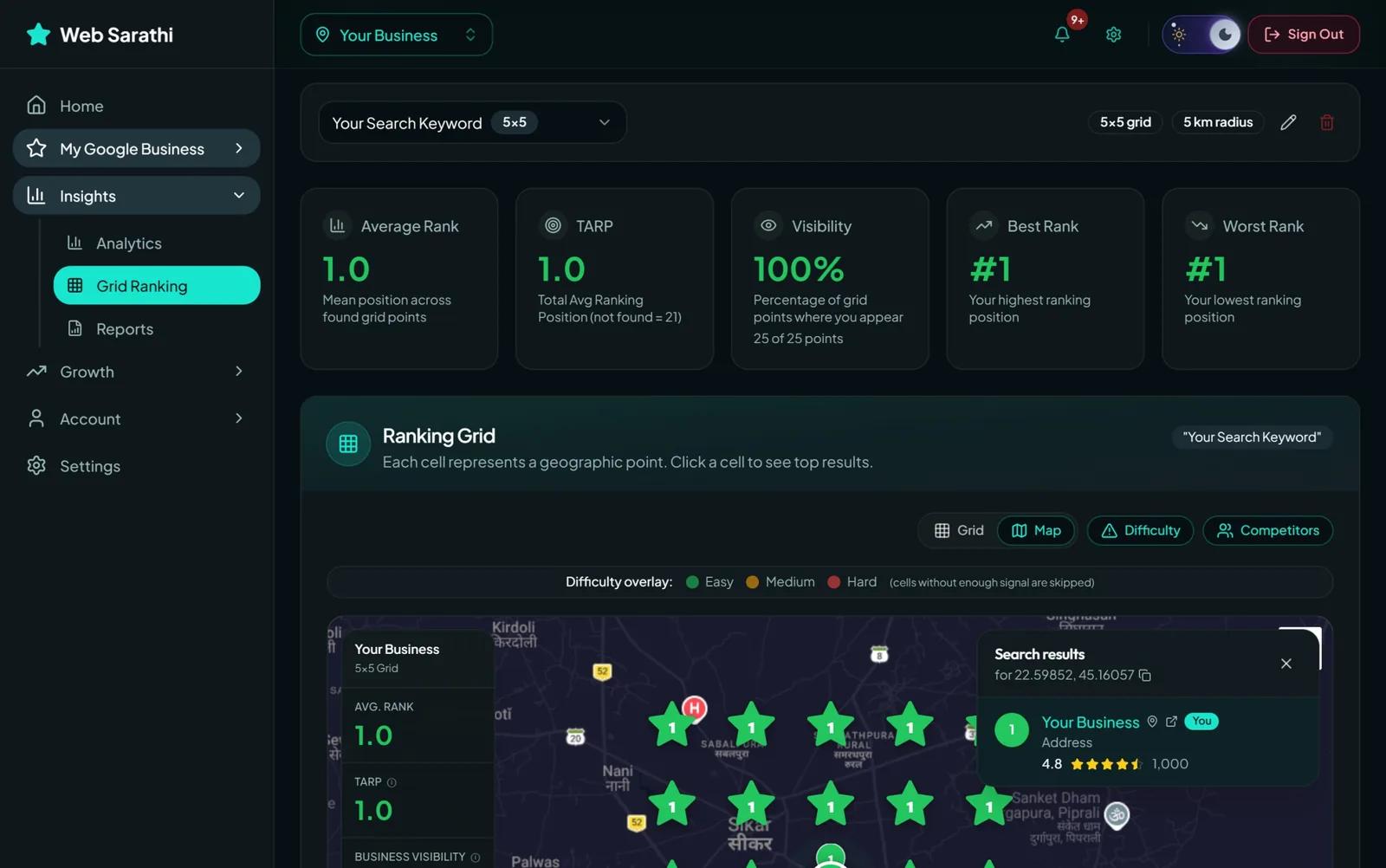
See which pickup areas can actually find you
The local shifting half of your demand is a proximity search, and proximity searches are what a profile is built to win. Grid ranking shows which societies and suburbs you are visible in.
- Measure the pickup catchment you really have, not the one you claim
- Track local shifting keywords through the run-up to the peak
- Judge a second branch or godown on coverage rather than instinct
Packers and Movers SEO questions, answered
The questions Indian packers and movers businesses ask us most often.