Bakery SEO in India: winning the counter and the cake order at the same time
A bakery runs two businesses out of one shop and they behave nothing alike. The counter sells bread, pastries, puffs and biscuits to people who walked past, decided in four seconds and will not travel more than a few hundred metres to do it again. The order book sells custom cakes for a named date to people who planned it, compared photographs, will drive across the city, and cannot move the birthday if you are late.
That second business is unusual in local search. Almost every other trade in this series sells either immediate demand or a considered purchase with a flexible timeline. A cake order is considered and deadline-bound at once — the customer chooses carefully days in advance, and then the delivery window is measured in hours and is completely non-negotiable, because a party has been arranged around it.
India adds two filters that no Western bakery guide will mention. Egg or eggless is a decisive constraint that eliminates you from consideration before anything else is assessed, and midnight delivery is a real, large and almost entirely unpublished category.
This guide covers both businesses, the gifting platforms that sell your cakes to somebody in another country, the photographs you produce every morning and throw away, the festival pre-order windows, and how the order itself is taken.
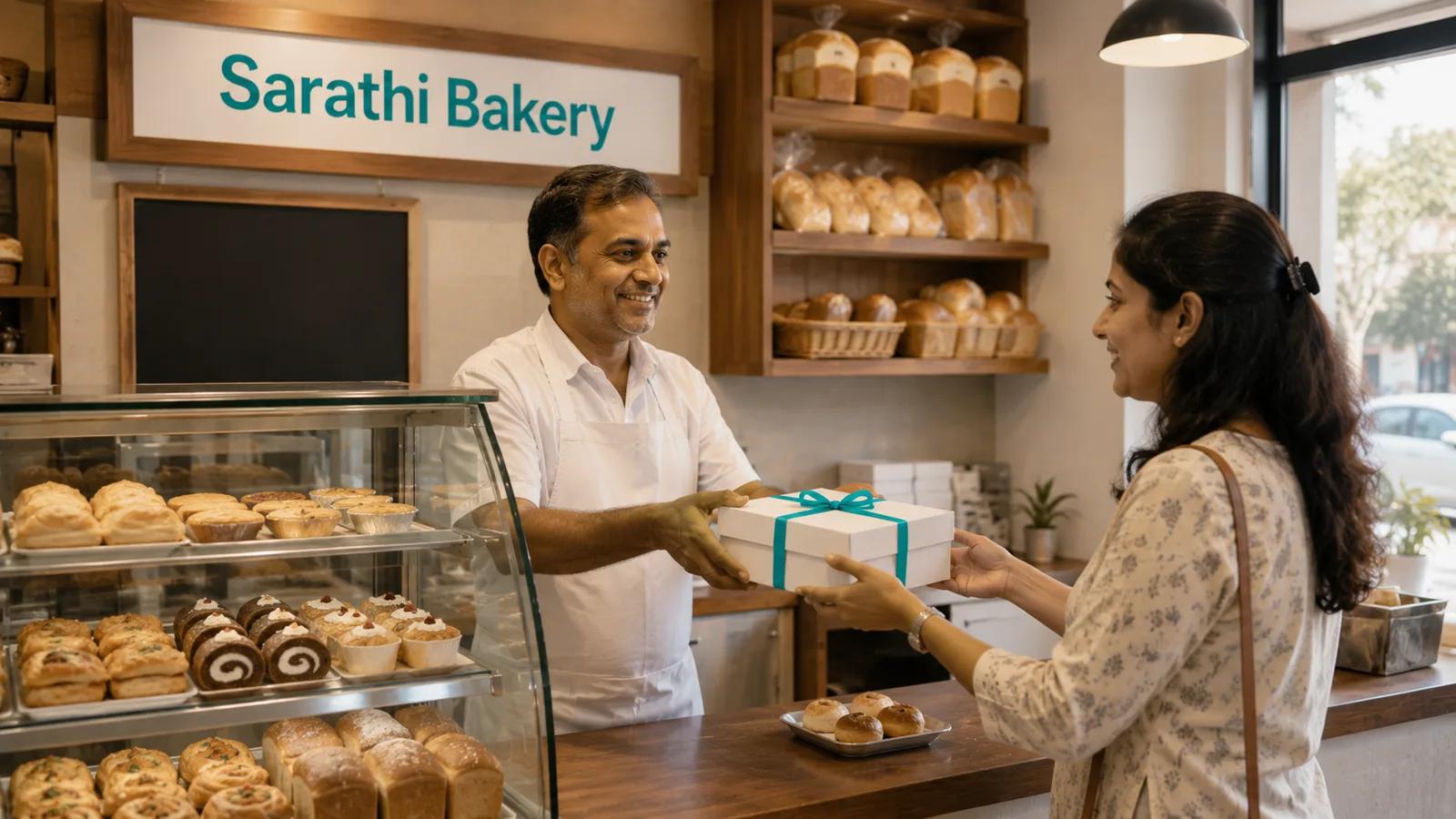
The pastry customer and the cake customer are not the same business
Almost every bakery in India treats itself as one business with two product lines. It is closer to the truth to think of it as two businesses that happen to share an oven, a counter and a signboard, because the customers arrive by different routes, decide on different grounds, and want different things from your listing.
The walk-in half is pure proximity and impulse. Somebody passing on the way home buys bread, a pastry, a patty, birthday candles. They did not research anything. The decision took four seconds and was made mostly on the window and the smell. They will not travel a kilometre for it, and if you close at eight they will buy from whoever is open at eight-fifteen. For this half, the profile is doing conventional local search work — hours, photographs of the display, proximity, being open when people are walking past.
The order half is a planned purchase with a fixed deadline. A parent organising a child’s birthday starts thinking about it three to seven days ahead, searches specifically, compares photographs of previous cakes across several bakeries, cares about flavour and design and whether you can do a particular theme, and will genuinely drive twenty minutes to collect from the bakery whose work looked right. Price matters but far less than it does at the counter, because this cake is the centrepiece of an event.
The failure this produces is predictable. Most bakery profiles are configured for the walk-in customer — a category, some hours, a few photographs of the display case — and are almost useless to the order customer, who is looking for a portfolio, a lead time, a price range and a way to actually place the order. The higher-value half of the business is invisible.
The reverse mistake exists too and is less common: a bakery that has become a cake studio online, all custom work and design galleries, while the counter that pays the rent is not represented at all. Somebody searching for bread near me at seven in the morning gets nothing useful, and that customer visits three hundred times a year.
Both halves fit on one profile without conflict, because they use different fields. Hours, the display photographs and the primary category serve the counter. The services list, the cake photographs, the lead time and the ordering route serve the order book. What is required is noticing that the second set exists, since almost every bakery profile in the country has left it empty.
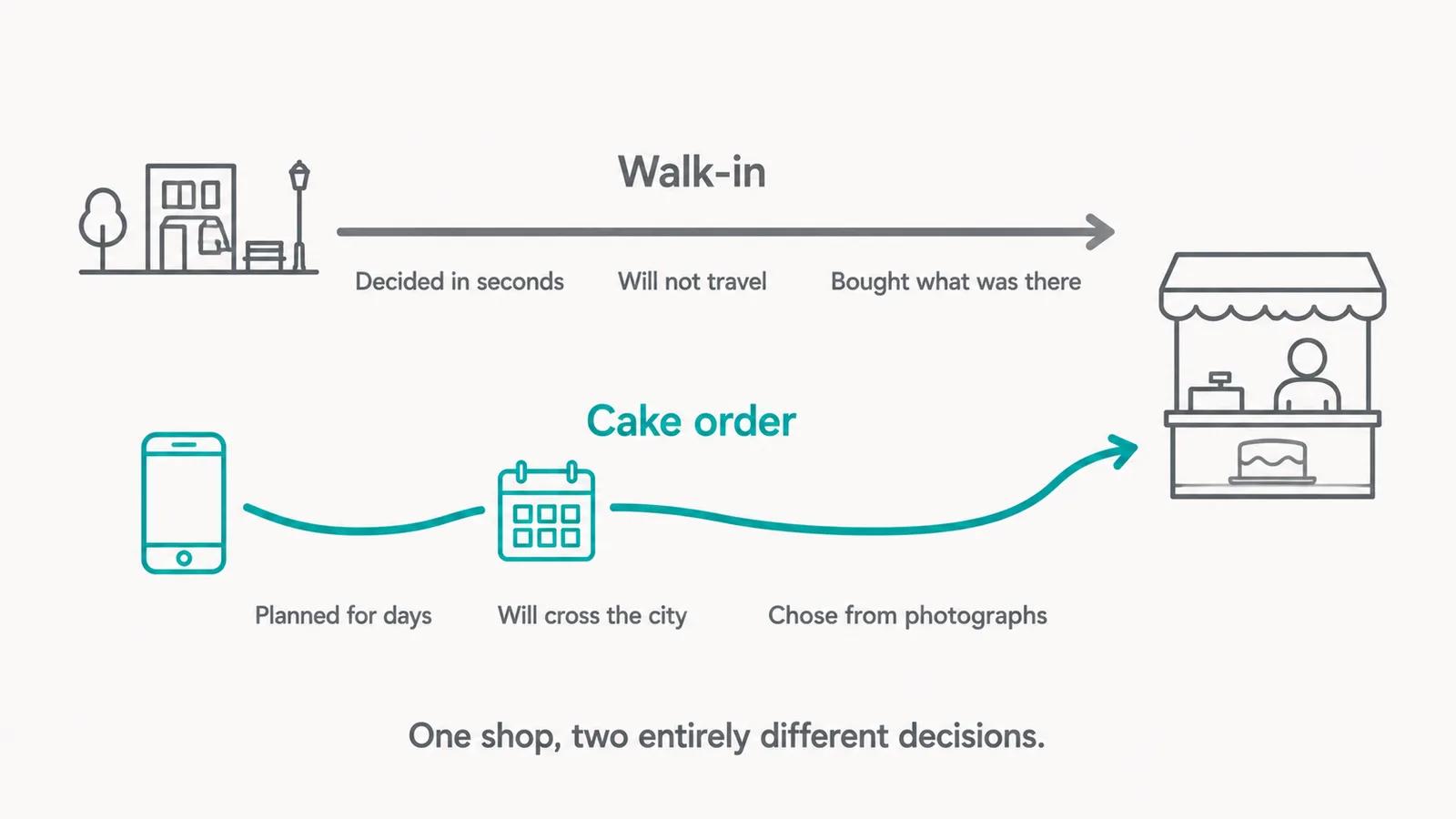
The counter is proximity. The order book is not.
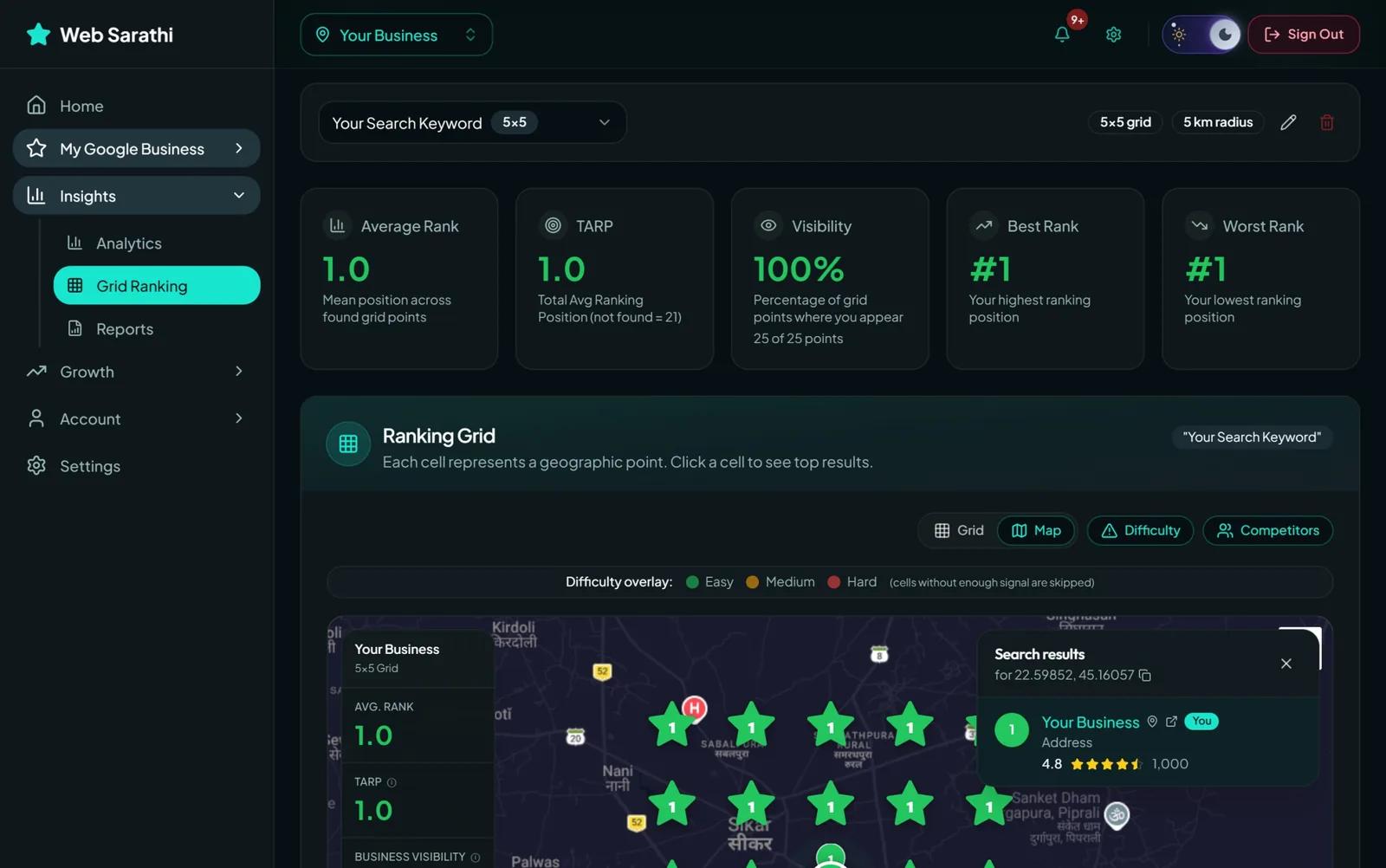
Walk-in trade lives inside a few hundred metres and cake orders travel across the city. Grid ranking shows you which streets return you for each, so you can tell the two halves of the business apart.
- Track bread and cake keywords separately — they behave nothing alike
- Find the streets where the passing trade never sees you
- Judge a second outlet on coverage evidence rather than instinct
A cake is ordered for a date, and the date does not move
The defining operational fact of the order business is that it is deadline-bound in a way almost nothing else in this series is. A restaurant that is slow disappoints somebody. A cake that is late ruins a birthday party that thirty people were invited to, and there is no version of the following day that fixes it. The customer knows this, and it is the source of nearly all their anxiety when choosing a bakery.
Which means the thing they are really trying to establish, underneath the questions about flavour and design, is whether you are reliable. That is not a question your photographs answer. It is answered by lead time stated clearly, by the order being confirmed in writing, and by reviews from other people whose cake arrived when it was supposed to.
Publish the lead time, and publish it honestly. How many days notice for a standard cake, how many for a tiered or sculpted one, how many for a photo print, whether you take same-day orders at all and with what restrictions. A bakery that says two days for custom orders, same-day for whatever is in the display is answering the first question every ordering customer has. A bakery that says nothing forces a phone call before the customer even knows whether you are a possibility.
Say what you will not do, as well. Bakeries lose entire afternoons to enquiries for things they cannot deliver — a five-kilogram tiered cake by tomorrow evening, a specific character design, a sugar-free version, a delivery forty kilometres away. Stating the boundaries removes the wasted conversations and, counter-intuitively, increases trust: a business that declines something clearly reads as one that knows what it can promise.
Delivery is the highest-risk part of the whole transaction and deserves its own sentences. Whether you deliver, how far, what it costs, what time window, and what happens if a cake is damaged in transit. The last one is worth having a stated position on before it happens rather than negotiating in a doorway with a party waiting inside, and it is the single most common cause of the furious one-star review in this trade.
The corresponding review opportunity is straightforward and almost nobody takes it. The relief when a cake arrives on time and looks like the photograph is real and it is short-lived — within a day the party has happened and the bakery is forgotten. Asking at collection or immediately after delivery, prompting for whether it was on time and matched the design, produces exactly the reassurance the next anxious customer is searching for.
The search begins
A parent or a partner starts looking, compares photographs across several bakeries, and shortlists on design rather than on price. Your gallery is doing all the work at this stage.
The lead-time question
Can you actually make it by Saturday. A published notice period answers this without a phone call; silence forces one before the customer even knows you are a possibility.
The order is placed
Flavour, weight, design, the spelling of the name, egg or eggless, collection or delivery, and the deposit. In writing, or it will be disputed.
The window that cannot slip
A party has been arranged around this. There is no version of tomorrow that fixes a cake that did not arrive, which is why reliability outranks everything else in this trade.
Ask, while the relief is fresh
On time and looking like the photograph is a specific relief that fades within a day. Prompt for exactly that, because it is what the next anxious customer is searching for.
Egg or eggless is the filter that decides who even considers you
This is the single most consequential piece of vocabulary in Indian bakery search and it has no equivalent in any bakery guide written for another market. A very large number of Indian customers will not eat egg, for religious or dietary reasons, and for them eggless is not a preference to be accommodated. It is a threshold condition. A bakery that cannot confirm it is eliminated before flavour, price, design or distance is considered at all.
The searches reflect that directly: eggless cake near me, eggless bakery, pure veg bakery, eggless birthday cake. They are high-volume, high-intent and specific, and they are made by people who have learned from experience to check first, because the alternative is a cake at a family event that half the guests cannot eat.
Most bakery listings handle this badly, and the failure has two forms. The first is silence — the profile says nothing, and the eggless customer assumes not. The second is a vague claim, which is worse: eggless options available reads as a small corner of the menu grudgingly provided, and it also leaves the more serious question unanswered, which is whether eggless products are made separately from egg-based ones.
That distinction matters more than most bakeries realise. For a customer avoiding egg on religious grounds, a cake baked eggless in a kitchen that also handles egg, with shared equipment, may not be acceptable at all. Bakeries that maintain genuine separation — separate equipment, separate preparation, or an entirely eggless kitchen — are offering something materially different and are usually silent about it. If it is true of you, say it plainly. It is one of the strongest differentiators available in this trade and it costs a sentence.
The same logic runs through the rest of Indian dietary vocabulary and the same neglect applies. Jain preparation, no onion and no garlic in savoury items, whole wheat and multigrain breads, sugar-free for diabetic customers, and increasingly vegan. Each is searched, each is a threshold rather than a preference for the person searching it, and each belongs in the services list and the description rather than being explained on the phone.
Practically, put it everywhere the customer might look: the description, the services list as named items, the attributes if applicable, and on the product photographs themselves. And be exact rather than generous — a bakery that claims pure vegetarian and is found to use gelatine in a mousse has done itself far more damage than one that never claimed it.
Saying nothing about egg at all
The customer assumes not and moves on. For a large share of Indian buyers this is a threshold condition, not a preference — you are eliminated before flavour, price or design is even considered.
Eggless options available
It reads as a grudging corner of the menu and it dodges the real question, which is whether eggless items are prepared separately from egg-based ones.
Not mentioning a genuinely separate kitchen
Separate equipment or an entirely eggless kitchen is materially different to a customer avoiding egg on religious grounds, and it is one of the strongest differentiators in this trade. It costs one sentence and almost nobody writes it.
Claiming pure vegetarian while using gelatine
Being found out does far more damage than never having claimed it. Check every ingredient in every product before the claim goes on the profile.
Leaving Jain, sugar-free and vegan to the phone call
Each is searched by name and each is a threshold for the person searching it. Explaining them on the phone only works for customers who called, and these customers filter before they call.
The buyer is often not the person eating it
A large and growing share of Indian cake demand is gifting, and gifting has a property that changes the economics entirely: the person paying is not the person receiving. A son in Dubai orders a cake for his mother in Pune. A colleague in Bengaluru sends one to a team in Hyderabad. A husband travelling for work arranges a delivery to his own house at midnight.
That buyer cannot walk into your shop, cannot see the cake, cannot collect it, and frequently has no knowledge of your city at all. Every part of the transaction has to work remotely — discovery, selection, payment and delivery to an address the buyer is describing from memory. It is a fundamentally different sale from somebody choosing a cake at a counter.
The national gifting platforms exist precisely to serve it, and they are formidable. They rank strongly for cake delivery in a named city, they accept international payment, they handle the delivery promise, and they fulfil through local bakeries — often yours. Which puts you in the position described in several other guides here: the platform owns the customer, sets the price, takes a share, and the recipient never learns your name.
The distinctive thing about the bakery version is how little of the relationship you ever see. In most fulfilment arrangements the customer at least meets you. Here the buyer is in another country, the recipient did not choose you and does not know who baked it, and no part of the transaction produces a review on your profile or a customer who might come back. A large volume of work can pass through your kitchen leaving no trace on your business at all.
The direct version is available and under-built. Buyers do search bakery name plus a locality when a friend has recommended one, and they do search midnight cake delivery in a named area. What stops them ordering directly is almost always operational rather than a preference for the platform: no way to pay remotely, no confirmed delivery promise, and nobody answering a message from a different time zone at eleven at night. Solving those three converts a share of the gifting demand into your own customers.
Two things make an outsized difference. First, a payment route that works from abroad — a UPI link is useless to somebody without an Indian bank account, so a card or an international payment option matters more than it seems. Second, a photograph of the delivered cake sent back to the buyer. They cannot see it, they are anxious about it, and that one image is the entire experience for them. Bakeries that do this routinely get remembered and recommended in a way that platform fulfilment never produces.
A cake fulfilled for a gifting platform
- The buyer found the platform and never learns your name
- Price and delivery promise set by somebody else
- A share of the value goes to the intermediary
- No review, no repeat, no relationship — nothing accumulates
- The recipient could not recommend you if they wanted to
A gifting order taken directly
- The buyer found you, and can find you again next year
- Your price, your delivery window, your promise
- The whole value stays in the shop
- A review you can ask for, from the buyer and the recipient
- A photograph of the delivered cake, which is their whole experience
You produce your best marketing asset every morning and bin it
There is no trade in this series with a better ratio of available photographic material to material actually published. A bakery produces, every single day, a stream of finished objects that are attractive, varied, seasonal, and directly representative of the thing customers are trying to evaluate. Then almost none of it is photographed, and of what is photographed almost none reaches the profile.
This matters more here than in most trades because the order customer is choosing on exactly this basis. They are not reading your description. They are scrolling images to answer one question — can these people make a cake I would be proud to put on a table — and a bakery with nine photographs, four of them of the shop front, cannot answer it. A bakery with two hundred, showing range, competence and consistency, answers it decisively.
The discipline required is small and it is a habit rather than a project. Photograph every custom cake before it leaves, on the same surface, in the same light, from roughly the same angle. That takes thirty seconds, it happens anyway at the moment the cake is boxed, and after six months it has produced a portfolio no competitor can assemble retrospectively. Consistency in the setup matters more than quality of equipment: a phone photograph in the same corner every time looks like a body of work, and the same phone photographing cakes in random lighting looks like a camera roll.
What to shoot beyond the custom cakes is worth saying, because bakeries default to the finished-product shot and stop. The display case full in the morning. The bread coming out. Somebody actually decorating, because process photographs do more for credibility than results do. The shop front lit in the evening. The packaging, which for a gifting customer is a genuine part of the product. Festival stock as it appears. A cake being handed over.
Faces help and are usually avoided. A customer collecting a cake and clearly pleased, with permission, does something no photograph of a cake alone achieves — it shows the transaction working. So does a photograph of the baker. A bakery whose profile contains no people reads as a stock catalogue rather than a shop somebody runs.
One caution that is specific to this trade. Do not publish photographs of cakes you did not make, and be careful with reference images customers bring. A gallery assembled from the internet is discovered quickly, usually by a customer holding a cake that does not match, and it is the fastest route to the kind of review that ends with everyone should know this. If a cake was made from a customer’s reference image, it is still your work and fine to publish, with their permission where the design is personal.
| The photograph | What it answers | Usual state |
|---|---|---|
| Every custom cake, same corner, same light | Can these people make something I would put on a table | A handful of cakes shot in random lighting over four years |
| The display case, full, in the morning | Is it worth walking in on the way past | One photograph of the shop front from across the road |
| Somebody decorating | Is this made here, by people who can do it | Never taken — process beats results for credibility and nobody shoots it |
| The packaging and a boxed cake | Will this look right when it arrives as a gift | Missing, though for a gifting buyer it is half the product |
| A customer collecting, with permission | Do people actually buy here and leave happy | Absent, which makes the profile read as a catalogue rather than a shop |
| Festival stock as it appears | Are they doing plum cake this year, and from when | Photographed on the last day, if at all, when the window has closed |
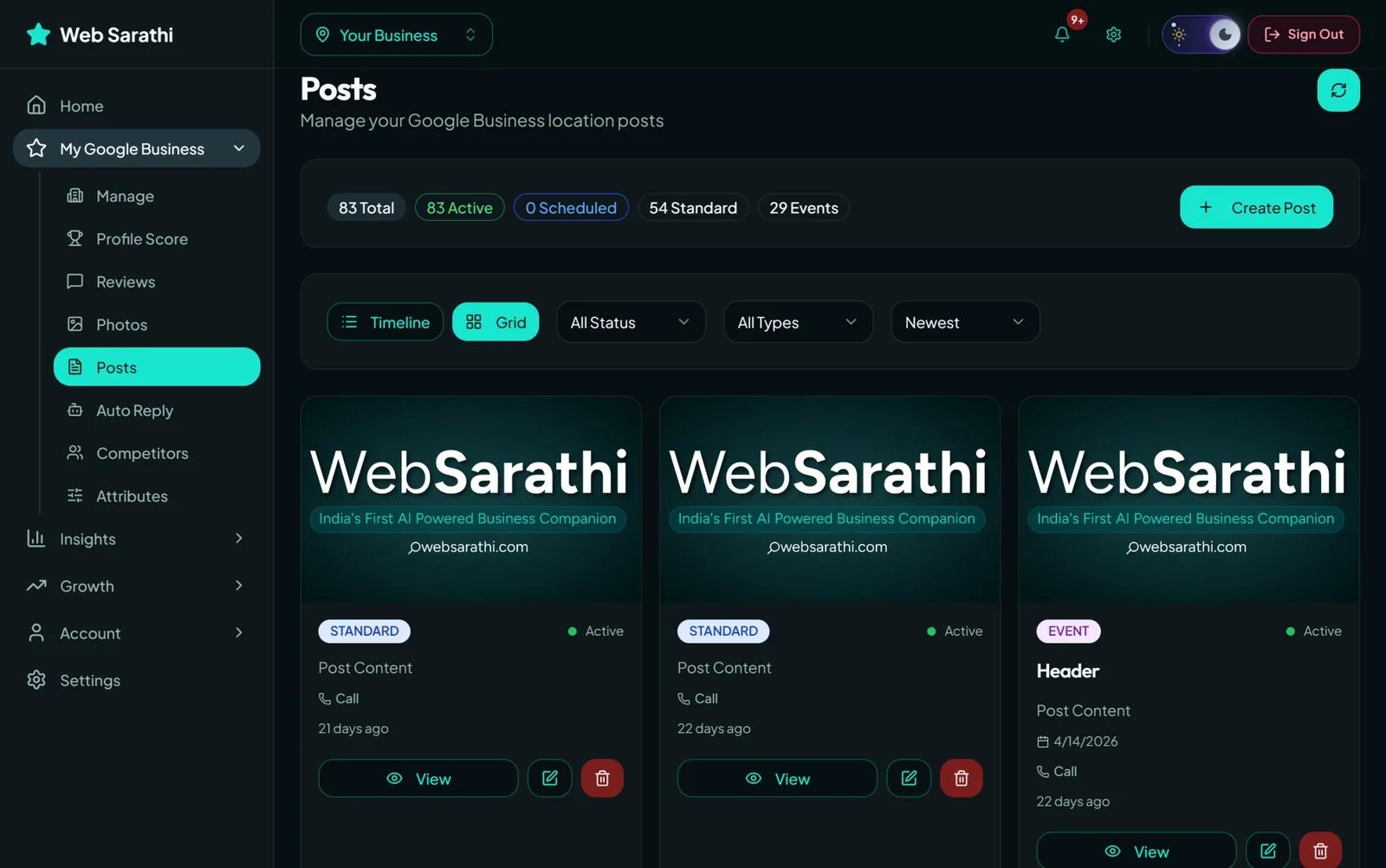
Thirty seconds a cake, published on a schedule
You finish the best marketing asset in local business every morning and it leaves in a box. Photograph it in the same corner every time and let the posting run itself.
- Festival ranges published four weeks early, when the orders are actually placed
- A steady stream of real work rather than a gallery from 2022
- Drafts built around your own products and season, not generic filler
Midnight delivery and the hours nobody publishes
Midnight cake delivery is a genuine and substantial Indian category with no real Western equivalent. The custom of cutting a cake at twelve o’clock to begin a birthday is widespread, particularly among younger customers, and it generates a specific, urgent, well-priced stream of orders — midnight cake delivery near me, cake delivery at 12 am, midnight surprise cake.
The striking thing is how few bakeries that actually offer it say so anywhere. The service exists, arranged over the phone or over WhatsApp for customers who thought to ask, and the profile lists closing time as nine in the evening. Every person searching for a midnight delivery skips that listing entirely, and reasonably so — it says you are closed.
This is a specific instance of a general problem in this trade, which is that bakery hours on Google are almost never right. The shop opens earlier than the profile says for bread. It stays open later than the profile says on Saturdays. It closes on a weekday that has never been recorded. It runs completely different hours during festival weeks. Hours are a hard filter before they are anything else — open-now searches remove closed businesses rather than ranking them lower — so wrong hours quietly delete you from results at exactly the times people are buying.
Handle the midnight service explicitly rather than through the hours field, which cannot express it cleanly. Name it as a service. Say in the description that midnight delivery is available, by how much notice, within which areas, and at what charge. Post about it. A bakery that has published this is the only visible option to a customer searching at nine in the evening for a cake to arrive in three hours, and that customer is not price-sensitive.
The same neglect covers the other timing questions customers actually have. What time is fresh bread out. Whether cakes can be collected before opening for a morning office celebration. How late an order can be placed for the following day. Whether you are open on a holiday, which for a bakery is usually the busiest day of the year and is frequently shown as closed because the special-hours field was never touched.
One practical note on the delivery itself, since this trade is where it goes wrong most publicly. A midnight delivery has no margin for error and no possibility of a retry — there is no next day. Whatever you promise, promise conservatively, confirm the address in writing rather than by voice, and have a stated position on what happens if the cake is damaged. Getting a cake to a door at midnight is a logistics operation, and a bakery that treats it as an afterthought will generate its worst reviews from its highest-value orders.
Offering midnight delivery and listing a 9 pm closing time
Everybody searching for it skips you, and reasonably — the profile says you are closed. Name it as a service and describe it, since the hours field cannot express it.
Hours that were entered once and never corrected
Open-now searches remove closed businesses rather than ranking them lower, so wrong hours delete you from results at precisely the times people are buying.
Showing as closed on a public holiday
For a bakery a festival day is frequently the busiest of the year, and the special-hours field is the one nobody ever touches.
Promising a midnight slot casually
There is no next day and no retry. Confirm the address in writing rather than by voice, promise conservatively, and have a position on damage before it happens.
The pre-order windows that open weeks before the festival
Bakery seasonality is sharper than restaurant seasonality and it works differently, because the demand is not merely concentrated — it is pre-committed. A restaurant fills up on Diwali night with people who decided that afternoon. A bakery takes Christmas cake orders in the last week of November for collection on the twenty-fourth of December, and by the middle of December the capacity is gone.
That means the marketing has to happen weeks before the demand is visible, and it is the single most common timing error in this trade. Plum cake posts published on the twentieth of December reach an audience that has already ordered from somebody who published on the twenty-fifth of November. The window that matters is the pre-order window, not the festival.
The Indian bakery calendar is unusually rich and worth mapping properly rather than reacting to. Christmas and New Year, with plum cakes soaked weeks in advance. Valentine’s Day, which is heavily gifting-driven and skews to midnight delivery. Rakhi. Diwali, where the competition is sweets rather than cakes and the useful positioning is often hampers and gift boxes. Mother’s and Father’s Day. Children’s Day. Eid. Ganesh Chaturthi. Local and regional new years. Plus the constant, unglamorous, entirely predictable baseline of birthdays and anniversaries that pays the rent between them.
For each of the big ones the useful pattern is the same and takes an hour to set up. Publish what is available and when orders open, three to four weeks ahead. Publish the order deadline, honestly, because a bakery that says orders close on the twentieth and means it is trusted next year. Publish capacity limits if you have them — a stated number of cakes available is both true and the only form of urgency that is not manufactured. And publish the collection and delivery windows for the day itself, which will be different from your normal hours.
The quiet weeks after a festival are when the next one is prepared, exactly as in every seasonal trade here. Photographs from the season just finished are the material that sells the next one, and they are only usable if somebody took them while it was happening. A bakery that photographs its Christmas range in December has something to publish in November; one that meant to and did not starts each season with nothing.
One thing worth doing that almost no bakery does: keep the order list. The customer who ordered a plum cake last Christmas, the parent who ordered a birthday cake last April, the office that ordered forty pastries for a Diwali party — all of them have an anniversary you know about and they do not expect to hear from you. A message a fortnight before, offering the same thing again, is the highest-converting marketing available to this trade and it costs nothing.
Announce the range and open orders
The pre-order window is the demand, not the festival. A post on the twentieth of December reaches people who ordered on the twenty-fifth of November.
Contact last year’s list
Everybody who ordered for this festival last year has an anniversary you know about and does not expect to hear from you. Highest-converting message this trade has.
Publish the deadline and mean it
Orders close on the twentieth, and a bakery that holds to that is trusted next year. Capacity limits are the only honest form of urgency available.
Special hours, and collection windows
A festival day is frequently the busiest of the year and is frequently shown as closed, because the special-hours field is the one nobody touches.
Photograph and file what you made
This season’s images are what sells next season. A bakery that meant to take them and did not starts every year with nothing to publish.
Taking the order: WhatsApp, the deposit and the spelling of the name
Everything above brings the customer to the point of ordering. The order itself is where a surprising share of bakery reputation is actually made or lost, and it is almost never treated as part of the marketing — which it is, because every dispute about a cake begins with something that was said out loud and remembered differently.
In India this conversation happens on WhatsApp, and that is the right channel rather than a compromise. The customer wants to send a reference image, discuss a design, ask about flavours and confirm a time, none of which works well on a phone call and all of which leaves a written record. A bakery whose profile offers only a phone number is asking for a harder conversation than the customer wants to have, at exactly the moment they are choosing between three bakeries.
What the written record needs to contain is short and specific, and getting it wrong causes almost every argument in this trade. Flavour. Weight. Egg or eggless. The design, with the reference image attached. The exact text to be written on the cake, spelled out and confirmed back — because a misspelled name on a birthday cake is the single most common complaint a bakery receives, and it is nearly always a hearing error on a phone call. The date and the time window. Collection or delivery, and the full address. The total, and what has been paid.
The deposit deserves a stated policy. A custom cake is made for one customer and cannot be resold, so a deposit is entirely reasonable, and bakeries that take none absorb a real number of abandoned orders. What causes trouble is not the deposit but the absence of a stated position on cancellation. Say what happens if the order is cancelled two days out, and what happens the evening before, and say it when the deposit is taken rather than when it is being argued about.
Design expectations are the other recurring dispute and they are manageable with one sentence. A customer sends a reference image from the internet, made by a different bakery with different equipment and possibly a different budget. Saying plainly that you will produce your own interpretation of the design, and confirming any element you cannot reproduce before accepting the order, prevents the disappointment that otherwise arrives at collection with a party in ninety minutes and no possibility of a fix.
And close the loop where you can. A photograph of the finished cake sent before collection lets a customer approve it while there is still time to adjust something, which converts a potential complaint into a conversation. For a delivery, and especially a gifting delivery to somebody else, a photograph of the cake at the door is the only evidence the buyer will ever have that it went well. Both take seconds and both prevent the category of review that this trade generates most.
| Detail | Why it is disputed | How to settle it |
|---|---|---|
| The name on the cake | The most common complaint in this trade, almost always a phone hearing error | Typed by the customer in the chat and confirmed back before baking |
| Egg or eggless | A threshold condition for the customer, and catastrophic to get wrong | Stated explicitly in the order message, not assumed from an earlier conversation |
| The design | A reference image from another bakery with other equipment | Say you will produce your own interpretation, and flag anything you cannot reproduce |
| The time window | A party is arranged around it and there is no next day | A stated window in writing, promised conservatively rather than optimistically |
| The deposit and cancellation | A custom cake cannot be resold, and nobody agreed what happens if it is cancelled | A stated policy given when the deposit is taken, not when it is being argued about |
| Delivery and damage | The highest-value orders travel the furthest and arrive unseen | A position agreed in advance, plus a photograph at the door as evidence |
Ask while the relief is still fresh
On time and looking like the photograph is a specific relief that lasts about a day. A code on the box or at the counter catches it before the party happens and the bakery is forgotten.
- Prompts for whether it arrived on time and matched the design
- Which is exactly what the next anxious customer is searching for
- Works for gifting buyers too, who never set foot in the shop
Bakery SEO questions, answered
The questions Indian bakery businesses ask us most often.