Salon SEO in India: winning the two-kilometre radius that decides your bookings
Salons occupy an extreme end of local search. Nobody drives across a city for a haircut. The customer wants somewhere near home, near the office or near the gym, and if the good salon is fifteen minutes further than the adequate one, the adequate one wins on most Tuesdays. Almost the entire commercial question for a salon is who owns the two or three kilometres around the chair.
That makes this vertical unusual to work on. Broad keyword ambition is largely wasted, and small, unglamorous things — a complete price list, honest hours, whether the listing says ladies or unisex, whether somebody can book without calling — decide far more than they would in any other trade.
It also has two problems no other beauty guide written for a Western market will mention. Indian salon search splits along lines that do not exist elsewhere, and if you also run a spa, your listing sits in a category Google polices considerably harder than it polices a bakery. Both are covered below.
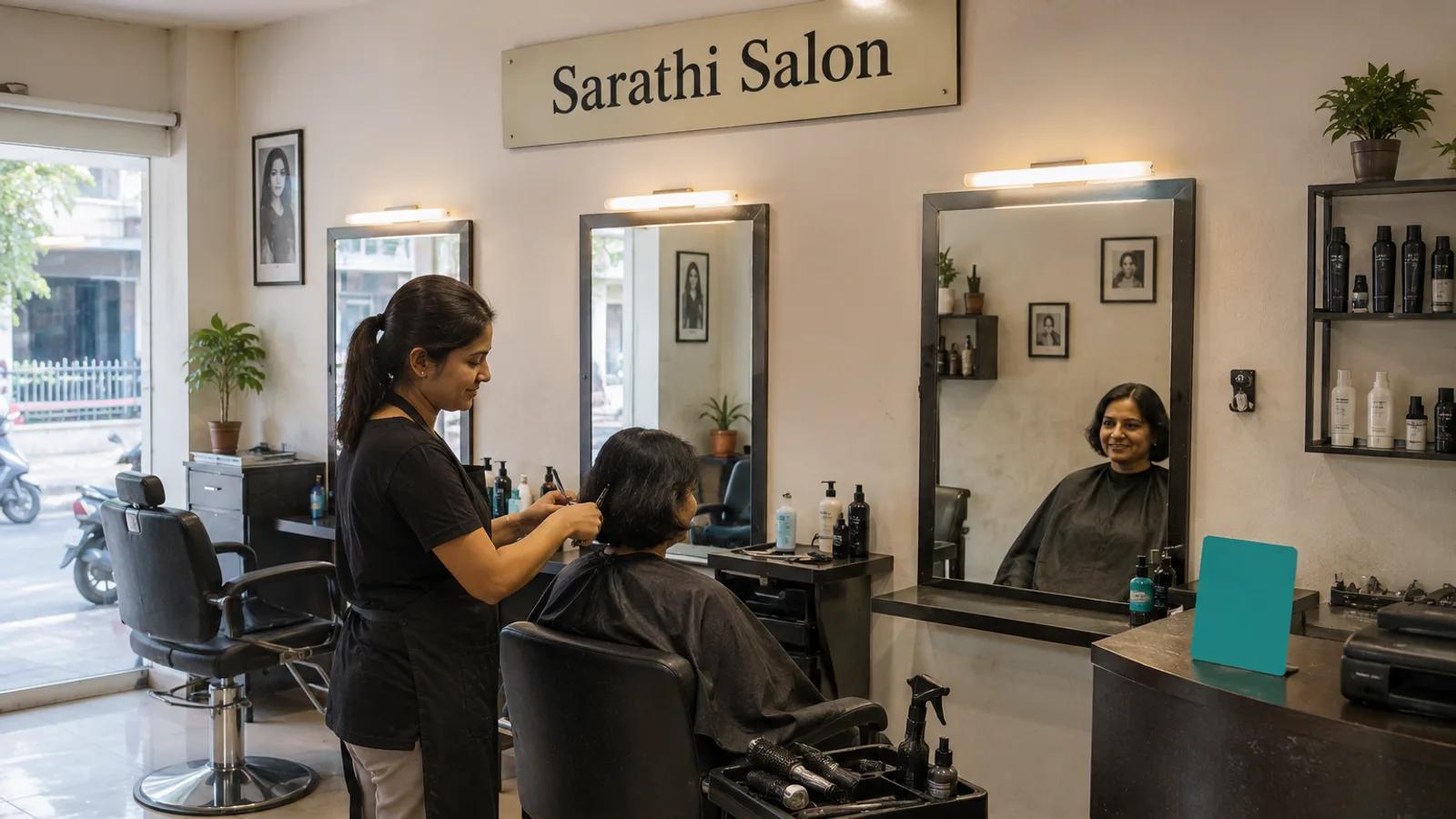
Nobody travels for a haircut, and everything follows from that
Local ranking is usually described as a balance of relevance, distance and prominence. In most verticals distance is one factor among three. For salons it behaves closer to a gate. A customer searching for a salon near me is not evaluating a market; they are looking at what is close enough to reach on the way home, and a result three kilometres further away has to be dramatically better to be considered at all.
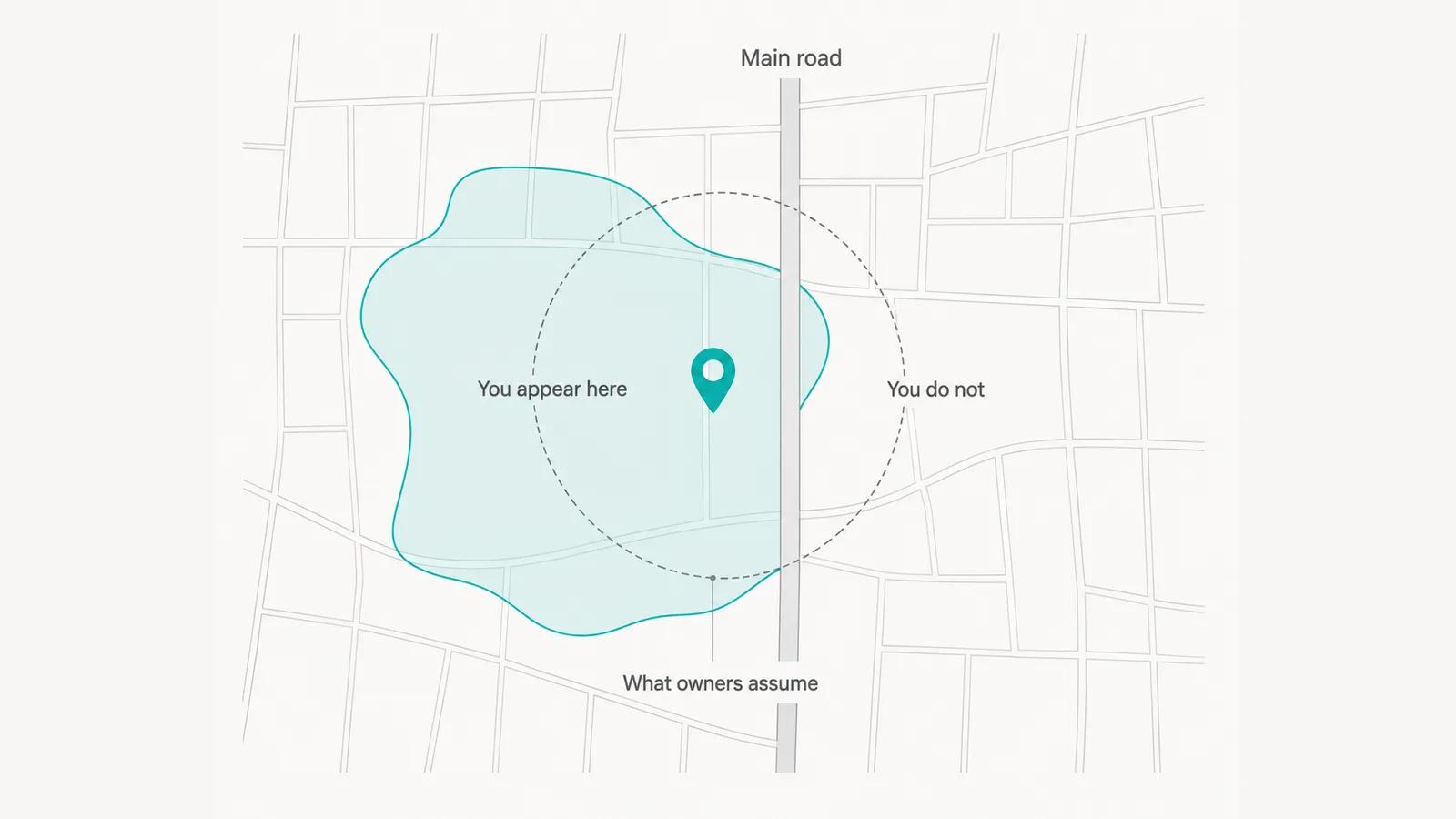
This produces the single most common misconception in the trade. An owner searches their own keyword from behind the counter, sees themselves at the top, and concludes their marketing is working. They are standing on the pin, so of course they are. The customer who matters is in a flat eleven hundred metres away, or in the office complex on the other side of the main road, and the result they get is a different one that the owner has never seen.
So the honest first step is to find out how far your visibility actually reaches. Measured across a grid of points around the salon rather than from a single search, most salons discover their real catchment is a good deal smaller than they assumed, and that it is asymmetric — strong on one side of a road or a railway line and absent on the other, because that is where the competing salons sit.
What that map is for is deciding where effort goes. If you are invisible in the residential pocket four hundred metres north, that is a specific, solvable problem: it is usually a competitor with more reviews and more recent activity rather than anything about your salon. If you are invisible five kilometres away, that is not a problem at all — those customers were never coming, and chasing them is how salons waste money on advertising.
The corollary is that a second branch is a genuinely different question in this vertical than in others. A restaurant can pull people across town. A salon cannot, which means growth is largely a question of adding radii rather than deepening one, and each new location needs its own profile, its own reviews and its own local footing rather than inheriting anything from the first.
How most local verticals work
- Customers will travel for quality, price or reputation
- Distance is one ranking factor balanced against others
- A strong brand can pull demand from across the city
- One excellent location can serve a wide catchment
How salons actually work
- Convenience beats quality on most ordinary appointments
- Distance behaves closer to a gate than a factor
- Reputation mostly helps you win inside your own radius
- Growth means new radii, each with its own profile and reviews
Find out how far your two kilometres actually reach
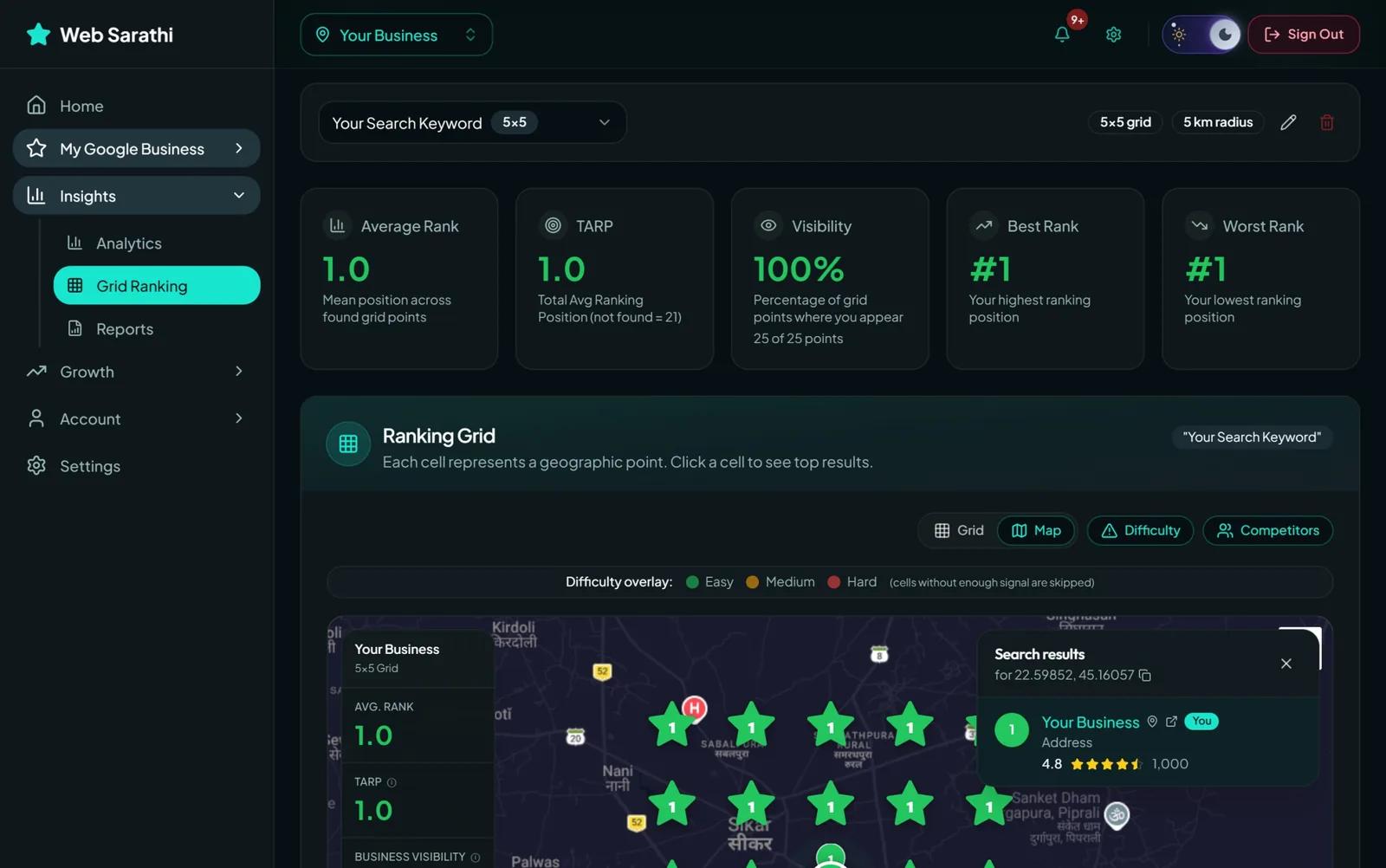
Searching from your own reception tells you nothing useful. Grid ranking measures your Maps position from dozens of points around the salon and shows you the streets you own and the ones where you do not exist.
- See your real catchment, including the side of the road you are losing
- Track a service keyword week by week instead of guessing
- Judge a second location on evidence about coverage rather than on instinct
Ladies, gents and unisex: the split that only exists in Indian salon search
Indian customers search for salons along a dimension that barely registers in beauty marketing written elsewhere, and it is the single most consequential piece of local vocabulary in this trade. People search for ladies salon, gents salon, unisex salon, ladies beauty parlour, and mens grooming or a barber shop — and they mean these terms quite precisely.
The distinction is not stylistic, it is a filter for comfort and suitability. A woman searching for a ladies salon is often specifically looking for a space that is women-only, sometimes with women staff, sometimes with privacy from the street. A man searching for a barber is not looking for a beauty parlour. Somebody searching unisex has decided they do not mind either way. Getting your own listing to match the term your actual customers use is worth more than any generic optimisation.
Most salons handle this badly by accident. The listing is called something aspirational, the category is set to Beauty salon, and the description is about pampering and rejuvenation — with the result that a listing serving only women never uses the phrase somebody would search, and a unisex salon reads to a male customer as a place he is not sure he is meant to walk into.
The fix is not keyword stuffing your business name, which is a straightforward violation and gets listings suspended. It is to use the accurate primary category, add the honest secondary categories, name the services in the vocabulary customers actually use, and state plainly in the description who the salon serves. If you are unisex with separate floors, say so — that sentence answers a question a large number of people are silently asking.
The same logic applies to services. Threading, waxing, bridal makeup, hair spa, keratin, beard styling, kids haircut, hair colour and pedicure are all searched by name, and a service list that says hair, beauty, spa in three words matches almost none of them. This list is the cheapest and most under-used ranking surface in the whole vertical.
Language is the other half of the vocabulary problem and it is almost never addressed. A significant share of these searches happen in Hindi, Marathi, Tamil, Telugu or a transliterated mixture of English and a regional language, and the terms people use are not translations of the English ones. Your reviews are the most natural place for that vocabulary to appear, because customers write in whatever language they think in, and a salon that replies in the same language rather than in English is reinforcing exactly the words its neighbourhood actually searches with. That is a free ranking asset most salons throw away by answering everything in stiff English or not answering at all.
| What they search | What they are actually asking | What your listing must show |
|---|---|---|
| Ladies salon near me | Is this a space I will be comfortable in, and are the staff women | Accurate category, explicit statement of who you serve, interior photographs |
| Gents salon / barber shop | Somewhere quick, masculine and reasonably priced | Men’s services named individually, prices, and realistic wait expectations |
| Unisex salon | I do not mind either way, but I want to know before I arrive | The word itself, plus how the space is arranged if it is separated |
| Beauty parlour near me | Often threading, waxing and facials rather than a haircut | Those services named individually with prices, not grouped as beauty |
| Bridal makeup artist | A specialist decision made weeks ahead, not a walk-in | A distinct service with portfolio photographs and a way to enquire |
| Hair spa / keratin / smoothening | A specific treatment with a price band they are trying to establish | Named service entries with prices, since the alternative is a phone call they will not make |
The price list is the field that decides who walks in
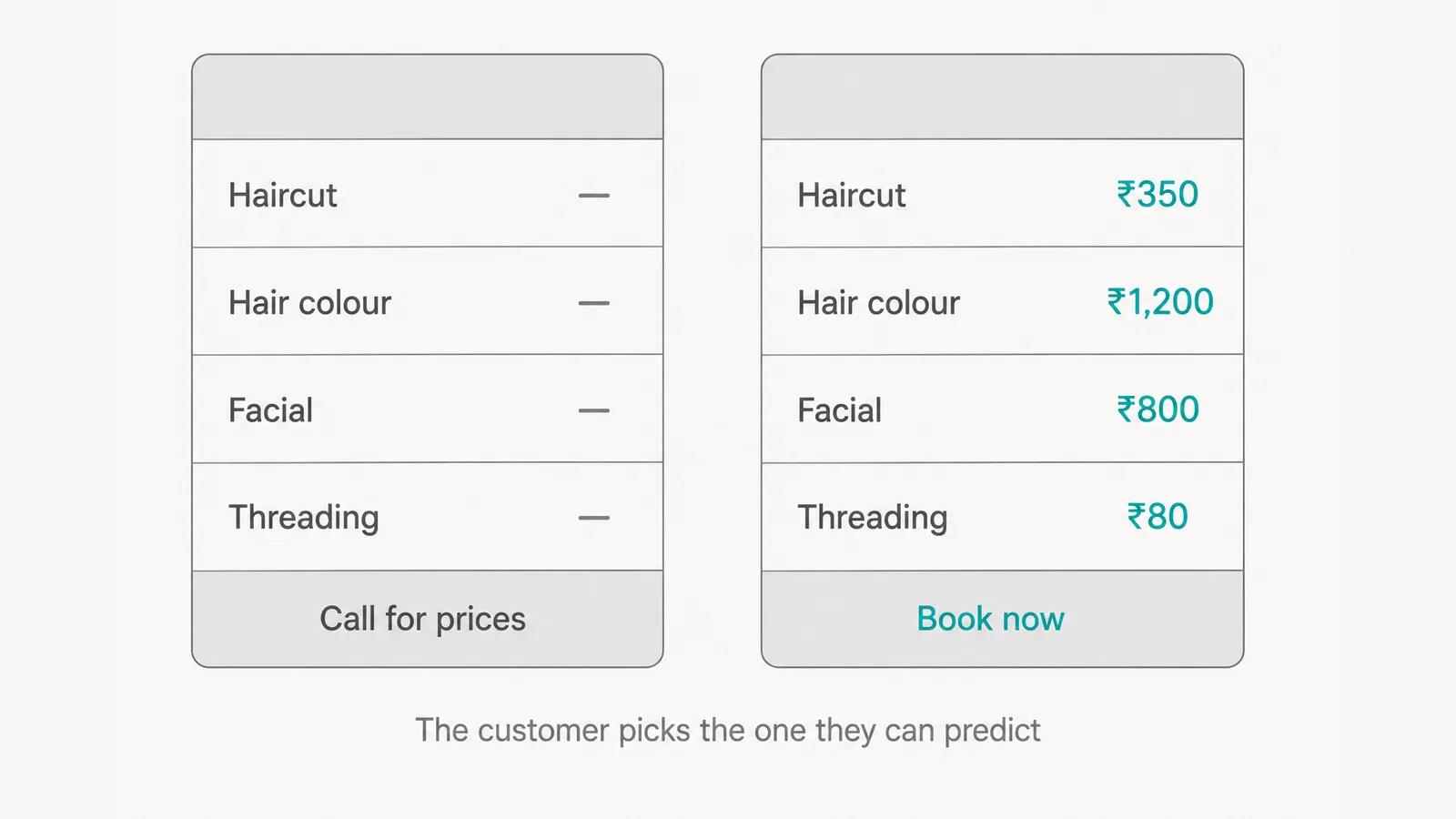
Salon owners resist publishing prices more than almost any other trade, usually for two reasons: a fear that competitors will undercut them, and a preference for explaining value in person. Both are understandable and both cost bookings, because the customer is trying to resolve exactly one question before they commit to walking anywhere, and that question is what this is going to cost.
Consider the alternative from the customer’s side. Three salons appear. Two publish a price list. One says call for prices. The customer is standing on a footpath deciding where to spend forty minutes, and calling a stranger to ask the price of a haircut is a small social cost most people will simply not pay. They pick one of the two they can predict. You did not lose on price; you lost on being unresolvable.
The competitor argument does not survive contact with reality either. Every salon within a kilometre of you already knows what you charge, because their staff have worked there, or because somebody walked in and asked. The only person your price list is hidden from is the customer trying to choose you.
Fill the services list properly, entry by entry, with the vocabulary customers use and a price or a band against each. Haircut, hair colour, global colour, highlights, keratin, smoothening, hair spa, head massage, threading, waxing, facial, cleanup, pedicure, manicure, beard trim, bridal makeup, party makeup, kids haircut. Bands are fine where length or product genuinely changes the price — starts at is far better than silence, and prevents the argument at the counter.
This is also where you head off the most common negative review in the trade, which is not about a bad haircut. It is about a bill that was larger than expected. A published list, plus a habit of confirming the price before starting, removes most of that category of complaint entirely — which makes it a reputation intervention as much as a search one.
| Field | Why it matters here | Usual state |
|---|---|---|
| Services with prices | Resolves the one question standing between a customer and a walk-in | Three vague entries, no prices |
| Primary and secondary categories | Decides which of the ladies, gents and unisex searches you can appear in | A single generic beauty category |
| Appointment link | The whole booking path, since Reserve with Google beauty is not live in India | Absent, so every booking costs a phone call |
| Hours, including Sundays | Sunday is the biggest salon day of the week in most Indian neighbourhoods | Copied from a shop schedule and wrong at the weekend |
| Interior photographs | Answers comfort and cleanliness questions before anyone walks in | A logo and two stock images |
| Description | The one place you can state who the salon serves, in plain words | Adjectives about pampering that match no search anybody performs |
Making the profile an appointment channel when Reserve with Google is not available here
Salons in Western markets are routinely advised to enable Reserve with Google, which puts a booking button on the listing and lets a customer choose a service and a slot without leaving Google. It is genuinely excellent, and Indian salons should stop trying to use it: the beauty and wellness booking programme is currently a United States facility, with Canada and the United Kingdom named on the roadmap. India is not on that list today.
What is available, and works, is the appointment link — a URL field on the profile that sends the customer straight into whatever booking system you use. It is less elegant than a native button and it does the important part of the job, which is converting intent into a confirmed slot without a phone call in the middle.
The phone call is the thing to design away. A salon booking made by phone requires somebody free to answer, which during business hours means somebody with their hands in a customer’s hair. Calls get missed, and a missed call at six in the evening is a booking that went to the salon that answered. Owners routinely underestimate this because the missed calls are invisible, but the pattern is easy to check on any phone bill.
If you have a salon software product with online booking, put its link in the appointment field and test it on a phone, because a large share of these links land on a desktop-only page or a login wall and quietly lose everybody. If you do not have booking software, a WhatsApp link is a legitimate and effective second best in the Indian market — it converts well, it does not require anybody to be free at that instant, and it leaves a written record of what was booked.
Whatever you choose, make the path from listing to booked appointment short and obvious, and then make somebody responsible for it. The most common failure is not the absence of a channel but the presence of one nobody watches, which converts worse than not offering it at all because it looks open and behaves closed.
There is a second-order benefit worth naming, because it changes how a salon runs rather than just how it is found. Bookings that arrive in writing produce a record of what was requested, which stylist was asked for, and what was quoted — and that record removes most of the disputes that generate bad reviews. It also lets you see demand you are currently turning away invisibly: how many people tried to book Saturday evening, how many wanted a stylist who was off that day, how many asked for a service you stopped offering. A salon that has never had that visibility is making capacity and staffing decisions on the memory of whoever happened to be at the counter.
Decide what the booking destination actually is
Salon software with online booking, a simple booking page, or a WhatsApp conversation. Any of the three works; having none, or having one nobody monitors, does not.
Put it in the appointment link field
Not only in the website field. The appointment link is a distinct field and it is the one a customer in a hurry taps.
Test the whole path on a phone
Most booking links fail here — a desktop-only page, a login wall, a form that needs an OTP nobody waits for. If you have not completed a booking on your own phone, it is not live.
Give the channel an owner and a response time
A WhatsApp booking answered in ten minutes converts. The same enquiry answered the next morning has usually already booked elsewhere.
Track how many bookings arrive without a call
This is the number that tells you whether the channel is working, and it is the argument for keeping it staffed on a busy Saturday.
When the customer follows the stylist rather than the salon
This vertical has a loyalty structure almost unique to it: customers are frequently loyal to a person, not to a business. They book with Priya, not with the salon Priya works at, and when Priya leaves to join a competitor or open her own chair two streets away, a measurable share of the client book leaves with her. Every salon owner in India knows this. Very few build their online presence with it in mind.
The reflex response is to hide the staff — no names, no individual portfolios, nothing that lets a customer attach to a person. It is understandable and it is a poor trade, because the personal connection is also what makes salon customers loyal in the first place, and a salon that presents as anonymous converts worse with the customer who is choosing where to trust their hair for the next two years.
The better structure is to make the salon the thing that is consistent while still letting individuals be visible. Reviews that name a stylist are excellent for you — they read as authentic and specific in a way that generic praise never does — provided the salon is what a reader remembers. That is achieved by having enough of them, across enough staff, that the pattern reads as a good salon rather than one good person in an otherwise unremarkable place.
Which makes review volume and distribution a genuine business protection rather than a vanity metric. If ninety per cent of your reviews name one stylist and that stylist leaves, your public reputation walks out with them. If they are spread across five people plus the salon itself, a departure is a staffing problem rather than a reputational event.
Salons are also fortunate on the supply side and mostly waste it. Customers return naturally every four to six weeks, which means you see each of them eight to twelve times a year — an opportunity a real estate agent or a wedding photographer would find extraordinary. Almost none of that gets converted, because asking is left to whoever is at the counter and nobody is at the counter. A prompt at the moment of payment, made into a routine rather than an initiative, turns the highest-frequency customer relationship in local business into the review base your radius is won with.
All your reviews naming one stylist
That is not a review base, it is a personal following hosted on your listing. When they leave, the reputation goes too. Spread the asking across the whole team deliberately.
Hiding staff entirely to prevent poaching
Anonymity costs you the trust that makes a first-time customer choose you, and it does not actually stop anybody leaving. Make the salon consistent instead of making it faceless.
Asking for reviews only when it occurs to somebody
A four-to-six week repeat cycle means each customer visits eight to twelve times a year. Salons that leave asking to chance end up with fewer reviews than businesses that see a customer once a decade.
Letting a departure sit unaddressed
When a stylist with a following leaves, existing reviews naming them stay up. Introduce their replacement publicly, with photographs and posts, rather than letting customers discover it at the chair.
Turn eight visits a year into a review base that protects you
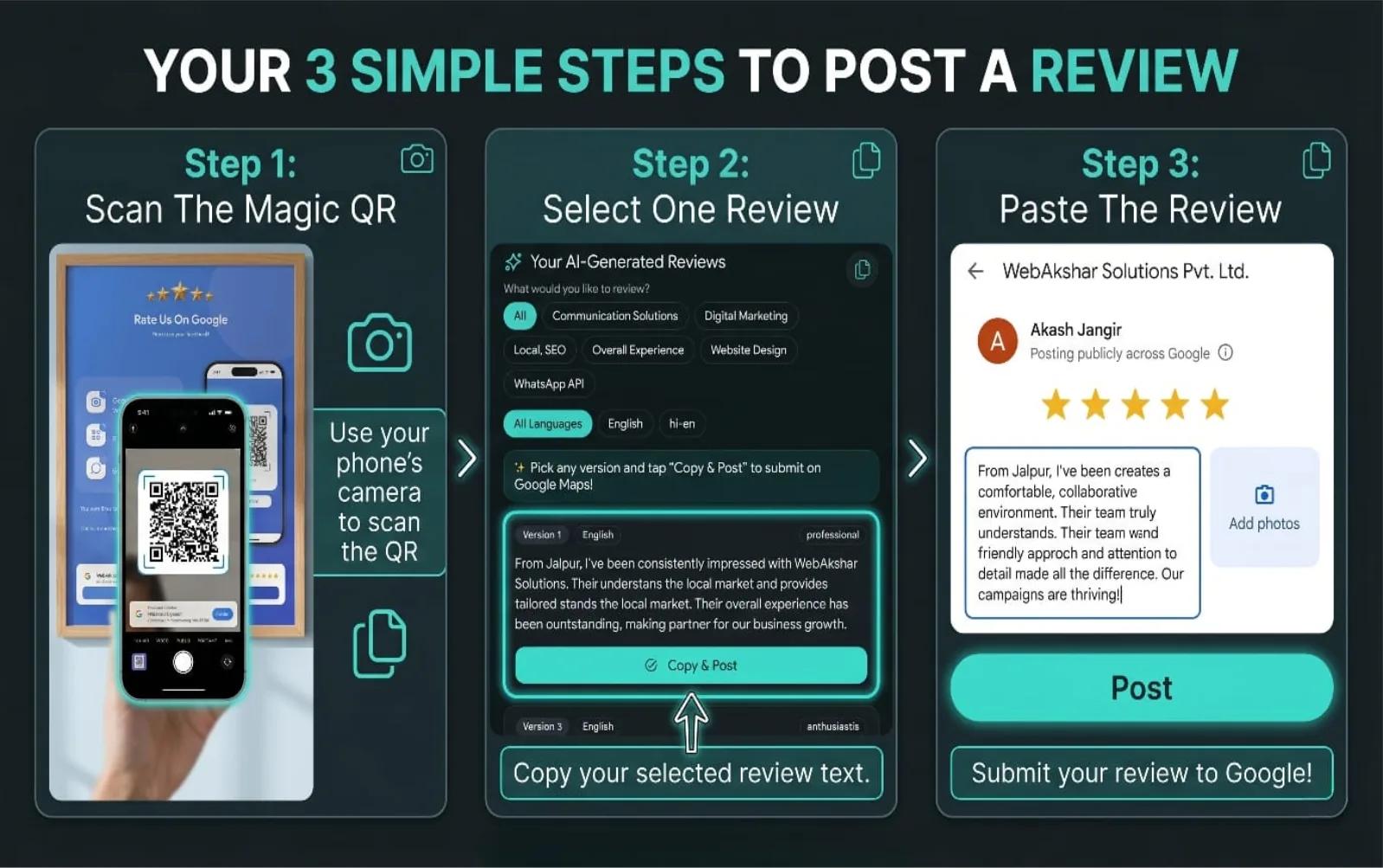
Salon customers come back every four to six weeks, which is more chances to ask than almost any other local business gets. A QR code at the payment counter turns that into a routine instead of something somebody remembers.
- Scan, pick a highlight, and the review is drafted in a few taps
- Spread across the whole team, so one stylist leaving is not a reputational event
- Works at the moment of payment, which is when people will actually do it
If you also run a spa, your listing sits in a category Google polices harder
This section applies to anyone whose listing includes spa, massage or aesthetic services, and it is the part of this guide with the largest downside attached. Aesthetics and massage are treated as a sensitive category and reviewed more aggressively than an ordinary retail or restaurant listing. The practical consequence is that mistakes that would earn a bakery a warning can take a spa listing down.
The triggers that come up repeatedly are worth stating plainly. Business name, address and phone details that do not match across the web. Before-and-after imagery that runs into medical-imagery policy. Listing services you are not licensed to perform. To that list, in the Indian context, add the obvious one: any language or imagery that could be read as suggesting services other than legitimate therapy, which is a serious problem for genuine spas because it is the reason the category is policed so hard in the first place.
The defensive position is unglamorous and effective. One business name, the one on your signage, used identically everywhere with nothing appended. An address that matches your signage and your registration exactly. A services list that includes only what your staff are actually qualified and permitted to perform. Photographs of a real, well-lit, professional premises with visible signage. Ordinary, clinical, boring language.
If a suspension does happen, the route back runs through a reinstatement request and frequently a video verification, where you walk through the premises showing signage, reception, treatment rooms and equipment. That is much easier to pass when the profile already matches reality, which is the real argument for keeping everything accurate rather than aspirational. Clean cases commonly come back within a few days to a couple of weeks; cases where the profile does not match what the camera sees do not come back quickly at all.
One practical structural point: if your salon and spa genuinely operate as one business at one address with one team, keep one listing. Splitting a modest operation into two profiles to chase two sets of keywords doubles your exposure in the category with the highest enforcement risk and halves the review base defending each one.
Name, address or phone that vary across the web
Inconsistency is one of the most common triggers for scrutiny in this category. Pick the version on your signage and make every directory, invoice and social profile match it exactly.
Before-and-after images that stray into medical territory
Aesthetic before-and-after imagery can run into medical-imagery policy. Keep it to hair and beauty outcomes, keep it modest, and do not imply clinical results you are not licensed to deliver.
Listing services you are not licensed to perform
Adding treatments you occasionally arrange through somebody else is a policy problem and a video-verification failure waiting to happen. List what your own staff actually do.
Splitting a small salon and spa into two listings
Two profiles in a heavily policed category means double the enforcement exposure and half the reviews defending each. One address and one team should mean one listing.
Bridal and festival season: the weeks that pay for the year
Underneath the steady rhythm of haircuts and threading sits a second business with completely different economics. Bridal packages, party makeup, festival appointments and pre-wedding treatment courses are booked far in advance, carry several times the ticket value of a normal appointment, and cluster into a small number of weeks. For a large number of Indian salons, that cluster is the difference between a profitable year and a flat one.
It also behaves nothing like the walk-in business. A bride is not searching salon near me. She is searching bridal makeup artist, comparing portfolios, asking for trial appointments, checking reviews written by other brides, and deciding two to six months ahead. Proximity matters far less; she will travel, and she will pay, for somebody whose previous work she has seen.
That means the bridal business needs its own treatment: a named service with a real price band, a portfolio of actual work with permission, reviews that mention weddings specifically, and a clear route to enquire that does not depend on somebody answering the salon phone during a busy Saturday. A salon that buries bridal makeup inside a general services line is invisible to the highest-value customer it will meet all year.
The festival calendar works differently again — shorter notice, enormous volume, and largely a capacity problem rather than a demand problem. Karwa Chauth, Diwali, Navratri, wedding season weekends and the run-up to New Year fill the diary faster than any marketing does. The useful work in these weeks is not attracting more demand, it is publishing the practical information that stops you losing the demand you have: extended hours, whether walk-ins are possible, how far ahead to book, and what a festival appointment costs.
As with the seasonal work in any trade, the timing is the whole discipline. Bridal content has to exist months before the season. Festival hours and offers need to be live one to two weeks ahead, not on the day. And the quiet weeks after a festival run are when the portfolio gets updated and the reviews get chased, because nobody is going to do it in the middle of Karwa Chauth.
Bridal enquiries begin
Brides research and shortlist months ahead. Portfolio, price band and a working enquiry route need to exist now, because this decision is made long before the season is visible.
Trials, packages and pre-wedding courses
The comparison stage, where reviews that specifically mention weddings do more work than anything else on your profile.
Festival hours and offers go live
Extended hours, booking advice and prices published before the rush rather than during it. This is capacity management, not advertising.
Protect the experience, not the marketing
Overbooked festival weeks produce the worst reviews of the year. Publish realistic waiting times and hold slots rather than accepting everything and running late.
Collect the proof while it is fresh
Photographs with permission, reviews from brides, and posts showing the work. This is the material that wins next season, and it evaporates if it is left a month.
Festival hours and bridal offers, live before the rush
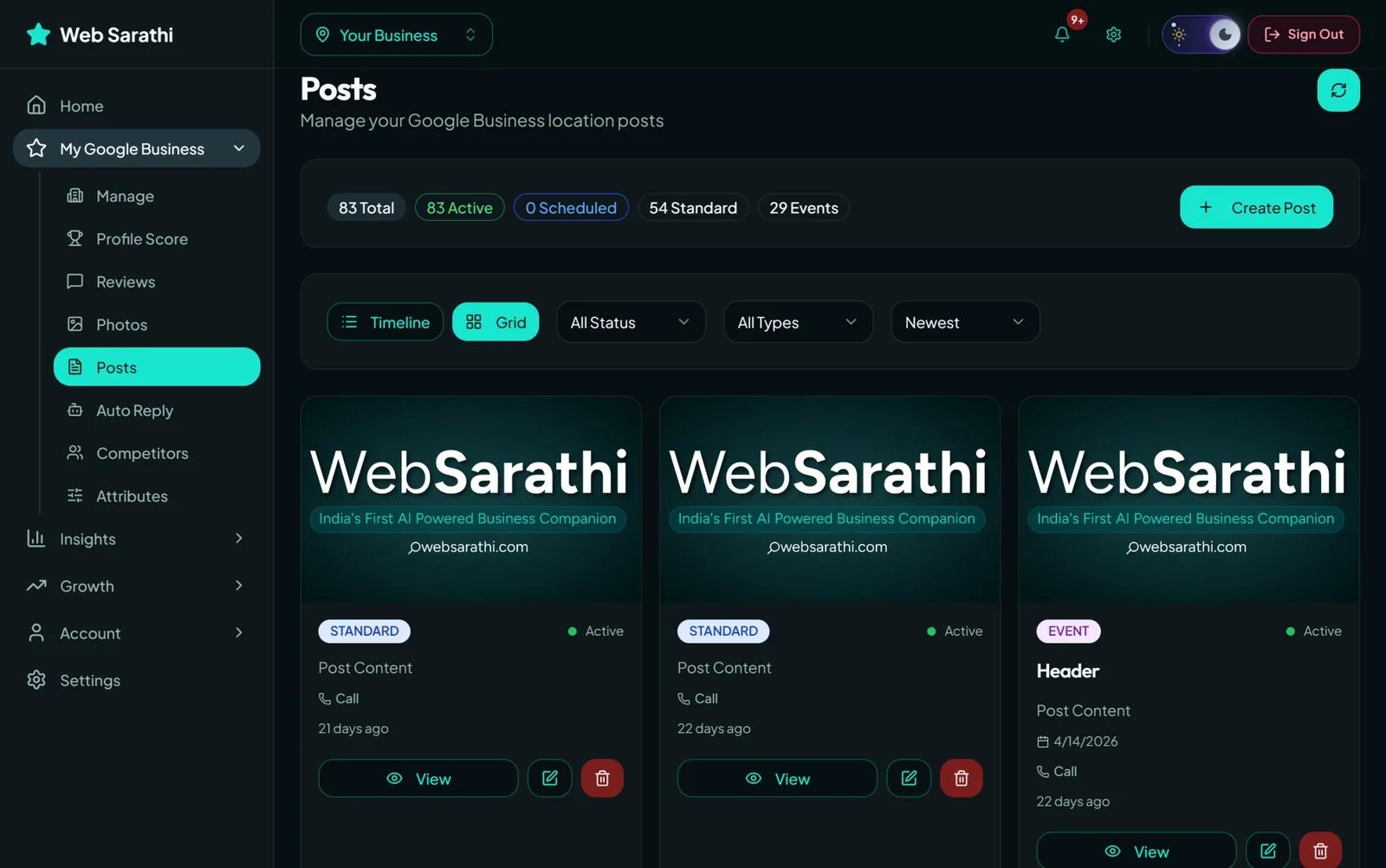
The weeks that pay for the year are exactly the weeks with no time to publish anything. Draft the season in a quiet fortnight and schedule the whole run against the festival calendar.
- Extended hours and offers published ahead of the rush rather than during it
- Drafts built around your services, prices and season rather than generic filler
- Keeps the profile active in the quiet months, when next season is being chosen
Before-and-after photographs, consent, and what to actually post
Salon work is visual in a way that almost no other local service is, and the photographs on your listing do more persuading than any words on it. They are also the place where salons create legal and policy problems for themselves, so it is worth being deliberate.
Consent first, because it is both the right thing and the practical thing. A customer sitting in your chair has not agreed to appear in your marketing, and asking afterwards in a message is awkward and frequently ignored. Ask before, in words, at the point where you are discussing the treatment, and record the answer somewhere. For bridal work, ask the bride rather than the family member who booked, and ask again before posting anything from the wedding day itself.
Then be careful about what before-and-after imagery is claiming. Hair and beauty transformations are fine and effective. Anything that drifts towards a clinical or medical claim — skin conditions, treatments that imply a medical outcome — runs into policy that applies specifically to this category, and it is one of the recurring reasons listings in the aesthetics space get scrutinised.
What actually converts is broader than transformation shots anyway. The interior, well-lit and honestly represented, because a first-time customer is deciding whether they will be comfortable. The stations and the equipment, because cleanliness is the unspoken question in every salon and spa decision. The team, presentable and identifiable. The frontage, so somebody can find the door. And the work itself, shot in the salon rather than styled elsewhere.
Cadence beats polish, exactly as it does in restaurants. A few honest photographs a week, taken on a phone in the salon, keep the profile looking like a place that is open and busy — and they accumulate into a portfolio without anyone ever scheduling a photoshoot. A gallery of twelve beautiful images from the opening in 2022 tells a stranger that nothing has happened here since, which is the impression that costs you the walk-in.
What salons usually post
- Stock imagery of models who have never been in the building
- A dozen professional shots from the opening, and nothing since
- Transformation photographs taken without asking anybody
- Text-heavy offer graphics that answer no question a customer has
What actually earns the walk-in
- The real interior, well lit and honestly represented
- Stations and equipment, because cleanliness is the unspoken question
- Work photographed in the salon, with consent asked in advance
- A few honest phone photographs every week, so the place looks alive
Salon SEO questions, answered
The questions Indian salon businesses ask us most often.