Clinic SEO in India: getting found without breaching the rules you practise under
Every other guide on this site tells a business to go and collect reviews. This one cannot, and that single fact is why clinics need their own guide rather than a general one with the word doctor substituted in.
Indian medical practice is governed by a professional conduct code that treats soliciting patients as misconduct and prohibits publishing patient testimonials outright. Meanwhile the search results that decide whether a nervous parent at eleven at night finds your clinic or the one down the road are driven substantially by reviews. That tension is real, most agencies selling to clinics either do not know about it or do not care, and the practitioner carries the consequences rather than the agency.
So this guide works the problem in the order it actually matters. What the rules permit and prohibit. How to answer a patient review without confirming that the person was your patient. Whether each doctor should have a separate listing. What a directory profile does and does not do for you. And then the ordinary, unglamorous profile work that is both entirely permitted and almost universally neglected.
One caveat stated plainly and once: the summary below reflects the position as we understand it, and professional conduct rules are interpreted and enforced unevenly. Take your own advice from your professional body or a healthcare lawyer before acting on anything in the compliance sections.

Health searches are judged by a standard no other local business faces
Google treats searches that could affect a person’s health, safety or finances differently from searches about lunch. Internally these are the pages where an inaccurate result does real damage, and the bar applied to them — for the expertise behind the content, the identifiability of who wrote it, and the reputation of the organisation publishing it — is materially higher than anywhere else in local search.
For a clinic this cuts in two directions, and the first one is good news. A thin, anonymous site with stock photographs of smiling models and no named practitioners is competing badly on the exact axis Google is most sensitive to. A clinic that publishes real doctors, with real qualifications, real registration numbers and real photographs, is doing the single most effective thing available in this vertical, and it costs nothing but honesty.
The second direction is the constraint. You cannot buy your way past this with volume. Publishing forty near-identical pages about conditions you treat, assembled from the same sources as everybody else, is a poor strategy in any industry and an actively dangerous one here, because health is precisely where quality assessment is strictest. One properly written page about a procedure you genuinely perform, signed by the doctor who performs it, outperforms thirty generic ones.
What this means practically is that the credibility work and the search work are the same work. There is no separate SEO layer to bolt on. Naming your practitioners, stating their qualifications and registration, describing what you actually treat in specific language, and keeping the whole thing accurate is simultaneously the compliance-safe route, the trust route and the ranking route.
It also means the most common instinct — hiring someone to write content about medical conditions — is usually the wrong first spend. The doctor is the asset. Getting the doctor’s name, credentials, photograph and specific clinical focus onto the profile and the site properly is worth more than a year of outsourced articles, and takes an afternoon.
There is a second-order effect worth understanding, because it explains why some clinics stall despite doing everything on the list. Health searches attract more scrutiny from the reader as well as from the algorithm. A patient choosing where to take a child compares two or three practices far more carefully than they would compare two restaurants, and they are specifically looking for reasons to rule one out. Vagueness is the most common such reason. A clinic that does not say who its doctors are, what they trained in, or what exactly it treats is not read as modest; it is read as evasive, and the reader moves on without ever telling you why. Specificity is not decoration in this vertical, it is the mechanism by which a stranger grants you the benefit of the doubt.
What works for an ordinary local business
- Volume of content across many related topics
- Anonymous copy written by whoever was available
- Aggressive review solicitation at every transaction
- Promotional posts and offers, published freely
- Claims about results, stated confidently
What a clinic is actually judged on
- Named practitioners with verifiable qualifications and registration
- Specific description of what you genuinely treat
- A review base built without soliciting it
- Informational posts that do not read as touting
- Accuracy, and visible restraint about outcomes
What the conduct rules actually permit you to do about reviews
This is the section every clinic needs and almost nobody publishes, so it is worth being precise rather than comfortable.
The operative code for Indian doctors remains the Indian Medical Council (Professional Conduct, Etiquette and Ethics) Regulations of 2002. The National Medical Commission issued replacement Registered Medical Practitioner (Professional Conduct) Regulations in 2023, but those were held back, so the older code is what still binds. Under it, a registered medical practitioner is not permitted to solicit patients directly or indirectly, nor to advertise in a way that touts, exaggerates or self-promotes. Publishing patient testimonials is prohibited. The NMC has also clarified that social media activity counts as advertising when it solicits patients.
Read that against how the rest of the local search industry operates and the conflict is obvious. The QR code at the counter, the follow-up message asking for a rating, the wall of quotes on the homepage — these are the standard playbook everywhere else and they sit somewhere between risky and plainly prohibited for a practitioner. An agency that sells a clinic the same package it sells a salon is selling professional risk that lands on the doctor, not on the agency.
There is, however, a meaningful piece of latitude that clinics consistently fail to use. The NMC has indicated informally that responding to Google reviews, including negative ones, is not prohibited, provided the response does not contain advertising content. So the door that is shut is asking for reviews and republishing them as testimonials. The door that is open is engaging properly with the reviews that arrive on their own, which is also the half that most clinics neglect entirely.
The other genuinely open door is everything factual. Your address, hours, phone number, appointment link, parking, wheelchair access, languages spoken, which doctors sit on which days, what a first consultation costs, whether you take a particular insurance. None of that is touting. All of it is what a patient is actually trying to find out, and a clinic that answers all of it comprehensively will out-convert a competitor with more reviews and a vaguer profile more often than you would expect.
A practical distinction worth taking advice on: these obligations attach to the registered medical practitioner. Many Indian clinics, diagnostic centres and hospital entities are companies whose marketing is not the personal act of a doctor, and the position for a corporate hospital has been the subject of active examination rather than settled certainty. That is exactly why this guide tells you to ask your own adviser rather than telling you what you may do.
| Practice | Position | What to do instead |
|---|---|---|
| Asking patients for a Google review | Solicitation. The regulations prohibit soliciting patients directly or indirectly | Nothing that requests a review. Concentrate on earning organic ones |
| Publishing patient testimonials on your site | Explicitly prohibited | Publish practitioner credentials, registration and clinical focus instead |
| A QR code at reception asking for feedback | Same problem, in a different format | Use internal feedback forms that do not route anywhere public |
| Replying to a review that arrived on its own | Indicated as not prohibited, provided the reply carries no advertising content | Reply factually and briefly. See the confidentiality section below |
| Posting clinic hours, doctors on duty, holidays | Factual information, not touting | Do it consistently — this is the permitted ground most clinics ignore |
| Posts claiming results, or comparing yourself to others | Reads as advertising and self-promotion | Describe what a procedure involves, not how well you do it |
Answering a review without confirming the person was your patient
Here is a trap that has cost practices in other countries real money and real regulatory attention, and which Indian clinics walk into daily without noticing. A patient posts a review naming their procedure and complaining about the outcome. The clinic replies, defending itself, explaining what happened during the consultation, correcting the timeline. Every word of that reply is a disclosure. By responding with clinical detail, you have publicly confirmed that this person was your patient and disclosed information about their care, to an audience of strangers, without their consent.
The reviewer disclosing it themselves does not release you. Their choice to publish their own information is not your authorisation to publish it, and the duty of confidentiality does not lapse because somebody provoked you. It is worth internalising that the most damaging reply is not the rude one, it is the detailed one.
What a compliant reply looks like is therefore short, warm, entirely non-specific, and pointed offline. Thank the person for the feedback. State the practice’s general standard or process in general terms. Give a route to discuss it directly — a phone number, an email, the practice manager. Do not confirm attendance, do not name a condition, do not correct their account of the facts, and do not mention treatment.
This is a discipline rather than a one-off decision, because the provocation to say more is strongest exactly when the review is most unfair. The practical safeguard is to remove the decision from the moment: agree a standard form of words in advance, make one person responsible for using it, and let nobody reply to a clinical review in the hour they read it.
The audience for the reply is the same as in every other vertical, and understanding that makes the restraint easier. You are not writing to the reviewer. You are writing to the next fifty people deciding whether to bring their child to you, and what they are assessing is whether this practice sounds calm, professional and discreet. A short, gracious, uninformative reply reads exactly like a clinic that takes confidentiality seriously — which is the impression you actually want.
Correcting the patient’s version of events
Every corrective detail is a disclosure about their care. You cannot win the factual argument in public without breaching confidence, so do not enter it.
Confirming they were ever seen at the clinic
Even a reply that says the visit was on a busy day confirms attendance. Keep replies general enough that they would make sense if the reviewer had never walked in.
Replying in the first hour
Unfair reviews produce the strongest urge to say more and the worst possible replies. Route clinical reviews through one named person and a pre-agreed form of words.
Adding a promotional line to a reply
Mentioning your other services or your experience turns a permitted response into advertising content, which is precisely the boundary the clarification draws.
Replies that stay short, factual and off the clinical record
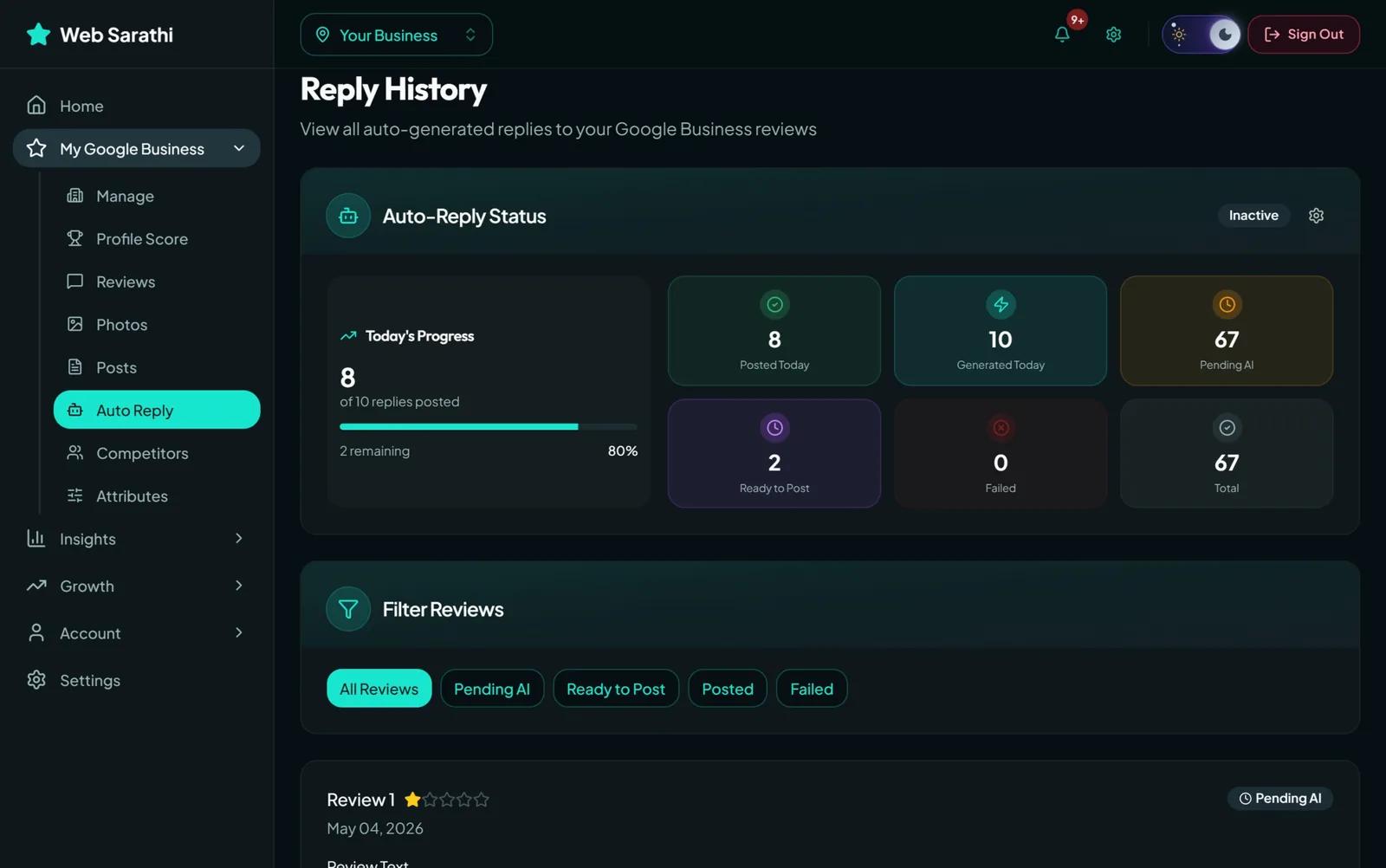
The most damaging reply a clinic can publish is not a rude one, it is a detailed one. Web Sarathi drafts a reply to every review as it arrives and holds it for approval, so nothing goes out in the hour somebody read it.
- Drafted in the language the reviewer wrote in, across 34+ languages
- Nothing publishes without approval — no automatic replies on clinical feedback
- One place to keep your agreed form of words, so every reply is consistent
One profile for the clinic, or one for every doctor?
This question comes up in every multi-doctor practice in India and is almost always answered by guesswork, which produces either a confusing sprawl of half-built listings or a single profile that leaves the individual reputations of the doctors invisible. Google actually has explicit rules here, and following them resolves it.
An individual practitioner is treated as a public-facing professional with their own patient base — doctors, dentists and their equivalents qualify. Where a practitioner is one of several public-facing practitioners at a location, the organisation should have a profile for the location, separate from the practitioner’s own, and the practitioner’s profile should be titled with only their name, not the name of the organisation. A solo practitioner is a different case: Google recommends a single listing combining the practice name with the practitioner’s name. And no practitioner should hold multiple profiles to cover different specialisations.
Applied to a typical Indian setup, the answer usually falls out cleanly. A single-doctor clinic gets one listing carrying both names. A three-doctor polyclinic gets one listing for the clinic plus, optionally, one per doctor titled with the doctor’s name only. A visiting consultant who sits at your clinic on Tuesdays and at a hospital on Thursdays is a genuinely separate matter, since the listing belongs to them rather than to you, and it needs to be contactable at the stated location during the stated hours.
Whether to create the practitioner listings at all is a judgement about capacity rather than eligibility. Each one is a real profile that needs its own hours, its own photographs and its own review replies, and an abandoned doctor listing with two stale reviews actively harms the impression of the practice. Three well-kept listings beat eight neglected ones, and most clinics should start with the location profile alone and add practitioners only when somebody is genuinely maintaining them.
One structural point specific to healthcare: practitioner listings follow the practitioner. A doctor who leaves takes their listing and its reviews with them, exactly as a stylist takes a following. If your practice’s entire online reputation sits on one senior consultant’s personal profile, you have a continuity problem rather than a marketing asset, and the fix is to make sure the clinic’s own listing is the one that is strong.
The same logic should govern how you handle a departure when it happens. Leaving a former doctor on the clinic profile, in the description or on the site, is both misleading to patients and a live problem if their registration details are still published under your name. Remove them promptly, introduce the replacement properly with their own credentials, and update the days-and-doctors information that patients rely on. Practices tend to delay this out of a reasonable wish not to advertise the loss, and the delay produces exactly the outcome they feared: a patient arrives asking for somebody who left in March, and concludes the clinic does not keep track of things.
| Your setup | Profiles | Naming rule |
|---|---|---|
| Single doctor, own clinic | One | Combine the practice name with the practitioner name |
| Several doctors at one clinic | One for the location, optionally one per doctor | Practitioner profiles carry the doctor’s name only, never the clinic name |
| Visiting consultant sitting with you weekly | Theirs, not yours | Must be contactable at the stated location during stated hours |
| One doctor, several specialisations | Still one | A practitioner may not hold separate profiles per specialisation |
| Clinic plus a separate diagnostic lab on site | Potentially two, if genuinely distinct | Distinct names, distinct signage, distinct public-facing operations |
What a Practo listing is, and what it is not
Most Indian clinics have a presence on at least one health directory, and a large number treat that presence as their online strategy. It is worth being clear about what you are actually renting there, because the answer differs from what clinics assume.
A directory profile is a stall in someone else’s market. It produces appointments, sometimes a lot of them, and that is genuinely valuable. But the patient arrived at the directory, browsed a list of comparable doctors, and picked one. The relationship, the ratings and the visibility all belong to the platform. Your position in it is theirs to adjust, your competitors are one scroll away by design, and if you stop paying, the demand stops on the same day.
A Google Business Profile is a different asset in a way that matters more in healthcare than in most trades. The patient searching for a paediatrician near them at ten at night is not browsing a market, they are trying to solve a problem now. There is no competing list curated by an intermediary, the enquiry reaches you alone, and the profile is yours whether or not you spend anything this month.
The two also behave differently on the thing this vertical is most constrained about. Ratings on a directory are collected through the platform’s own mechanisms, which is convenient and also means your visible reputation there is shaped by a system you do not control. Reviews on Google arrive when patients choose to leave them, which is slower, and — given everything in the ethics section above — is the only kind you should be building anyway.
The reasonable position is the same one this site takes about aggregators in other trades. Do not delist; the demand is real. But understand that a directory subscription is rent rather than an asset, and put the unpaid effort into the profile and the site you own. In healthcare specifically, the asset you are building is not really the listing at all — it is the identifiability of your doctors, and that transfers everywhere.
A health directory listing
- The patient chose the platform, then chose among its doctors
- Competitors are deliberately one scroll away
- Ratings and position are shaped by mechanisms you do not control
- Stop paying and the demand stops the same day
- Useful, and it is rent rather than an asset
The profile you own
- The patient searched for care nearby and found you directly
- The enquiry reaches you alone, with no curated list beside it
- Reviews arrive organically, which is the only kind you should build
- It persists whether or not you spend anything this month
- Builds identifiability of your doctors, which transfers everywhere
A site that names your doctors, because a directory profile will not
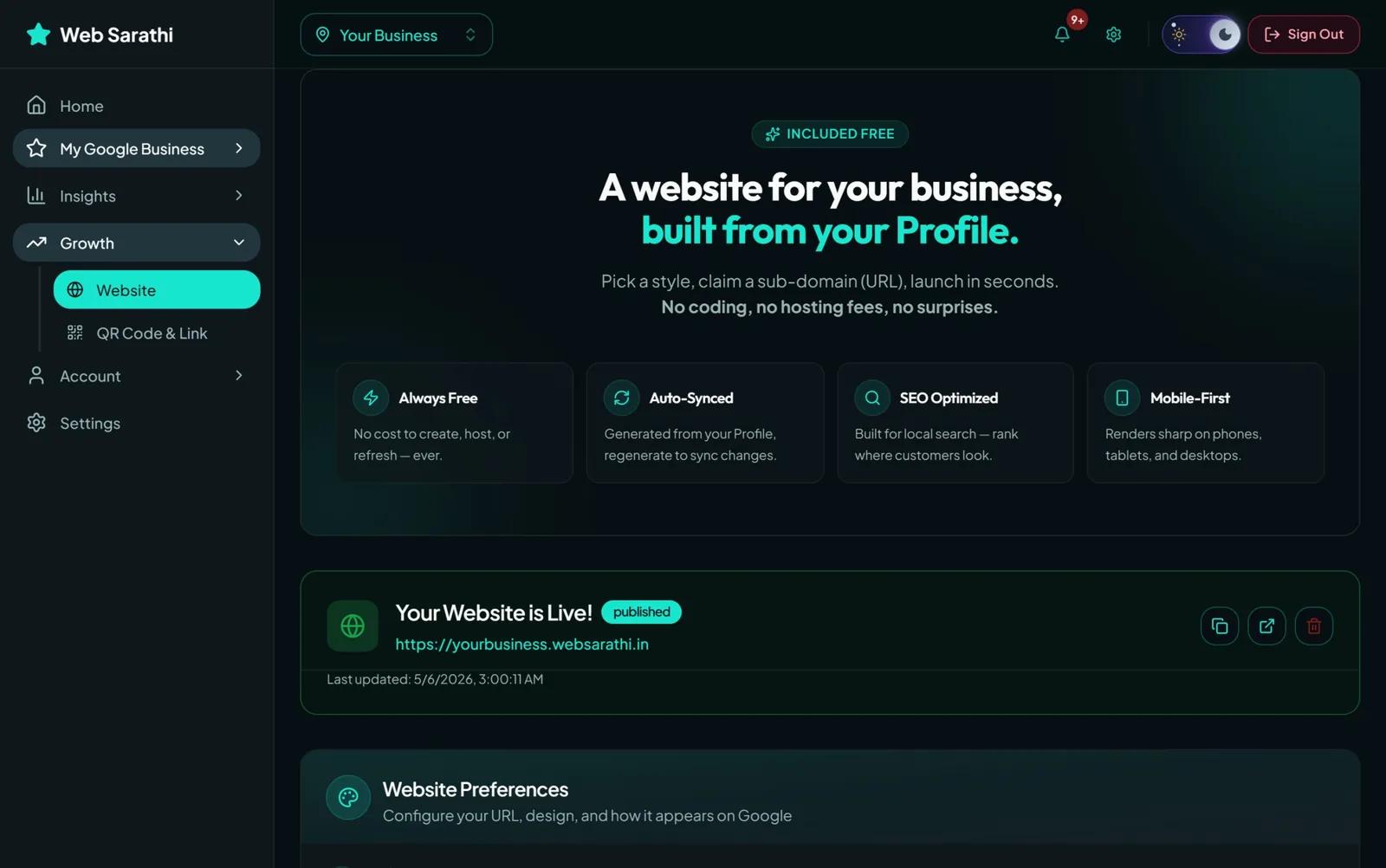
The considered patient compares practitioners, and a directory stall cannot carry qualifications, registration and a properly described procedure. Web Sarathi builds a real site from your profile so that credibility lives somewhere you own.
- A page per doctor with qualifications, specialisation and registration
- Procedure pages you control, rather than a listing in someone else’s market
- Kept in step with the profile, so hours and doctors never contradict
Registration, accreditation and the credentials patients check
Because clinics cannot lean on testimonials, verifiable credentials do the work that social proof does elsewhere — and they do it better, because a patient choosing where to take a health problem is looking for legitimacy rather than popularity.
Start with the practitioners. Full name, qualifications as actually awarded, specialisation, and the state medical council registration number. That last one is the single most under-used trust signal in Indian healthcare marketing: it is verifiable, it is unglamorous, and publishing it distinguishes a real practice from the large number of listings that do not. It is also entirely factual rather than promotional, which puts it comfortably inside the conduct rules.
Then the establishment. The Clinical Establishments (Registration and Regulation) Act of 2010 makes registration mandatory for clinical establishments including diagnostic centres and single-doctor clinics across recognised systems of medicine — but it operates through state adoption, and has been adopted in around nineteen states and union territories rather than uniformly nationwide. Whether it binds you depends on where you practise, and states that have not adopted it usually have their own regime. Know which applies to you, comply with it, and then say so.
Accreditation, where you hold it, belongs in the same block. NABH accreditation and its programmes for smaller healthcare organisations carry genuine weight with the patients who research before choosing, and with any corporate or insurance relationships you want. Empanelment with insurers and cashless arrangements are similarly concrete and similarly under-published: a patient who needs to know whether their policy works at your clinic is asking a question you can simply answer on the profile.
Put all of it where people look rather than in a certificates page nobody opens: the profile description, an about page that names each doctor individually, and the service pages themselves. And keep it current. A registration number that belongs to a doctor who left two years ago is worse than none at all.
Be equally careful about what you do not claim. Qualifications inflated by a word, a fellowship described as a degree, an accreditation that lapsed, a specialisation nobody at the practice actually holds — each of these is trivially checkable by a patient who is already in a checking frame of mind, and being caught on one destroys the credibility that every other honest item was building. In a vertical where you cannot publish testimonials, verifiable accuracy is the entire foundation of the case you are making, which means the discipline of stating slightly less than you could get away with is not modesty. It is the strategy.
| Signal | What it establishes | Where patients look for it |
|---|---|---|
| State medical council registration number | The practitioner is who they say they are, and is verifiable | Doctor profile page, profile description, consultation paperwork |
| Qualifications, as actually awarded | Training, and the honesty not to inflate it | Named per doctor, on the site and the practitioner listing |
| Clinical establishment registration | The premises is lawfully registered where your state requires it | About page and reception, and on request |
| NABH or equivalent accreditation | Assessed standards, which matters to researchers and to insurers | About page, service pages, corporate and insurer discussions |
| Insurance empanelment and cashless facility | Answers a practical question that decides where a patient goes | Profile description, service pages, and the phone script |
| Which doctor sits on which days | The single most asked question a clinic receives | Profile hours, posts, and the top of the contact page |
Same-day pain and six-week planning are not the same search
Clinics serve two demand patterns that behave so differently they might as well be separate businesses, and profiles built for one are usually invisible to the other.
The first is immediate. A fever that has not broken, a child who has fallen, a tooth that started at midnight. This behaves like the emergency demand in any trade: the person scans the top few results, checks whether you are open, and calls. What decides it is proximity, accurate hours, a phone that is answered and a listing that names the thing they are worried about. If your hours say you close at eight and you actually run until ten, you are invisible for the entire window in which this demand exists.
The second is considered. An elective procedure, a second opinion, a chronic condition, a planned dental treatment, a fertility consultation. These patients research for weeks, read about the procedure, compare doctors by credentials, and often arrive having already decided who they want to see. Nothing about the local pack decides this. What decides it is whether there is substantial, specific, signed content about the procedure and the doctor, on a site you control.
The mistake is optimising for one and assuming it serves the other. A clinic with immaculate hours and no doctor pages captures walk-in demand and loses every high-value elective enquiry to a hospital with a proper site. A clinic with beautiful procedure content and hours that were entered in 2021 loses the parent at ten at night without ever knowing it happened.
Handle them separately and the work is manageable. The immediate funnel is profile hygiene — hours by day including holidays, a phone that reaches somebody, an appointment link that works on a phone, categories and services named the way patients say them rather than the way clinicians write them. The considered funnel is credibility content — a page per procedure you actually perform, written or signed by the doctor who performs it. Neither is expensive. They are just different jobs.
Immediate care: minutes from search to call
Decided on proximity, accurate hours and whether the phone is answered. Your listing must name the complaint in the words a worried person uses, not in clinical vocabulary.
The considered patient starts reading
A procedure, a second opinion, a chronic problem. They are searching the condition rather than a clinic, and no amount of local pack position reaches them.
They compare doctors, not clinics
Qualifications, registration, specialisation and how specifically the procedure is described. This is where named practitioner pages decide the outcome.
The practical questions come last
Cost of a first consultation, insurance and cashless, which day the doctor sits, parking, access. Unanswered, these lose patients who had already chosen you.
Reviews arrive, or do not
You may not ask. What you can do is answer every one that appears, briefly and without clinical detail, so the profile reads as a practice that is present and discreet.
A work plan that stays inside the rules you practise under
Almost everything above can be done by the practice manager, in short sessions, without an agency and without any activity that would trouble a conduct committee. The sequence matters because the compliance-sensitive items should be settled before anything public changes.
Do the boring half first. It is entirely permitted, it is what patients are actually trying to find out, and in most Indian clinics it is badly incomplete — which means it is also the fastest improvement available.
Then do the credibility half, which is the part that substitutes for the social proof you cannot collect. Named doctors, real qualifications, registration numbers, specific procedure descriptions. This is the work that makes a clinic legible to both a patient and to a search engine applying a higher standard to health.
Deliberately absent from this plan is anything that asks a patient for anything. There is no review campaign, no feedback QR at reception, no testimonial page. That is not an oversight, it is the whole point, and any adviser who suggests adding them should be asked in writing whether they will carry the professional consequence.
Settle the compliance questions before changing anything public
Confirm your position on solicitation and testimonials with your professional body or a healthcare lawyer, and agree the standard form of words for review replies.
Fix hours, contact and access
Hours by day including which doctor sits when, holiday closures, a number that is answered, an appointment link that works on a phone, parking and wheelchair access.
Sort the profile structure
One listing for the location, correctly named and categorised. Decide whether practitioner listings are worth maintaining, and only create the ones somebody will keep current.
Publish the practitioners properly
Name, qualifications as awarded, specialisation, registration number and a real photograph for every doctor. This is the highest-value afternoon in the plan.
Write one procedure page, properly
A single treatment you genuinely perform, described specifically, signed by the doctor who performs it. One good page beats thirty generic ones, and sets the template.
Answer every review, ask for none
Short, warm, no clinical detail, no promotion, pointed offline. Publish factual updates about hours and doctor availability. Nothing that solicits.
Sixty checkpoints on the half that is entirely permitted
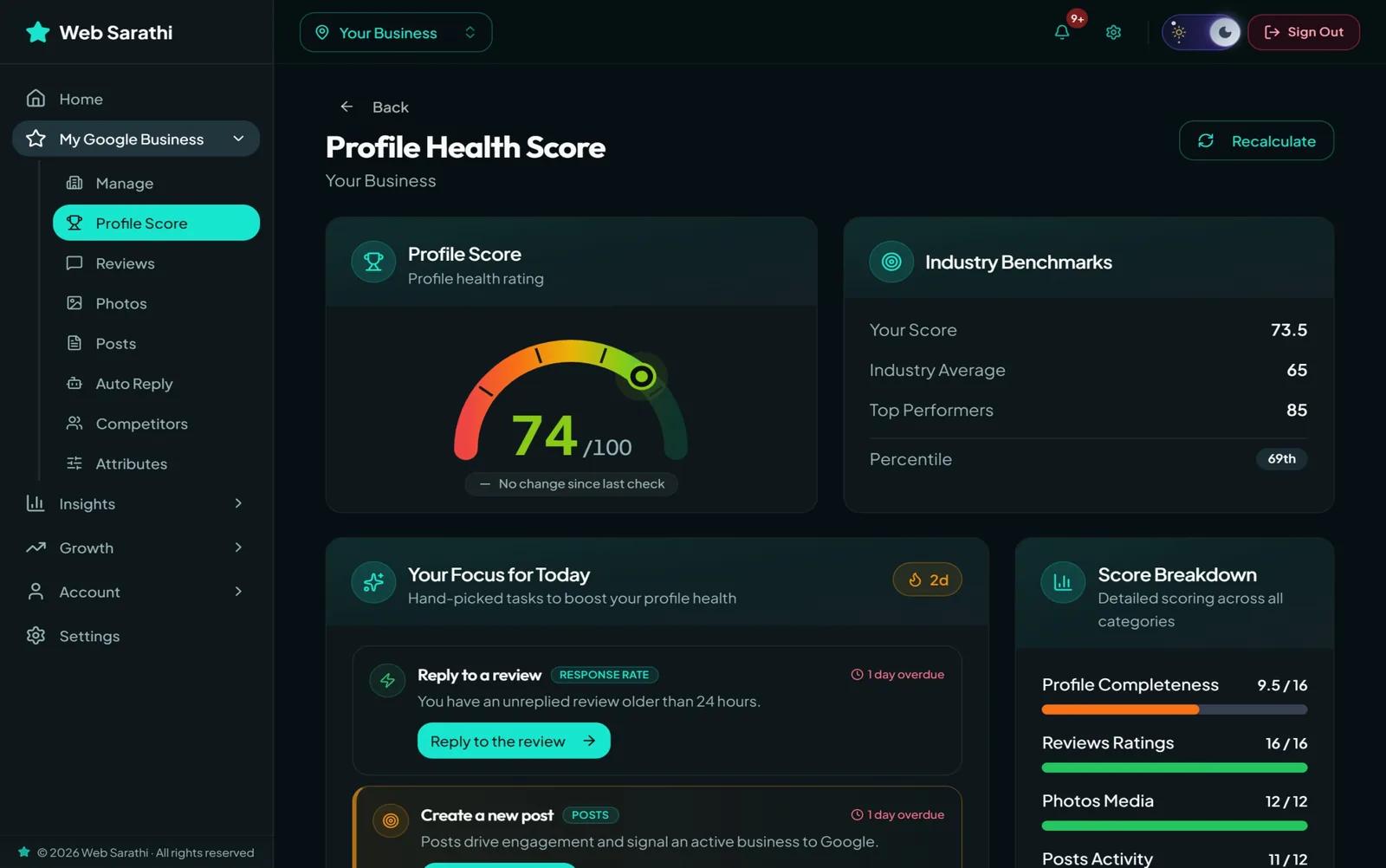
Clinics lose most of their visibility on things no conduct rule touches — blank hours, missing services, an unanswered appointment link, a category that does not match what you treat. The audit finds them and ranks them by cost.
- One profile score you can actually move
- Prioritised by impact, so the expensive gaps get fixed first
- Re-audits automatically, so regressions surface on their own
Clinic SEO questions, answered
The questions Indian clinic businesses ask us most often.