



Industry guide

Real estate SEO: how Indian agents and developers win the local pack

Most real estate SEO advice you will find online was written for a market that does not look like India. It assumes an MLS, it assumes buyers search by ZIP code, and it assumes your competition is a handful of licensed brokerages rather than four hundred independent agents, six portals with unlimited budgets, and every builder in the city running their own microsite.

This guide is about what actually moves the needle here: getting your Google Business Profile to show up in the three-result local pack when somebody in your city types "2 bhk flat for sale near me" or "property dealer in Wakad", and doing it in a way that survives RERA scrutiny and the fact that your customer will buy from you exactly once in the next fifteen years.

It is long on purpose. Read the section that matches where you are stuck, or work through it in order.

An Indian couple on a rooftop at golden hour looking out over a city of apartment towers and construction cranes, with map pins floating above the skyline — bright teal near the centre, fading to grey toward the edges
3
local pack slots — that is the whole game
10+ yrs
between a buyer’s first and second purchase
1 pin
ranking a dozen localities you actually sell in

Why real estate is not like other local SEO

Local SEO playbooks are mostly written for businesses with repeat custom and steady footfall — restaurants, salons, clinics, gyms. Real estate breaks three of the assumptions those playbooks rest on, and if you do not adjust for it you will spend a year doing the right activities in the wrong proportions.

The first break is purchase frequency. A cafe can ask every customer for a review and get a fresh one every week. You close somewhere between six and forty transactions a year, each one taking months, and the client will not be back for a decade. Review velocity — how many new reviews you gather per month, which Google visibly rewards — is structurally harder for you than for almost any other local business. That does not make it less important. It means you have to engineer it deliberately instead of hoping it accumulates.

The second break is the gap between what you sell and where you sit. A dentist ranks around their clinic because that is where the service happens. You have an office in one part of the city and inventory scattered across twelve localities. Google ranks your profile from your verified pin, so by default you are invisible in exactly the areas where your listings are. Solving that is the single largest ranking problem in this industry, and it is why city-wide rank tracking matters more here than in any other vertical.

The third break is regulatory. RERA governs what you may say about a project, when you may advertise it, and what identifiers must appear alongside the claim. A Google post advertising a pre-registration launch, or a service page promising possession dates you cannot guarantee, is not just an SEO risk — it is a compliance one. Every recommendation in this guide is framed to keep you on the right side of that.

A typical local business

  • Customers return weekly or monthly, so reviews accumulate on their own
  • Sells where it sits — the pin and the service are the same place
  • Competes with a handful of businesses in the same few streets
  • Can say more or less anything about its own offer
  • A quiet month costs a little traffic and nothing else

Real estate

  • A client buys once a decade, so review velocity must be engineered
  • Office in one locality, inventory across twelve — the pin covers one
  • Competes with hundreds of agents plus portals with unlimited budgets
  • RERA governs what may be claimed, when, and with which number attached
  • A quiet quarter between launches reads to Google as a dead business

What decides it when four agents are equally close

When somebody searches with local intent — property dealer near me, flats in Kharadi, real estate agent Andheri West — Google shows a map with three business profiles above the blue links. That block is the local pack and it takes the overwhelming majority of the clicks. Everything below it is fighting the portals for scraps.

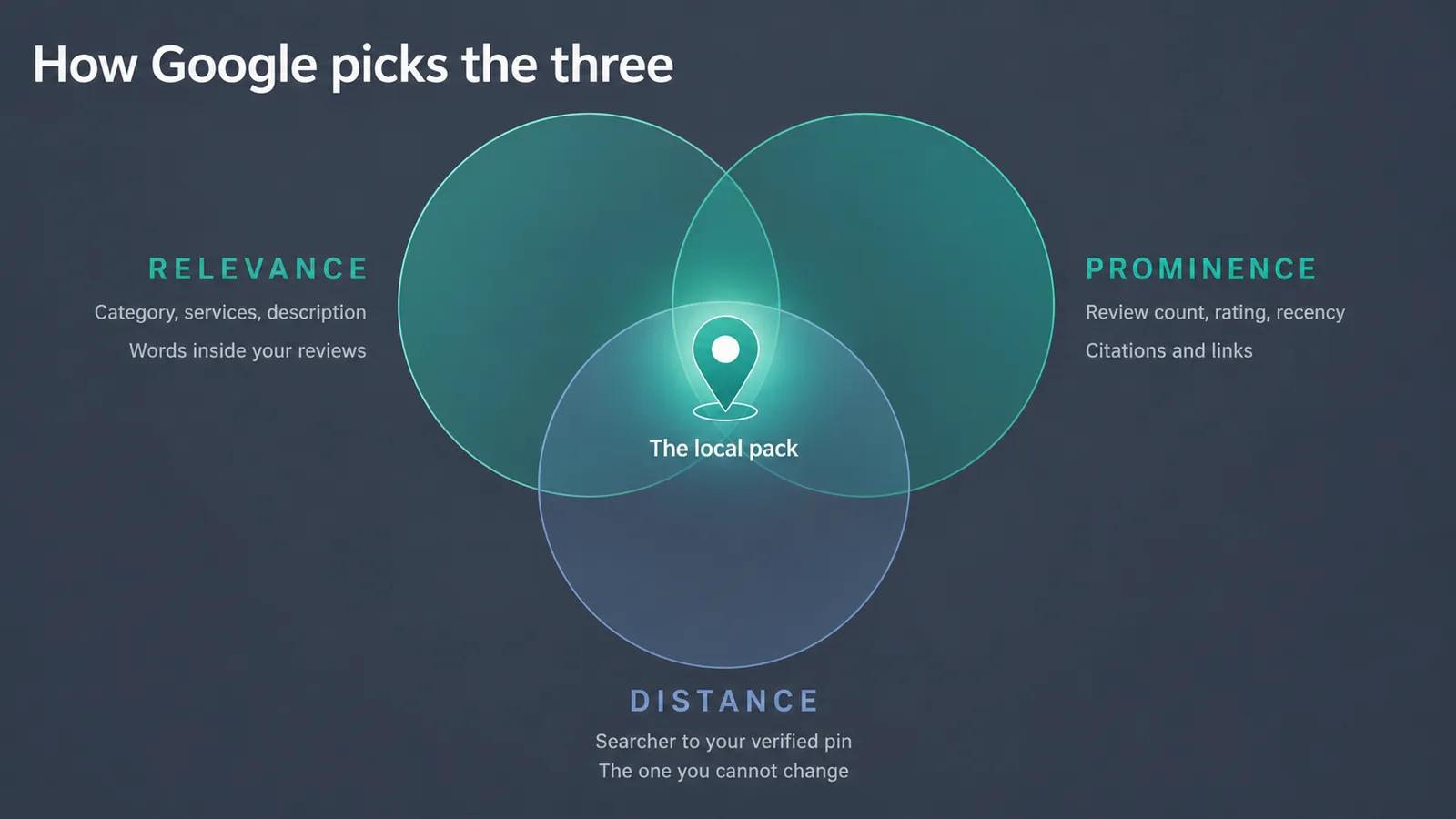
Google weighs three things in choosing those three: relevance, meaning whether the profile matches what was searched; distance, meaning how far the business is from the searcher or from the place named in the query; and prominence, meaning how well known and well regarded it is. That much is true of every local business. What is specific to this trade is which of the three actually separates you from the people you are competing against.

It is not distance, and this is the thing agents most often get backwards. Estate agents cluster. Walk any market road in an Indian suburb and there are four brokerages within three hundred metres of each other, because they all located near the same junction for the same reason. To a searcher standing anywhere in that locality, all four are effectively equidistant. Distance has already done its work by excluding the agents two kilometres away; among the ones actually in contention it separates nobody.

Which means the contest between you and the four firms you genuinely compete with is decided almost entirely on relevance and prominence — the two you control. That is unusually good news, and it explains why the results in this vertical are so volatile compared with, say, restaurants: there is no moat. The agent at position one is there because of what is on their profile and who has written about them, not because of where they sit, and any of the four can take it.

Relevance is decided mostly by the profile itself: primary category, secondary categories, the description, the services you have listed, and the words that appear inside your reviews. A profile that says Real Estate Agency and nothing else is telling Google almost nothing. One carrying the right primary category, six named services, a description that lists the localities you work in, and forty reviews mentioning resale flat, rental agreement and site visit is telling it a great deal — and the review vocabulary is doing work no field you can edit yourself can do.

Prominence is reviews, ratings, recency, citations, links and the general density of your footprint. Two profiles with fifty reviews each are not equal if one collected them across eight years and the other across eight months. This is where the once-a-decade purchase frequency from the previous section becomes a ranking problem rather than merely a business one, and it is why the review section of this guide is longer than it would be in any other trade.

The practical consequence is that a real estate profile which ranks is not one somebody set up correctly. It is one that changes — new posts, photographs, reviews and services — because in a category with no distance moat, visible activity is most of what separates four otherwise identical firms on the same road.

Venn diagram of the three local pack ranking factors — relevance (category, services, description, words inside your reviews), prominence (review count, rating, recency, citations and links), and distance (searcher to your verified pin) — overlapping on a map pin labelled the local pack

RERA is not a footnote, it governs what you may publish

Most marketing guidance for Indian agents treats RERA as a paragraph of throat-clearing before the interesting part. That is a mistake, because the Real Estate (Regulation and Development) Act does not regulate your paperwork — it regulates your publishing. Nearly everything this guide asks you to do, from a profile description to a weekly post to a project page, is an advertisement within the meaning of the Act, and that changes what you are allowed to write.

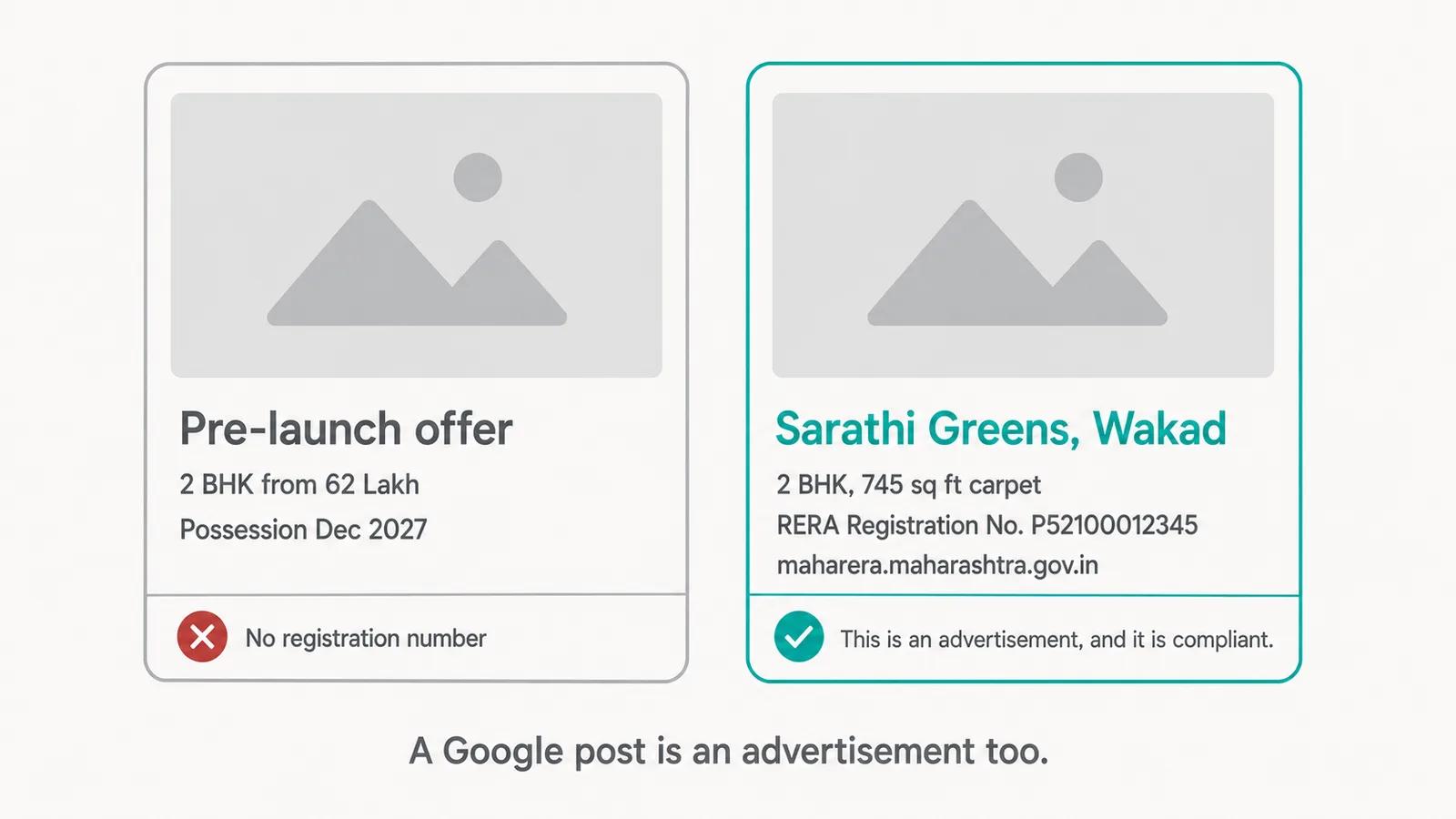
Start with Section 3, which is the one people underestimate. It prohibits advertising, marketing, booking, selling or offering for sale any plot, apartment or building in a real estate project without prior registration of that project. The word advertising there is not confined to newspapers and hoardings. It covers online listings and social media, which means a Google Business Profile post about a project that is not yet registered, an Instagram story about a pre-launch, or a listing page on your own website are all doing the regulated act. The pre-launch teaser — arguably the most common piece of marketing in Indian real estate — is precisely what this provision was written to stop.

Then Section 11(2), which governs what a compliant advertisement has to contain. A promoter’s advertisement or prospectus must prominently mention the Authority’s website address, where the project’s details are entered, and must include the registration number obtained from the Authority. Several state authorities have gone further with operational directions: in print, the lettering of the registration number should be not less than half the size used for the project name; hoardings must carry the authority website and registration number legibly to the naked eye; and advertisements on television, radio or digital media must state the registration number audibly. Whatever your state’s wording, the direction of travel is the same — the number has to be findable without effort, not buried in six-point type at the foot of the frame.

Agents have their own obligations and they are frequently ignored by people who assume RERA is a builder problem. Under Section 9 no real estate agent may facilitate the sale or purchase of a plot, apartment or building in a real estate project without obtaining registration, and Section 10 sets out what a registered agent must and must not do — including not making false statements. The penalty in Section 62 for contravening either is ten thousand rupees for every day the default continues, which may cumulatively extend to five per cent of the cost of the unit whose sale or purchase was facilitated. On a modest flat that is not a nuisance fine.

Translate that into the fields this guide has been talking about and the work is small. Put your own agent registration number in your profile description, where it also happens to be a trust signal. Put the project registration number on every project page, every listing and every post that names a project, in the same size as the surrounding text rather than hidden. Link to your state authority’s website. Do not post about a project that is not registered, however tempting the early-bird pricing is. And be careful with possession dates in posts, because a promised date in an advertisement is a statement you can be held to.

There is a genuine search upside hiding in all of this, which is why it belongs in an SEO guide rather than a compliance appendix. The registration number is exactly what a careful buyer searches to verify a project before committing, and a page of yours carrying that number, the project name and honest detail about it is findable by somebody performing that check. You are being asked to publish the one string of characters your most serious prospects are actively looking for. Almost nobody treats it as an opportunity.

One caveat, stated once. RERA is a central Act implemented through state authorities, and the rules, formats and enforcement vary considerably between states. Everything above reflects the position as we understand it; check your own state authority’s directions, and take advice before relying on any of it for a specific advertisement.

Two property listing cards side by side, each with a grey placeholder image above the text. The grey card is headed Pre-launch offer, shows a price and a possession date, and carries a red cross with the note No registration number. The teal card is headed with a project name and locality and adds two lines, RERA Registration No. and maharera.maharashtra.gov.in, with a tick and the note This is an advertisement, and it is compliant. A caption reads A Google post is an advertisement too
  • Posting about a pre-launch that is not yet registered

    Section 3 prohibits advertising, marketing or offering for sale a unit in an unregistered project, and it reaches online listings and social media — not just print. A Google post or an Instagram story about an unregistered project is the regulated act.

  • A registration number in tiny type at the foot of the creative

    Section 11(2) requires it prominently, and several state authorities have directed that in print it be at least half the size of the project name, and that broadcast and digital advertisements state it audibly. Prominent means findable without effort.

  • Assuming RERA is a builder problem

    Section 9 requires the agent to be registered before facilitating a sale or purchase in a project, and Section 62 sets the penalty at ten thousand rupees per day of default, up to five per cent of the cost of the unit facilitated.

  • Promising a possession date in a post

    A date in an advertisement is a statement you can be held to, and posts are advertisements. Describe the stage of construction rather than committing to a handover you do not control.

  • Leaving your own registration number off the profile

    It belongs in the description, where it is both an obligation you are meeting and the single fastest way for a cautious buyer to establish that you are a registered agent rather than an intermediary who is not.

Profile Audit

Sixty checkpoints, including the ones RERA cares about

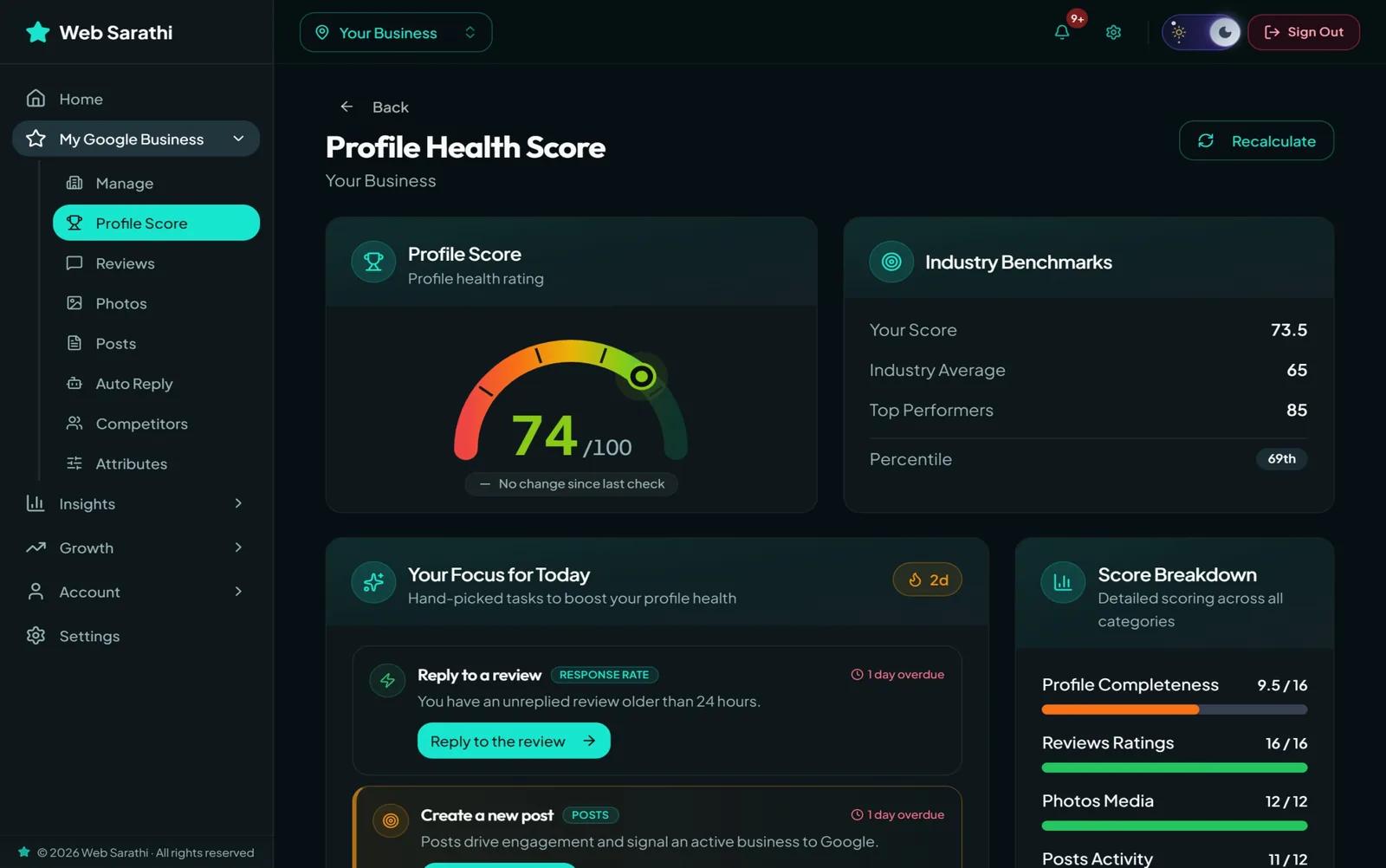
Registration numbers, name violations and stale claims live in the same fields the audit already reads. It surfaces what your profile, description and posts actually say — which is usually where an agent finds the line they removed from a hoarding still sitting in their Google description.

  • Flags keyword-stuffed names, the most-reported violation in this trade
  • Checks name, address and phone consistency across portals and directories
  • Re-audits automatically, so a regression surfaces before a complaint does
Learn more
Profile health score dashboard with prioritised recommendations

Google Business Profile setup for agents, brokers and developers

The setup differs depending on which of the three you are, and getting the structure wrong is expensive to unwind later, because verification and review history do not transfer cleanly between profiles.

If you are an individual agent working under your own name or a small brand, you get one profile at your office address. Primary category is almost always "Real Estate Agent". If you genuinely work out of a home office and do not receive clients there, use a service-area business configuration and list the localities you cover rather than publishing a residential address — Google supports this and it avoids a suspension risk.

If you are a brokerage with more than one office, each staffed office gets its own profile at its own address, and each one needs its own reviews, its own posts, and its own photos. Duplicating the same description and the same three photos across five locations is the fastest way to have all five treated as low quality. Managing that properly by hand is where most multi-office brokerages quietly give up.

If you are a developer, the distinction that matters is project versus company. Your corporate office is one profile. Each project with a site office that a buyer can physically visit is potentially its own profile, categorised as a housing development rather than an agency. This is genuinely powerful — a project profile can rank for the locality searches your corporate profile never will — and it is genuinely risky, because a project profile created before there is anything to visit will get suspended.

Whichever shape you are, the fields below are the ones that carry ranking weight and the ones most profiles leave empty.

Three panels comparing how a solo agent, a brokerage and a developer structure their Google Business Profiles: one profile at one address; one profile per staffed office, all three offices carrying the same firm name; and a corporate profile plus a profile per site office, once that site office exists
FieldWhat to put in itWhy it ranks
Primary categoryReal Estate Agent, Real Estate Agency, Property Management Company, or Housing DevelopmentThe strongest single relevance signal on the profile. Pick what you actually do, not what sounds biggest.
Secondary categoriesCommercial Real Estate Agency, Real Estate Consultant, Real Estate Appraiser, Property RegistryWidens the set of queries you are eligible for. Add only the ones that are genuinely true.
ServicesResale brokerage, rental and leasing, NRI property management, home loan assistance, RERA documentation, valuation, site visit coordinationListed individually, each one is a query you can match. Mirror them as pages on your own site.
Description750 characters naming your localities, your specialisation, and your RERA registration numberWhere you tell Google which areas you serve, given that your pin only covers one of them.
PhotosOffice exterior and interior, your team, and photos from the localities you serve — refreshed monthlyFreshness is a signal. A profile whose most recent photo is two years old reads as inactive.
Attributes and hoursIncluding the ones agents skip, such as online appointments and accessibilityFeeds filtered searches most agents never appear in, purely because the field was left blank.
The profile fields that carry ranking weight — and the ones most real estate profiles leave empty.

Getting reviews when your customer buys once a decade

This is the hardest structural problem in real estate SEO and the one most agents handle by not handling it. The instinct is to ask at closing, which is correct but insufficient: if you close twenty deals a year and half of those clients follow through, you gain ten reviews a year. Your competitor who is actively working this will gain forty.

The fix is to widen the definition of who you are allowed to ask. Your buyers and sellers are the obvious pool, but they are not the only people who have had a genuine experience of your service, and Google does not require a completed transaction — it requires an honest account of a real interaction.

Tenants you placed are a real pool, and they turn over every eleven months, which means the same person can legitimately review you again across separate tenancies. Buyers you took on site visits who eventually bought elsewhere had a real experience of your service, and a review saying "showed me six properties in Baner, very patient, I ended up buying in another area" is credible and useful. NRI clients you managed property for, sellers whose valuation you did without a mandate, and people you helped with loan paperwork all qualify.

The second half of the fix is timing and friction. The moment to ask is when the emotion is highest — at handover, at registration, when the keys change hands — not three weeks later over email. And the ask has to take under thirty seconds. A QR code on your site-visit folder, on the back of your card, or on the handover envelope removes the entire "I will do it later" gap that kills most requests.

The third part, which almost nobody does, is replying to every single one. Google has said outright that responding to reviews improves local ranking, and there is a second-order benefit: your reply is indexed text you control, sitting under a review you did not write. If a buyer writes "great help with my Wakad flat", your reply is a legitimate place for "glad the Wakad resale search worked out — happy to help with the rental if you ever let it out."

  • Ask at the emotional peak: handover, registration, key transfer. Not later.
  • Widen the pool: tenants, non-converting site visitors, NRI clients, valuation-only sellers.
  • Under thirty seconds, or it does not happen. A QR beats a link, and a link beats an email.
  • Reply to every review. It is a confirmed ranking factor and it is indexed copy you control.
  • Never buy reviews. Google has been removing them at scale in India, and losing forty fake reviews at once looks far worse than never having had them.
An estate agent handing keys to a delighted young couple in their new flat, a printed QR code visible on the folder she is holding
Review Engine

Turn a handover into a review in under thirty seconds

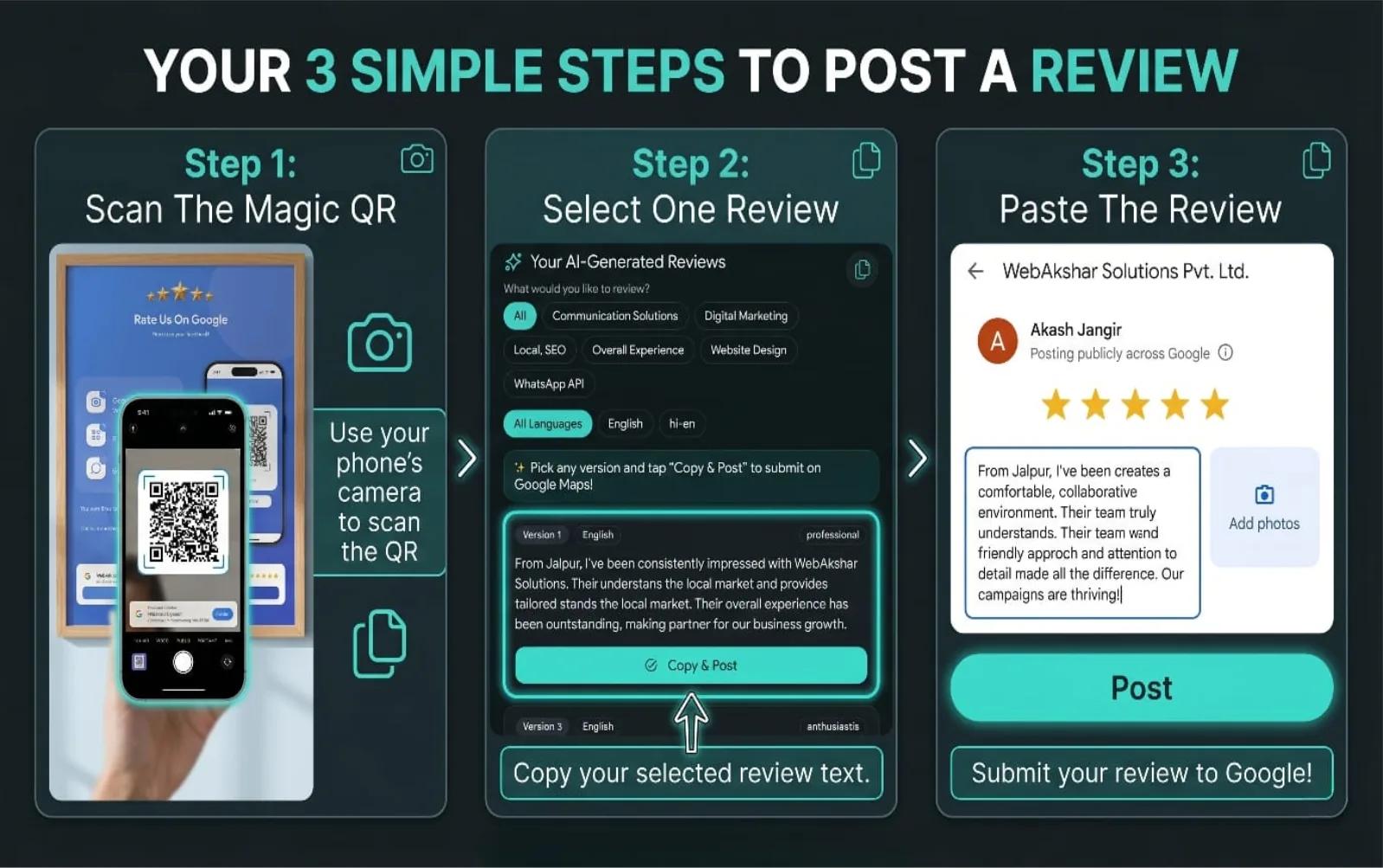
The gap between "I will do it later" and never is where most review requests die. A QR on the handover envelope or the site-visit folder opens a pre-filled review flow the client can finish on the spot — and every review that lands gets a drafted reply waiting for your approval, in whichever of 34+ languages the review came in.

  • Printed QR for handover envelopes, site-visit folders, and business cards.
  • AI-drafted replies to every review, tuned to your locality and specialisation.
  • Negative Review Shield routes unhappy feedback to you privately before it reaches Google.
  • Review velocity tracked against your competitors, so you know if the engine is actually running.
Learn more
Smart QR code review flow — scan, choose a highlight, paste and post

The rental book is the review engine your sale business needs

The previous section described the structural review problem in this trade: your customer buys once and then does not need you again for years. Most agents accept that as a fact of the business and work around it. It is worth noticing that the answer is sitting in the other half of the same office, and is usually treated as the boring half.

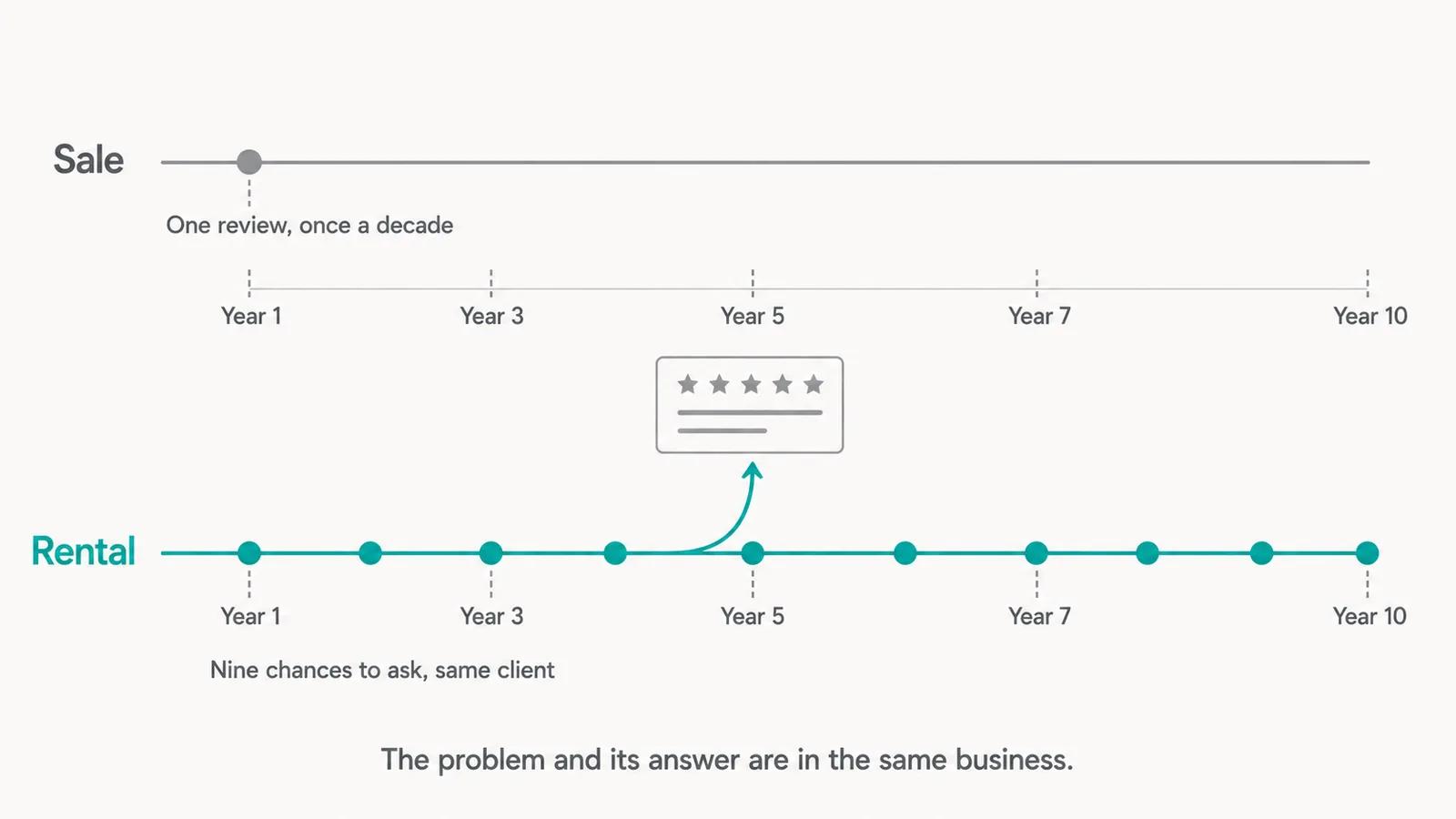
Indian residential tenancies run on eleven-month agreements. The convention exists because a lease of a year or more attracts compulsory registration, so almost everybody stops at eleven months and renews. The consequence for you is that a rental client is a transacting client every eleven months — renewal, renegotiation, or a move to another flat, frequently through the same agent. Against a sale cycle measured in years, that is not a small difference in frequency. It is the difference between a relationship you can ask something of and one you cannot.

Run the arithmetic across a decade and it is stark. One buyer produces one review, at one moment, if you catch them. One tenant you keep in touch with produces an opportunity to ask most years, plus a landlord on the other side of the same transaction who is also renewing annually, plus the referrals that come out of both. Review recency is a live ranking input, and the rental side of the business is the only part of a real estate practice that generates it naturally.

Rentals differ from sales in almost every other respect too, and treating them as one funnel is why the vocabulary on most agents’ profiles is so thin. Renters search differently — 2 BHK for rent in a named locality, flats for rent near me, house for rent without brokerage — and decide in days rather than months. A large share of them are new to the city and have no local network, which makes an agent with visible reviews far more valuable to them than to a buyer who has three uncles with opinions. And the money is small enough that the decision is made almost entirely on responsiveness.

That last point is worth dwelling on because it is where rental enquiries are lost. A renter messaging about a flat has usually messaged four agents in the same ten minutes and will visit whoever replies first with something specific. Nothing about that rewards a considered approach. It rewards being reachable, having the listing details to hand, and being able to say yes to a viewing this evening.

There is a long game as well. Today’s tenant is a buyer in three to seven years, usually in the same city and often in the same locality, and the agent who found them a flat when they arrived in town with nothing is the agent they call. Landlords are a separate recurring relationship again — a property management arrangement is effectively a subscription, and an NRI landlord who trusts you with a flat for six years is worth more than most single sales.

Practically: list rentals and property management as their own named services rather than folding them into brokerage, give each a page, and ask for a review at agreement signing every time — from the tenant and from the landlord. The reviews that result will use rental vocabulary rather than sale vocabulary, which broadens what your profile is relevant for at the same time as it fixes the supply problem.

Two horizontal timelines. The upper grey one is labelled Sale and shows a single transaction marker with the note One review, once a decade. The lower teal one is labelled Rental and shows markers at eleven-month intervals across ten years, with the note Nine chances to ask, same client. Between them a teal arrow points from the rental line up to a review card. A caption reads The problem and its answer are in the same business

The sale side

  • One transaction per client, then a decade of silence
  • Months of consideration, several decision-makers, high ticket
  • One chance at a review, at handover, if somebody remembers
  • Reviews use sale vocabulary — resale, registration, site visit

The rental side

  • A transacting client roughly every eleven months, on both sides
  • Days of consideration, decided largely on who replied first
  • A natural moment to ask at every agreement and every renewal
  • Reviews use rental vocabulary, widening what you rank for

Ranking across a city, not just around your office pin

Here is the thing that changes how you think about real estate SEO once you see it. Your Google ranking is not one number. It is a different number at every point on the map.

Search "property dealer near me" while standing outside your office and you will probably see yourself at position one or two. Do it from a locality four kilometres away where you have three active listings and you may be at position eighteen, or not in the local pack at all. Both results are real. Both are Google. The one you check from your desk is the one that flatters you and the one that tells you nothing about where your buyers actually are.

This matters more in real estate than anywhere else because the mismatch between where you sit and where you sell is built into the business. A restaurant that ranks well within two kilometres of itself is doing fine, because nobody drives across the city for lunch. A broker who ranks well within two kilometres of their office is invisible to every buyer searching in the eight other localities they hold inventory in.

The way to see the truth is a grid scan: pick your keyword, lay a grid of search points across your target area, and check your actual rank at each point. What comes back is a heat map — green where you own the search, red where you do not exist. For most agents the first scan is uncomfortable, and it is also the first time they have seen where their money is actually leaking.

What you do with that map is the strategy. A red patch around a locality where you have live inventory tells you to build a service page for that locality, add posts and photos that reference it, get reviews from clients there that name it, and — if you have enough business to justify a physical presence — consider whether a satellite office is worth the ranking it would unlock. A green patch tells you to stop spending there and defend it.

Run the same scan monthly and you get something more valuable than a snapshot: you get to see whether the work moved anything. Real estate SEO takes months, and without a measurement sensitive enough to detect movement before revenue does, most people quit in week seven.

An estate agent on a rooftop at dusk looking out over a vast city. A teal ring on the ground marks the small area where their ranking is strong; the map pins inside it glow teal while the hundreds beyond it fade to grey
Live Grid Ranking

See your real rank in every locality you sell in

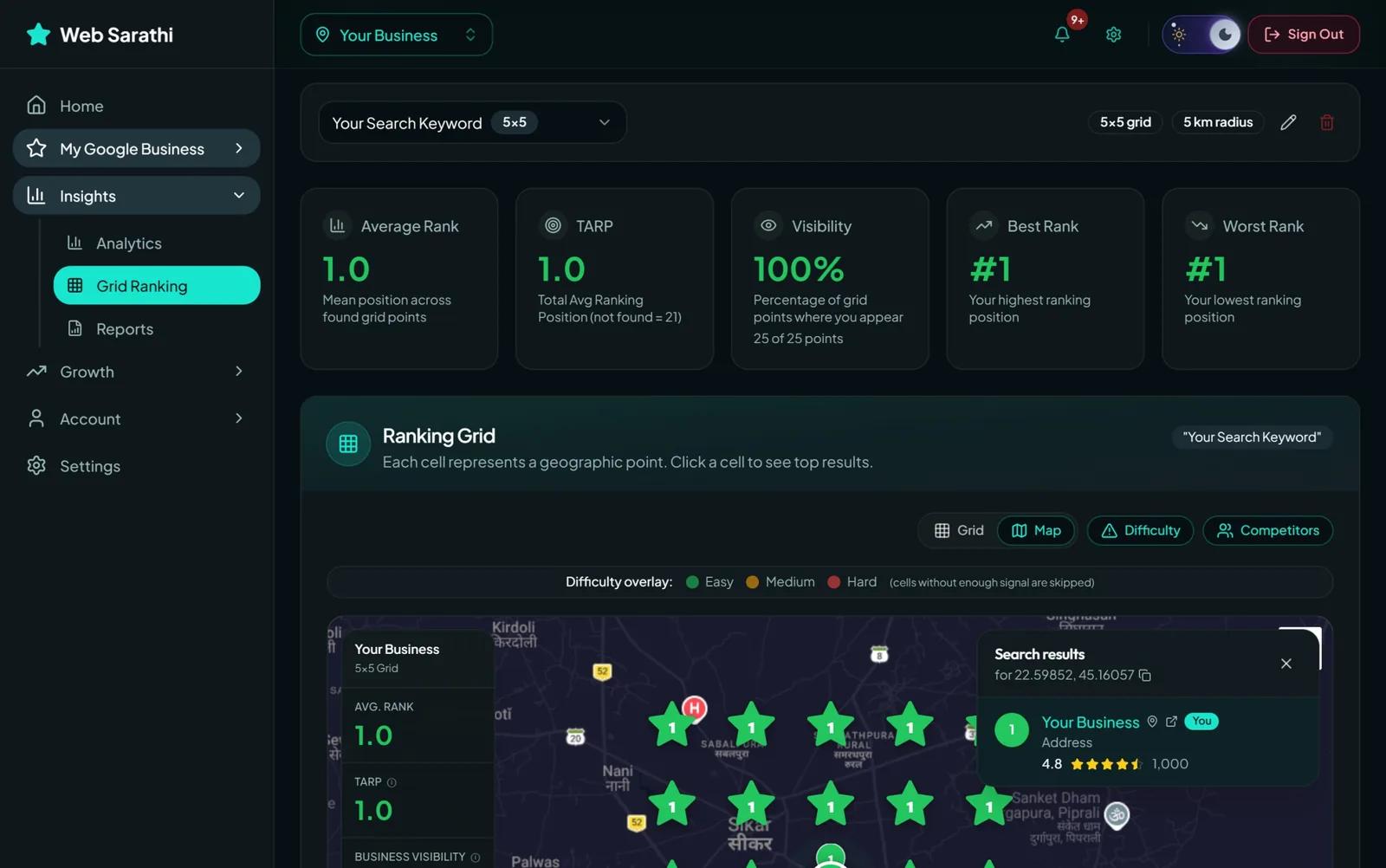
Grid Ranking runs your keyword from a grid of real search points across your city and returns your actual Google Maps position at each one. Green where you own the search, red where a buyer would never find you. Run it monthly and you can see whether the last four weeks of work moved anything — long before it shows up in enquiries.

  • Pick any keyword — "2 bhk resale flat", "property dealer in Baner" — and scan your whole operating area.
  • Your rank at every grid point, not the flattering number you get standing in your own office.
  • Month-on-month comparison, so a slow-moving channel finally has a fast-moving signal.
  • Competitor overlay shows who is occupying the localities where you are red.
Learn more
Grid ranking heat map showing Google Maps position at each search point across a city

You are paying the portals to outrank you

Search almost any generic property query in an Indian city and the first page belongs to three or four large portals, with a layer of directories underneath. That is not a failure of your optimisation. Those companies have spent heavily for more than a decade on precisely these terms, and no individual agent or brokerage is going to take a head term off them.

What makes the relationship worth examining is that it is not the ordinary aggregator arrangement described elsewhere in this series. A food platform takes a commission on an order a restaurant might have received anyway. A design platform acquires the client and subcontracts the work to you. A property portal does something stranger: it is your competitor, your supplier and your customer at the same time, and you pay it in the third capacity.

Look at what each listing you upload actually does. It fills the portal’s inventory, which is the content that makes its locality page rank. That page then outranks yours for the search your buyer performs. The buyer arrives on it and sees your listing next to eleven alternatives, several of them the same flat posted by other brokers. And you paid for the privilege, because listing packages and lead credits are how the portal makes its money — from you, not from the buyer.

The leads that come back are shaped by the same economics. A buyer enquiry on a portal is frequently visible to several brokers, so the first conversation is a race, and the buyer has already been contacted four times before you get through. That is a recognisable pattern by now: it is the same auction dynamic that shapes the packers and movers trade, and it produces the same result, which is that the conversation starts on price rather than on service.

None of this is an argument for leaving. A new agent with no ranking and no reviews has to get inventory in front of buyers somehow, and portals genuinely do that. It is an argument for treating a portal as one channel with a hard ceiling rather than as the whole strategy, and for building something you own alongside it from the beginning rather than at the point where the rate card changes.

The place you can win is the part portals handle badly, and they handle it badly for a structural reason: their pages are generated at scale from listing data, so they are broad, thin and identical in tone. They cannot write about what it is actually like to live in one society, what a named project’s resale flats genuinely transact at this quarter, what the maintenance really costs, or which towers get the afternoon sun. You can, because you have shown people around. That is the long tail of the query distribution, it converts far better than a head term, and it is not worth a portal’s engineering time to defend.

The measurement that settles the argument internally is one most brokerages have never run: of the deals you closed last year, how many originated on a portal, how many came from your own listing, search or referral, and what did each cost to acquire. Agents who work that out for the first time usually find the direct deals were both cheaper and larger — and that the portal spend had been renewed annually on the assumption that it was working, rather than on evidence.

What you are to the portalWhat it costs youWhat to do about it
Their content supplierEvery listing you upload strengthens the page that outranks yoursKeep listing, but publish the same property on your own site first and better
Their paying customerListing packages and lead credits, renewed annually out of habitWork out what a portal-sourced closing actually costs against a direct one
Their organic competitorThey own the head terms permanently and you cannot outspend themCompete on the specific tail — a named society, a project resale, a real locality page
One of several brokers on one leadThe conversation starts as a price race you did not chooseReply first with something specific, and move the relationship off the platform
Three relationships with the same company, running at the same time.
Website builder

The locality pages a portal cannot generate from listing data

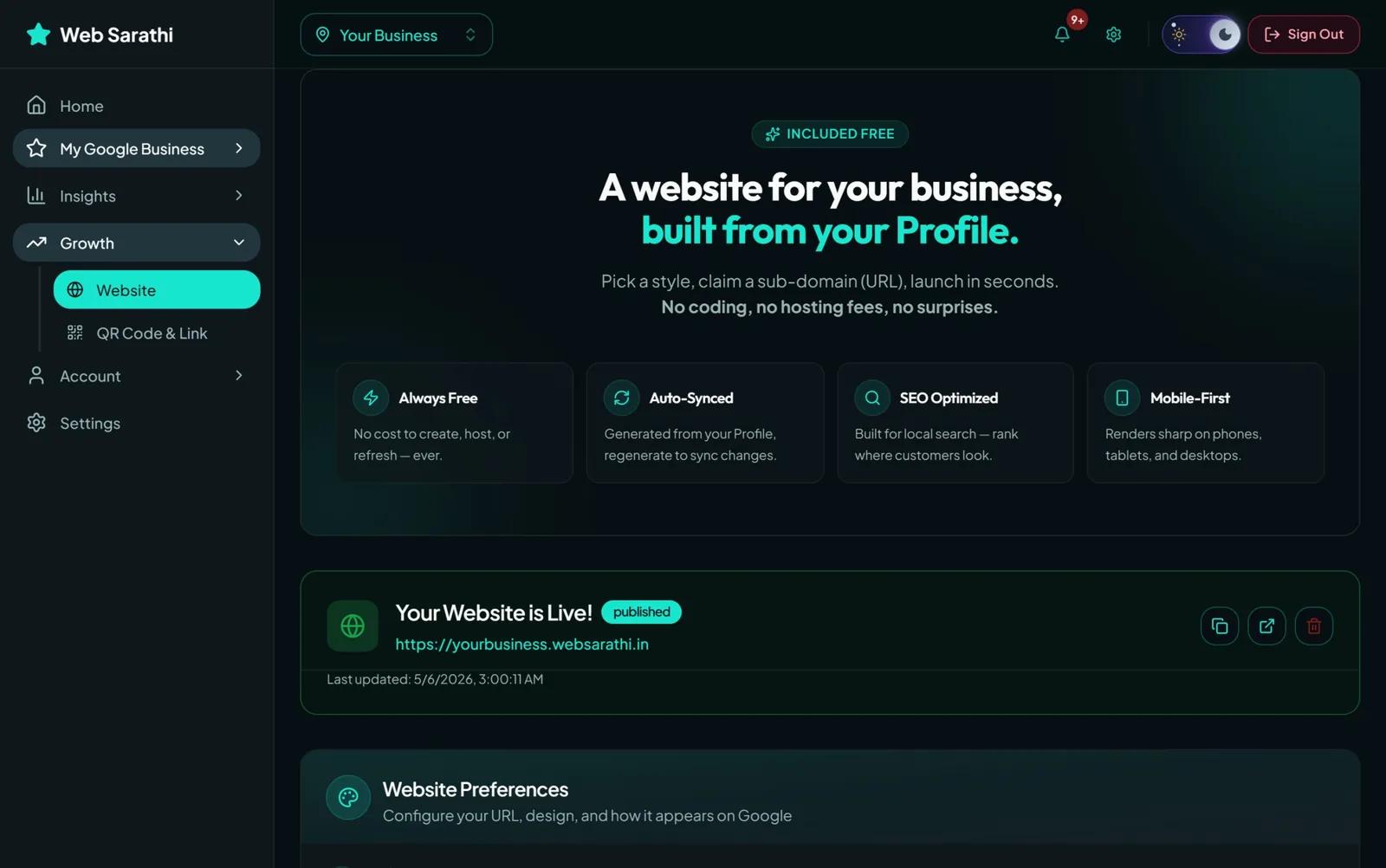
Portal pages are built at scale from inventory, so they are broad, thin and identical in tone. What a named society is actually like to live in is not in their data and is not worth their engineering time — which is exactly why it is available to you.

  • A real page per locality and project you genuinely work in
  • Service pages that mirror the services on your Google profile
  • Registration numbers and honest detail, which is what buyers verify with
Learn more
AI website builder generating SEO pages for a local business

The content and service pages that actually rank

You are not going to outrank the big portals for "flats in Mumbai". Accept that early and it frees you to compete where you can win, which is the long, specific, high-intent end of the query distribution that portals handle badly because they generate pages programmatically.

The unit of work is a locality page: one page per area you genuinely operate in, and only for areas you genuinely operate in. Not a template with the locality name swapped. A real page — what the area is like, what a 2 BHK actually transacts at right now, what the connectivity is, which projects are RERA-registered and delivering, what the rental yield looks like, what society maintenance runs to. Three of these written properly will outperform thirty spun ones, and the spun ones now carry an active penalty risk under Google’s scaled-content spam policy.

The second unit is a service page: one per service in your Google profile. If your profile lists NRI property management, there should be a page about NRI property management that names the specific problems an NRI faces — power of attorney, TDS on sale, repatriation, remote tenant handling. The alignment between the services on your Google profile and the pages on your site is a relevance signal, and almost nobody bothers to make them match.

The third is the transactional-question page. "Stamp duty in Pune", "how to check the RERA registration of a project", "documents required for a resale flat purchase". These bring in people who are mid-purchase and have not chosen an agent yet, which is the most valuable traffic in the funnel and the traffic portals capture almost all of by default.

Google Business Profile posts are the fourth channel and the one with the worst effort-to-payoff ratio when done by hand — a post lives seven days, so a genuinely active profile needs one or two a week, every week, forever. Posts that reference the locality and the RERA number of what you are discussing do double duty: they keep the profile fresh and they put the right words in front of Google.

  • One page per locality you actually work in. Real research, not a template with the name swapped.
  • One page per service listed on your Google profile. Make the two match exactly.
  • Transactional-question pages catch buyers who are mid-purchase and unrepresented.
  • Two posts a week, referencing locality and RERA number. Consistency beats brilliance.
  • Never publish a project claim you cannot back with a registration number.
AI Posts & Locality Pages

Keep the profile alive between launches and closings

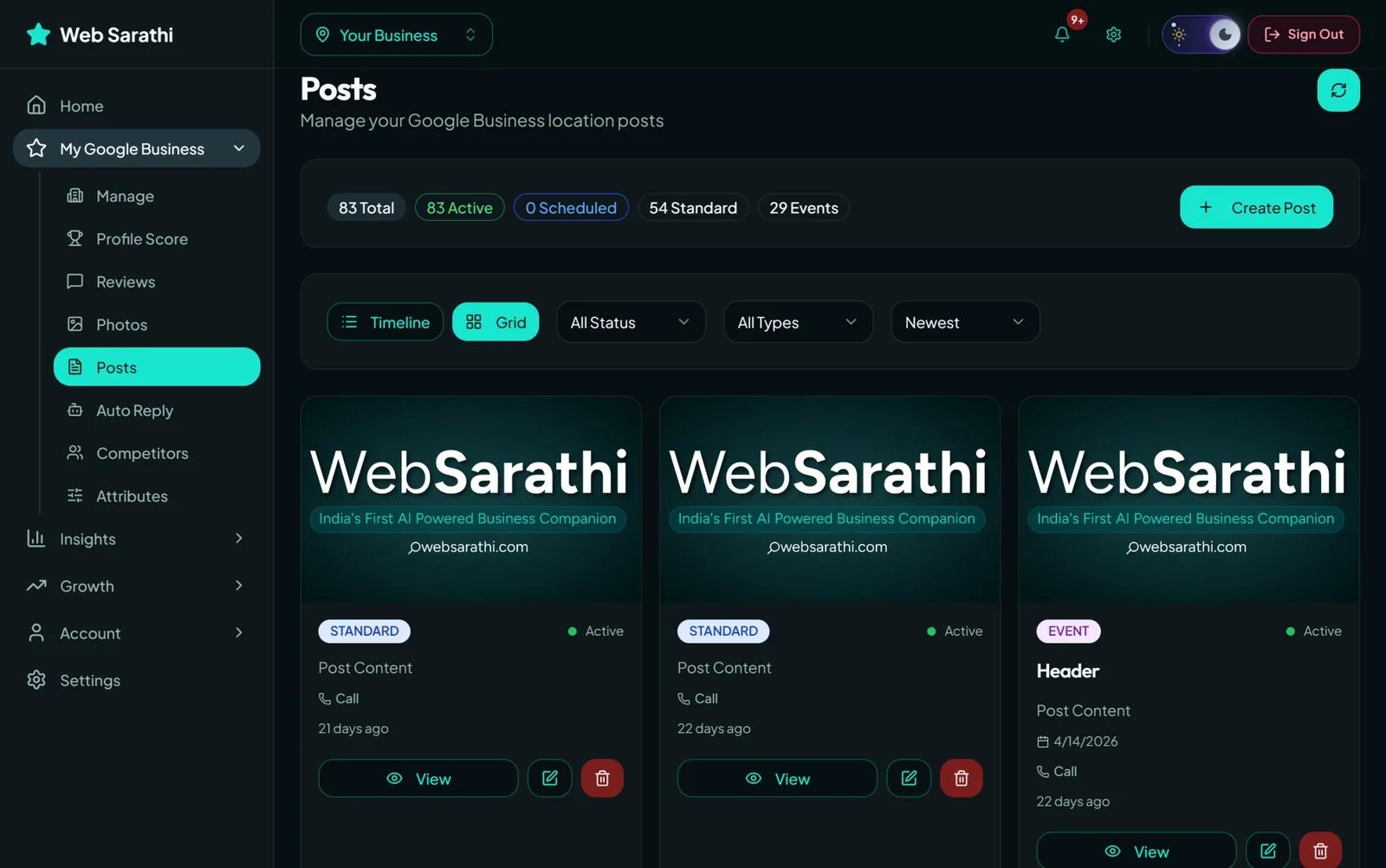
Two Google posts a week for a year is a hundred posts, and a post lives seven days. Web Sarathi drafts them from your listings, your localities, and your services — RERA number included where you have set one — and schedules them so the profile never goes quiet during the months when you have nothing new to announce.

  • AI-drafted posts that name the locality and carry the keywords buyers actually type.
  • Scheduled weeks ahead, so a busy fortnight does not break the cadence.
  • A one-click SEO website with a page per locality and per service, matched to your profile.
  • A daily task list that tells you the one thing worth doing today, ranked by impact.
Learn more
AI-generated Google Business Profile post with keyword-rich local copy

Mistakes that cost real estate businesses their ranking

Most of the damage in this vertical is self-inflicted and concentrated in about seven behaviours. They are worth reading even if you are confident none apply, because two of them are things people do deliberately, believing they help.

The pattern underneath most of them is the same. Real estate is a competitive, low-margin, high-ticket trade where everybody can see what everybody else is doing, and the temptation is always to reach for the shortcut that appears to be working for the firm two doors down. Keyword-stuffed names, a profile for every agent at one desk, a project listing created the week the land was bought — none of these are misunderstandings. They are deliberate attempts to buy an advantage, and the reason they keep happening is that they work briefly before they do not.

It is worth being clear about what the downside actually is, because agents tend to imagine the penalty is a quiet slide down the results. Usually it is not. The characteristic outcome in this category is suspension, which is binary: the profile disappears, along with every review on it, and it stays gone while an appeal is processed. Losing eight years of accumulated reviews in a category where reviews are the whole contest is not a setback you optimise your way out of.

The second pattern is neglect rather than ambition, and it is more common. A profile is set up properly during a launch, worked hard for two months, and then left. Nothing dramatic happens. It simply stops appearing in searches it used to win, gradually enough that nobody connects the drop in enquiries to a listing they have not opened since March. That is the failure mode a monthly grid scan exists to catch, because it is invisible from the inside.

  • Keyword-stuffing the business name

    Sharma Properties — Best Real Estate Agent in Noida Sector 62 is a policy violation. It is the most-reported thing in this industry, and the usual outcome is suspension rather than a quiet demotion.

  • A profile per agent at one office address

    Google treats co-located duplicates as spam, and when it acts it usually takes the genuine profile down along with the extras.

  • Project profiles built before the site office exists

    A profile pinned to an empty plot fails verification or gets removed after a complaint, and the appeal is slow. Wait until a buyer can actually visit.

  • Letting the profile go quiet between launches

    Six months with no post, no photo and no new review reads as a dead business — and you will not notice the decline until a scan shows it.

  • Ignoring negative reviews, or arguing in public

    An unanswered one-star is worse than a well-answered one, and a defensive reply is worse than both. Every reply is indexed copy you control.

  • Inconsistent name, address and phone

    Every mismatch across portals, directories and your own site is a small subtraction from prominence. Agents accumulate dozens of these on portal profiles set up years ago.

  • Checking your rank from your own office

    You are measuring the one point on the map where you were always going to look good. It says nothing about the localities your buyers actually search from.

A realistic first ninety days

If you attempt everything in this guide at once you will do all of it badly. The order below front-loads the work that compounds — reviews and profile completeness, both of which take weeks to accumulate and cannot be rushed later — and defers the work that pays off immediately once the foundation exists.

Expect meaningful movement in the local pack somewhere between month three and month six. Anyone promising it in three weeks is either selling you paid advertising under a different name or doing something that will eventually get your profile suspended. The honest version of this timeline is uncomfortable to sell and it is the reason most agents abandon the work in week seven, having done everything correctly and seen nothing yet.

That gap between effort and visible result is precisely why measurement matters more here than the activity does. Enquiry volume is far too noisy a signal to steer by month to month, because it moves with the season, the rates and whatever a builder in your area happened to launch. Rank position across a grid of points is not noisy in the same way, which makes it the only thing sensitive enough to tell you in month two whether month five is going to work.

One sequencing note that matters more than its place in the list suggests: get the compliance work out of the way in the first fortnight, before you start publishing anything. Adding your agent registration number, putting project registration numbers on listing pages and removing any pre-launch material is an afternoon of work, and doing it first means the ninety days of posts, pages and photographs you are about to produce are built on something you will not have to go back and unpick.

  1. Audit and repair

    Fix the category, write the description properly, list every service, upload twenty real photos, and correct your name and address everywhere it appears online. Run a baseline grid scan so you have something to measure against later. Nothing here needs new content, and all of it moves relevance.

  2. Build the review engine

    Put the ask inside your actual process — the QR on the handover envelope, the message that goes out at registration. Go back through the last eighteen months of closed clients and tenants you placed, and reply to every review sitting unanswered. Target eight to twelve new reviews in the window: aggressive, but achievable once you widen the pool.

  3. Publish the content

    Two locality pages and two service pages, written properly rather than spun. Start the posting cadence and do not break it. This is the stretch where nothing visible happens and most people stop.

  4. Measure and correct

    Re-run the grid scan against your baseline. Look at which areas moved and which did not, and let the map decide where the next quarter of content goes rather than deciding it from your desk.

  5. Expect the local pack to move

    This is the realistic window for movement on competitive locality keywords, assuming the review and posting cadence held throughout. If a scan shows nothing at all by month four, the profile almost certainly went quiet somewhere.

FAQ

Real Estate SEO questions, answered

The questions Indian real estate businesses ask us most often.

Want the tooling that does all of this?

Web Sarathi runs the grid scans, drafts the review replies, schedules the posts, and tells you what to do next — so the ninety-day plan above takes twenty minutes a day instead of a full-time hire.

Ready to grow on autopilot?

Rank higher, collect more reviews, and grow your local business — all from one dashboard, in 20 minutes a day.

No credit card required. 7-day free trial