
Yoga Studio SEO in Surat: the short version
Where yoga demand concentrates in Surat
In short: In Surat, the areas that matter most for yoga businesses are Vesu, Adajan and Pal, Piplod and City Light and 3 more below. Rank in each one separately; a single search from your own counter tells you nothing about them.
Surat · 6 areas to check one by one
How people in Surat search for a yoga class
In short: People in Surat search in Gujarati, Hindi, English, and they name the area, not just the service. Your profile has to match the words they actually type.

What makes Surat different
In short: What changes in Surat: Working hours set the timetable · The Tapi divides the market · Diwali empties the east.

The Surat yoga calendar
In short: Demand in Surat moves with Yoga Day (May–Jun), Monsoon (Jun–Sep), Navratri (Sep–Oct). Prepare your profile two to three weeks before each one.

Yoga DayMay–Jun
Large public sessions and society events introduce first-timers. Post society and office availability three weeks ahead, and have a beginners’ batch ready for the last week of June.
MonsoonJun–Sep
Heavy rain can waterlog low-lying roads. Post closures and changed timings on the profile the same morning, and say that indoor batches continue wherever access is safe.
NavratriSep–Oct
Evening batches thin as garba takes over. Shift the weight of the timetable to mornings, announce it two weeks ahead, and post a restart after Dussehra.
The Diwali breakOct–Nov
Publish the break and restart dates early, ask regulars for reviews before they travel, and announce a beginners’ batch for the weeks when the city returns.
Measuring your reach across Surat
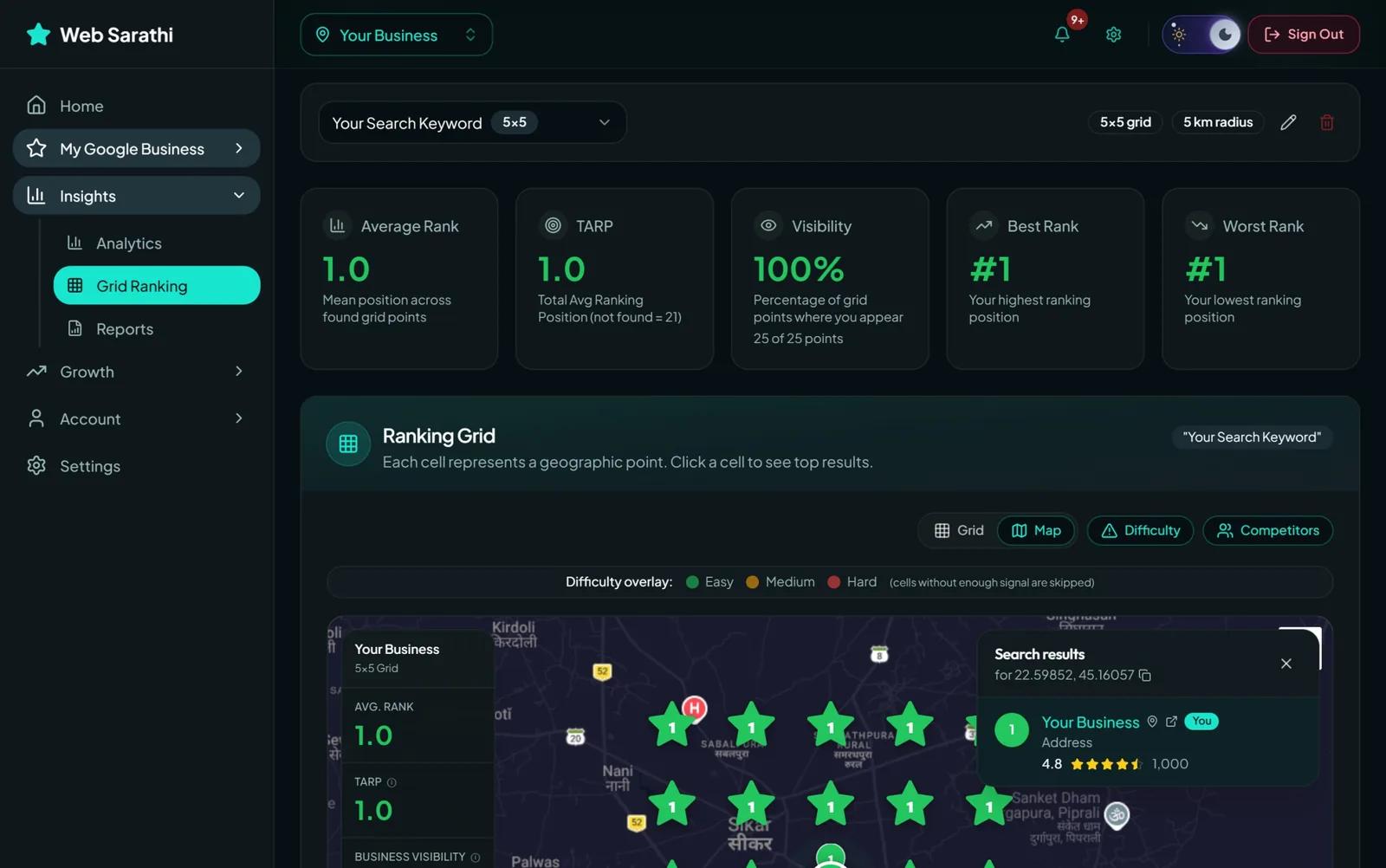
In short: Scan a 5×5 grid over 3 km around your location to see where you appear in the local pack and where a competitor beats you.
Example scan, Surat
Example5×5 grid, 3 km radius, points about 1.5 km apart
A 5×5 at 3 km gives a quick view of your own bank of the Tapi. Centre it on the studio and compare an early-morning keyword with “yoga classes near me”; in Varachha the timing keyword may surface competitors the generic term hides, and those are the studios students actually weigh you against.
In the top three at 5 of 24 points
- Top 3, the local pack5 points
- Ranks 4 to 107 points
- Ranks 11 to 306 points
- Ranks 31 to 1003 points
- Not in the results3 points
- Your business, at the centre of the scan
Illustration. A real Web Sarathi scan plots your actual Google Maps position at every point, with the businesses ranking above you.
An app can have yoga at home. It cannot have your locality.
The searches you can win are the ones with a place in them, and they are lost to neglected profiles far more often than to competition. Grid ranking shows which streets actually return you.
- Measure the catchment students will genuinely travel from at six in the morning
- Track style and condition keywords separately, since they rank differently
- Judge a second studio or a new slot on coverage rather than instinct
The yoga playbook behind this page
In short: Everything on this page applies the national Yoga Studio SEO guide to Surat. These are its core rules.

Surat at a glance
Surat’s economy is built on diamonds and textiles, and both shape its local market. Diamond cutting and trading are concentrated around Varachha, Katargam and Mahidharpura, and textile wholesale runs through the markets along the Ring Road, which bring traders, workers and buyers from across the country. Residential growth has pushed west and south-west, so Adajan, Piplod, Vesu, Athwa and City Light now hold much of the city’s newer retail, dining, healthcare and fitness businesses.
The Tapi river separates Adajan, Rander and Pal from the old city, and people on either side tend to look for services nearby. Varachha and Katargam behave very differently from Vesu or Adajan: the older areas are dense, with long-standing shops and loyal customers, while the newer western areas have more apartment residents who pick businesses through Google search and reviews. Customers commonly search in Gujarati and English, and Hindi is widely used by workers who have moved to Surat from other states.
The Tapi separates Adajan, Rander and Pal from the old city, and traffic on its bridges and on the Ring Road keeps most customers on their own side of town.
Surat · 6 zones · 28 localities
Old City
- Chowk Bazaar
- Nanpura
- Gopipura
- Mahidharpura
- Salabatpura
East Surat
- Varachha
- Mota Varachha
- Kapodra
- Sarthana
- Puna
North Surat
- Katargam
- Ved Road
- Amroli
- Utran
West Surat
- Adajan
- Rander
- Pal
- Jahangirpura
South-West Surat
- Athwa
- Ghod Dod Road
- City Light
- Piplod
- Vesu
- Althan
South Surat
- Udhna
- Pandesara
- Bhestan
- Limbayat
Searched alongside the city
- Hazira
- Kamrej
- Olpad
- Sachin

Yoga Studio SEO in Surat: questions owners ask
Our students work long hours. Which batches should we run?
Ask them, then publish what they say. In Varachha and Katargam that often means a dawn batch and a late-evening one, which many studios do not offer. Name each batch in the services list with its days and times, and post when a new one opens. A student who cannot see a batch that fits will not ask.
Can we say our class is good for thyroid?
Say who the class is for, not what it does to the thyroid. A batch for people managing thyroid conditions, taught with modifications and alongside medical treatment, matches the same searches and is defensible. Avoid cure and reverse, and do not repost testimonials saying a condition went away; a student’s words carry the same claim as your own.
Does closing for the Diwali break hurt us on Google?
A planned closure with holiday hours set is normal. What costs you is a profile showing you open when you are not, because students who make a wasted trip remember it. Set the hours before the break, post the dates and the restart, and keep replying to reviews while you are away.
After the city’s big Yoga Day events, how do we catch the new interest?
Be ready before the day. Post a beginners’ batch starting the week after 21 June, near where people live, and say plainly that no experience or flexibility is expected. Public events introduce people to yoga for a morning; the studio with a clear next step nearby is the one they try.
Which areas of Surat matter most for a yoga business?
Start with Vesu, Adajan and Pal and Piplod and City Light. In Vesu: A newer high-rise neighbourhood where young families search for prenatal, power yoga and children’s batches, and compare reviews before trying a class. Check your Google Maps position in each area separately, because ranking in one does not carry over to the next.
How do people in Surat search for a yoga class on Google?
They name the area as well as the service, in Gujarati, Hindi and English. Typical searches include “yoga class vesu ma” and “savare vahela yoga varachha”. To win “yoga class vesu ma”, your profile has to show your building or landmark, and batch times.
When is the busiest season for yoga businesses in Surat?
Demand in Surat moves with Yoga Day (May–Jun), Monsoon (Jun–Sep) and Navratri (Sep–Oct). Large public sessions and society events introduce first-timers. Post society and office availability three weeks ahead, and have a beginners’ batch ready for the last week of June.
How should a yoga business in Surat measure its Google Maps ranking?
Scan a 5×5 grid over 3 km around your location rather than searching from your own premises. A 5×5 at 3 km gives a quick view of your own bank of the Tapi. Centre it on the studio and compare an early-morning keyword with “yoga classes near me”; in Varachha the timing keyword may surface competitors the generic term hides, and those are the studios students actually weigh you against.
How does Web Sarathi help a yoga business in Surat?
Web Sarathi audits your Google Business Profile on day one, gives you a short daily task list of about ten minutes, collects reviews through a QR code, drafts replies in the reviewer’s own language — including Gujarati and Hindi — and maps your ranking across Surat so you can see which areas you are winning. You can start with a free audit.