
Coaching Institute SEO · Surat

Coaching institute SEO in Surat: fire safety, the Tapi and the dhoran 12 rush

In Surat, the first question many parents ask about a coaching class has nothing to do with results. Since the 2019 fire at a coaching class in Sarthana, in which students died, families want to know which floor the classroom is on, how they would get out, and whether the building has fire clearance. A profile that answers that before the phone call is answering the question that decides the visit.

Written by
Web Sarathi Local SEO Team
Last updated
Updated
Reading time
6 min read
A coaching teacher at the front of a classroom with students at their desks behind him
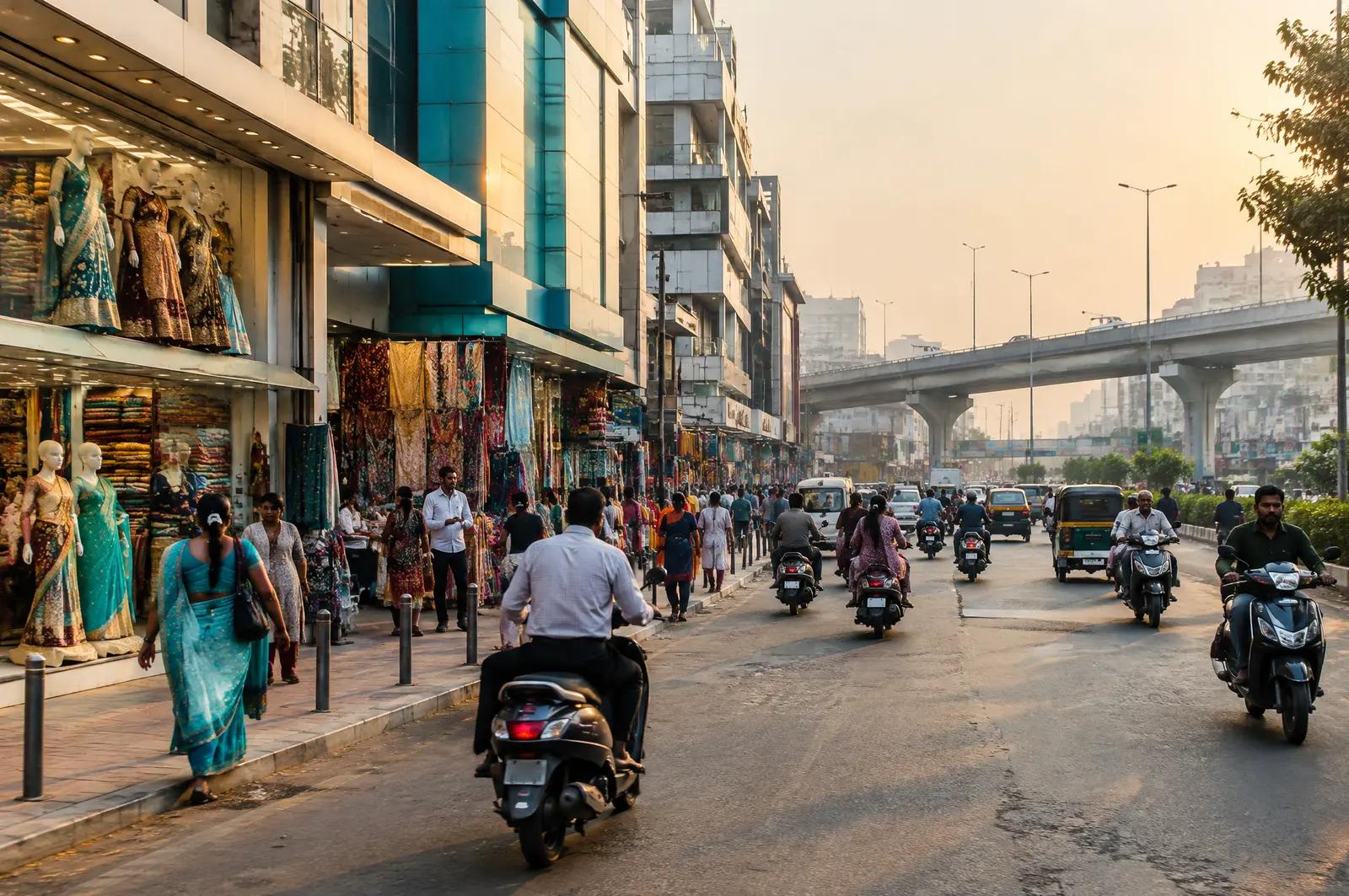
A commercial street in Surat, Gujarat, with local shops and traffic

Coaching Institute SEO · local report

Surat

Gujarat

The rest of the market follows the city’s split. Varachha, Katargam and Kapodra have dense, Gujarati-medium GSEB demand from families rooted in the diamond trade; Adajan, Vesu, Piplod and Pal across the Tapi have more CBSE and English-medium families who choose on reviews. Hindi-speaking families in Udhna and Pandesara form a third market that most profiles never address.

Search languages
Gujarati · Hindi · English
Areas covered below
7 hotspots · 6 zones
Recommended scan
7×7 · 3 km
Key local dates
Uttarayan · Board exams and results · Monsoon and new batches

Coaching Institute SEO in Surat: the short version

  1. State your floor, exits and fire-safety arrangements plainly and photograph them; in Surat this is a parent’s question before fees or faculty.

  2. Use dhoran 10, 12 science and 12 commerce alongside English terms, and list GSEB and CBSE batches separately with the medium stated.

  3. Treat each side of the Tapi as its own market; ranking well in Varachha says nothing about visibility in Adajan.

  4. Plan around the long Diwali break, when many families travel to their native places; finish profile work and schedule posts before it starts.

Where coaching demand concentrates in Surat

In short: In Surat, the areas that matter most for coaching businesses are Varachha and Mota Varachha, Katargam and Ved Road, Adajan and Pal and 4 more below. Rank in each one separately; a single search from your own counter tells you nothing about them.

Surat · 7 areas to check one by one

  1. Varachha and Mota Varachha

    Dense family neighbourhoods tied to the diamond trade, with heavy Gujarati-medium GSEB demand for dhoran 10 and 12; parents compare fees and teachers, and replies in Gujarati read as local.

  2. Katargam and Ved Road

    North Surat’s crowded residential market, where classes compete within a few streets; floor, exits and batch timings answer the questions parents ask before they climb the stairs.

  3. Adajan and Pal

    West of the Tapi, with apartment families looking for CBSE tuition and JEE or NEET batches near home; they choose on reviews and expect a demo they can book without a call.

  4. Vesu and Piplod

    Newer South-West Surat with English-medium families and high expectations of facilities; classroom photographs, batch size and published fee bands decide shortlists.

  5. Athwa and Ghod Dod Road

    Central and well established, with commerce, CA and entrance batches drawing from several areas; timings and parking matter more here than in the dense east.

  6. Kapodra and Puna

    Eastern areas with strong Gujarati-medium tuition demand and parents attentive to building safety; the floor, the exits and an honest classroom photograph do more than any banner.

  7. Udhna and Pandesara

    Industrial South Surat with Hindi-speaking families from other states looking for Hindi- or English-medium tuition; few profiles address them, so stating the medium and replying in Hindi stands out.

How people in Surat search for coaching

In short: People in Surat search in Gujarati, Hindi, English, and they name the area, not just the service. Your profile has to match the words they actually type.

A customer in Surat looking up a nearby business on a phone
  • varachha ma dhoran 12 science classes
    What they mean
    Gujarati mix: “Class 12 science classes in Varachha”
    What your profile must show
    Group A and B batches, GSEB named, and replies in Gujarati
  • adajan ma dhoran 10 tuition
    What they mean
    Gujarati mix: “Class 10 tuition in Adajan”
    What your profile must show
    Board and medium stated, with the nearby society or landmark
  • hindi medium tuition udhna
    What they mean
    A Hindi-speaking family looking close to home
    What your profile must show
    Hindi medium stated plainly, and replies in Hindi
  • neet coaching vesu fees
    What they mean
    A newer-area parent checking cost first
    What your profile must show
    An annual fee band with what is included
  • cbse maths tuition class 9 piplod
    What they mean
    One board, one subject, one class
    What your profile must show
    Subject-and-class entries and evening timings
  • gujcet coaching katargam
    What they mean
    A GSEB science student aiming at the state entrance
    What your profile must show
    GUJCET as its own course, with dates
  • ca foundation classes ghod dod road
    What they mean
    A commerce student after Class 12
    What your profile must show
    CA Foundation with duration, faculty and a fee band

What makes Surat different

In short: What changes in Surat: Safety is the first filter · The Tapi and the trades · The long Diwali break.

A local business owner in their shop in Surat

Safety is the first filter

After 2019, coaching premises across Gujarat were inspected and many sealed, and Surat parents have not forgotten why. Photograph the staircase, exits, extinguishers and the classroom from the door; state the floor in the description; and if you hold a fire safety certificate, say so. Here these are not marketing details. They are the reason a family does or does not walk in.

The Tapi and the trades

East Surat’s families, many tied to diamonds and textiles, search in Gujarati and choose by teacher and word of mouth; west of the river, apartment families search in English and choose on reviews. One profile rarely serves both well. Write for the side you are on, and if you have branches on both, let each speak its own language.

The long Diwali break

Many Surat businesses close for an extended Diwali break, and large numbers of families travel to their native places in Saurashtra. Enquiries pause, then return in a rush. Finish course updates and schedule posts before the break, set special hours, and be ready to answer messages in the week families come back.

The Surat coaching calendar

In short: Demand in Surat moves with Uttarayan (Jan), Board exams and results (Mar–May), Monsoon and new batches (Jun–Sep). Prepare your profile two to three weeks before each one.

Students listening attentively in a demo class
  1. UttarayanJan

    Kite-flying empties classes around 14 January. Set special hours a week ahead and schedule the posts that announce next year’s batches for after the board exams.

  2. Board exams and resultsMar–May

    GSEB and CBSE exams run in March and results arrive in May. Publish dhoran 10 and 12 batches, GUJCET crash courses and fee bands before results, and have someone watching the profile that week.

  3. Monsoon and new batchesJun–Sep

    New batches start as the rains arrive, and low-lying roads flood when the Tapi runs high. Post class status on bad days and ask demo families for reviews while batches fill.

  4. NavratriSep–Oct

    Evening attendance falls for nine nights. Move batches earlier, set special hours, and post the revised timetable a week before the first night of garba.

  5. The Diwali breakOct–Nov

    Many families travel for an extended break. Before it, refresh photographs and course entries; after it, answer returning enquiries quickly and start the review requests that will carry February.

Measuring your reach across Surat

In short: Scan a 7×7 grid over 3 km around your location to see where you appear in the local pack and where a competitor beats you.

Example scan, Surat

Example

7×7 grid, 3 km radius, points about 1 km apart

3 km at 7×7 puts points 1 km apart, which matches how far most Surat parents will send a child for evening tuition. Centre it on the class, scan a Gujarati and an English version of your main course, and look for visibility stopping at the Tapi bridges or the Ring Road.

In the top three at 14 of 48 points

  • Top 3, the local pack14 points
  • Ranks 4 to 1014 points
  • Ranks 11 to 308 points
  • Ranks 31 to 1004 points
  • Not in the results8 points
  • Your business, at the centre of the scan

Illustration. A real Web Sarathi scan plots your actual Google Maps position at every point, with the businesses ranking above you.

Grid ranking

Find out which localities actually see your institute

Searching from your own office always returns you at the top. Grid ranking measures your position across the residential pockets families actually search from, exam keyword by exam keyword.

  • Track NEET, JEE or board keywords separately, since they rank differently
  • See which societies and school catchments you are invisible in
  • Judge a second branch on coverage evidence rather than instinct
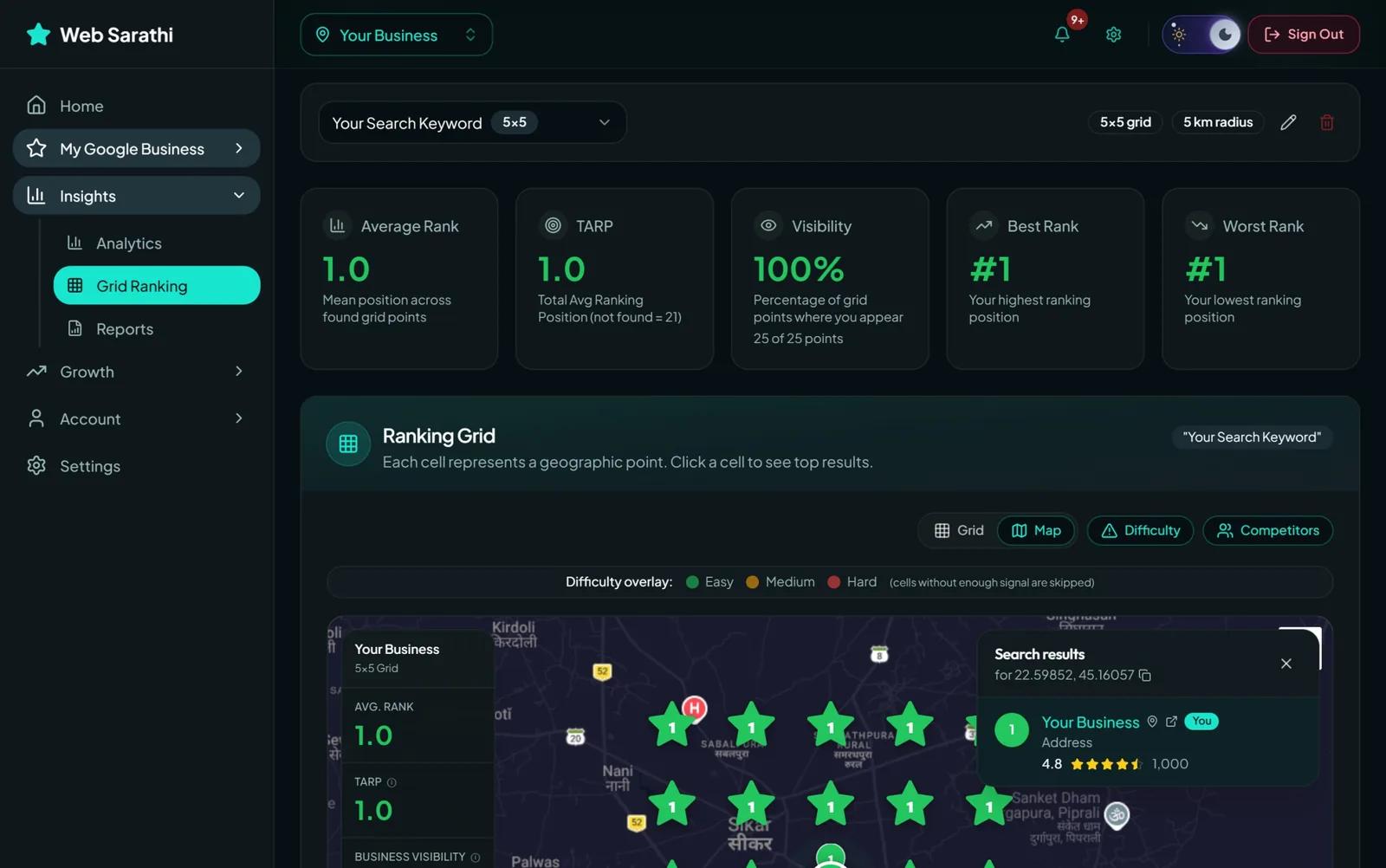
Grid ranking heat map showing Google Maps position across a neighbourhood

The coaching playbook behind this page

In short: Everything on this page applies the national Coaching Institute SEO guide to Surat. These are its core rules.

A coaching business owner at work, looking at the camera
  1. Most coaching admissions are decided between February and July, so the ranking for that cycle has to be built from September to January, before the phone starts ringing.

  2. The parent usually searches and pays while the student attends, so the profile must answer the parent on fees, safety, batch size and medium, and the student on faculty and timings.

  3. Since November 2024, any successful candidate you show must carry the rank, the course name and duration, and whether the course was paid for, and that includes your Google profile.

  4. Families search for an exam, not for a coaching institute, so list every course as a named service, such as NEET preparation or class 11 physics, and state your medium of instruction.

  5. Ask for reviews after the demo class and at term ends, not only after results, so one bad result week becomes a wobble rather than your whole rating.

Surat at a glance

Surat’s economy is built on diamonds and textiles, and both shape its local market. Diamond cutting and trading are concentrated around Varachha, Katargam and Mahidharpura, and textile wholesale runs through the markets along the Ring Road, which bring traders, workers and buyers from across the country. Residential growth has pushed west and south-west, so Adajan, Piplod, Vesu, Athwa and City Light now hold much of the city’s newer retail, dining, healthcare and fitness businesses.

The Tapi river separates Adajan, Rander and Pal from the old city, and people on either side tend to look for services nearby. Varachha and Katargam behave very differently from Vesu or Adajan: the older areas are dense, with long-standing shops and loyal customers, while the newer western areas have more apartment residents who pick businesses through Google search and reviews. Customers commonly search in Gujarati and English, and Hindi is widely used by workers who have moved to Surat from other states.

The Tapi separates Adajan, Rander and Pal from the old city, and traffic on its bridges and on the Ring Road keeps most customers on their own side of town.

Surat · 6 zones · 28 localities

Old City

  • Chowk Bazaar
  • Nanpura
  • Gopipura
  • Mahidharpura
  • Salabatpura

East Surat

  • Varachha
  • Mota Varachha
  • Kapodra
  • Sarthana
  • Puna

North Surat

  • Katargam
  • Ved Road
  • Amroli
  • Utran

West Surat

  • Adajan
  • Rander
  • Pal
  • Jahangirpura

South-West Surat

  • Athwa
  • Ghod Dod Road
  • City Light
  • Piplod
  • Vesu
  • Althan

South Surat

  • Udhna
  • Pandesara
  • Bhestan
  • Limbayat

Searched alongside the city

  • Hazira
  • Kamrej
  • Olpad
  • Sachin

Coaching Institute SEO in Surat: questions owners ask

Should we mention fire safety on our profile, or will it remind parents of 2019?

Mention it. Parents are thinking about it whether or not you do, and silence leaves them to assume the worst. State the floor, describe the exits, say whether you hold a fire safety certificate, and photograph the staircase and extinguishers. Keep it factual and do not refer to the tragedy itself; the point is reassurance, not drama.

Our class is in Varachha. Should we target Adajan too?

Not with the same profile. Families rarely cross the Tapi for a weekday class, and the two sides search in different languages for different boards. If Adajan demand is real, check your visibility there first; a separate branch with its own profile, written for English-medium CBSE families, usually does better than stretching one listing.

Hindi-speaking parents call us but say they never found us online. Why?

Probably because nothing on your profile uses their words. If you teach in Hindi or welcome Hindi-speaking families, state the medium in the description, add a Hindi-medium batch as a service if you run one, and reply to Hindi reviews in Hindi. Google matches the words on the listing, and most Surat profiles are written only in Gujarati or English.

Can we put our toppers’ hoarding on the Google profile?

Yes, if every student shown carries the disclosures the 2024 guidelines require: the result or rank, the course name and duration, and whether the course was paid for, displayed prominently. Consent has to be taken after the result, and for a minor the parent should agree as well. The profile is an advertisement just as the hoarding is.

Which areas of Surat matter most for a coaching business?

Start with Varachha and Mota Varachha, Katargam and Ved Road and Adajan and Pal. In Varachha and Mota Varachha: Dense family neighbourhoods tied to the diamond trade, with heavy Gujarati-medium GSEB demand for dhoran 10 and 12; parents compare fees and teachers, and replies in Gujarati read as local. Check your Google Maps position in each area separately, because ranking in one does not carry over to the next.

How do people in Surat search for coaching on Google?

They name the area as well as the service, in Gujarati, Hindi and English. Typical searches include “varachha ma dhoran 12 science classes” and “adajan ma dhoran 10 tuition”. To win “varachha ma dhoran 12 science classes”, your profile has to show group A and B batches, GSEB named, and replies in Gujarati.

When is the busiest season for coaching businesses in Surat?

Demand in Surat moves with Uttarayan (Jan), Board exams and results (Mar–May) and Monsoon and new batches (Jun–Sep). Kite-flying empties classes around 14 January. Set special hours a week ahead and schedule the posts that announce next year’s batches for after the board exams.

How should a coaching business in Surat measure its Google Maps ranking?

Scan a 7×7 grid over 3 km around your location rather than searching from your own premises. 3 km at 7×7 puts points 1 km apart, which matches how far most Surat parents will send a child for evening tuition. Centre it on the class, scan a Gujarati and an English version of your main course, and look for visibility stopping at the Tapi bridges or the Ring Road.

How does Web Sarathi help a coaching business in Surat?

Web Sarathi audits your Google Business Profile on day one, gives you a short daily task list of about ten minutes, collects reviews through a QR code, drafts replies in the reviewer’s own language — including Gujarati and Hindi — and maps your ranking across Surat so you can see which areas you are winning. You can start with a free audit.


How Web Sarathi helps

Everything above, done in about ten minutes a day

Ranking across Surat comes down to a few things done steadily. Web Sarathi tells you which ones to do today, does the slow parts for you, and maps your position across Surat so you can see it working.

  • A customer scanning the review QR code at a coaching counterReviews in seconds
  • A coaching business owner replying to reviews on a phoneReplies, steadily
  • A coaching business owner photographing their work for a postReal photos, posted
  1. Audit and score

    Day one: more than 50 checks on your profile and a score out of 100, so you know exactly what is missing.

  2. Ten minutes a day

    A short daily task list — complete the profile first, then photos, posts, reviews and replies, in the right amounts.

  3. Reviews in seconds

    A QR code at the counter. Customers pick a suggested highlight, make it their own and post it from their Google account.

  4. Replies Google rewards

    One-click or automatic replies in the reviewer’s language, paced so the profile never looks automated.

  5. Posts and a live website

    Keyword-aware captions for your real photos, published to Google and to a website that updates itself every night.

  6. Rank map and protection

    Your Google Maps position street by street, the competitors beating you, and an alert when someone edits your profile.

Other businesses in Surat

Local SEO guides for other industries in Surat.

Be one of the three businesses Google shows first.

Start with a free audit of your Google profile: where you rank on a map around your business, the competitors Google shows above you, and what your profile is missing, so you know exactly what to fix first. Then sign up, pick an onboarding slot, and our experts set your profile up with you on Google Meet. After that, about ten minutes a day.

No credit card Expert setup on Google Meet, then your 7-day free trial

Read the Coaching Institute SEO guide